Renegade – meditation on a scooter.

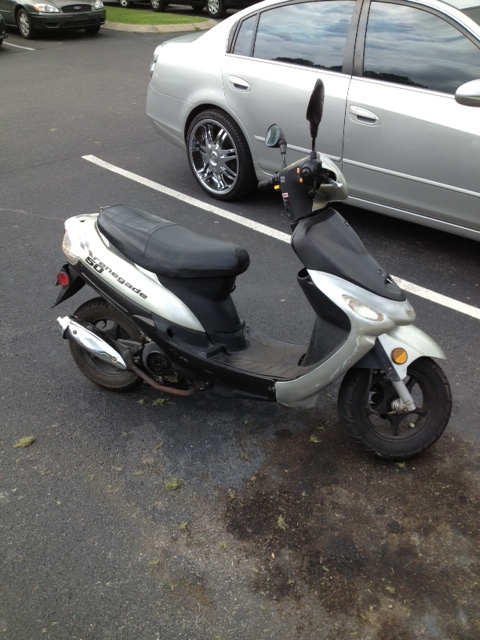
I saw a scooter parked at my work. The make was “Renegade”. My first thought was that the manufacturer was trying to make a scooter seem tough. A scooter isn’t like a motorcycle. Motorcycles are for renegades. But scooters? Not so much.

renegade

But then I thought again. It takes a bit of counter-cultural thinking to drive a scooter. It uses less gas. Some are electric. So you are as far away from the Hummer mentality as possible. You are being environmentally conscious in a society that prides itself on big cars and big debt.

You are also risking your life. You don’t have two tons of 14 gauge steel insulating you from the vagaries of drivers. Driving in Nashville is risky business. People don’t pay attention normally, even when they aren’t texting and updating their Facebook and eating their lunch. Zipping around on a scooter is pretty brave.

So perhaps it is a renegade act to drive a scooter. I still think scooters look funny. But perhaps that is my problem. I think “tough” should look a certain way. I forget that Mother Teresa was tough, and so was Gandhi. “Renegade” isn’t about looks but action.

Who is in charge here?

Jesus didn’t come to make a religion. He didn’t come to establish rules of who was in charge. God is in charge. God is the teacher. But then, as now, people can’t handle that. They want to have proof, and documentation, and certificates of training. They want to control and limit. Jesus wanted nothing to do with that.

In Mark 11:27-33 we read about an interaction between Jesus and the authorities of the day.
“27 Again they came to Jerusalem. As he was walking in the temple, the chief priests, the scribes, and the elders came to him 28and said, ‘By what authority are you doing these things? Who gave you this authority to do them?’ 29Jesus said to them, ‘I will ask you one question; answer me, and I will tell you by what authority I do these things. 30Did the baptism of John come from heaven, or was it of human origin? Answer me.’ 31They argued with one another, ‘If we say, “From heaven,” he will say, “Why then did you not believe him?” 32But shall we say, “Of human origin”?’ -they were afraid of the crowd, for all regarded John as truly a prophet. 33So they answered Jesus, ‘We do not know.’ And Jesus said to them, ‘Neither will I tell you by what authority I am doing these things.’”

Even Jesus was questioned. How could he possibly have the authority to heal people and to forgive them their sins? This was radical. This still is radical. Healing? Without medical training? Forgiving sins, without theological training? Are you kidding?

Then others started taking Jesus’ lead. They realized that they had the power to heal too. This concerned the disciples.

In Luke 9:49-50 we hear this conversation between Jesus and his disciples – 49 John spoke up, “Master, we saw a man using your name to expel demons and we stopped him because he wasn’t of our group.” 50 Jesus said, “Don’t stop him. If he’s not an enemy, he’s an ally.”

Perhaps this is how we got to where we are today. Jesus’ disciples didn’t like the idea of someone else getting in on the action. This was their thing. This was special, and they’d left their homes and jobs and families to join him. They were in the club. Then these strangers started doing what they were supposed to be doing, and they got angry. I suspect they thought “How dare they – they aren’t part of our club!”

But Jesus didn’t come to create a club, or a clique, or a church full of rules. Jesus came to wake us all up. Jesus came to let us know that we all are children of God, and we all can call on Him. With Jesus, we can heal the wounds of the world.

Then Jesus says in Matthew 23:8-12
8 “But as for you, do not be called ‘Rabbi,’ because you have one Teacher, and you are all brothers.9 Do not call anyone on earth your father, because you have one Father, who is in heaven. 10 And do not be called masters either, because you have one Master, the Messiah. 11 The greatest among you will be your servant. 12 Whoever exalts himself will be humbled, and whoever humbles himself will be exalted.”

So why do we have ordained people? Why do we have priests and ministers, who are set aside and separate? Why isn’t everyone trained, instead of just a few? How much of this is about control?

What of this is in line with what Jesus taught?

Jesus called us all to be part of the Body. We are all to work together. No one is greater than another.

In Matthew 20:16 we hear this from Jesus – 16 So the last shall be first, and the first last: for many be called, but few chosen.”

We aren’t to raise ourselves up over each other. We are all equal in the eyes of God. We are all called to love and serve the Lord.
A million dollars worth of enlightenment.

What would you do if you were given a million dollars? A lot of people say that they would give it to charity. They’d spend it on something good or worthwhile – defeat cancer, solve hunger, stop war. Maybe they’d also give some to family members who were in debt.

Sometimes I think they are lying for the sake of sounding like they are nicer than they are. Would any of us, really, give away all that money to help others? Wouldn’t we spend some of it on ourselves first? I know I would. Perhaps I want everybody else to be honest. Or perhaps I don’t want to think I’m the only selfish person around.

Sure, I’m not entirely self-centered. I want to learn how to do conflict negotiation. I want to be a peacemaker. Learning how to do that will take time and money – and I won’t get that money back. The peacemaking I’ll do will be for free. And I want to learn how to perform life-cycle ceremonies for people, like weddings and funerals. There are plenty of people who need these ceremonies but they don’t belong to a faith community. I would perform those ceremonies for free. The classes and time to learn how to do that are not cheap, however.

If a million dollars came my way I’d show it a good time. I’d pay off the cars and the house. I’d build a storm shelter in the basement. I’d put away a large chunk in savings. I doubt I’d quit my job because I like having some structure to my days, but I might go part time and spend the rest of the time taking classes or volunteering. I certainly would take more time to work on my art.

But I wouldn’t just give it away. There are so many things that might be helped with a judicious application of money, but they won’t be cured. Throw a million dollars at the homeless problem and you’ll just have another batch of homeless people in a year. Throw a million dollars to solving child abuse and you’ll have more abused children later. Sometimes it isn’t about money, but about attitude. So often we are trying to fix something with a band-aid when really only an amputation will cure it. So often we treat the symptom rather than the cure.

I’ve heard of people making “blessing bags” for homeless people. The bags have food for a day, along with toiletries and some underwear and socks. That is something – and I’ve long said it is better to do something than nothing. But that is only for that day. And meanwhile, the person still will be sleeping in the cold and the rain.

Maybe it is the yetzer hara speaking. Maybe I’m getting frustrated because I think the goal should be to prevent people becoming homeless, and I can’t figure out the solution. But I also want to prevent people becoming drug addicts, or bullies, or child abusers, or rapists, or prostitutes. I want to prevent the problem, and it seems so much bigger than I can possibly get my head around. I’d rather prevent someone becoming a child abuser than say I want to prevent child abuse. See the difference? It is the difference between teaching women to not be a target for a rapist, and teaching men to not rape. The person being attacked has a problem, certainly. But the person who is the attacker has a problem too. Stop the problem at the source and you’ve fixed two problems rather than one.

I have some ideas about this. The attacker feels lesser-than. The attacker feels that the other person has something that they need. The attacker often does not feel that the other person is a person at all – and that is why it is OK to attack them. Empathy is part of the solution. How do we teach this?

I don’t think money is the cure for this. I think some of it is an attitude shift in our society that needs to help people feel comfortable expressing themselves. They also need to be comfortable with other people being different and having different opinions. Teaching people dialogue versus debate would be helpful. But that isn’t money, but time and mindset. It is time for a different way of thinking.

Money just short-changes growth. It is like putting training wheels on a bike. You may be able to ride that bike, but you don’t really have the balance necessary. You haven’t built up those muscles yet. You ran right past the experience of falling down (many) times. So you can ride, but you have to have the training wheels to do it, and you can’t empathize with people who had to do it the hard way.

I’ve heard that people who have a lot of money are the least likely to volunteer or to donate money to charity. Perhaps something about having it easy makes it harder to understand those who have it hard.

Doing things halfway.

There is a Jewish concept called the yetzer hara. I’ve written about it before but there’s more I want to say.

Sometimes it is translated as “the evil inclination.” It is the thing in your head that says if you can’t do something all the way, don’t do it at all. It is what stops you from doing good deeds and from making positive contributions.

The idea is to catch it in the act and do something good anyway. It is better to do part of a good deed than nothing at all. Don’t beat yourself up for not doing the whole thing – at least you did something.

The part that I’ve just realized is that too many of us think that just doing that little something is enough and we stop there.

We shouldn’t beat ourselves up for not being able to do all of the good deed, but we also shouldn’t pat ourselves on the back for doing just the minimum. There has to be a balance somewhere. Do what you can, and then try to do a little more.

The value of slow.

I’ve realized I’m trying to write a blog in a time where people can’t even take the time to write out what they are saying. We have acronyms for everything. I just learned a new one – “tltr”. This means “too long to read.” I’m part amused and part saddened that we don’t even have the time to write out that something is “too long to read” but have to have an acronym for it. We don’t have time to have time.

I could change how I do things. I could shorten everything down to small digestible chunks. I could distill out the essence of the thing. I could write it out, but post the synopsis at the beginning so people don’t have to wade through to the end. I could post just two sentences, or a paragraph at most. Or I can keep doing what I am doing. Sometimes you have to go through the whole thing to get it. The Cliff’s notes may tell you what happened, but you’ll miss everything else.

I’ve learned that if you really want to see something, you have to draw it. Go find some paper and a pencil. Draw one thing. Pick something that you look at all the time or that you’ve seen every day for years. When you draw it, you’ll notice it for the first time. You’ll see lines and curves that you’ve never noticed before. You’ll notice blends of color that you’ve never seen. Did you know that a fig has a bit of green in the purple? Did you know that there were five washing machines in a row at the laundromat you go to, not four? When you take time to draw what you see instead of what you think you see, you start to notice other things. You start to wonder what else you’ve missed because you’ve assumed something about it.

We often want to get to the punchline before we’ve even heard the joke. We want things to be fast. We don’t want it now – we want it yesterday. We think that we have gained an advantage by making everything fast.

We want to blast through our emotions and stop feeling sad and go straight to happy. But how can we appreciate the mountain top unless we have been in the valley?

We want to have labels for people and put them in boxes. But how can we really get to know someone if we assume they are the same as everyone else of that race/gender/nationality/creed?

We want to have our lives prepackaged. We want to be told what to do, to eat, to think. Until we don’t. People are starting to wake up to how much power we have given away by letting others make our decisions for us. It isn’t that long ago that major life events were done at home. Now we are born in a hospital, get educated in a school, and when we die we are taken to a funeral home. Strangers take care of us our whole lives. And because they take care of us, we don’t know how to take care of ourselves. The old knowledge is fading away. We barely know how to feed ourselves – everything is prepackaged.

Fortunately, there are people who are realizing the danger in this prepackaged, convenience-store life. The more we give away, the less we have. The more we let others do for us, the less we know how to do.

I’m grateful for the upsurge in crafting. I’m glad that people are relearning how to sew, knit, crochet, quilt, and embroider. I’m grateful that people are taking the time to paint and bead for fun. I’m grateful that people are starting to appreciate the value of slow.

People are taking the initiative and not only learning how to cook their own food but how to grow it as well. They are learning the value of taking care of their bodies instead of getting a doctor to treat the symptom rather than the cause. They are exercising for health, not weight loss. They are looking at the long term rather than the right now. They are starting to question everything that they have been told – education, government, religion – nothing escapes their scrutiny. “We’ve always done it this way” no longer stands as an excuse for ignorance.

Slow down. Slow down, because you might miss something. And the thing you will miss the most is your life.

Forgetting, forgiveness

I know a lady who refuses to go to a certain church because they are OK with gay people. And by OK I mean the denomination not only welcomes gay people but also has gay ministers.

She says that homosexuality isn’t Christian.

I asked her what Jesus said about homosexuality. She got a little defensive and paused. She then admitted that she wasn’t completely familiar with all of what Jesus said. When I told her that Jesus said nothing about being gay, but said a lot about loving other people and a lot about not judging, she got even more defensive.

I wasn’t winning over a convert here. She thinks I’m wrong, and I think she is wrong. She thinks I’m twisting the rules to say that something that she has been taught is wrong isn’t actually wrong. I think she is using religion as an excuse to be a bigot.

The ironic part is that she is living with the father of her child, but they aren’t married. Their daughter is three. So by the same bag of rules that she was handed by society, she too is a sinner.

But she isn’t. And neither are gay people. Or, we all are, and that debt is paid.

No matter how you do the math, it is OK.

On one side, Jesus gave us two rules – love God, and love our neighbor as ourselves. If whatever you are doing honors those things, then you are good. If it violates these things, then stop doing them.
But then here’s the other side. Jesus paid for all of our sins. All of them. For all time. Jesus totally got that it is really hard to be perfect. He got that it is very hard to be human. We make mistakes. We try. We fail again.

When Jesus said “Father, forgive them, for they know not what they do” he might as well have said to us “That’s OK – just try again to do it right the next time, but I know you won’t get it right, and that’s OK too.”

This doesn’t mean that we are off the hook. This doesn’t mean that we can do whatever we want and forget the consequences. We need to be mindful. But we need to also be patient with ourselves because we aren’t ever going to get it perfect.

Alexander Pope said “To err is human, to forgive divine.” This bears remembering.

Perhaps what people are afraid of about gay people being welcomed in church is that they think there won’t be room enough. They don’t want to share space with them. They think there won’t be room for them to be in church with all gay people there. Maybe they think that church is only for perfect people – ones who have it all figured out and are living a blameless life.

Maybe they forget that nobody’s perfect, and we are all forgiven.

Maybe they forget that we are all called to love, in the same way that Jesus loved us.

This, too, is forgiven, this forgetting.

You have control over your moods.

If you are feeling anxious, your breathing will become shallow. However, once you notice this you can change things. You can change your feelings with your breath. Breathe in slowly and calmly and deeply and you will start to feel better. Intentionally shift from shallow breathing to deep breathing and your mood will shift. You have control.

We have control over depression too. When we are depressed, we tend to eat a lot of “comfort food” that is high in carbohydrates. Bread, desserts, potatoes, pasta – you know the routine. We also tend to not exercise. Sadly, this is a terrible cycle – we feel bad, so we eat more of the things that we think will make us feel good, but they actually make us feel bad. We take time off from exercising because we just don’t feel like it, then we feel worse.

Just like with anxious feelings and breathing, you can turn around depression by eating better and exercising.

Sometimes I wonder what causes what. Are we not mindful about our breathing so we start to breathe shallowly, then we feel anxious? Or is it that we feel anxious and then we breathe shallowly? Do we slack on eating well and exercising and then we feel depressed? Or do we feel depressed and then sink lower because we start to eat badly and stop exercising?

Does it matter, if we have this key? We can improve our moods by being mindful. We have control. We no longer have to suffer the randomness of our emotions.

You don’t have to do anything complicated. Go for a walk. You don’t have to go on a run. And the walk doesn’t have to be long – twenty minutes is good. Can’t do twenty? Then do 10. Now, don’t think you can get away with five – that’s cheating. What you put into it is what you get out of it.

I know people who say that they don’t have a safe place to walk. Walk inside your house. Walk around the kitchen. Walk down the hallway and back. Then when you feel brave, go outside and walk to the mailbox. And back. And back to the mailbox. And back to the door. This trick also works for those people who think they don’t have the strength to walk a long distance and are afraid of getting stranded out far away from their houses. I know a lot of people who think this way. Another option is to drive to a large public place – the hardware store is one of my favorite suggestions. Use their large area and air conditioning to walk. No gym membership needed!

Your body isn’t a car. Well, it is, kind of. It is a machine, albeit an electrochemical one. It is a vehicle for your soul. And you need to put good fuel into it if you want to get anywhere. But you don’t really run out of gas. You may get tired, and if that happens, just slow down and wait until you feel better. You’ll get stronger for the next time. Soon you’ll surprise yourself.

We are so good at making excuses for why we can’t take care of ourselves. Trust me; taking care of your body is a great investment. It is all you have. It is more important than your car or your house or your neighborhood. It is where you live, in the deepest sense. Make it strong.

Eat more vegetables and less meat. Skip the fried stuff. Drop sodas and go for water. Try to go for natural, unprocessed food. Sadly, this is really hard because we’ve been taught that food comes in little packets with writing on it. Rather than eating an energy bar, have an apple and some almonds. Try something organic. Go for colorful food – green, red, yellow – let your eyes be delighted by a rainbow of food.

Sure, there is a lot of fear in changing. And your mind try to trick you – you’ll think you want to eat whatever you want and not exercise. This is your inner two-year-old saying “NO! You can’t tell me what to do!” Tell it to shut up. Two year olds aren’t known for making good decisions.

Don’t be at the mercy of your cravings. They aren’t real. You don’t need a soda. You don’t need pizza. You don’t need a candy bar. You don’t need fried chicken. You think you want them – but they all leave you feeling flat. Deep down you know this.

They are like a bad boyfriend, all flash and pizzazz, but no substance. And just like with the bad boyfriend, you think you are being a rebel by hanging out with him. Really, he’s no good for you.

Lessons from kindergarten – you can’t do your own thing.

Here’s another reflection from kindergarten. Part of why it is so hard is that you can’t do your own thing. Well, you can, within limits. You can pick what color you want use, but you have to hold the crayon in your hand and you have to draw what you are assigned to draw. You can write whatever words you want, but they have to be about the topic that is assigned.

It is about learning to be in community. It is about learning to dampen down your individuality. Sure, you are still you. Sure, you might figure out how to be an individual within the confines of the assignment. But you can’t do your own thing all the time anymore.

This is really hard if you are an only child or if you have doting parents. You think that the world revolves around you. You think that you are special. And yes, you are special. But so is everybody else.

Part of being in kindergarten is that there are a lot of other people there. Sometimes there are over 20 other kids who are also trying to learn the alphabet and count to 100. A good teacher makes these tasks seem like games, but they aren’t. They are deadly serious things. If you can’t read and write, you are doomed. If you can’t use numbers, you are in big trouble. You can fake it for quite a while, but after that if you can’t do these basic things you are sorely limited as to what kinds of jobs you can get. Because of that, you are limited to where you can live because you can’t afford good housing. Because of that it will affect the kind of school your child will go to. If you can’t master reading and numbers your whole life is affected. School is the key that unlocks a lot of doors.

Another part of being in kindergarten is that you have to learn how to get along with others. Remember how you are special, and so is everybody else? A lot of kindergarten is behavior modification. You have to learn how to sit still so that everybody can see and hear the teacher. You have to learn to keep your hands to yourself. You have to learn how to share. If you are a child who is used to having her own way all the time or bossing around younger siblings then this is going to be a hard time with a lot of adjustments.

Some lessons are harder to learn because they aren’t spelled out.

Some children take toys from each other. Some children hit each other. Some cut line. Some say mean things. There are a lot of adults who do these things too. I have a suspicion that if they learned better as five year olds they would do better as fifty year olds.

I’m all for individuality. I think it is important to be the person that God made you to be. But I think it is also important to learn how to fit into society. I’ve read that in Japanese culture there is no word for “privacy”. It just isn’t a concept that exists. I’ve heard that part of that is because there are so many people living in such a small area that privacy just can’t happen. It is essential that everybody conform to a social standard. We aren’t as crowded here in America, but we certainly aren’t spread out either. In the “wild west” times people were much more spread out and there was much more individuality. People took the law into their own hands. When more people move into an area, that just doesn’t work out and it is time to establish some sort of authority. People had to learn to let the sheriff handle disputes rather than do it themselves.

Going to school teaches you to submit to authority, to a teacher, to rules. It teaches you how to not disturb others. You might learn language, math, history, and science too.

It doesn’t teach you how to be yourself, but be honest – nobody can teach you how to be yourself. Only you can figure that out.

Organic food is just a start.

One advantage to eating organic food is that you feel like you are making a difference. Whether the benefit is all in your head or real, you feel healthier and more vibrant. I feel like I’m doing something good for myself and the planet. I think also that if more of us eat organic food, then it will get less expensive.

I don’t eat a lot of organic food because of the cost. I have a low level civil service job with the government, so I’m paid very little. I feel like I’m being paid in a future pension and in health insurance rather than in wages. But that is part of the package. Government jobs aren’t get rich quick. They aren’t get poor slow, either. They are middle of the road.

Currently I eat organic oatmeal and apples and hummus. It isn’t much but something is better than nothing. You have to start somewhere.

The disadvantage to eating organic food is you retrain your taste buds. I had some regular oatmeal this morning and it tasted terrible. I felt like I had a coating of chemicals in my mouth. I felt a little dizzy too. This was the same flavor as the organic version, so there isn’t a flavor issue I’m dealing with. Perhaps it was artificially flavored as well? Generally maple and brown sugar flavor isn’t messed around with. Dang it, I just checked. “Natural and artificial flavors”. Bleah.

It reminds me of when I switched to drinking water instead of sodas. I used to drink Mello Yello every day, several times a day. Lots of caffeine and sugar and fizz loaded in that. Let’s not forget the artificial coloring too. I hated drinking water at first because it is so boring. But then after a month of water, a soda tasted terrible. I burped a lot from the carbonation. The sugar was too much and made me feel weird, or maybe that was the caffeine. Or maybe it was both.

I started to wonder why I even drank that stuff to start with. Now I wonder how I could eat regular oatmeal. I’m starting to dread finishing that box in the pantry.

I’m wondering what else I’ve come to think is “normal” that isn’t normal at all.

This isn’t just about food. I’ve been looking into everything I can and trying to uncover and unveil what I’ve ignored. I’m trying to open my eyes and my mind. What am I missing? What have I always assumed? What have I not questioned? This applies to education, healthcare, government, religion – everything.

There is a lot to studying other ways of doing things involved in this. Different ways of communicating, eating, thinking, believing all factor in. There is a lot to learning different traditions and faiths. The more I question why “we’ve always done it that way” the more things open up.

The bad part is that the more I become aware, the harder it is to fit in. Perhaps there are others who are faking it too. Perhaps by just talking about it, we can start to change things. Wouldn’t it be nice to go into a restaurant and have everything on the menu be not only tasty to eat but good for us and the planet? Wouldn’t it be nice to go into a doctor’s office and be told how to prevent our illnesses by eating the right things and exercising properly?

I want everybody to be awakened and empowered.

Snakes, again. Trust the process.

There is a part in the Gospels where Jesus says that if you are acting in accordance with the will of God, you cannot be harmed by snakes or poison. There are a tiny number of Appalachian churches that take this seriously and make handling snakes and drinking poison part of the worship service. Personally I find this missing the point.

It is taking the message far too literally, and in far too small a way. The message is for us to not be afraid of anything. If we are in alignment with God, nothing will harm us.

This doesn’t mean that we will never be hurt, never suffer, never be sick. Cancer kills Christians the same as atheists. Tornadoes flatten Christian homes the same as anybody else’s.

But remember the story of Daniel in the lion’s den? He refused to worship the king as his God. He didn’t obey the law of the land and was thrown in a pit with a hungry lion. He didn’t get eaten. He didn’t even get harmed. He was ok with the idea of being killed by the lion, however. Better to die obeying the heavenly king than to live following a mortal one.

Remember the story of Shadrach, Meschach and Abednego? They were thrown into a hot furnace because of their refusal to serve anyone but God. It gives me chills to read how the observers saw an angel in there with them.

Jesus is constantly telling us to not be afraid, constantly telling us that he will never forsake us. He tells us that he will be with us to the end of the age.

Are you afraid whether you are able to follow Jesus? He tells his disciples, then and now, to not worry about what to say, because the Holy Spirit will provide the words. He tells his disciples then and now to not worry about what we are going to eat or wear.

Remember the story about how they needed to pay the temple tax and Jesus tells Peter to go fish? What a crazy story. But it is to let us know that our needs will be provided for.

So if nothing can harm you if you are doing God’s will, how do you know if you are? How do you know if you are walking on the right path? You are. It may not seem like it sometimes, but if you are seeking God, you are on the right path.

Paul tells us that all things work together for good for those who follow God. This doesn’t mean that it is all wonderful. It means that everything is part of God’s plan. It may seem like you are being held back in some area – but in reality, God is keeping you from something worse.

Trust the process. The more we try to define that something is “good” or “bad”, the more trouble we make for ourselves. Try not to define it. Let it be. We humans have a hard time with perspective. We only see things right here and now, and how they affect us. God sees things in the eternal and the universal.

Isaiah tells us that whether we turn to the left or the right, God is with us. God is constantly with us, and for us. No matter where we go and what we do, nothing can separate us from the knowledge and love of God. Nothing.

Know that everything is going as it should, and that you are part of this plan.