On Gentiles and Messianic Jews

I want to learn more about Judaism, but I don’t want to become Jewish. Well, in the way that Jesus meant, yes, I do want to be Jewish. In the way that Judaism is now, no, I don’t. I can’t give up Jesus.

It isn’t out of fear that I say that. Years ago it would have been easy to walk away from Christianity, and with it, Jesus. Years ago I thought I was Christian because I believed that Jesus was the son of God, was God in human form. I still believe that but there is so much more to it now. Now it seems like every month I get closer to understanding who Jesus is, not who he was.’

Because I see Jesus as alive and present in my life, I can’t cut him out of it. This wasn’t so ten years ago.

Part of how I’m coming to know Jesus is through his culture. If I made a friend from say, Uzbekistan, I’d try to learn more about her by learning more about where she came from. What are the foods, the dances, the songs that she grew up with? What are the values she was raised with? This will help me to understand her better. Her idioms will make more sense. Her habits won’t seem out of place to me. Sometimes, to understand “where someone is coming from” you actually have to understand where they are coming from.

Now, Jesus is Jewish. There is no way around that. He was born and lived as a Jew. So I want to learn more about Jewish culture.

I’ve been reading about Judaism but I want to experience it. It is the difference between reading a recipe versus actually cooking it. So I need to interact with people who are Jewish and participate in their customs, rituals, and holidays.

But the last thing I want to do is make them feel uncomfortable. It is super important that they understood that I’m not there to convert them, nor am I there to convert to becoming Jewish.

So I thought, how about a Messianic Jewish congregation? This seems ideal. Since I live in a major city there has to be one. I’ve found one listed online and it seems exactly what I want. These are Jews who see Jesus as the Messiah, yet retain the Jewish customs that are in harmony with Jesus’ teachings.

Now I have to admit that I’m a little amused by the term “Messianic Jew”. If you are from any background and you believe that Jesus is the Messiah, then you are Christian, by default, right? There are some people these days who are Christian and add extra adjectives to that term to separate themselves from mainstream Christians, but they are still Christian first. But I digress.

So this congregation looks ideal. And then I read the fine print. They say essentially they believe that Jews and Gentiles are equal, but Jews are more equal. Gentiles are welcome to worship with them, and have a role to play, but the role is to help convert more Jews to their side. But still, the Jews, by virtue of being Jews, are better.

I cannot handle that attitude. It isn’t in line with the teachings of Jesus at all.

Jesus erased all distinctions. In Jesus women and men are equal. All races are equal. There are no leaders or subordinates.

If they truly believe that there is a distinction between Jews who believe in Jesus and Gentiles who believe in Jesus, then they have missed the whole message of Jesus. It isn’t about blood, or genetics. It isn’t about history or ancestry. It isn’t about the past. It is all about the present. It is about who you are, right now, and how you have chosen to live your life. If you have accepted Jesus as the Messiah, then you are equal with every other person who has done the same.


On separation and inclusion.

The Jewish rules of kashrut, the kosher rules, were to ensure purity and separation. They were to keep the Jews safe from being diluted or dirty. The rules reminded them they were separate and special. There were other, similar rules that ensured that they kept apart from people who were not Jewish. These rules created lines of “us and them” and demarcated what was “other”.

Jesus came to erase those lines. He says that there are no distinctions between secular and sacred, between earthly and heavenly. He says in the lingo of today that “It’s all good”.

And it is all good. God looked at the world after he made it and said it was good. God made and continues to make the world. If we believe in a good and loving God, we have to believe that God will only make good things, and that includes people.

They may not seem good to us at the time. They may in fact seem very bad and broken. But if we have accepted Jesus into our hearts and lives, we have to believe that they are in fact good at the core, because Jesus believes that.

Jesus came to say that nothing is broken and nothing is dirty. Jesus came to say that everything is safe. Jesus showed us by getting right in the middle of the world that it is safe.

Jesus touched lepers and didn’t get leprosy. By touching them, he not only healed their condition, he healed their relationship with the community. They were no longer excluded.

Jesus says that when we separate ourselves, when we play it safe, we aren’t being love made visible. He says we aren’t showing trust in God as a loving God when we exclude others.

Jesus came to join together heaven and earth, God and humans. Jesus came to heal all divisions. When we divide, when we exclude, when we limit, we are not being like Jesus. We are operating out of fear instead of love. We are saying that our decisions keep us safe. We are saying that rules keep us safe.

When we do this, we are taking our lives into our own hands instead of putting them in God’s hands.

Jesus in a box.

They’ve locked up Jesus.

This isn’t just symbolic. It’s for real, on so many levels.

Look at this.

10

For those people who weren’t raised in a Christian tradition that does this, I’ll explain. This is a box for the reserved sacrament. This is the extra Communion wafers and/or wine. They have extra so that people who take Communion to homebound church members have something that has been blessed by the minister.

They put it in a special box after it has been blessed because they honestly feel that the bread and the wine actually become the body and the blood of Jesus. Literally. Yeah, I know. Kind of creepy, but there you go.

Now, the box has a lock on it, so not just anybody can get to it.

11

These are the same people who put limits on who can take communion. You need to be a member of that denomination or at least baptized as a Christian. They don’t quite get that Jesus didn’t make any such rules.

Jesus is available to all, for free, everywhere and at all times. He isn’t limited or locked up.

The reason they control access is because they want to control Jesus. They think they have some sort of exclusive arrangement with Jesus, that they are “in.” They don’t get that when they start putting limits on who is worthy of receiving Jesus, they aren’t “in” at all. They are as far out as possible. They haven’t gotten the message that Jesus makes everybody equal. With Jesus, everybody is in.

Maybe they are afraid of that. Maybe they fear that if they let “those people” in, whoever they are defined as that week, then that will take away from their own worth. Like the only thing that makes them special is that they make others not special by excluding them.

But this isn’t Jesus. It isn’t who he is. You can’t put limits or locks on Jesus, because he’s so much bigger than that. Death couldn’t stop him. Neither can silly rules.

Imagine their surprise when they realize that Jesus isn’t in the box at all. He never was. He’s out, in the world, in disguise as a shoe repairman, or as a car mechanic, or as a teacher, or as a lawyer. Jesus is hiding in plain sight in every single person who has made a space for Him in their hearts. Jesus is here, right now, with us.

How’s that for thinking outside of the box? There is no box. Jesus is the ultimate escape artist.

Jesus chose everybody who was nobody. So should we.

Jesus was constantly breaking the rules. He especially broke the purity rules. Nobody and nothing was unclean or unworthy. His arms were wide enough for everybody.

He talked to the Samaritan woman at the well. Jews and Samaritans never talked to each other. He actually asked her for water. He didn’t obey the traditions that had been part of their upbringings.

He touched a woman who was menstruating. This was unheard of. Even today in Orthodox Jewish culture, women and men sit separately just in case a woman is on her period. Even married couples will sleep in separate beds during a woman’s period and for a week afterwards. For Jesus to touch a woman at all was unheard of.

Jesus touched lepers. Nobody touched lepers. To touch a leper is to become a leper. Lepers had to live outside of the camp for fear of infecting everybody.

Jesus didn’t only touch the untouchables, he hung out with them. He hung out with tax collectors and prostitutes. He hung out with everybody who was nobody. He picked untrained people to be his disciples.

Jesus didn’t choose the educated, the upper class, the elite, the well to do. Jesus didn’t choose the best of the best. He chose the leftovers, the forgotten, the ignored.

Jesus chooses us, too.

Jesus chooses you and me. With our embarrassing laugh and weird fashion sense, he thinks we are cool. With our cowlicks and acne, he thinks we are beautiful, just like we are.

And we, Jesus’ chosen, are to do the same. We are to see the beauty in others. We are to include the excluded. We are to welcome the stranger, the misfit, the weirdo.

There are no misfits with Jesus. He loves us all, and we are to extend that same love and acceptance to everyone. In the same way that we are loved and chosen, we are to love and choose others.

(Written on retreat, 1-17-14, 7:45 pm)

“God breathed” – on Paul’s words versus Jesus’ words

People have used Paul to justify Paul to me. Paul says that “all scripture is God-breathed”. (From Timothy 3:16-17) They use this as proof that whatever Paul says is from God.

The problem is that Paul wasn’t talking about his own words. Paul was writing letters to other people. His words weren’t considered Scripture at the time he wrote them. That was many years later.

Scripture is indeed God-breathed. It is inspired, in-spired. To “respire” is to breathe. We get the word Spirit from that root – spirit and breath are the same. It means the same thing. So the Holy Spirit is the breath of God.

It is what makes humans different. When God created Adam and Eve, God breathed into Adam to give him life. God didn’t do this for animals.

Some of what Paul says is helpful, but some of it is divisive. Some of his words go against the basic command of Jesus to love our neighbors as ourselves. There is nothing uplifting or loving about telling women to shut up. (1 Corinthians 14:34-35) There is nothing loving about telling gay people (or anybody) that they are going to hell. (1 Timothy 9-10, among others)

Judging people isn’t our job. Our job is to look after ourselves. Paul says that we are to nicely tell off other people in order to correct them (1 Timothy 5:20, among others).

Jesus tells us otherwise. Jesus says that we should look out for the plank in our own eyes and not the speck in our neighbor’s eye (Matthew 7:3-5, among others). Jesus tells us that whatever we use to measure others will be used to measure ourselves (Matthew 7:2). Thus – don’t judge at all.

It is important to always compare the words of anyone who says they act on the behalf of God with the words of Jesus. If what they say isn’t showing love to God and to all of God’s children (everybody), then what they say isn’t in fact “God breathed.”

Praying at a football game. On inclusion and good witness.

If Mary, the mother of Jesus, came to take Communion at a Catholic church, she would be refused. She wasn’t even baptized as a Christian. She was Jewish.

If she showed up as a potential church member, an unwed mother, she would be shunned in most churches. Tongues would wag.

How many times have we as a church turned away someone because they didn’t measure up to our standards? How many times have we not acted in a Christ-like manner because we think someone isn’t acting “Christian” enough?

It isn’t for them to act Christian. It is for us to. And Christ was radical about inclusion.

I recently mentioned about Mary not being able to take Communion in a Catholic church and a Catholic friend stopped and thought about it and realized I was right. She’d never had to think about this before, had never even thought about the exclusionary rules. Of course not. She was in. The rules don’t affect her. She hadn’t had to think about it.

This reminds me of when I attended a public high school and the majority of my friends weren’t Christian. They were either Jewish or Hindu. I felt so awkward for them when we had prayers before football games. The principal of the school would come on the intercom while we were in the bleachers and pray to God and Jesus before a football game.

I noticed that he never did this before tests or anything else that really mattered.

I’ve never understood public prayers before football games. Sure, it is good to be mindful and hope that they play safely and with respect. But not everybody there is Christian. It is strange for the principal of a public school to pray to God in a situation where everybody has to be there. We didn’t have a choice. It was mandatory attendance at these gatherings. It isn’t like it was just for the Christians, or those who chose to be there. I felt bad for my friends. They couldn’t leave. I wanted to leave as well, and I was Christian. This guy, this authority figure, didn’t represent me. It just didn’t feel right. It felt like some line had been crossed.

What would parents have said if the principal had been Wiccan and said a prayer before the game? This is important to consider. If you feel there is a difference if it is one faith or another, then think about that for a moment. Why is it different?

Remember, this was a public school, not a faith-based one.

I can hear one of my coworkers now saying “If they don’t like it, they can go back to where they came from. It is our country.” She says this about us having a Christmas tree set up in our public library. I’m opposed to that too. If we have one image from a faith, we need to have all of them, or none.

She says “our” country quite possessively. She gets very defensive about this.

The problem is, it isn’t “our” country if “our” only means one group. “Our” means all of us. Remember how the Puritans came over the sea to America to have the freedom to practice their religion as they wished? Remember the first sentence in the first Amendment to the Constitution – “Congress shall make no law respecting an establishment of religion, or prohibiting the free exercise thereof…”

This also means we have freedom from religion. We don’t have to practice anything.

For Christians to force their viewpoint and their faith on others or to force them to listen or participate in public prayer isn’t Christ-like. Jesus never did this. It is insensitive.

I don’t care if they think they have “it” right. When Christians do this, they are doing it wrong.

Sure, you can pray in a public school. Nobody is taking away that right. Anybody can pray. You just can’t pray in a way that forces other people to participate. You can pray privately. You can pray with a prayer group. You can pray with your friends. You just can’t pray over an intercom to the whole school, or pray in a classroom to the whole class.

Not everybody is on the same page. Not everybody shares the same belief system. And that is OK. In fact, it’s not only OK, it is wonderful. It is part of what America is supposed to be about.

Forcing your belief system on someone else isn’t going to turn them into converts. In fact, it is going to turn them off. It does the exact opposite of what you want. It says that Christians are more interested in sharing a message than in having a relationship. It says that Christians are more interested in talking than listening.

The best way to get people interested in the message of Jesus is to live like Jesus. Be kind. Be loving. Welcome the stranger. Feed the hungry, clothe the naked, heal the sick. Work for justice and peace.

Let your life be your testimony.

Room at the table.

I was in a pastoral care class last year. A guy from another church started talking about the Christian church today. He was really afraid for how far out the church had gone, trying to make it open to everybody. He was afraid that we “had pushed the boat out so far from the shore” that we couldn’t even call ourselves Christian anymore.

He was afraid that making the church “all things to all people” watered it down so much that the message was lost.

Deep down, he was afraid that anybody could do anything and still say they were Christian.

They could be women and want to be ministers. Not deaconess, not pastor’s wife, but honest-to-God minister. Women are supposed to support men in their ministry, not be ministers Women are supposed to be like children – sit down and shut up. They are supposed to cover their heads and be silent in church and be submissive to their husbands.

Or they could be gay, and not only gay but openly gay, holding hands with their partner in public. There is a bit of “don’t ask don’t tell” going on with homosexuality in the church. Some people are ok if you are gay, as long as you aren’t open about it. They may understand that homosexuality isn’t a “lifestyle choice” in the same way getting a tattoo is, but they still don’t want to see it. They want to at least pretend that you are gay, but celibate. They want to think that you have at least stopped acting gay.

While we are on the subject of tattoos, there is that too. For some people who go to church, they are uncomfortable with you saying you are Christian if you have tattoos. They know in the back of their heads somewhere that it is wrong. They can’t tell you the verse that mentions it, or explain it even if they knew it, but they know it is wrong, because they were told it was. So they want to close the doors to you.

I wonder how they would handle a gay woman with tattoos in the ministry.

The trouble is that Jesus didn’t give us any of those rules as to who was in and who was out. Those rules came from the Old Testament and from Paul. Not Jesus. Jesus leveled the playing field.

I wonder what their fear is? What are they afraid of if we open church up to everybody? If we are to find the lost sheep, who are we to tell this one that he isn’t good enough? This sheep is black, this one has a limp, this one is blind in one eye, this one has a strange smell, this one sounds different when he bleats. Sorry – you aren’t like the rest of the sheep that are here. You are out.

If Jesus calls them to him, who are we to stand in the way?

When Jesus multiplied the loaves and the fishes, he made enough for everybody there and lots left over. He didn’t feed just his disciples. He provided for everybody, no exceptions. Nobody was asked if they were worthy, if they were contrite, if they were holy enough.

Nobody was asked anything about their sins and what they planned on doing about them.

They were there for Jesus. They were there to hear his message. Jesus spoke to them all, and fed them all.

We are to do the same.

Instead of members of the church worrying about watering the message down by allowing “just anybody” to be a member, we need to worry about our own actions. Are we holding on to the bread, thinking it is ours alone?

Jesus hung out with the hooligans, the misfits, the has-beens and the never-was. He hung out with the outcasts, the lepers, the last on the list. He touched people he wasn’t allowed to touch. He broke all the rules.

He gave us a new kind of math. His cross is a plus sign, and an equals sign. Jesus is the centerpoint – where Heaven meets Human. Jesus is the epicenter, where God came down here, to be with us, as we are. No longer was God up there, out of reach, rarified and separate. No longer was there a division between God and us. This is the plus sign. This is the cross.

And he made us all equal – all forgiven, all blessed, all loved. We are all equal in God’s eyes. We are all his children, not the chosen few who look the part, but all of us, as we are, right here, right now.

Jesus made enough room for all of us at his table.

“All Are Welcome” – on Communion, and limits.

I was at a retreat and heard the sound of Mass. The songs were familiar. The words were familiar. I have spent many years as an Episcopalian. The Catholic service is close. It is like the difference between England and America – everything is almost the same. I could have joined in and faked it. I could have taken Communion. It has been four months since I’ve had the sacrament of Communion. I miss it.

I wanted to join in, but knew I shouldn’t. Catholic rules say only Catholics can get Communion. Jesus didn’t make any such rules, but when in Rome…or dealing with Roman Catholicism…it is best to play by their rules, even if I think the rules are wrong. Even if I know the rules are wrong.

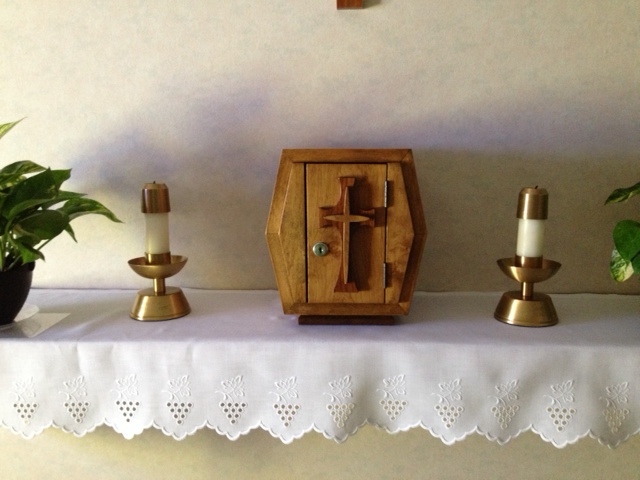
I’ve spent the past day at a convent for retired Catholic nuns. There are two chapels – one big and one small. They both have a box called an aumbry or tabernacle for the reserved sacrament. It is where you put consecrated Communion wafers. Before they are consecrated they are just wafers. After a priest has blessed them, they are different. They are so different that they are separated from the others in a special box. The Catholics believe that the wafers become the actual flesh of Jesus when they are blessed by the priest.

Here is a picture of the altar in the little chapel.

box 5

Here’s slightly closer.

box 1

I know that consecrated wafers were in them because the candle beside the altar was lit.

box 2

The candle means Jesus is in.

I can’t even tell you how tempted I was to see if the box was locked. Yes, these boxes have locks on them, but often they are open. If I tried the door and it opened, would I have taken a wafer?

Here’s a picture closer up of the box, showing the lock.

box 4

Taking one out would be stealing. That would have been the same as attending Mass and going up to take Communion, knowing full well that their rules say I can’t. No – actually, it would have been worse. It would have been sneaky and sly. It would have been taking something like a thief.

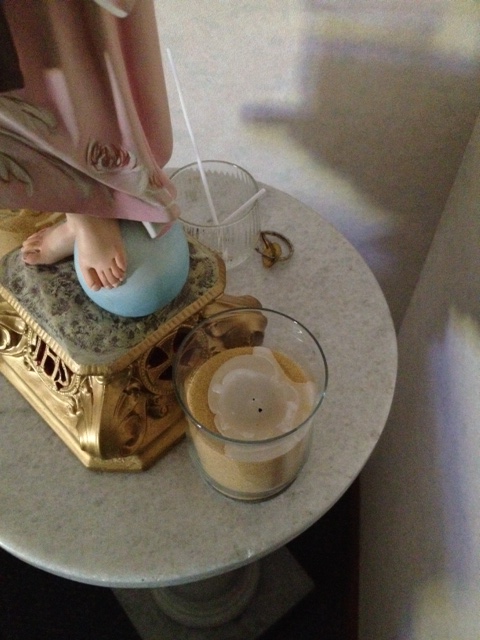
When I was wandering around the room, I came across a little statue with some candles around it. I saw the key behind the statue.

box 3

I felt like I was part of some adventure game, where you find the key to the locked door with the treasure. Remember those? You’d use simple instructions with a verb and a noun to get across what you wanted to do.

Take Key. Go East. Go to Box. Use Key. Open Box. Take Wafer. Eat Wafer.

And then I’d win a bonus life in the game.

But I didn’t. I didn’t do any of that. I didn’t even touch the key.

The Methodist church that sponsored the retreat has Communion every Sunday. They say on their website that their Communion is open to all. “All are welcome” is their motto. They even go so far as to explain that this means everybody – members of that church, members of other churches, and people who have never been to church. This is a welcome surprise. This means that people who aren’t baptized can take Communion there.

This is a radical departure from the Episcopal Church. This is right up my alley.

I’m all for opening up Communion to everyone. While I was part of a church that allowed people from other denominations to take Communion there, it still didn’t allow unbaptized people to. Sure, there is nobody checking baptismal records at the altar rail, but still, the rule is there, printed in the church bulletin you got when you came in the front door. When you read it, you know you’re out. You know you are breaking a rule if you put out your hands for a wafer.

It isn’t the role of Christians to stand in the way of Christ. Who are we to set rules and parameters as to who is worthy? If someone is called to the table, who are we to stand in their way?

Jesus is all about welcoming and including. Jesus is all about breaking down barriers. Jesus is all about leveling the playing field. Jesus is all about opening doors wide open and inviting everybody in.

Bonus life, indeed. This is a game where all can play. It isn’t a game of musical chairs, where there are limits on who is in. We all win. We all are invited, and blessed, and loved. We all are. No exceptions.