Recovering church member.

Christians in recovery aren’t like recovering alcoholics. We are more like food addicts. We can’t do without food. We just need a healthy relationship with it.

When you are a recovering alcoholic you have to learn to live your life without alcohol. But you can’t live without food. You have to relearn how to eat. The trick is to learn what is a healthy relationship with food and what isn’t. The trick is to set up boundaries.

In the same way as food addicts, people who have been hurt by mainstream church (by the current definition of what “church” means) are renegotiating this relationship. They can do without the top-down leadership, the politics, and the obsession with money that comes with church as it is currently defined.

When we have had an unhealthy relationship with church, we have to renegotiate the deal. We often try to stay away from church. Sometimes we go back but to a different denomination and we find we are welcomed. Sometimes we find that welcome is short lived and we discover the same bad processes and unhealthy ways of thinking that plagued our old churches. Sometimes we start to think that the whole idea of Christianity is wrong, and we stay away from anything associated with the idea.

The only problem is that the thing that drew us to church, and the thing that got us to leave is the same thing. It is Jesus in both cases. Those of us who leave church don’t do it because we don’t love Jesus. We do. We just weren’t finding him in church, or at least any modern definition of it.

As for me, I wasn’t finding him in the activities that the church sponsored. I wasn’t finding him in the book clubs that featured books that had nothing to do with how to be a better Christian. I wasn’t finding him in the margarita karaoke evenings. I wasn’t finding him in the Bunco gatherings that were held in the parish hall. And I certainly wasn’t finding him in a minister who told me to stop talking about how God was and is interacting with my life.

I left church, but I couldn’t leave Jesus. The only problem is in trying to figure out how to have one without the other. Just like with food addiction, I need Jesus in order to live. I just can’t handle all the extras that have been added on top of him.

So much was put on my plate when I’d go to church that Jesus became the side dish instead of the main course. There were so many garnishes and condiments and appetizers and desserts that I couldn’t see him at all. When I left church and left all of that, I missed him, and I got hungry for him all over again.

I think this is true of many people I’m meeting. We love Jesus. We just don’t love how he’s been served to us.

Just like a food addict, we need to strip it all down to the basics and start from scratch. We need to reevaluate our relationship. We need to set up healthy boundaries. We need to figure out what we need and what makes us feel ill.

For me, one of the big things is that the group not have a permanent building. Jesus didn’t build a church with bricks, but with bodies. The church is the people, not the place. The more money that is spent on a church building, the less that is spent on helping people who need it.

Another thing is there needs to be no one minister. We are all ministers, by virtue of our baptism and our acceptance of Jesus into our lives. To have only one person sharing their story, and only one person making the decisions, is to take away the God-given power, voice, and ability that we all have.

So while I really like the gatherings that I’ve been going to, I’m still missing Jesus in them. I think we’ve all gotten so afraid of how we were treated at church that we’ve just dumped everything and been feeling it out. We are reassembling the jigsaw puzzle but without the picture on the box, and we are leaving out all the bits that we are afraid of.

While I like that the meetings are in friend’s homes and we all get to share our stories openly and honestly, I feel that we are missing something really important. We forget to invite Jesus to our circle. We don’t talk about him. We don’t have communion. Well, not openly. Tea and cookies can count, but it has to be intentional for it to count.

I think we feel that because we don’t talk about Jesus, because we don’t invite him to our circle, that we aren’t going to get hurt like we did the last time we were in a place that mentioned Jesus. And we might. We might get hurt because whenever we gather with other people, we gather with other people’s problems. I also think that we still need to try. Just like renegotiating a relationship with food, I think we need to renegotiate a relationship with Jesus. I think we need to invite him in, to help heal that brokenness and that hurt. I think if we don’t, then we will start to feel more and more empty.


Church refugee. On circle, and communion.

I’ve met so many refugees from church recently. We are starting to find each other. We are all people who went to church for many years because we love Jesus. We left church because we weren’t finding him there.

So many of us feel hurt by church. We were made fun of or silenced. We were mocked for our gifts and talents. It seems that all we were wanted for was our money. We were expected to sit down and shut up and listen to the minister and pay our tithes and then go home and be equally passive. If we read the Bible for ourselves and asked questions we were discouraged. We knew in our hearts that this wasn’t right. We knew that God wanted more of us.

We tried to make it work in church. We volunteered for more activities. We were on committees. We were in several different groups. We were active. We were the first at the church and the last to leave on Sunday morning.

But it wasn’t enough. It wasn’t enough for us, and it wasn’t enough for God. We were trying to make it work.

So we left. Some of us left the churches we’d put a lot of time and money into. Some of us left the churches that we were raised in, that our families still go to.

Several of us have found each other in a circle gathering. We share time together, and we are honest and open. Each person gets to talk, and every person listens. This is so different from church as we know it.

But for me, there is one thing missing. We don’t invite Jesus into it.

This isn’t an interfaith gathering. We are refugees from church, remember? We are people who left church because we couldn’t find Jesus there. While many of us think that Buddha and Rumi are enlightened beings and we like to share their quotes, we are still afraid in these gatherings to invite Jesus into it.

Why is this? Have we thrown out the baby with the bathwater? Are we afraid to bring Jesus into our circle because we associate Jesus with the people we left? If people are hateful, they don’t have Jesus. If there is love, then Jesus is there. If there was love at our last church, we would have stayed.

We left because we felt undervalued, underappreciated. We left because we were silenced. We left because we knew that the car that is church was going off the road and to stay in it would have meant we were going to go off the cliff with it. We left because we’d rather walk towards what is right than go quickly towards what isn’t.

So while we are reevaluating what church is, what community is, we aren’t taking the Guide along with us. We aren’t inviting Jesus into our circle, into our hearts.

I’m considering hosting my own circle, and I want to have communion. From all I’ve read of the words of Jesus and from my personal prayer time I’ve realized that you don’t have to be ordained to do this. That is yet another method of controlling people. Jesus didn’t create the institution of priests. Jesus did away with all of that and gave the power to everybody, with no distinctions. Jesus made us all equal.

I’m learning more and more about Judaism, and it is amazing how diluted the Christian communion service is. It is simply a Sabbath meal at the dinner table. It has been boiled down to the bread and the wine. There are two candlesticks as well. The chalice and the paten are the Kiddush cup and the saucer. It is like Christians are playing house. The congregation doesn’t know about the Jewish roots of this ritual.

I’m thinking about making it as inclusive as possible – having kosher grape juice and gluten-free matzo. While I’d love to serve actual wine, it isn’t fair to exclude those people who are in recovery. While I’d love to serve challah, the bread that is served at the Sabbath meal, it isn’t fair to those who are gluten intolerant. And while some churches will have a separate line for those people who are gluten intolerant, and tell those in recovery to let the cup pass them by – that isn’t fair. We all need to share the same bread and wine. When you exclude someone, you are saying they aren’t the same. When someone has to exclude themselves for health reasons, they are making themselves stick out. If the elements of the meal are safe for everybody, then everybody is welcome and everybody is equal.

And that is really important.

Dream of Fields

I had a dream the other night that didn’t mean anything at the time but now feels relevant.

I was driving on a freeway and got off. I parked in a field, newly sown with seeds. There were hundreds of thousands of seeds. The land soupy, even bog-like, with them. I laboriously slogged through the field. The excess of seeds kept slowing me down.

After I had gone far enough from my car that I couldn’t see it because of the trees in the field and a bend in the land, I noticed that the field had an end. I saw a guardrail and the freeway again. It wasn’t an endless field.

I turned around to get back to my car. When I came back to it I saw that there were other people who had followed my un-beaten path and had also parked in the field. They had followed me, but they weren’t doing what I was doing. They weren’t walking in the furrows or studying the unusual amounts of seeds. They were taking pictures of the field, like it was a tourist attraction or a historical landmark.

I was a bit disgusted with them. They didn’t get anything about the field.

And how is this not different from my path?

I’ve left the road of church as usual. I’ve gotten off the path and found a field of green seeds. There is so much life and growth and vibrancy here that I am getting bogged down by it all. There are so many ideas for posts to write that I get overwhelmed at times with where to start.

I hope that my posts are helpful. I hope that they have spoken to fellow travelers. I hope that they have provided encouragement or enlightenment. I hope that they have shown a way out or a way in.

The last thing I would want is for anybody to follow me off the road and then treat it like it is a game or a show. It isn’t. It is hard work. It is like growing your own food or building your own house. There are some books offering suggestions but they can’t really show you exactly what to do.

By definition, they can’t.

Nobody can give you a blueprint for your life. It is your life and yours alone and they can’t really know what you need to make it work. They can offer advice from the sidelines, but they can’t play the game for you. They have a different perspective from seeing things from the side, but they can’t see it the way you are seeing it.

So I want people to read my words and get them, sure. I feel that I have useful things to say. I feel that they can help people get out of ruts or avoid falling into them in the first place. But I don’t want to be followed or iconized.

I want people to pull off their own roads and find their own fields and wander around them for a while. I want them to be inspired by my journey to take their own. I want them to question everything. I want them to be awake and conscious and intentional about life.

It all goes to fast to spend it in someone else’s field.

Poem – Stone (predictive text)

So it seems like we are
sent to be the ones.
So what now?

They don’t want to do it.
This may sound strange.
There are many different churches
that I have been deceived by.

Then the lights came up.

On to the shelter
our bodies house

Now I’m adrift in the middle.
Note that I am sure how to do it
no matter how.

Everything else is extra.

————————————————————————————————–
I’ve started a new thing with my predictive text poems. The Kindle offers words all the time while I write. It thinks it knows what I want to write even if I’ve just put down one letter. It is kind of like that annoying friend who won’t let you finish your sentences. I decided to let it help me write poems. Previously I’d just go with the flow and let it offer whatever it wanted. At a certain point it bogs down and starts only giving me two or three letter words. This is after the first word in a sentence. Most of the words aren’t nouns or verbs either, so this gets old really fast.

I decided to start poems with a theme or a trick. I’ll pick a word, and start each section with one letter of the word. When I put the first letter down, the Kindle offers me about ten words that start with that letter and I’ll pick whichever one seems the best at the time. It is kind of random, and kind of by feel. I have input – but I can only pick the words that are there. At the end of each line, reuse the letter until I have gotten to an ending point. Then go on to the next letter as the next section. I’m trying to pick a word that has a resonance with me, and if I remember I’ll put an intention at the beginning, as a sort of prayer request. The resulting poem is either the answer to it or a further meditation on it.

I write what I can, then email it to myself and edit it on my real computer. The Kindle assumes every line starts with a capital letter, and sometimes the syntax is a little off so I have to tweak it. Sometimes in the middle of the poem I feel it has led me to a place where I need to say something that it isn’t giving me the words for and I’ll free write. But in general, when I call something a predictive text poem, the Kindle supplied around 90% of the words. I just harvested them.

I especially like the tension in this one in the line “On to the shelter/our bodies house” because is the shelter the house, or our bodies? Is the body a house? I think it points to the idea that we don’t need a church because we carry it with us. Our bodies are temples of the Holy Spirit. We no longer need to go anywhere to find God – God is always with us. Actually, this has always been the way, it is just that now we are coming to see this. We have been mislead for so long in thinking that we didn’t have any power and we had to go to someone or somewhere else to find it.

Boat – on an anchorless faith.

I’m starting to think that the Episcopal church is better off without me. The whole deacon discernment process was put on hold a year ago. I understand now that there is no way I could speak freely and have them put their stamp of approval on me.

Because how dare I say that God is talking to me?

As Christians, our goal is to be connected with God. How can we possibly do the will of God if we can’t hear God?

Oh, right, I forget. We are supposed to trust that the priest/minister/pastor is hearing from God, and telling us what to do.

Yet, this isn’t what Jesus wanted.

So I’m on my own now. I’m non denominational. I’ve been without a church home for half a year, and it is a bit terrifying. There isn’t a road map for this. I keep wanting to go back to the old way, but then I feel a pain in my gut every time I think about it. I know that I can’t. I know that isn’t my path.

I’ll go to a Christmas Eve service. I’ll take communion in a gym. I’ll celebrate Christ in the pool at the Y. I’ll go to my spiritual director. I’ll go to a friend’s house where we share what the Spirit leads us to share. I’ll host events at my house. I’ll pray over my meal in silence at a buffet. I’ll make healing jewelry for a grieving friend. I’ll write.

God is connecting with me in new ways.

It is like I’m on a boat, sailing far away at sea. I’m no longer following the coastline or the man-made lights along the shore. The lights I’m following are the same lights that sailors have followed for thousands of years.

I’m going backwards to go forwards.

The radio doesn’t work here, this far out. There’s no map on the sea either. I have no way of knowing if I’m headed the right way. I have no way of knowing if I’m lost.

I’m pushed along by the breath of God, and that suits me just fine.

This is the same breath that created the world, that gave life to Adam.

I feel safe in this boat, this ark, the ark of Noah, the ark of Moses as a baby. Both went out on trust, went out in wooden boat on the ocean, adrift. Both were there because all was lost and the old ways didn’t work anymore. Both were there because to stay where they were meant certain death.

The Covenant has an ark too. So do Torah scrolls.

The main body, the sanctuary of a traditional church building is known as a nave. It is from naval, from ship. It is an ark for people. It looks like a ship, upside down. The sharp pointed roof is the hull of the ship, pointed towards the sky.

I don’t want that ship anymore. I want to take it and turn it all upside down and set it afloat again.

I don’t think that God wants us to be grounded or set in our ways, or stuck in one place. I think God wants us to be forever trusting in God’s ways, and the only way to do that is to set sail, rudderless, anchorless, free. God wants us to take us further than we’ve ever gone and right where we need to be.

God is, was, and shall be. The Hebrew YHWH is a contraction of these words. It is a good name for God, the infinite, the forever, the now and always is. God is endless and eternal.

We can’t understand this, we humans. We invented time. We invented the idea that tomorrow follows today and each day has a separate name and that time takes place. Perhaps that is why we are confused. We don’t understand God because we can’t limit God. We can’t define God because God is indefinable.

Wake up. Hear the gulls. The day is dawning here.
There’s no shore, but we are not alone.
The beings of the sea and sky keep us company.
Wake up, and smell the salt in the air.
We are safe.
We are home.

I miss church.

I miss going to church. It has been 8 months since I have been to church. I miss church in the same way I miss my family. When holidays roll around I miss the warm fuzzy feeling of family that I never had. It is part of why Mother’s Day hurts so much. I miss the never-was, or the might-have-been. When the holidays roll around I miss going to church even more. I feel like I’m missing out.

I think a lot of people go to church because of those very same feelings. I think that church fills a hole in them that family couldn’t. It provides a sense of belonging. It is an artificial construction, but a good one, usually. Family is an accident. Friendships are chosen. Church, being (hopefully) a conscious choice, is more like the latter. It provides some of the same kind of support that family should provide but often doesn’t.

The problem is that I can’t go back to my old church. Even if the priest there leaves, I can’t go back. I’ve seen behind the curtain. I know too much. The magic spell has faded away to tinsel and mirrors.

I can’t go back to church as it is, because it isn’t what Jesus meant for us to be doing. But every now and then I have a hankering to go back.

I know three families who left that church before me (because of the same priest) and attend another one of the same denomination. I know that the priest of church A has called the priest of church B to tell him about those families. She told me this back when I was still on her side. She thinks she was “smoothing the path” and “building bridges.” If she was so good at doing that, then how come she couldn’t do that at her church with these families? Now I wonder if she has called the priests at the other local Episcopal churches to warn them about me? I wouldn’t put it past her.

I went to a “Lay Ministry Appreciation Day” at the Cathedral last year. It was the second one they had. I went to the first one too. I felt that something was wrong when I went to the first one, but I couldn’t put my finger on it. After the second one I figured it out. At the end we were asked to write our impressions. I wrote that I was very sad to find that we’d spent the whole day learning how to “do church” and not learning how to be better Christians.

There were classes on how to be an acolyte, a chalice bearer, a person who administers home Communion, a lector, and an altar guild member. There wasn’t a single one on how to serve Jesus outside the church. There wasn’t anything about building up the Body. If you wanted to know how to wear vestments or hold a candle or prepare enough Communion wafers for a crowd, they had a class for it. Everything else, forget it.

Here are some examples of things I saw at the Cathedral that opened my eyes.

These are kneelers at the altar rail.
6

I wonder how much time was spent needlepointing them. Wouldn’t it be more Christ-like to spend that time visiting the sick and those in prison?

This column is one of many. The marble is imported from Scotland. They are at least twenty feet high, by my estimation.
9

I wonder how much that cost? Wouldn’t it have been more Christ-like to spend that money housing the homeless?

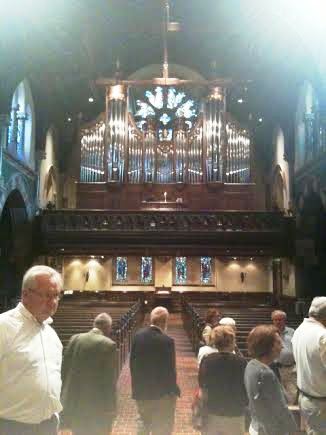
Check out the stained glass window and the pipe organ.
8

There are stained glass windows throughout the building. One is from Louis Comfort Tiffany. The tour guide says that the Cathedral paid for none of them – they were donations. He’s missing the point. If someone can donate 5 to 10 thousand dollars for stained glass, they can donate the same amount to feed the hungry and clothe the naked instead – you know, the stuff Jesus tells us to do?

God didn’t come down to Earth for us to spend time and money prettifying a building. Jesus didn’t die for us to debate over where to keep the reserved sacrament. The more I went to church, the more I realized that I wasn’t serving Jesus at all. I was serving the administration. I was serving the institution.

Sadly, there are a lot of us who are stuck in this hamster wheel. There are a lot of people who go to church who have invested a lot of their lives and their egos in what they thought was being a good Christian, and what they are doing isn’t Christ-like at all.

It isn’t un-Christian. It just isn’t what Jesus would do.

Breaking out of this mindset is very hard, especially for people who have spent a lot of their time and money in and on the institution that is church. It is especially hard for those who get paid to lead. They have the most to lose. Yet, the way I’m seeing it, they have even more to lose if they keep on following the wrong master. We can follow only one master – make sure it is God, and not the institution.

So yes, I miss church, but it is more like I still haven’t found what I’m looking for. I can’t miss what I never had. There are a couple of options I’m looking at that have a lot of the qualities I feel Jesus meant. I think they are a good start. But I’m wary. I’m wary of getting sucked in and fooled again, like I was last time. I’m wary of letting down my guard and getting really hurt.

Exodus

I’ve found that more people are leaving my old church. These are people who have gone there much longer than I have, and have worked in lay ministry much longer than I have. These are people who are essential to the running of the church. These are people who are also waking up to the fact that church should be more than margarita karaoke and a night out watching the local baseball team.

Those things are fun, sure. But they aren’t the purpose of a church. Church is meant to build up the Body of Christ. Together, we are stronger. Together, we can make the world a better place. Together, we can feed the hungry, clothe the naked, heal the sick. Together we can do what Jesus did.

I haven’t told them to leave. They haven’t read my blog. They don’t know why I’ve left. But they too are leaving.

I’m not the first to leave. There were others before me. Others with children, who were dismayed by how the priest handled a change in how Communion was distributed to children. They were the first of the group of active members to leave. They were acolytes and chalice bearers and readers. The problem is, the membership wasn’t that big to start with, and of that number, there were even fewer who were willing and able to serve in liturgical roles. That is the thing with liturgical churches – you have to have worker bees. It can’t all be done by the queen.

It shouldn’t be done all by one person. That is the purpose of church. Church should be training ground for the rest of the week. In church we should learn about how to work together to build something amazing. In church we should learn about our own unique gifts and talents, and learn how to use them to serve God. We do it through the simple actions of preparing the worship space and time. We do it by polishing the silverware like we are preparing for a special guest (we are). We do it by assigning readers for that week’s lessons. We do it by practicing those readings, so that people can hear the Word of God clearly.

These are literal yet symbolic actions. They pale in comparison to what we are supposed to do outside of church, but they are still important. But when the people who do these things are leaving, it is a sign that something very deeply wrong is going on. It is a sign that needs aren’t being met.

I wrote the Bishop to let him know my concerns. I let him know about my concerns with that parish specifically, and of the Episcopal Church, and of Church in general. I wrote to tell him that I feel that we are doing it wrong, that Jesus didn’t mean for us to have church buildings and ordained ministers. Our tithe was meant to feed the hungry and clothe the naked – not pay for minister salaries and a mortgage. He told me thanks for writing, but he doesn’t see any problem. Of course he doesn’t. His job would disappear.

The more I read of what Jesus said, the more I see that His words don’t synch up with what we do. A person cannot serve two masters, after all. I can either serve Jesus, or I can serve the church, which often seems to be going in an entirely different direction.

I don’t want it to. I don’t want people to leave. I want this thing to work. I’m deeply concerned and sad about the state of things. I want church to be about healing and reconciliation and love. I don’t want it to be about chili cookoffs and ice cream socials. I don’t want it to become another social club.

Church isn’t the building, but we’ve spent so much money and time and energy on it that it has become the building. Church isn’t about ordained ministers either. Jesus told us not to have any. Yet we’ve given them money and time and energy too and we’ve gotten distracted. We’ve forgotten that WE are the Body of Christ. We’ve forgotten that WE are the ones who build up. We’ve forgotten that WE are the ministers, every one of us.

Some churches get it. Some churches understand the healing power of having many hands make light work in doing the work of Jesus. There is a lot of work to be done. There are a lot of people who need help. There are some churches that get that we can’t waste our time just hanging out together – we need to hang out while we are doing this work.

Meanwhile people are leaving. It is an Exodus, a leaving. They are escaping a bad situation, and looking for what they are being called to. They are leaving to try to find another place that gets it. They are frustrated. They haven’t left entirely. They are there half the time. The other half the time they are church shopping. They go to other area churches of the same denomination. They go in a group. Twice a month they are gone.

They haven’t come to the conclusion that I have. I don’t expect them to. My leaving was radical. While I’m sad that something that I’d come to see as the center of my life is gone, I’m also glad. I’m glad that the leaving wasn’t drawn out. It was a clean break. The words of the priest were so severe when she read my concerns about church that I had to leave. There is a bit of mourning, sure. I miss going to church. But what I really miss is that church never was what Jesus wanted it to be. I think I miss the never-was more.

White is white – on blind obedience to the Church, and going it alone.

Some of you will remember that I was in the deacon discernment process for the Episcopal Church. This means that I believe (and the priest believed) that I was being called by God to serve “the least of these” – the poor, the homeless – those who have no one to serve them. Some of you have been reading along since April of this year, when I stopped going to church. The part that is interesting to me is that only a handful of people have even seemed to notice I’m gone.

I’ve recently written to the team that was involved in the process. It took me this long to get over my anger at and sense of betrayal by the priest. I didn’t want to write an angry letter. There are/were (what tense do I use?) nine people on that team, all trying to “listen” with me to see if it was a call from God. None of them have written back. I then sent a copy of the letter to the Bishop. Nothing, again. I feel like I’m standing at the front of an auditorium and the microphone isn’t on so nobody can hear me. Or maybe they are ignoring me, hoping I’ll go away. But the weirdest part is that more people from a church that prides itself on being welcoming and friendly hasn’t contacted me.

I was very active in this church. I was there every week. I was the leader of the team of lectors and chalice bearers. I was also an acolyte. I served up front as part of the worship team nearly every week. It is a small church. I’m hard to miss.

To be a deacon in the Episcopal Church is a big crazy process. It takes years. It takes homework and meetings. You have to submit your transcripts. You have to submit your baptism and confirmation records. You have to submit to a physical and psychological exam. Basically, you have to submit. They want to make sure that you are hearing from God, sure, but they also want to make sure they can control you. They want to make sure that the Church is safe by not signing off on a wacko, sure, but they also want to find out if the priest or the Bishop tell you to do something, you’ll do it.

The odd part is that you have to go through all this for an unpaid position. You are expected to keep your day job. You have to do more at church and in the community, but you don’t get paid for it. They have this whole multi-year process to shape you into a deacon. The process is arduous.

But it turns out that they don’t really have a framework to teach you how to follow God when the Church isn’t. That’s the scary part. There’s a group in the Catholic Church that embodies this blind faith in the Church. The Jesuits say that if they see that something is white, and the Pope says it is black, they are to say it is black.

I’m not about that kind of obedience. I understand it, somewhat. We humans are fallible. I entered into this process because I know of my weakness. I’m bipolar. So I wanted training and oversight. I wanted to make sure that if I thought I was seeing white, it was indeed white. It is my greatest hope that I not deceive or mislead anybody. I think it is really important to make sure it is God’s voice I’m hearing and not my own imagining.

I left church because I could see white and everybody else was doing black. The more I read of the Gospels, the more I realized that what we, collectively as a Church, are doing, is wrong. It isn’t about building church buildings or having ordained ministers. It is about building up the Body of Christ – by teaching every person who is called to be a Christian how to be a loving servant of God and how to hear the voice of God. Everybody. Not the elect, not ordained people – everybody.

I think everybody needs to go to Cursillo and be woken up to the Holy Spirit. I think the homework assignments for the deacon process are very helpful for helping people “hear” their calling. I think small groups where people “listen” to each other and keep each other accountable are useful. I think reading books by progressive Christian authors about their struggle to integrate the ways of God with the ways of the world are helpful. I think we all need to work on our faith rather than take it for granted.

Perhaps this is what they are afraid of. Perhaps this is why they haven’t contacted me. I represent a total upheaval of the way things have always been done. No more church buildings. No more vestry. No more priests. Church isn’t a social club but a way of life – and that life is service. Perhaps this frightens them.

It is like the early Christians, who knew in their hearts that what they were doing was right, was in fulfillment of all the promises that they as Jews had been told. They knew that Jesus was the Messiah. But everybody else railed against them. How dare you upset the way we’ve always done things? How dare you tell us that we are doing it wrong?

I get that. People are like that.

But white is white, and black is black, and the blinders are off now.

The broken down car.

We have gotten to a point with Christianity that we are sitting in a broken down car.

The car used to go. It used to get us where we needed to go. It used to work really well. But that was many years ago. Sometimes it works really well, but more often than not, it fails and sputters.

Something has happened to this car, and it wasn’t done to us. We haven’t maintained it. Nobody is to blame but us. Nobody stole the tires. We let them rot.

The steering wheel doesn’t work anymore. The car no longer goes where we intend for it to go. Instead of driving us to the people that need help, we take care of our own people in church. Instead of showing compassion to everyone, we are taught to feel sorry for people who aren’t Christian. We are taught to “love the sinner but hate the sin” – while forgetting that Jesus never said anything like that. We are taught that homosexuality is a sin, while forgetting that Jesus taught us to love everybody, and that judging others is a sin.

We were never taught how to get the oil changed, so the vitality of the car isn’t there anymore. We no longer are taught how to heal in the name of Jesus. We are no longer taught how to welcome the Holy Spirit. All the gifts that were given to the Disciples on Pentecost are lost to the majority of us.

We have the owner’s manual, but we don’t take it seriously. We have the Bible, but we don’t actually make them applicable to our life today. We pick and choose the parts of the Bible we want to follow, rather than paying attention to Gospel, which for Christians is the new, updated portion of the manual, to make it supercharged. Or we let someone else do the interpreting for us, and we don’t study the Word for ourselves.

When our mechanic tells us to fix the car, we don’t listen. We aren’t taught how to hear from God. And in some churches, the minister will discourage this behavior.

We’ve decorated the car up with all the geegaws we can, rather than on what is important. We’ve spent money on the windows and the seats and the paint job – but still we aren’t getting to where we need to go. Why are we spending money on the car, rather than on the poor and the homeless and the hungry and people in prison, you know, like Jesus told us to do?

So now we sit in this car. We sit in it every Sunday. It sure is pretty. But it doesn’t go anywhere. We content ourselves that sitting in it is what it is all about. At least we are there, rather than sleeping in. We feel so good about ourselves for going.

Every now and then the car goes. Sometimes we are able to fire it up and make it do what it is supposed to do. But it isn’t for very long. Then soon enough we are back to having book club meetings that cover books that aren’t about our faith, or having covered dish suppers where we feed ourselves rather than the hungry people in our neighborhood.

And be sure not to tell those people who have sat in the car the longest that the car doesn’t go. People don’t like having their possessions taken away from them. They don’t like being told that it is broken. They will hold on to it for their very lives. I think this is normal human behavior, but it is not what our goal is.

We’d be better off selling the car for scrap metal and giving away the money to help people in need than what we are doing now.

I was like those people who sat in the car. I looked at my friends who had left church with some small version of compassion. I thought that they just didn’t get it. Perhaps they were in the wrong denomination, or in the wrong parish. Perhaps they could see how things weren’t as they thought they were if I just kept on trying. So I did. And then I started to see the cracks too. And I couldn’t look away any more.

I wanted to help people. I asked three years ago, how do I learn how best to help? My motives were questioned. I had to submit a spiritual history on myself. I had to submit a photo, and a financial disclosure. I had to prove when and where and by whom I was baptized and confirmed in the Episcopal Church. I had to wait two years before all that began – and it still didn’t get me any closer to being able to help people. This is like the church telling me that I needed to build a car first.

I’ve walked away. I’ve not walked away from God or Jesus, just the church as it is. There is some thought that I should stay, to help repair the car. But I’ve been told not to talk about how broken the car is, because it hurts people’s feelings. How can I wake people up when I’ve been told to be quiet? Perhaps there is some concern that I won’t do it in the right way. Perhaps I don’t take everybody’s feelings into consideration. But there is a lot to be said against being too cautious and too careful. If you wait to make everybody happy, nothing is going to happen.

This is not a social club, and it isn’t a personality contest. It is hard work. This isn’t about feelings. This isn’t about egos.

I’m sorry that people’s feelings were hurt, but not for the reason they think. I’m sorry that they have invested so much of themselves into something that no longer works.

On Leaving Church

I am on the threshold of leaving church. Not just my church, but church in general. I’m not finding what I need in it. I’m finding that it keeps people back. It doesn’t empower them. The entire structure of church as we know it these days does not teach people how to be ministers. It teaches them how to be sheep.

I don’t have butterflies in my stomach about this. They are larger than butterflies, and not as pretty. These are owls. They are large and mysterious, and they hit me when I’m alone. When I’m busy with other things they fly away. When I’m off the desk at work, or at night, they hit. They represent fear. Fear of not doing the right thing. Fear of not doing what is expected of me. Fear of straying from the path. Fear of getting lost, of getting hurt.

So – the best way to confront fear is to face it head on. Funny that it was part of the discernment process to be a deacon that taught me this. What I’ve learned from yoga and Buddhism has helped too. And there is a lot of nonviolent conflict resolution going on in this mix.

I’m standing on this cliff. I feel that everything in my life has led me to this place. I feel that the more I look at all I have learned, all the classes I’ve taken, all the books I’ve read in the past three years, have led me here and given me the strength.

What are my tools? The Diversity in Dialogue classes at the Scarritt-Bennett Center. Books such as “Codependent No More,” “Boundaries,” and “Difficult Conversations.” The homework from the deacon discernment process for the Episcopal Church. Journaling. Prayer. My entire life history – remembering the times I’ve walked out in faith away from something I knew to be wrong. I say I’m walking out in faith because I don’t know where I’m going, but I know it is time for a change.

I’m getting strength from a verse my spiritual director gave me. It is from Isaiah 30:21. It is “Whether you turn to the right or to the left, your ears will hear a voice behind you, saying, “This is the way; walk in it.”” I’m also getting strength from her teaching to “ask Jesus into it.” Any time I feel fear or angry or hurt or lost – ask Jesus into it. That way I’m not alone with my hard feelings. No priest has every taught me something so simple yet essential. I feel like they have consistently hidden something important from me.

It is time to look behind that curtain. I’m starting to see the entire structure of church as a magic trick. The magicians, the ministers, have all the tricks. They have all the power. They don’t want the punters to know how the trick works, so they can keep up the illusion that they are in charge. This is exactly like when Dorothy and her pals looked behind the curtain and saw the Wizard. He wasn’t big and powerful. He was tiny and weak. He used his machines to make him seem much bigger and louder.

What exactly am I afraid of? Being disconnected from God? God isn’t in a church. God isn’t in a building. God is in everything and in everyone. Time to dig deeper into this. What else is there?

I’m afraid of what happens if I’m not taking communion. But what is communion? A symbol. The wafer and the wine aren’t anything special. The priest doesn’t do anything except remind us that this is a reenactment of the Last Supper. The Catholics think that all other priests are doing it wrong anyway. They think only they have the ability to “confect” the elements. “Confect” is Catholic for “do magic” essentially. They think they are actually converting the wafer and the wine into the actual flesh and blood of Jesus. That is not only creepy, it is another sign of control. Come to us – we serve the only pure Jesus. Everybody else has the watered down Jesus. We have the full-strength version.

I think, maybe I just need to go to another church. Another Episcopal church, or try another Christian denomination. Or maybe even Unitarian or Baha’i. Or Buddhist.

I get more owls from thinking like that. Big flopping wings. But then I face them on – why does that frighten me to leave church? Do I think it means I’m leaving God? Am I afraid of going out on my own and getting lost?

It is like church has slapped training wheels on my bicycle. And they haven’t even begun to tell me how to ride without them. They are afraid of my independence. They are afraid that I’ll go rogue. Look out for all those lost sheep, Jesus says. Gotta go save every one.

But I’m tired of being a sheep. I don’t want to be a shepherd either. I don’t want anybody to follow me. I want them to be strong enough to hear God’s call on their own. I want them to be strong enough to find other lost people and empower them.

I remember a time in a club I was in where I was talking about teaching other people how to do something. I made glass beads and the other person made arrows. I was one of the few people in this part of the country who knew how to make glass beads by melting rods of glass onto a clay-coated mandrel. I was taught by a fourth-generation glassblower and lampworker. My friend was very good at making arrows, and had won awards for it. He was self taught. Our disagreement came when I said I taught my students everything I’d learned. I taught them all that my teacher had taught me, and everything I’d figured out on my own behind the torch, and everything I’d read in books. Meanwhile, he taught them the basics, but nothing extra. He admitted that he didn’t want his students excelling him. I strongly disagree with this way of thinking. I want my students to excel. I want them to surprise me. I want them to be able to teach me something.

I feel like the church is more like my friend than anybody wants to admit. Maybe I haven’t found the right church. Maybe that church doesn’t exist yet.

My Mom didn’t want to teach me to drive because she was afraid that I’d get lost. She knew that I was directionally impaired. She was afraid that I’d call her, wailing, lost, and because I didn’t know where I was, I’d not be able to tell her so she wouldn’t be able to rescue me. Perhaps there was kindness in her thoughts. Perhaps she really was concerned for me. Perhaps she wasn’t trying to control me. But she didn’t think of the solution. Teach me how to read a map. Give me a compass.

Every good teacher should teach their students how to be self sufficient. Students need to learn how to think, rather than what to think.

In church, I asked for training and oversight. I got put into positions of responsibility and when it was felt I’d overstepped, that position was taken away. This has happened multiple times. I’m starting to feel betrayed. When a person asks for training, it means they think they can’t do what they are called to do. To put them into a leadership position without training will only set them up for failure. To then take away that position when they cause concern does not teach them anything.

There are training programs that exist within the Episcopal church, but we don’t have them at my parish. They are EFM (Education for Ministry) and the Stephen Ministry. Both teach people how to be lay ministers.

I saw a picture of one of my favorite Christian authors (Sara Miles) distributing the ashes on Ash Wednesday, out on the streets in San Francisco. I was shocked. A lay person handling the ashes? And then I thought, why not? I went to a different church last Sunday and saw a deacon was distributing the wafers. I thought the same – that is never done. And then I thought, why not?

I got chastised by the priest for writing “My problem with church.” The conversation began with “So, did you mean to be the school shooter? Did you mean to plant the bomb on the racetrack?” This is not constructive criticism. This is very harsh. This does not open up a dialogue. I was told that I’d hurt a lot of people with what I’d written. I’m wondering why they didn’t contact me, as we are instructed to do by Jesus in Matthew 18:15-17. 15 “If another member of the church sins against you, go and point out the fault when the two of you are alone. If the member listens to you, you have regained that one. 16 But if you are not listened to, take one or two others along with you, so that every word may be confirmed by the evidence of two or three witnesses. 17 If the member refuses to listen to them, tell it to the church; and if the offender refuses to listen even to the church, let such a one be to you as a Gentile and a tax collector.”

Go, and point it out to them alone. Don’t tattle on them to the teacher. I told her to look at that post as well, because I thought she needed to know where my thought processes were going these days. So it isn’t like I was doing anything in secret. But to complain to the priest instead of the person you have issue with is immature.

I started to think about who are my friends in church. There aren’t many, because there aren’t that many people in church who are anywhere near my age level. But then I thought further. All the people I’ve befriended have either already left already or are in the process of leaving. Several of them I’ve talked into staying. I’ve talked three different people into staying, trying to smooth over a disagreement that they had with either the priest or with church in general.

I feel like the point of that post has been proven, along with the one called “On Ministers, and Spoon-fed Faith.” Instead of learning “humility” as I was told I needed to learn by the priest, I’m gathering up steam.