What the Duck? Hate isn’t a Christian virtue.

Last Thursday I was in my water aerobics class. There is a lady there who I regularly talk with. She is an evangelical Christian and is a minister in her church. I’ve had better talks about God in that pool than I ever have in church.

Today was different. She came up to me and asked me if I’d heard about the whole Duck Dynasty thing. Of course I have. Who hasn’t, by now? I don’t even watch TV and I know about it. The patriarch of this group of rednecks says some pretty harsh things about gay people and the network his show is on fires him.

She starts talking to me about this as if she assumes I’m going to agree with her. I’m reminded of the times when people start to tell me a racist joke, thinking I’m on their side. She smiles really big and says “But we know who is going to win in the end, right?” She means Jesus. She means to say that she thinks this intolerant, judging, backwater man is right, and that she thinks I agree with him.

I took a breath in. I smiled. I’m learning this is a good tactic to disarm people. Because this is disarming. I’m trying to remove a dangerous weapon from her. I’m trying to remove the most dangerous weapon there is – using Jesus as a weapon.

I can’t stand it when people use Jesus as an excuse to hate other people. Of course, they don’t think they are being hateful. They think they are being obedient. They think they are following the Word.

So, I decided to test this minister. She’s studied the Bible longer than I have, and been examined by her church. She is a lay minister, sure, but she had to be certified and tested by them to say she is a minister. So she should be able to answer a simple question.

She didn’t see this coming.

I asked her – “What did Jesus say about homosexuality?”

Full stop. She looked to the side, in deep thought. She was scanning her memory banks. They came up blank, because Jesus didn’t say anything about homosexuality. He talked a lot about love. Part of love is not judging other people. He talked a lot about not judging. It isn’t Christ-like to tell other people what they are doing is wrong.

She fumbled. She had to be right. She said “But Scriptures say that…” and I interrupted. “Not Scriptures. What did JESUS say?”

And then she realized that her whole plan was going wrong. She thought she had an ally. I’ve never challenged her on her homophobia before. I’ve let her talk it out. But I certainly haven’t agreed. I’ve hoped that she would come to the same conclusion that I have – that the only sin is to be hateful and judgmental and to not show love.

As Christians, we follow the commands of Jesus. His commands supersede the rules of the Old Testament. Take whatever rule there is in the Old Testament and measure it up against Jesus’ rules – Does it show love to God? Does it show love to our neighbor (i.e. everybody)? Then do it. If it doesn’t fulfill those parameters, it is optional. This is why Christians can eat bacon cheeseburgers, and don’t have to cover their heads, and don’t have to worry about wearing fabric that is woven from two different materials. These rules don’t push us further in love.

The same thing applies to the words of Paul in the New Testament. If his words measure up against Jesus’ commands to show love, then do them. Otherwise, skip them. Remember, Paul is the same person who said that women shouldn’t speak in church. If they have any questions in church they should be silent, and ask their husbands at home later. (1 Corinthians 14:34-35) If she is going to use Paul’s words against homosexuals, she needs to remember that Paul was totally against women ministers, of which she is one.

Now, she has to prove she’s right, so she goes into Scriptures, even though that isn’t what I asked. She tells about the men in Sodom and Gomorrah who wanted to sodomize the angels. (Genesis 19:4-5)

Fine. I’ve read Scriptures too. I may not be a certified minister, but I know this.

I countered with the fact that Lot volunteered to send out his two virgin daughters instead, to be raped by the crowd of men. (Genesis 19:6-8)

Then I added the fact that after the destruction of Sodom and Gomorrah, Lot’s daughters were convinced that they were the only people left on Earth and that they were responsible for continuing their father’s line. They got their father drunk and had sex with him, and got pregnant. (Genesis 19:30-38)

I pointed out that you can’t talk about homosexuality being wrong in Scriptures without noting that raping virgins and incest is perfectly fine.

This stumped her.

She countered with “Jesus says love the sinner, hate the sin”.

I didn’t have the heart to tell her that Jesus said nothing of the sort. Try to find the verse for that. Try to find anything like that in the Gospels. It just isn’t there. It isn’t there because it isn’t loving.

Jesus didn’t define people as sinners.

Jesus died for everybody’s sins. Jesus died to let us all know that we are free of that debt. Jesus died so that we could live.

Plenty of Christians say that they aren’t judging gay people. They say this in the same way that racists say they aren’t racist. They judge them when they say that being gay is a sin. They judge them when they say they aren’t entitled to the same legal rights that every other adult citizen has. They judge them when they exclude them or limit them, or deride them.

When Christians judge gay people, they aren’t being Christ-like. They just aren’t. The bad part is that they are giving a bad name to Christians. Because they are so vocal in their judgment, they give the impression to non-Christians that being hateful is a hallmark of being Christian. It isn’t.

Love is the answer, always.

Basement faith

We spent our evening in the basement last night. That is part of living in the South. A tornado can happen anytime, even four days before Christmas.

We knew all day that bad weather was coming. My husband and I are both “certified storm spotters”. We have certificates to prove it. We have taken seven hours of classes to learn more about severe weather. We’d been watching the weather and anticipating it turning worse. It was fairly pleasant all day. Overcast, sure, but warm. If it weren’t for the grey sky you’d think it was a nice spring day.

We went about our day as normal, with the understanding that we might have to cut our plans short and get home fast. Fortunately the bad weather held out and we got most of our chores taken care of.

We don’t really have a plan of action when a storm hits. The training really is for spotting tornados, not riding them out. But I’ve lived in the South all my life and tornadoes are just part of the package. That and a few years in Girl Scouts and I think I know what I’m doing. I hope and pray I’ll never actually need a real plan of action.

We started arranging things when we heard the sirens. It was around 8:30 p.m. They’ve just installed tornado sirens in our neighborhood and we are still getting used to them. I looked at the weather radar and decided we had about 20 minutes.

We turned off our computers. Lightning was associated with this storm. Of course, if it was a tornado we were facing then losing electricity would be the least of our concerns. Who cares about losing electricity when losing your house is an option?

I looked at Scott and said that the worst part about tornadoes is that where we were standing could be gone twenty minutes from now. He looked at me and said “Well, I didn’t want to come here.” He’s missing something. Sure, he moved here with his parents when he was young, but when his parents had a job opportunity when he was in his 20s, he stayed. He’s stayed all this time, and it has been 20 years. So he has chosen to stay here. That counts.

Now, it doesn’t really matter if you want to be in a tornado-prone area or not when a tornado is coming. It doesn’t matter if it is your choice or not, it is coming, and you’d better deal with it. First plan of action – don’t freak out. Assigning blame doesn’t help either.

We had just finished supper so we took our medicine. That just isn’t something to miss. Then we went to the bathroom, because well, it is important too.

We got our coats and hats and headed toward the hallway. Then I got my purse. And a book. And a flashlight. And a cushion to sit on. And a bottle of water. As an afterthought I picked up the weather radio. It isn’t much help, really, after the initial alert, but it felt like it was something I was expected to pick up.

Then the wind picked up. I went outside for a moment to look. I also prayed while out there. God can hear me inside the same as outside, but somehow I feel the connection is better when I’m outside. Perhaps something about being in harm’s way is part of it. It shows I’m not kidding.

I went back in and sat in the hallway. It was kinda boring.

I went to get a shopping bag. If I have to move quickly, it is best to have all my stuff together. Then I thought it might be a good idea to prepare the spot in the basement. You know. Just in case the storm actually got bad.

I’m reminded of the Arabic phrase. “Trust God, but tie your camel.” So I prayed, but I did something just in case. I know God looks out for me. But I also think God wants some participation here.

But then there is the story of Jesus in the boat. (Mark 4:35-41) There’s a terrible storm, and he’s taking a nap. The disciples are freaking out, and he’s cool as a cucumber. They wake him up and the only thing he’s upset about is the fact that they are upset. He knows that God is in control. They haven’t figured that out yet.

Whatever happens to us is the will of God. Freaking out doesn’t change anything. So it is better to accept it. Tornadoes in the South are good teachers of this lesson.

We pulled out some camp chairs and went to sit in the part of the basement that realtors amusingly term “unfinished.” We amusingly call it the “dead body room”. It looks like it would be perfect for that. It is all dirt and rock and cinderblocks and venting for the central air unit. There is a little standing room. There is just enough room for two people to sit face to face, so we did. Scott was a little overwhelmed with the seriousness of the situation. He and I had not waited out a storm together in this spot. Normally we are either separated because we are at work when a storm hits, or we ride it out in the hallway. We talked for a little bit about what was going on, and then I distracted him with other topics.

Sometimes the best way to get through a situation is just to live through it and not to think about it too hard.

He was getting concerned about what would happen if there was a big storm and he died. He wasn’t concerned for himself. He was concerned for me. I’ve been abandoned a lot throughout my life and he didn’t want me to go through that again. I’m not worried about it. It is what it is, and I’ve gotten through it before. I’ll get through it again. I assume it must be a lesson I need to learn.

The storm was over fast, and it wasn’t bad. Well, it wasn’t bad for us. Nobody died, but plenty of people were inconvenienced over the county. A lot of people were without electricity. Some trees down. A brick wall fell and blocked a road. Nothing big. Nothing that requires the Red Cross to mobilize.

But you never know. I’d rather ride out the storm in the “dead body room” than not and become an actual dead body. But then, am I trusting in God, or myself at this point? Sure, God is in control. God has a plan, and everything happens for a purpose. So am I supposed to go hide out during a storm or not? Is hiding out during a storm taking matters into my own hands? Or is it using the brains God gave me?

I’m reminded of the story of the guy who stayed at his house during a flood. Everybody else had evacuated, and he was still there. A rescue worker came by in a boat, and the guy was on his front steps. The rescuer yelled to him – “Come on! Get in the boat! The waters are rising!” The guy says, “Nope! I’m staying right here. I’ve followed God my whole life and He’s not going to abandon me now!” The rescuer shakes his head and goes on. An hour goes by, and the waters have risen dramatically. The guy is now standing at his second story window, because the first story is flooded. Another rescuer comes by in another boat, and says the same thing. The guy again refuses, again saying how he has followed God his whole life and God will provide for him. Another hour passes and the waters are so high now that the guy is standing on his roof. A helicopter comes by with a rope dangling down to the guy. “Come on! Climb the rope! We’re here to save you!” The guy waves them off just the same as before, with the same story. They go away.

The waters rise. He drowns. He arrives at the Pearly Gates and is quite angry with God. “I have believed in You my whole life, and always followed You! How could You let this happen?!”

And God looks at him and says “I sent you two boats and a helicopter…”

Nativity pictogram

I saw this little image of the Nativity yesterday and it started me thinking. It is kind of like a pictogram, or a Chinese written word. It has all the basics of the scene in a compact version. The idea is transmitted in a sort of shorthand.

4

It shows Mary and Joseph with Jesus in the stable. It is a humble place, nothing fancy. It was probably drafty and simply put together. It wasn’t meant to be a holy place, but it became one.

Isn’t this like us?

The stable is our bodies, while our souls are inside. We are lit by the light of God.

God in us is the same as that image – Jesus being born in a stable.

Be that image. Let your body be that stable. Let it be that humble, worn, unexpected place where God gets in and makes everything different.

Nothing was the same after that moment.

God shows up in the most unexpected, unadorned, unusual ways. God shows up in the muck and mess of our daily lives. We don’t have to be special for God to come to us. We already are special. God loves us as we are – God made us this way.

Nativity scene with Magi – I almost missed the best part.

I saw a picture of the nativity that took my breath away recently. Maybe it was the size. The picture is maybe three feet high by four feet across. Maybe it is the colors. Maybe it is the composition. Maybe it is all of it together, and more.

I apologize for the pictures. It is framed behind glass and there are a lot of fluorescent lights at the store. But, something is better than nothing.

1

The first thing that got my attention is the tender scene of the Holy Family. It is to the right of the picture, bathed in light. It appears that all the light is coming from Jesus. Then I notice the shepherds kneeling, holding a candle for light, admiring Jesus. They were the first to be told by an angel that the Messiah had been born. They are joyous and overwhelmed. What they have waited for has finally happened.

2

A dove looks on. This is the dove of peace, the dove of the Holy Spirit, and the dove of Noah, all at the same time. Doves are powerful symbols.

Then I wondered where the Magi were. There is no logical reason for thinking this. They don’t appear until 12 days later. The shepherds and the Magi aren’t together in the story, so they shouldn’t be together in this image.

Then I pan over, looking to the left. There they are, just getting off their camels. There they are, just about to come in. The artist has shown a moment in time, just for us, the viewer to see.

3

The Magi haven’t seen Jesus yet, but they know He is there. He is the reason for their long journey.

Mary and Joseph haven’t seen the Magi yet. They don’t even know they are coming. They are still overwhelmed with the miracle that has just happened to them.

It is just us, the viewers, who are privy to this scene. We see it all.

It nearly made me cry, to see this moment. To think that I am seeing this slice of history. And to think I almost missed it. The Magi were there all along.

We read from left to right in America, and we view pictures the same way. Once you learn a pattern it is hard to break. I almost missed the Magi because I jumped straight ahead to Jesus.

When I saw them it was such a surprise that I gasped a little. There they were, and I almost missed them.

How often do we do this? We jump ahead to the good part, forgetting that it is all the good part. We forget that everything counts, every character, every brush stroke. We only see a piece and we miss out on the big picture.

The Magi are coming. They are on their way. They are in the desert, wandering like the Jews did, but not for forty years. They are following the same God who leads us all to freedom. At the end of the journey lies redemption, and proof that God is here, with us.

Are you ready?

People are asking me one question right now. It is the same question they always ask this time of year. “Are you ready for Christmas?”

Are we ever? Really? Even if you’ve cleaned your house to the impossible standards of your mother in law, even if you’ve bought every relative and friend a present (or two), you aren’t ready.

You aren’t ready for Christmas, and you won’t ever be, and that is just fine.

Even if you think you are ready, there will always be something you missed. There will always be something that you forgot to do or a present you forgot to buy. Someone will always show up that you didn’t prepare for, and something will always happen that you weren’t ready for.

That’s part of Christmas.

We aren’t ever ready for Christmas, because we aren’t ever ready for Christ.

Christ is always more than we can handle, and always exactly what we need. Christ is the cup spilling over, an extra blanket on the bed, a second helping of your favorite meal, a friend there even before you pick up the phone. Whatever you have, Jesus has more of it and is giving it to you, with no questions asked.

And you can’t ever repay it. And that is OK.

You don’t have to pay it back. You have to pay it forward.

You pay it forward by being kind, by giving, by forgiving. You pay it forward by smiling at a stranger. You pay it forward by tipping the harried server extra at the buffet. You pay it forward by letting someone cut in line while in traffic.

The real meaning of Christmas has nothing to do with presents, and everything to do with presence.

It has to do with being real, and being kind, and being awake to the moment. Every moment is Christmas – every moment is a chance to serve Christ by being Christ to someone else.

So are you ready for Christmas? I’m not. And that is OK.

Christmas washes over you and pulls you down. You start to drown, your arm up, waving, begging for help. There you go, down for the count, and Jesus steps in.

Drop everything. Drop all your plans. Don’t buy a thing for Christmas. Don’t wrap anything.

Christmas isn’t about the gifts you give. It never was.

Christmas is about the amazing gift you get. You get God, right here, with you. You get God every day, in your heart, loving you – yes you – right now, as you are.

Are you ready?

I miss church.

I miss going to church. It has been 8 months since I have been to church. I miss church in the same way I miss my family. When holidays roll around I miss the warm fuzzy feeling of family that I never had. It is part of why Mother’s Day hurts so much. I miss the never-was, or the might-have-been. When the holidays roll around I miss going to church even more. I feel like I’m missing out.

I think a lot of people go to church because of those very same feelings. I think that church fills a hole in them that family couldn’t. It provides a sense of belonging. It is an artificial construction, but a good one, usually. Family is an accident. Friendships are chosen. Church, being (hopefully) a conscious choice, is more like the latter. It provides some of the same kind of support that family should provide but often doesn’t.

The problem is that I can’t go back to my old church. Even if the priest there leaves, I can’t go back. I’ve seen behind the curtain. I know too much. The magic spell has faded away to tinsel and mirrors.

I can’t go back to church as it is, because it isn’t what Jesus meant for us to be doing. But every now and then I have a hankering to go back.

I know three families who left that church before me (because of the same priest) and attend another one of the same denomination. I know that the priest of church A has called the priest of church B to tell him about those families. She told me this back when I was still on her side. She thinks she was “smoothing the path” and “building bridges.” If she was so good at doing that, then how come she couldn’t do that at her church with these families? Now I wonder if she has called the priests at the other local Episcopal churches to warn them about me? I wouldn’t put it past her.

I went to a “Lay Ministry Appreciation Day” at the Cathedral last year. It was the second one they had. I went to the first one too. I felt that something was wrong when I went to the first one, but I couldn’t put my finger on it. After the second one I figured it out. At the end we were asked to write our impressions. I wrote that I was very sad to find that we’d spent the whole day learning how to “do church” and not learning how to be better Christians.

There were classes on how to be an acolyte, a chalice bearer, a person who administers home Communion, a lector, and an altar guild member. There wasn’t a single one on how to serve Jesus outside the church. There wasn’t anything about building up the Body. If you wanted to know how to wear vestments or hold a candle or prepare enough Communion wafers for a crowd, they had a class for it. Everything else, forget it.

Here are some examples of things I saw at the Cathedral that opened my eyes.

These are kneelers at the altar rail.
6

I wonder how much time was spent needlepointing them. Wouldn’t it be more Christ-like to spend that time visiting the sick and those in prison?

This column is one of many. The marble is imported from Scotland. They are at least twenty feet high, by my estimation.
9

I wonder how much that cost? Wouldn’t it have been more Christ-like to spend that money housing the homeless?

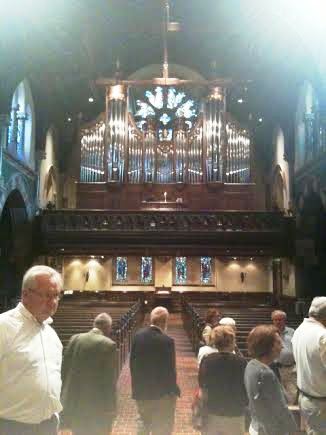
Check out the stained glass window and the pipe organ.
8

There are stained glass windows throughout the building. One is from Louis Comfort Tiffany. The tour guide says that the Cathedral paid for none of them – they were donations. He’s missing the point. If someone can donate 5 to 10 thousand dollars for stained glass, they can donate the same amount to feed the hungry and clothe the naked instead – you know, the stuff Jesus tells us to do?

God didn’t come down to Earth for us to spend time and money prettifying a building. Jesus didn’t die for us to debate over where to keep the reserved sacrament. The more I went to church, the more I realized that I wasn’t serving Jesus at all. I was serving the administration. I was serving the institution.

Sadly, there are a lot of us who are stuck in this hamster wheel. There are a lot of people who go to church who have invested a lot of their lives and their egos in what they thought was being a good Christian, and what they are doing isn’t Christ-like at all.

It isn’t un-Christian. It just isn’t what Jesus would do.

Breaking out of this mindset is very hard, especially for people who have spent a lot of their time and money in and on the institution that is church. It is especially hard for those who get paid to lead. They have the most to lose. Yet, the way I’m seeing it, they have even more to lose if they keep on following the wrong master. We can follow only one master – make sure it is God, and not the institution.

So yes, I miss church, but it is more like I still haven’t found what I’m looking for. I can’t miss what I never had. There are a couple of options I’m looking at that have a lot of the qualities I feel Jesus meant. I think they are a good start. But I’m wary. I’m wary of getting sucked in and fooled again, like I was last time. I’m wary of letting down my guard and getting really hurt.

Not one stone will be left.

I read “Forward Day by Day” every morning. It is a quarterly periodical that has a commentary on every day’s Bibley readings. Sometimes the commentary adds to the meaning. Sometimes it takes away. I think today’s commentary got it entirely wrong and took it literally. The author took today’s reading to be about the literal destruction of the Temple, and of church buildings today that get burned to the ground.

The reading is Matthew 24:1-14, but for brevity I’m just going to quote the beginning and sum up the rest.

Matthew 24:1-2
1As Jesus came out of the temple and was going away, his disciples came to point out to him the buildings of the temple. 2Then he asked them, ‘You see all these, do you not? Truly I tell you, not one stone will be left here upon another; all will be thrown down.’

He goes on to explain to his disciples the signs that they will see for how to know this. It is all pretty apocalyptic, with “wars and rumors of wars” etc. The author of today’s Forward Day by Day says that ultimately there is hope in the end, that God will prevail. Sure, that is in there. That is always in there. But I don’t think that the literal destruction of the Temple is what Jesus was talking about.

Remember, Jesus came to tell us that we are the temple. We are the Body of Christ. We aren’t supposed to build up our treasures on Earth and build buildings to worship God. We are to love and serve God, and if we are going to build buildings, we need to build them to house the homeless.

So Jesus wasn’t talking about the Temple, or modern church buildings at all.

Jesus was talking about the WAY we worship God. Jesus came to strip everything away – all the rules and regulations that kept us from seeing God in everyone and serving each person. Imagine how amazing our world would be if everyone saw God in everyone, and served them accordingly? That is the heart of the Sanskrit word “Namaste”. They had it figured out long before anybody else. God put a bit of light into each of us. We all have a little bit of God in us, and our goal is to recognize that and tap into it.

We can’t do that with the church structure the way it is. In fact, we can’t do that until we understand that “church” has nothing to do with a building or administration or ordained ministers. It means us, the believers. We are the Church. No stones required. Until we get that the Body isn’t a Building – we are still waiting for the end times. Jesus hasn’t come again until that time.

Thoughts on the Lord’s Prayer.

With the Lord’s Prayer, Jesus was trying to give us a model of how to pray. It is a recipe, a framework, a blueprint. We aren’t supposed to repeat these words mindlessly. We are to use them as an example and make them our own.

Here’s the version I was taught. There are slightly different versions. Some don’t include the “trespasses” part. Some add “For thine is the kingdom, and the power, and the glory, for ever and ever.” at the end.

Our Father who art in heaven,
hallowed be thy name.
Thy kingdom come.
Thy will be done
on earth as it is in heaven.
Give us this day our daily bread,
and forgive us our trespasses,
as we forgive those who trespass against us,
and lead us not into temptation,
but deliver us from evil.
Amen.

Really, how many people even talk like this today? Jesus sure didn’t. In spite of what some fundamentalists would believe, Jesus didn’t speak English. And Jesus certainly wouldn’t use King James English in the 21st century. Jesus is all about getting down to our level. Jesus talks like how the people he’s with talk.

How many of us even really understand these words? Who knows what “hallowed” means? How many of us just say these words like they are a magic formula? We have them memorized and we say them and we are done. The words have passed through our lips but not through our minds or hearts.

These words of Jesus are a pattern, not a formula. They provide us a framework. They give us topics to cover. If you cover these basic topics, you’ll have prayed in a good way. Jesus isn’t about people mindlessly muttering words to God. Jesus tells us to pray from our hearts.

God made each one of us a little different, and God wants to hear from each one of us in our own special way. That is way we were made different. For us to pray the same prayer all the time makes no sense.

So what is Jesus saying in this prayer? What is Jesus telling us to do?

Perhaps it is something as simple as this:

Dear God/ Creator/ Divine Source of all that is, You are the master of everything and you are the Lord. (Our Father who art in heaven, hallowed be thy name.)

Help me to remember that You are always in charge, and You know what is going on better than I do. Help me remember that I don’t have to try to control everything – that you’ve got it all figured out. (Thy kingdom come. Thy will be done on earth as it is in heaven.)

Thank you for taking care of my physical needs, not just food but clothing and a place to live. Thank you for making sure that I have what I need. (Give us this day our daily bread,)

Help me to remember to always forgive other people, because You have already forgiven me. Help me to hold no grudges. (and forgive us our trespasses, as we forgive those who trespass against us,)

I ask that you not test me by tempting me with things that are bad for me. (and lead us not into temptation,)

Please protect me and keep me safe. (deliver us from evil.)

Amen.

You can formulate it along this pattern. Think about each phrase as if you are seeing it for the first time. Think about each word. Look each one up – not just the ones you aren’t familiar with. What do they mean to you? They will mean something different to you ten years from now.

Some thoughts on this –

The “For thine is the kingdom, and the power, and the glory, for ever and ever” part is really a repeat of the “hallowed be thy name. Thy kingdom come. Thy will be done on earth as it is in heaven” part. They both refer to the fact that God is in charge. God is the creator and ruler of everything. God is the beginning and the end and everything in between. God has the master plan. We keep thinking we are in charge, and it is up to us to make sure everything gets done. This is a very unhealthy way to think. So perhaps it is good to refer to this twice in this prayer. It is the key to it all.

In the “and forgive us our trespasses, as we forgive those who trespass against us,” part, we need to look at the word “as” – it means “in the same way, or like” but it also means “at the same time” Our mistakes are forgiven when we forgive others their mistakes. It isn’t up to us to judge. We have to let it go and let God be in charge. Jesus came to teach peace and forgiveness. This is something that comes from God to us, but it is also supposed to be something that we extend out to everyone. Consider it trickle-down forgiveness, but the trickle is more like a waterfall.

In the “lead us not into temptation” part, I feel that is there because God often tests us to strengthen us. God is like a personal trainer, and wants us to grow strong. We have to be tested for this to happen. Perhaps part of this is also that we are asking that we see that whatever tests do come our way we see as being from God. Then we will have the strength to endure them.

If we live an easy life then we won’t ever get to test our faith. It is easy to “love your neighbor” if your neighbor is kind – it is much harder when your neighbor is a jerk. But it is exactly that kind of neighbor that we are here to be kind to. I also think Jesus put in the “lead us not into temptation” line because God forgets how hard it is to be human.

God gave us all these rules to follow. And we kept breaking them. God gave us more rules, and we still didn’t get it right. So God came down in human form, and finally understood why we couldn’t get the rules right. God finally understood how hard it is to be human because God finally saw what it was like from our perspective.

It is like a professional race car driver trying to give driving instructions to someone who has an antique VW van to drive. The professional is going to keep getting frustrated – why can’t this person get it? It is easy. Then, when the driver finally gets into the old, clunky, VW van with its impossible stick shift and heater that is always on, even in the middle of summer, and the rusted out floorboards, the driver will finally get a clue as to what is going on.

It is as if God says after all that “Of course you can’t do it the way I’ve been telling you. I see now. Here, let me break it down to just two rules. Love Me, and love your neighbor.”

And really, it is just one rule. Love.

Sometimes that is the hardest thing ever.

Jesus as a BFF.

Last week I went to my spiritual director and she asked me to choose one of the times that we had been discussing. I talk with her about all sorts of events that have occurred in the past month. I talk about troubles with family as well as good times when I took time to take care of myself. She asked me to pick one time and “see” Jesus there with me.

This is still a foreign concept to me. I wasn’t raised with the idea of Jesus being right here with me, or being “crazy” about me, as my spiritual director insists that he is. But I’m playing along, and it seems to be helping. I often feel like I’m doing it wrong, but she seems to think differently.

I chose a time when I was sitting up in my “star stones” area, where I go to talk to God at the top of the back of my yard. It was one of the times where I did it not because I was mad but because I wanted to just visit. I’m trying to get in the habit of inviting God into each moment, not just the hard ones. I’m trying to be mindful of God’s presence all the time.

I visualized Jesus sitting right next to me on my right. She asked me what direction he was looking. I said he was looking forward, in the same direction I was looking. She asked me if he was saying anything to me. I said he wasn’t saying anything, but it was as if I could feel colors from him. She had me describe the colors.

This is the best picture I can provide to illustrate. I’d taken it the week before, on an especially “God” kind of walk.
winter4

It isn’t about the color, or what is in the picture, it is about what it makes me feel. These colors make me feel safe. They are calm and earthy and soothing.

She asked me to stay with that feeling and to think about it.

I started to cry. Nobody has ever made me feel like that. Nobody has ever made me feel that safe or loved or wanted. Nobody has ever just wanted to be with me and not wanted something from me. I feel like I’m constantly on my guard with people. I keep waiting for them to let me down or beat me up. With guys I’m always something to try to have sex with. I’m an object, not a person.

It was refreshing to feel that oasis of calm, where I’m not wanted for what I can give, but who I am. Everything that I am, my beauty and my bruises, my wisdom and my weakness, is loved and cherished and celebrated. Everything.

Later I started thinking that this isn’t fair, this feeling. This perfect feeling of peace just can’t be matched. Nobody else will ever live up to it. I’m going to get hurt. My feelings are going to be ignored and overlooked. I’m going to be treated like a thing, an object. Nobody is going to measure up to this feeling I get from Jesus. Why go to the effort of knowing Jesus more closely, when it is so beautiful? It is so fragile and strong at the same time. It is so heartbreakingly kind. Nothing compares. Nothing.

It reminds me of when I stopped smoking pot. Everything started to seem vanilla in comparison. Life was dull. Movies were boring and predicable. Food was tasteless. Friends were annoying. Family was impossible. I remembered why I started smoking in the first place. It added seasoning to my life and smoothed off the rough bits. Pot was the rainbow, real life was the black and white. Who wants three channels on the TV when you can have 187? Real life doesn’t compare well to altered life.

Jesus is always present and real and holy and pure and safe. He’s never thoughtless. Never pushy. Never aggressive, needy, groping. He always knows what I need. Nobody is ever going to measure up to that. So why even go there. It hurts.

And then I got a feeling back. I knew the answer in that moment.

Because He heals the brokenness.
He fills in the cracks.
Jesus makes up the difference in their lack.

Jesus is like this –
He pays the bar tab. He orders the cab. He holds your hair when you have had too much to drink and you have to barf. He wipes your face afterwards with a warm wet washcloth.

Jesus is in the face of all kindness
and is in all kinds of people
you’d never expect.

Focus on the light, not the cracks.

trinity tree

The bread of God.

“Man does not live by bread alone, but by every word that comes from the mouth of the Lord.” (Deut. 8:3b)

There is a Jewish blessing that is said at every meal that has bread. It is called the HaMatzi Blessing. In English it is:

“Blessed art Thou, Lord our God, King of the Universe, who brings forth bread from the Earth.”

Now, bread does not come from the Earth. Bread comes from wheat, which comes from the Earth. And it doesn’t just spring forth. It has to be planted by humans. It has to be tended by us. Then it has to be harvested, threshed, and milled. Only then it can be used to make bread.

Yes, we have to be thankful to God that the Earth produces food. We have to be thankful of the amazing process that makes a seed grow into a plant which grows into food. We should never take that for granted. But we also are part of the process. We have to do work too.

The blessing refers to the time when the Jews were wandering in the desert and had nothing to eat. It isn’t really about bread. It is about reminding us that God always provides for our needs. That we should take nothing for granted. That we owe our very existence to God.

We say there are no miracles anymore. We forget that every moment is a miracle. We forget that every beat of our heart is God saying that we are loved and we are needed.

The verse above is what we are familiar with, but it is only part of the verse. Here’s the full verse:

“He humbled you by letting you go hungry; then He gave you manna to eat, which you and your fathers had not known, so that you might learn that man does not live on bread alone but on every word that comes from the mouth of the LORD.” (HCSB)

There is a Christian twist on this blessing that changes it to “Blessed art Thou, Lord our God, King of the Universe who brings forth the living bread from Heaven.”

This is a reference to Jesus’ words in John 6:35-40:

35 “I am the bread of life,” Jesus told them. “No one who comes to Me will ever be hungry, and no one who believes in Me will ever be thirsty again. 36 But as I told you, you’ve seen Me, and yet you do not believe. 37 Everyone the Father gives Me will come to Me, and the one who comes to Me I will never cast out. 38 For I have come down from heaven, not to do My will, but the will of Him who sent Me. 39 This is the will of Him who sent Me: that I should lose none of those He has given Me but should raise them up on the last day. 40 For this is the will of My Father: that everyone who sees the Son and believes in Him may have eternal life, and I will raise him up on the last day.”

Jesus said this after feeding 5,000 people with five barley loaves and two fish, which were a donation. There were twelve baskets of food left over after everyone had been fed. In the Gospel according to Mark, book 8 we learn that Jesus also fed 4,000 people with seven loaves of bread and a few small fish. There were seven large baskets of leftover pieces.

That miracle is the same miracle as the manna. God always provides for us. It rarely is in a way that we expect. Even Jesus’ disciples didn’t expect this. He did this miracle twice, and they still didn’t get it. They still didn’t understand that it isn’t about the bread at all.

God is bigger than we can imagine. God is always providing for us. Blessed be God, who provides bread – that the conditions are right for wheat to grow, and that we have the knowledge and skill to create it into something that will nourish us. Blessed be God, who feeds us in surprising ways.