The ark and us. On doing things God’s way.

I’ve recently been writing about how important it is to obey God. Sometimes not doing things God’s way has some pretty severe repercussions – like death. Sometimes it doesn’t even seem like a logical consequence.

In the Book of 1 Chronicles, David is escorting the Ark of the Covenant to the new home he has built for it.

1 Chronicles 13 5-8
5 So David assembled all Israel from the Shihor of Egypt to the entrance of Hamath, to bring the ark of God from Kir′iath-je′arim. 6 And David and all Israel went up to Ba′alah, that is, to Kir′iath-je′arim which belongs to Judah, to bring up from there the ark of God, which is called by the name of the LORD who sits enthroned above the cherubim. 7 And they carried the ark of God upon a new cart, from the house of Abin′adab, and Uzzah and Ahi′o were driving the cart. 8 And David and all Israel were making merry before God with all their might, with song and lyres and harps and tambourines and cymbals and trumpets.

But then something terrible happens in verses 9-10.

9 And when they came to the threshing floor of Chidon, Uzzah put out his hand to hold the ark, for the oxen stumbled. 10 And the anger of the LORD was kindled against Uzzah; and he smote him because he put forth his hand to the ark; and he died there before God.

Uzzah didn’t intentionally reach out to the Ark – he was trying to protect it from falling. It was on an ox cart, and the oxen stumbled. He instinctually reached out, and he was killed by God because of it. This sounds pretty harsh. It was an accident. He wasn’t intentionally sinning. He was actually trying to do something good. It would have been terrible if the Ark had fallen and gotten damaged.

The story continues in verses 11-14.

11 And David was angry because the LORD had broken forth upon Uzzah; and that place is called Pe′rez-uz′za to this day. 12 And David was afraid of God that day; and he said, “How can I bring the ark of God home to me?” 13 So David did not take the ark home into the city of David, but took it aside to the house of O′bed-e′dom the Gittite. 14 And the ark of God remained with the household of O′bed-e′dom in his house three months; and the LORD blessed the household of O′bed-e′dom and all that he had.

(Pe′rez-uz′za means “outburst against Uzzah”)

What are we supposed to learn from this story? It seems pretty illogical and capricious of God. I don’t want to follow a God who strikes down people without reason. I need there to be logical rules and consequences.

So I started to think about it. Why did Uzzah die? Perhaps there is something more to this story. Sometimes we can’t see the big picture because we don’t have all the pieces. I kept reading on. Perhaps there were more clues.

Perhaps it was to bless O′bed-e′dom and his family. Perhaps there is more to that story later – how the Ark being at his house had a result that we don’t see for years later.

Perhaps we don’t get to see the result. That too is part of our human perspective. Sometimes we will never know it all – we just can’t. Our brains don’t have the capacity. Plus – God doesn’t owe us any explanations. Sometimes the biggest thing we can do is trust.

But there is more to the story, and it comes fairly soon.

1 Chronicles 15:11-15
11 Then David summoned the priests Zadok and Abi′athar, and the Levites U′riel, Asai′ah, Jo′el, Shemai′ah, Eli′el, and Ammin′adab, 12 and said to them, “You are the heads of the fathers’ houses of the Levites; sanctify yourselves, you and your brethren, so that you may bring up the ark of the LORD, the God of Israel, to the place that I have prepared for it. 13 Because you did not carry it the first time, the LORD our God broke forth upon us, because we did not care for it in the way that is ordained.” 14 So the priests and the Levites sanctified themselves to bring up the ark of the LORD, the God of Israel. 15 And the Levites carried the ark of God upon their shoulders with the poles, as Moses had commanded according to the word of the LORD.

So the problem was that they didn’t ask God how to do it before they did it. They tried to move the Ark, a very sacred thing, using their own ways rather than God’s ways. They even had a correct way to move it – Moses had already asked, and God had said to move it with poles resting upon people’s shoulders. It wasn’t supposed to be on a cart at all. Either they forgot this information over the years, or they thought they didn’t need it. But when it came time to move it, they didn’t inquire of God how to do it. That was the problem.

In the words of Solomon, King David’s son, we read in Proverbs 3:5-8
5 Trust in the LORD with all your heart,
and do not rely on your own insight.
6 In all your ways acknowledge him,
and he will make straight your paths.
7 Be not wise in your own eyes;
fear the LORD, and turn away from evil.
8 It will be healing to your flesh
and refreshment to your bones.

We are to constantly seek God to know how to do things. Then we will have life, and have it in abundance.

Do God’s thing – not your own.

Several people in the Bible chose to do things their way rather than do things God’s way. In these situations, they either didn’t listen or they didn’t trust that God would do things in God’s time – not theirs. They took matters into their own hands, and caused problems.

King Saul, the first king of Israel, didn’t do exactly what the Lord told him through the priest Samuel. He defeated the enemy who was attacking Israel, but spared their king and some livestock. He was told to wipe them out, to leave nothing standing.

1 Samuel 15:1-3 Revised Standard Version (RSV)

And Samuel said to Saul, “The LORD sent me to anoint you king over his people Israel; now therefore hearken to the words of the LORD. 2 Thus says the LORD of hosts, ‘I will punish what Am′alek did to Israel in opposing them on the way, when they came up out of Egypt. 3 Now go and smite Am′alek, and utterly destroy all that they have; do not spare them, but kill both man and woman, infant and suckling, ox and sheep, camel and ass.’”

The battle took place.

1 Samuel 15:7-9
7 And Saul defeated the Amal′ekites, from Hav′ilah as far as Shur, which is east of Egypt. 8 And he took Agag the king of the Amal′ekites alive, and utterly destroyed all the people with the edge of the sword. 9 But Saul and the people spared Agag, and the best of the sheep and of the oxen and of the fatlings, and the lambs, and all that was good, and would not utterly destroy them; all that was despised and worthless they utterly destroyed.

Saul didn’t “utterly destroy” all that they had. He kept the best of the livestock alive, along with the king. Because of this, Saul is rejected as the king of Israel. He was not obedient to the Lord.

1 Samuel 15:10-11
10 The word of the LORD came to Samuel: 11 “I repent that I have made Saul king; for he has turned back from following me, and has not performed my commandments.” And Samuel was angry; and he cried to the LORD all night.

When Samuel challenged Saul about his disobedience, Saul acted like he had done nothing wrong. Saul said he kept all the good stuff so he could offer it as a sacrifice. Samuel says that isn’t what he was supposed to do. Saul had made a decision he shouldn’t have.

1 Samuel 15:22-23
22 And Samuel said,
“Has the LORD as great delight in burnt offerings and sacrifices,
as in obeying the voice of the LORD?
Behold, to obey is better than sacrifice,
and to hearken than the fat of rams.
23 For rebellion is as the sin of divination,
and stubbornness is as iniquity and idolatry.
Because you have rejected the word of the LORD,
he has also rejected you from being king.”

Saul tries to get out of it, asking Samuel to pardon him. It isn’t for Samuel to pardon him. The Lord has already made the decision. To be really honest, Saul is the one who made the decision to not do what he was commanded to do. He isn’t being punished out of the blue – he made a bad choice. He is facing the consequences of his action.

The words of Samuel are echoed later by the prophet Hosea.
Hosea 6:6
For I desire steadfast love and not sacrifice,
the knowledge of God, rather than burnt offerings.

Abraham is also someone who took matters into his own hands.

Genesis 15:1-6
After these things the word of the LORD came to Abram in a vision, “Fear not, Abram, I am your shield; your reward shall be very great.” 2 But Abram said, “O Lord GOD, what wilt thou give me, for I continue childless, and the heir of my house is Elie′zer of Damascus?” 3 And Abram said, “Behold, thou hast given me no offspring; and a slave born in my house will be my heir.” 4 And behold, the word of the LORD came to him, “This man shall not be your heir; your own son shall be your heir.” 5 And he brought him outside and said, “Look toward heaven, and number the stars, if you are able to number them.” Then he said to him, “So shall your descendants be.” 6 And he believed the LORD; and he reckoned it to him as righteousness.

So Abraham and Sarah (at this point named Abram and Sarai) couldn’t figure out how they were going to have children, so they decided instead of waiting on God to make it happen, they’d make it happen on their own.

Genesis 16:1-6
Now Sar′ai, Abram’s wife, bore him no children. She had an Egyptian maid whose name was Hagar; 2 and Sar′ai said to Abram, “Behold now, the LORD has prevented me from bearing children; go in to my maid; it may be that I shall obtain children by her.” And Abram hearkened to the voice of Sar′ai. 3 So, after Abram had dwelt ten years in the land of Canaan, Sar′ai, Abram’s wife, took Hagar the Egyptian, her maid, and gave her to Abram her husband as a wife. 4 And he went in to Hagar, and she conceived; and when she saw that she had conceived, she looked with contempt on her mistress. 5 And Sar′ai said to Abram, “May the wrong done to me be on you! I gave my maid to your embrace, and when she saw that she had conceived, she looked on me with contempt. May the LORD judge between you and me!” 6 But Abram said to Sar′ai, “Behold, your maid is in your power; do to her as you please.” Then Sar′ai dealt harshly with her, and she fled from her.

While Hagar was away from Sarai, an angel of the Lord prophesied to her.

Genesis 16:7-16
7 The angel of the LORD found her by a spring of water in the wilderness, the spring on the way to Shur. 8 And he said, “Hagar, maid of Sar′ai, where have you come from and where are you going?” She said, “I am fleeing from my mistress Sar′ai.” 9 The angel of the LORDsaid to her, “Return to your mistress, and submit to her.” 10 The angel of the LORD also said to her, “I will so greatly multiply your descendants that they cannot be numbered for multitude.” 11 And the angel of the LORD said to her, “Behold, you are with child, and shall bear a son; you shall call his name Ish′mael; because the LORD has given heed to your affliction. 12 He shall be a wild ass of a man, his hand against every man and every man’s hand against him; and he shall dwell over against all his kinsmen.”

Ishmael is the progenitor of the Arabic people.

Note Abraham’s age. He’s 86. It is thirteen years later when the story picks up again. He’d been told that God would make him the father of a nation, and still nothing has happened. Then God talks to him again.

Genesis 17:1-9
When Abram was ninety-nine years old the LORD appeared to Abram, and said to him, “I am God Almighty; walk before me, and be blameless. 2 And I will make my covenant between me and you, and will multiply you exceedingly.” 3 Then Abram fell on his face; and God said to him, 4 “Behold, my covenant is with you, and you shall be the father of a multitude of nations. 5 No longer shall your name be Abram, but your name shall be Abraham; for I have made you the father of a multitude of nations. 6 I will make you exceedingly fruitful; and I will make nations of you, and kings shall come forth from you.7 And I will establish my covenant between me and you and your descendants after you throughout their generations for an everlasting covenant, to be God to you and to your descendants after you. 8 And I will give to you, and to your descendants after you, the land of your sojournings, all the land of Canaan, for an everlasting possession; and I will be their God.”

God then asks him to circumcise himself and all of the males in his household as a sign of the covenant between God and Abraham. After that, the Lord again promises that Abraham will have a son, but this time there is a time mentioned.

Genesis 18:10a
10 The LORD said, “I will surely return to you in the spring, and Sarah your wife shall have a son.”

Isaac was born when Abraham was 100 years old – 14 years after the Lord told him that he would be the father of a nation.

While everything worked out for Abraham and Sarah, things didn’t go so well for Hagar and Ishmael. They were sent off to die in the wilderness. God heard their distress and rescued them. This is also the source of the conflict between the Arabs and the Jews. Both want their birthright, and they are unable to share it.

Then there is Moses. God told him to speak to the rock to get water out of it. Instead, he struck it with his staff.

Numbers 20:1-13
And the people of Israel, the whole congregation, came into the wilderness of Zin in the first month, and the people stayed in Kadesh; and Miriam died there, and was buried there. 2 Now there was no water for the congregation; and they assembled themselves together against Moses and against Aaron. 3 And the people contended with Moses, and said, “Would that we had died when our brethren died before the LORD! 4 Why have you brought the assembly of the LORD into this wilderness, that we should die here, both we and our cattle? 5 And why have you made us come up out of Egypt, to bring us to this evil place? It is no place for grain, or figs, or vines, or pomegranates; and there is no water to drink.” 6 Then Moses and Aaron went from the presence of the assembly to the door of the tent of meeting, and fell on their faces. And the glory of the LORD appeared to them,7 and the LORD said to Moses, 8 “Take the rod, and assemble the congregation, you and Aaron your brother, and tell the rock before their eyes to yield its water; so you shall bring water out of the rock for them; so you shall give drink to the congregation and their cattle.” 9 And Moses took the rod from before the LORD, as he commanded him. 10 And Moses and Aaron gathered the assembly together before the rock, and he said to them, “Hear now, you rebels; shall we bring forth water for you out of this rock?” 11 And Moses lifted up his hand and struck the rock with his rod twice; and water came forth abundantly, and the congregation drank, and their cattle. 12 And the LORD said to Moses and Aaron, “Because you did not believe in me, to sanctify me in the eyes of the people of Israel, therefore you shall not bring this assembly into the land which I have given them.” 13 These are the waters of Mer′ibah, where the people of Israel contended with the LORD, and he showed himself holy among them.

On an earlier occasion when they needed water, he had been told to strike the rock, so perhaps he was confused. Perhaps he wasn’t intentionally disobeying God.

Exodus 17:1-7
All the congregation of the people of Israel moved on from the wilderness of Sin by stages, according to the commandment of the LORD, and camped at Reph′idim; but there was no water for the people to drink. 2 Therefore the people found fault with Moses, and said, “Give us water to drink.” And Moses said to them, “Why do you find fault with me? Why do you put the LORD to the proof?” 3 But the people thirsted there for water, and the people murmured against Moses, and said, “Why did you bring us up out of Egypt, to kill us and our children and our cattle with thirst?” 4 So Moses cried to the LORD, “What shall I do with this people? They are almost ready to stone me.” 5 And the LORD said to Moses, “Pass on before the people, taking with you some of the elders of Israel; and take in your hand the rod with which you struck the Nile, and go. 6 Behold, I will stand before you there on the rock at Horeb; and you shall strike the rock, and water shall come out of it, that the people may drink.” And Moses did so, in the sight of the elders of Israel. 7 And he called the name of the place Massah and Mer′ibah, because of the faultfinding of the children of Israel, and because they put the LORD to the proof by saying, “Is the LORD among us or not?”

Because he disobeyed, even unintentionally, he was not allowed to enter into the Promised Land. He died in the desert.

So, we are to obey the Lord’s instructions precisely, and we are to trust that if the Lord says something is going to happen, it will. It isn’t for us to force it or to take matters into our own hands. It is for us to let God work through us and with us, not in spite of us.

Image of God

We are made in the image of God, but that is all. Externally, we are like God, but internally we aren’t. Our minds are nothing like God’s.

God says “My ways are not your ways.” We forget that we are not God in all ways. We get upset when we can’t know the future or have control.

We think we are like God, because God has made us. God formed us and speaks to us. God calls to us in dreams and has spoken directly to us to help us. We have the words and ways of God as a guide to us. We need them because we do not share in the mystery of the mind of God.

We are the clay, and God is the potter.

But the pot cannot tell the maker what to do, nor hope to understand how it is being formed. It is for us to trust that God is in charge.

Pray without ceasing

To pray without ceasing does not mean you have to quit your job and become a nun or a monk. It does not mean that you have to sit in a quiet room contemplating and in communion with God all the time. It does not mean that you have to read a prayer book out loud all day long.

It means to constantly seek to know and then act according to the will of God.

It means to ask God before you do anything, to see if it is something you should do.

Nonbelievers have come up with a term for themselves. It is “freethinker”. They think that believers are zoned out zombies who never follow their own thoughts. And my clarification of “pray without ceasing” sure sounds like that.

But why would I want to plug into a 110 outlet when my tool works better on a 220? Why would I want to use a 20 watt light bulb when I can use a spotlight?

When we pray without ceasing – when we are in constant communion with God, we are tapping into a huge power source.

We are also less likely to resist or freak out when something unusual happens, because we know it is from God.

So yes, pray without ceasing. Pray when you wake up. Pray while you are making breakfast. Pray before you start your car. Pray while you drive.

Don’t pray mindlessly – pray about what you are doing right then. Talk with God. Not to God, but with God. It is a two-way communication. That is the heart of what Communion means.

Sure, you won’t have the words to start off with, and you will feel awkward. Keep doing it anyway. It will start to feel natural the more you do it.

God loves to hear from us and to talk with us. God understands all about us, better than we know about ourselves. Just open up and be yourself, and that will be perfect.

Memory postcard 3, Me the astronaut

This is what happens when I remember a picture but I can’t find it. I put things together in a way that remind me of it.

me1

One of my favorite pictures of me as a child was me standing on my grandparent’s porch wearing a plastic astronaut helmet. I’m not sure why that was part of the toy collection. It was larger than my head by far, and had a green visor that could open up. So I could see the world with a green tint, or not.

I can’t find that picture, but I can find this one. It was from around the same time.

I considered making an astronaut helmet for me in this picture – watercolor paper and pencils, green acetate – but then I realized if I did that, my face would be obscured. There is enough of that in the other two memory postcards.

Here is a closer picture of me.

me2

Then I added the “Women in space” stamp. I’ve used a photocopy of it for another project, but here I’m using the real thing. I love her smile.

me3

Here are the fortunes.

me4

I included things to remind me of my childhood and also point towards the future. What instructions would I like to give my former self and my future self?

…message…
My aunt mockingly calls hearing from God – at least when my Dad (her brother) did it – getting “Messages”. I think that she mocks it because she has never heard from God.

…lost penny…
My Mom was big on shiny pennies. She’d give me them for good luck. I’d almost forgotten that. It also reminds me of the parable of the lost coin – how God will go out of the way to find it. We are the lost coins, and we are precious to God.

…Never be less than your dreams…

Seems like a good message for then, now, and future me. My dreams are something to aspire to. And, they are like the mustard seed – from small things can grow big things. I just have to remember that Jesus tells us we have that energy inside us. If God gives us the desire to do something, we can do it. It isn’t just a fantasy – it is the seed of a reality. We have to give it energy to make it grow, and trust the process.

Bell towers

I keep being drawn to bell towers these days. Not real ones, but images of them. I didn’t even realize they were bell towers. I just knew they were four-sided tall towers, with window-like openings at the top.

What did I think they were? I didn’t. I just thought they were pretty. Now that I know what they are, I have to meditate upon it, because apparently it has a meaning and a message for me.

Anything can be a useful thing to meditate on. Anything can give you insight and teach you. But I find it especially significant to focus on things that repeat, because I see them as a sign from God to pay attention. God is saying “Here is something you need to notice.”

One of the images was at a friend’s house. Her husband had taken a picture of a bell tower at a church in downtown Nashville. It is just the bell tower, the sky, and birds. Something about it reminds me of the Episcopal retreat center on Monteagle Mountain. That place is old and musty and quaint and a little falling down. It has a Spanish mission style architecture, with red-tile roofing and white stucco exteriors.

This bell tower is like that, but I think there is more to it. There is something that hints at the idea of the Holy Spirit, with the birds flying nearby. There is something about the angle of the picture that makes me think the eye was suddenly jerked upwards, noticing this structure for the first time.

I’d admired this picture several times when I went over to visit, and then it was missing. They’d taken it to an art show to try to sell it. I felt the loss of it more than I realized. I didn’t know that I liked it that much until it wasn’t there. I asked my friend to have her husband make me a copy of it so I could have it at my house.

Then there is another picture. There is an etching that I’ve admired for at least eight years. It was tucked away under the stairs in an art gallery in Banner Elk, North Carolina. Every year, for years, I’d gone by this gallery and noticed that it was still there. I hoped that they would put it on sale. It was $100. I couldn’t really justify $100 for an etching. They can make more – it isn’t an original, a one-of-a-kind. But the more I thought about it, the more I realized that if I didn’t have it, I would feel the same loss, the same emptiness that I felt when my friend took that photograph away.

I remembered that I’d paid more than $100 for that photograph. That too can be reproduced. That too isn’t a one of a kind. But, hey, artists have to eat and pay bills, and I sure wish that people would pay me full price for what I make. So it was time to pony up and buy it.

It wasn’t until I saw the title written on the back of the etching that I knew it was of a bell tower. Two bell tower images, purchased within a few months of each other, both now in my house. I’d admired the etching for years and not even known what it was.

So what about bell towers? They are where the church uses to call the faithful to prayer. But “the call” can also mean the call from God. It can mean about the call to ministry, the call to service.

I need to listen to this message.

If I don’t respond to the call, I’ll feel empty. I’ll notice that it isn’t there and feel lost. This isn’t about iconizing the image of a bell tower – it is about heeding what it points to. It is about hearing the call and responding to it. It is about realizing that if I don’t respond, I’ll feel like I’ve missed out on my life’s purpose.

Does this mean I’m being called to the ordained ministry? No. Most certainly not. The more I read of the words of Jesus, the more I know with all certainty that the ordained ministry is a direct affront to Jesus’ wishes.

Jesus came to take away the power from the authorities. He removed all divisions between God and people, and between different groups of people. Jesus says we are all good, and we are all ministers, by virtue of our baptism.

So what, exactly? I feel like I’ll know when I get there. It would be nice to follow along a path that others have trod. It would be nice to be able to say what I’m headed towards, but there aren’t words yet. Perhaps it should just suffice to say that I’m headed towards God, and forget about the how or the what or even the when. Just do it, you know?

Meanwhile I’m going to fall and fail and trip a lot. Meanwhile I’m going to tick some people off and alienate some others. In short, I’m going to be human.

Basically, I’m like a bell tower. I want to call others to prayer. I want people to go towards God. If I can show them a path or light the way, awesome. Meanwhile, I have to hear and heed the call for myself.

But bell towers crumble, and get dirty, and birds start to nest in them. They stop working right.

Just like how I don’t want to get stuck iconizing the image of the bell tower, I don’t want people to focus on me. I don’t want people to think I’ve got all the answers, because I certainly don’t. I want people to know that they are forgiven and loved, and that they are supposed to go do the same.

One person, one book

Ramadan is the Muslim holy month celebrating Mohammed receiving the Quran while he was alone in a cave. Shavuot is the Jewish holiday celebrating that the Jews received the Torah, which was through Moses when he went up a mountain. Alone.

In both holidays, one person, alone and away from everybody else, was given a large amount of material to share with a group. In both, one person receives the rules that everybody else has to follow.

How does that work? How do people agree that this one person, without any witnesses, actually got a message from God? Why do they then change their ways so that they follow this message their whole lives, and teach it to their children?

Seems like a bad idea to just take somebody else’s word that this thing, just created, is The way that things have to be done. There was no precedent, no history. The stories and rules didn’t grow over generations. These were created out of whole cloth, if you will.

All at once.
By one person.
Who said they were talking to God.

And a large group of people just follows along. Oh, God told you that? OK, we’ll change our whole lives just to fit that.

People don’t even listen to basic health advice which has been proven by science. They still smoke and eat fatty foods and drink caffeine and have all the sugar they want and don’t exercise. They won’t change even one basic thing about their lives so they will be healthier, even though there have been years of studies to prove the truth behind the claims.

But one guy goes into a cave or up a mountain and says God talks to him and tells him to write this stuff down, and they change their whole lives to fit it?

Yeah, that makes sense.

I believe that God who dials direct.

God is in the darkness

dark1

I was painting the background for a space picture. This alone is a new thing for me. I’m trying to learn that it is OK to work on a project over the course of time. I’m trying to learn to do things in stages. I don’t have to do the whole thing at once.

I’m not sure where I got the idea that I had to finish a painting all at once. I have wirework projects that I can’t finish all at once. The work is too hard on my hands and wrists to complete it in one day. There are certainly beading projects that are sitting in plastic bags in bins right now, half finished. I may never finish them.

Perhaps part of it is that acrylic paint can’t be worked with once it is dry, and it dries very fast. Beads don’t care. With beads, I can take the whole thing apart and redo it as many times as I want. Paint isn’t forgiving like that.

But I keep reading about image transfer and collage, and I keep thinking it is cool. I’ve got all the materials I need (I think) and I’ve read quite a number of books about it. I still don’t think I know what I am doing, so I haven’t tried. But I’m trying to convince myself that if I don’t try, it is worse than trying and failing. Not using art supplies for fear that I’ll mess them up is worse than using them and not getting what I was aiming for. At least when I use them, I’m learning how to use them, and I’m learning what works and what doesn’t.

All the image transfer and collage techniques are multi-day projects. You have to paint the background, and let it dry a day. Then you paint a layer of clear glue on it. And let it dry a day. Then put something else on. And let it dry a day. You get the idea. Lots of waiting. Lots of days.

Part of my issue is that I want results now. I’m trying to get over that. I’m trying to use these kinds of projects to get over that. I always have “quick” projects to give me that “I made something” buzz, in the meantime.

So, back to the painting. I needed a black background, but I didn’t want to use black. That is too easy. So I used a really dark grey called Paynes Grey, and a really dark purple called Dioxazine Violet (Hue). I squirted some of each on the canvas and swirled them around and together. I really like the color I got. It isn’t traditionally black, but it is plenty dark. I figure space isn’t black, but more purple/grey, if it had to have a color.

In reality, I figure it is the absence of light, and that doesn’t have a color at all.

But then I didn’t like the lines in it. Because I use my fingers to paint, there were large lines in it. No matter how I swished and flicked my fingers, the lines were still there. I don’t want lines, because they will draw attention to themselves. This is a background. Backgrounds are supposed to stay in the back, right? They are the supporting role, not the main character.

So I started “writing”. I have a friend who does “light language”- which is really the gift of tongues. It can be done with the voice or with writing. Her coming out about it has reminded me of the fact that I’ve done this for years. I stopped doing it because it felt silly. I got really self conscious of it and stopped. I never showed anybody what I was doing. I guess there was some shame in it, because I felt like an oddball.

You aren’t weird if there are other people who do the same thing, though.

So I’ve started doing it again, intentionally. I’m letting the Holy Spirit work through me in this new/old way, and it is really freeing. I’m still really aware how unusual it is so I don’t do it all the time. I’m mindful of my audience.

I don’t think I’ll ever forget that a minister told me to stop talking about how God was talking to me, was waking me up at night to give me messages. A minister, telling me to stop talking about God. In church. To church members. Isn’t that the place where people who have those kinds of experiences go? Isn’t that the place where people seek to have those kinds of experiences? Isn’t that the place where people read about other people in the Bible having those experiences?

I’m glad I chose to leave that church rather than to be silent.

So when I started to write on this painting, I learned something. I didn’t write down or record my experience. I spoke the words out loud and “wrote” them in my light language shorthand. When I write this way, I write left to right, then right to left. I kind of make an S across the page, going back and forth, until I am done.

Here is what I remember of it:

Under the sea, and deep in space, it is very dark. The darkness is vast and silent.

There is potential in darkness.

Babies grow in darkness.

The seed is the same way, swelling, stretching.

And God is there in the darkness.

This reminds me of Jeremiah 1:5 “Before I formed you in the womb I knew you, before you were born I set you apart; I appointed you as a prophet to the nations.”

Which then leads to Psalm 139-12-16
…even the darkness is not dark to You.
The night shines like the day;
darkness and light are alike to You.
13 For it was You who created my inward parts;
You knit me together in my mother’s womb.
14 I will praise You
because I have been remarkably and wonderfully made.
Your works are wonderful,
and I know this very well.
15 My bones were not hidden from You
when I was made in secret,
when I was formed in the depths of the earth.
16 Your eyes saw me when I was formless;
all my days were written in Your book and planned
before a single one of them began.

I was afraid of darkness when I started this project, and now I am at peace. I’ve gotten the message that God is there, at work, even if I can’t see it. I’ve gotten the message that God has a plan for my life.

Then this leads me to Jeremiah 29:11-13
11 For I know the plans I have for you”—this is the LORD’s declaration—“plans for your welfare, not for disaster, to give you a future and a hope. 12 You will call to Me and come and pray to Me, and I will listen to you. 13 You will seek Me and find Me when you search for Me with all your heart.

What an amazing message to come from just painting the background to a piece that I don’t even know what it is going to be.

Thanks be to God.

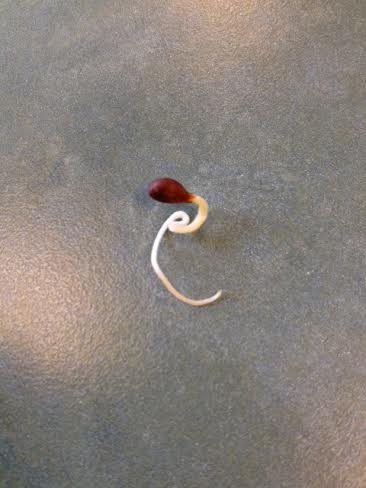
seed

An apple seed, sprouting.

Words

I kept using the word “crazy” to define myself when I was with my spiritual director. She knows my history with bipolar disorder. She knows I hear from God. She, unlike my former minister, doesn’t freak out when I say that. She doesn’t like it however when I say I’m crazy. She thinks my difference is a gift. She thinks that God made me this way on purpose, that it isn’t an accident and it isn’t a handicap.

She asked me recently to ask Jesus what words he would use to describe me. When I did, instantly I got back these two words:

Anointed. Chosen.

My reaction to this? That again? You have to be talking to someone else. Nobody is going to believe me.

Then I think of Moses, arguing with God. He didn’t want it either. He kept trying to get out of it. Moses was one guy, untrained, with a speech impediment. God told him to go in front of the most powerful person in the world at the time and ask him to free thousands of people. God was asking him to liberate people from a tyrant.

With no army.
With no diplomatic skills.
With nothing, except the word of God.

God called to Moses from a burning bush. He didn’t send an angel. This was a bush on fire, yet it wasn’t being consumed by the fire. Sounds like a hallucination.

It all sounds crazy, right? Yet it happened. Why can’t something like that happen now? Why wouldn’t it? If we believe in an active and living God, then we have to believe that God still talks to people.

Why does God call amateurs? Why not call the experts? If God keeps working through the amateurs, why become an expert? What is the point of becoming ordained? If “God doesn’t call the equipped, he equips the called” as is frequently said, then it means the call is more important than the preparation.

God made the waves part for the Israelites to escape from the Egyptians. God made water come from a rock when they were thirsty. God made bread for them too.

Blessed are you God, who makes bread come from the earth. This Jewish prayer said at every meal where bread is served. It is a reminder of the manna from heaven. It is a reminder that God provides for us all the time. We didn’t buy or bake that bread. God gave us the ability to buy it or bake it. God made the grain grow from the earth. Sure, somebody planted it. But God made it happen.

If by my faith I am healed as Jesus says throughout the Gospels to people, then I want to believe that God has called me. I want to believe that I’m not making this up. I want to believe that the voice I hear is God’s voice. I want to believe that it is real.

Jesus tells us in Matthew 4:4 that man does not live by bread alone but by every word that comes from God.

Now, Jesus is the bread of life, and the Word.

When my spiritual director tells me I am amazing and special, I think that she tells that to everyone she directs.

Sure I’m special. And different and unique. I stress that to everybody how special they are and that they should celebrate their uniqueness. And then I have a very hard time fully believing it myself.

Perhaps my hesitancy is part of it all. Perhaps God needs me to be certain of my call. It has taken me a lot to tell ministers of the call I first heard when I was 12. It took me a lot of self convincing before I even told a minister. I had to convince myself first. There were a lot of walls that had to be overcome in my own heart first.

Why not believe that Jesus has made a home in my heart? Why not believe that I am called to build a new church?

What is the danger of believing this?

Embarrassing the church. Leading people away from the truth. Having them be mislead. Like David Koresh. Like Jim Jones.

Going so far that I am discredited, that the message is not heard.

But, then I think, if the message is from God, it will get out. If it really is of God, it will happen.

I ask to not get in the way, and to be the way. It is both at the same time. God made me the way he made me because he needs me this way.

My diagnosis means I am mindful and careful. It means I ask for guidance and for oversight. It means also that I self limit. This is good and bad.

I’m still upset that the place I asked for training and oversight didn’t know how to handle me. But then again if I am to do something new, I can’t follow an old pattern.

New wine, old wineskin, and all that.

Translation

When I pray, it sometimes feels like I have to translate.

Sometimes I feel that when I reach out to the beyond it all comes back so fast that I have a hard time keeping up. Communing with the infinite requires an interface.

I feel like I have to translate what I experience into something I can share. I don’t do it right all the time. Sometimes I completely miss the mark and the images or words that I get are all jumbled.

Maybe it isn’t about sharing it or ever getting it perfect. Maybe it can’t ever be fully brought down. Maybe I’ll always lose something in the translation.

Maybe the point is to just show the way and tell others that there is more to just this world than what we see. May be the goal is just to be a conductor and not a guide. I’m here not really to help you get there, but to know that there exists. I’m not here to take you to my secret hiding place, because it isn’t secret.

You are just seeing a different corner of it.

The fact that I had to go in the back door doesn’t matter. You had to go in the window. Another had to go in the dog door. Another had to cut a hole in the roof.

But we all got there.

My way in isn’t the only way, or the best way. Sometimes it isn’t even the best way for me. However, the more I do it, the better it gets.