Here’s to all the fathers –
Those who are here, and those who aren’t.
Those who show up every day, and those who were never there.
Those who abandoned us, and those who have died.
They have made us who we are.
It doesn’t take a license to be a father. There is no training for it. Fatherhood can be done by amateurs, and often is. Even having had other children doesn’t prepare you for having more. Every time is a new time, with new challenges.
I had an uneasy relationship with my father. He was emotionally distant. He hadn’t been nurtured by his parents, and he didn’t know how to nurture his children. Is this an excuse? Is this an explanation? Or is it just the way it is?
There are plenty of guys who left when they found out they were going to be fathers. Some stayed, but only half-heartedly. Some initially wanted to be fathers, but found out they weren’t up to the task.
Let us forgive them all. Not excuse them. Forgive them.
The best thing I ever was able to do was to forgive my father. He never knew about that bit of grace that happened that day. Shortly before he unexpectedly died, I finally saw him as just a person, and not my Dad. He didn’t owe me anything. There were no expectations to be unmet. There were no promise to be broken. I saw him as broken and sad and hurting. I finally realized he had done the best he could, with what tools he had.
I’m grateful to have gotten to that point. It took a lot of work.
I’d realized years before that if I wanted to have a relationship with my father, I was going to have to find something we could both do together. He seemed unable to connect with me, so I had to make the effort. Eating out seemed to be the way. We would meet for Sunday brunch at Ruby Tuesday’s, or Bob Evan’s. Every Sunday I would go to church alone, and then come back home and we would go together out to eat.
It was his choice to not go to church, even though he was an ordained minister, even though the church I went to was the one he had gotten married in. It was kind of an awkward routine on Sundays. It would have been easier if we had gone to church together and then to brunch afterwards, but that wasn’t going to happen. I took what I could get.
He didn’t come up with the idea of us eating out together, I did. I saw it as a point of agreement, something we could both enjoy. His other interest was classical music, and that wasn’t really something we could meet on. I didn’t love it like he did, and he would always be the expert on it. We wouldn’t have been on equal ground.
When we ate out, it was our time together, just us. It wasn’t always easy. He was a sloppy eater, a bit greedy. I remember when we would eat at home he would finish his food first and then look at my plate and ask to finish it for me. I ate slowly, carefully. He ate ravenously, like a dog. He was willing to take food from his child. This pattern happened in other areas of my life too.
This is who he was. This is how he was raised. He wasn’t allowed to grow up true and strong. His parents were either overbearing (his dad) or flighty (his mom). There was no healthy role model. It was military precision and perfection, or playtime. He never had a childhood, not really. His dreams were squashed as being unreasonable and unrealistic.
One day, over a mid-day breakfast of pancakes and sausage, it clicked. I stopped seeing him as somebody who owed me a good childhood. I stopped seeing how he had failed me. I stopped expecting anything from him. I started seeing him as just a person.
He died twenty years ago. There was no more time to work on our relationship. There was no more time to rebuild it. I was grateful that I’d had that epiphany while he was still alive. I was grateful that I’d had all those Sunday brunches with him to build up to that point. I wanted more. I wanted to rediscover my Dad as a person, but there wasn’t time. He died unexpectedly, just six weeks after Mom died.
My brother never made the time to get to know Dad as a person. That is his fault. That is his loss. He’d threatened to kill Dad when he was 17, and the relationship had never gotten better. Dad’s will reflected that. My brother blamed Dad for the bad relationship, but it takes two to have a good one. And Dad didn’t threaten to kill his son.
My brother insisted on an etching as part of the estate. It was of “The Prodigal Son” by Rembrandt.
It was worth a lot of money. It was worth nothing. It was a piece of paper.
I had the “returning” in reality, because I’d worked on it. In the story, the son returns, and the father welcomes him. But my brother hadn’t worked on it, hadn’t returned. He had the image, but not what it represents. It is sad, but not tragic. Perhaps he thought he’d have more time. Perhaps he didn’t think about it at all.
When Dad died suddenly, there was no more time to work on the relationship. Tomorrow is never guaranteed. We didn’t know he was that ill. In a way, it wasn’t a surprise – he’d never taken care of himself. He smoked two packs a day. He never exercised. He ate whatever he wanted and it was never fresh.
Relationships transform after death. I’ve come to see that every time I think about him, he’s thinking about me. People who die don’t leave, so much as change state.
Death is freeing – a person is not limited to the body anymore. Your loved one is always with you.
There is a time of transition, surely. There is grief, and acceptance, and anger. There is a time of growth and deepening after that. It isn’t all pain.
Our society doesn’t teach us how to deal with death and grief. It doesn’t teach us how to transform it. It doesn’t teach us the other side of it.
Here it is –
After death, you can ask your Dad anything and he will answer. He is part of you now, just like you were always part of him. All of your ancestors are with you now – even the ones that you never met, even the ones that you don’t even know the name of. Your presence is the sum result of all their efforts. You are the end of the relay race. The baton has been handed to you. They passed on their genes, their knowledge, their fears and hopes – to you.
They are all with you, now.
Death isn’t an end. It is just a beginning.
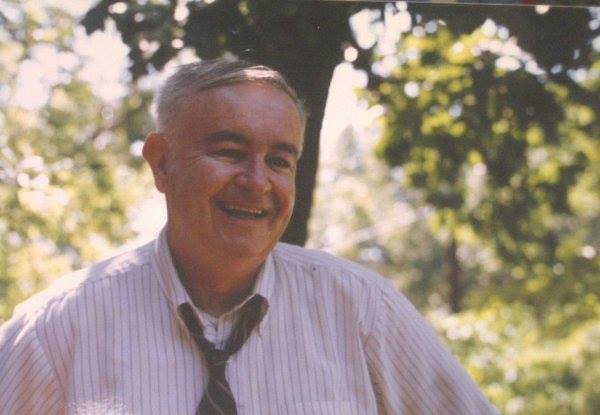
My Dad.
 betsybeadhead
You must be logged in to post a comment.