Spending too much time with strangers

It seems unusual that we are expected to spend time with people that we didn’t choose to, but it happens all the time.

When you work forty hours a week, you are expected to spend all that time with people you don’t know. The only way this doesn’t happen is if you start your own business or you work with family. But for the majority of people, you spend all that time with strangers. Your boss decides who gets hired and who you work with. You often end up spending more time with them than you do your own family.

If you marry into a family, you are then expected to spend every major holiday (like Christmas, Thanksgiving, and Easter) with them, as well as minor holidays (like birthdays). This is odd, since when you marry you state that you are committing to that one person – not their entire clan. Likewise, you certainly did not agree to spend time with people who were not even members of the family when you joined it. Here I’m speaking about people who become members through marriage (brother or sister in-laws) and any resulting children.

One way cloistered communities have it right is that they give the new person and the rest of the community time to feel each other out, to see if they would be a good fit together. This is not done over a luncheon. This is done over the course of years. With monastic communities, it is a minimum of seven years before the person is allowed to make final vows and become a full member of the community. The new person, the abbot or abbess, and the community are all consulted on this.

It seems like something like this would be useful for everyone who is expected to spend a lot of time together.

I remember when I was in the medieval reenactment group, if a new person wanted to join the household I was in, they would approach the Knight (the head of the household). He then would ask each one of us privately what we thought about that person. Not only would we be spending many weekends together, but we also would have different perspectives on that person. We might know something about his personality that he didn’t reveal to the Knight. In one instance, we all had seen that the person was very polite to the Knight, but would be short-tempered and downright mean to anyone he thought was beneath him. The Knight had no idea of this, because the new person had always been on his best behavior with him.

Some combination of these approaches could be useful for workplaces and families. Have the new person spend a significant amount of time with the group before a long-term commitment is made. Each person should then be asked if they feel this new person would be a good fit. Likewise, it gives the new person a chance to see if this group would be the kind of people they would like to be with. This could prevent a lot of stress, and would reduce the amount of workplace and domestic violence.

The little white house

little white house

The little white house had been there longer than anyone could remember. The cornerstone said 1781, but nobody thought that was possible. Sudbury wasn’t a town that far back. The archives in the local library said the first deed had been issued in 1824 to Saul Abrams, a fur trader, but it was the only house for miles then. It was four years later before the town had its first boom and then there were a dozen homes scattered about like corn thrown to chickens. Close enough to help if there’s a need, but far enough away that you didn’t have to worry about your neighbor seeing your business. Not like anybody was up to anything, mind you, but it was still nice to have the breathing room.

Nell was currently the youngest resident of the little white house, but she certainly wasn’t going to be the last. Her mom was due to give birth within a week to her latest sibling. Meanwhile, grandma Rose and uncle Pat lived upstairs in the north-east facing room. They preferred the early morning light to paint by. They said it meant they got a head start on the day before the rest of the family got up.

The little white house had resisted all sorts of change over the years. It had plumbing but no electricity. The family had never seen a need for it, preferring natural light over artificial. Plus the money they saved was nothing to sneeze at. Of course, money wasn’t a problem for Nell’s family. Up to four generations at a time lived there, sharing their skills and resources along with their joys and sorrows. It was so much cheaper to pay one mortgage than four (or more). The money saved was worth the minor annoyance of the cramped quarters. For starters, it meant that they didn’t all have to work full-time, and especially not at jobs that took more than they gave.

The Abrams family realized early on that they would have to be careful about how many children they had if they were going to share a house. It wouldn’t do to be too crowded. Plus, more mouths meant more food, and food wasn’t cheap. They’ve had a lot of land to work with years back, but now that the city had grown up around the house they had to buy food just like everyone else.

Of course, there was always the apple tree out front. It had been the reason Saul had bought the property in the first place. The apples had just ripened on it once Saul came over the hill, looking for a campsite for the evening after a long day of marmot trapping. That tree’s beauty stopped him in his tracks and he set up his canvas tent smack dab under it to spend the evening with it as his company. The next morning he knew he’d finally found a place he could call home. He dreamed about that tree the whole night long.

Saul’s family put great stock in dreams, being descended from Jacob, who God renamed Israel. Jacob knew that where he slept was a holy place and so set up an altar to God once he awoke. Saul knew the same was true here, but he knew he was to establish a house rather than a temple.

There wasn’t much difference, really, to his mind.

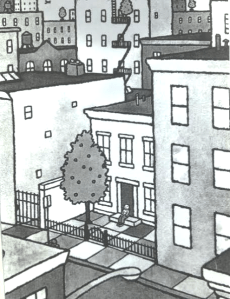
The city had grown up around the house, getting closer and closer. The yard had shrunk down to a little patio in front with the tree. Tall buildings bracketed the little white house on the sides but not at the front or back. Somehow, there was still an alleyway to one side, and Nell would often play there when she wanted to be alone.

The alley was gated, and only her family had a key, but it didn’t matter. Nobody would even think of walking through that gate. Most didn’t even notice it. It was kind of like one of those Japanese gates that weren’t really gates, marking out a difference between “there” and “here”. “Here” was the difference between storm and calm, between noise and harmony. Most people walked on by because this little island wasn’t what they were looking for, even though it was what most of them needed. Most people were looking for peace in the wrong places – more activity, more possessions, a different job / spouse / church / hobby. They figured if they weren’t happy it was because of something outside of them. Change that and they’d change how they felt, they thought. Yet they made the changes outside and they still felt empty inside.

The little white house had no ornamentation to speak of but it was always clean and tidy. It stuck out only in that it didn’t stick out at all, taking up just enough space but no more.

The residents kept a low profile, always doing things the same way. They always put the trash out on Wednesday mornings, always went to get the groceries on Thursday. On Friday they prepared for a day of rest by cooking double portions of food to make Saturday easy. On Sunday they might travel or work on school projects. They were always learning, whether they were enrolled in an institution or not. All of the Abrams kids went to public school and then to college, yet they also were expected to follow their own inspirations and learn as much as they could about whatever they wanted. The Sahara desert, bowling, tea, it made no difference. Anything was fair game to do a research project on, but each person had to do something.

Right now, for Nell, that something was sitting on the front steps, sketching the apple tree. Year after year it produced crisp red apples that the family lovingly harvested and ate fresh, baked into pies, made into sauce and preserves. Every single fruit was carefully harvested and used or processed immediately. “An apple a day keeps the doctor away” should have been engraved as the Abrams family motto because they sure took it seriously. Even if they were traveling they were sure to take enough applesauce or apple butter along with them so each person could have their daily allotment. Every day they ate from the fruit of that tree just like it was medicine, just like it was prescribed by the family doctor.

In a way, it was. All those many years ago, God told Saul in that dream to eat the fruit of that tree every day – him and his descendants, and they would never get sick. He took God at his word and had an apple for breakfast first thing when he woke up. Within moments the usual aches and pains he’d had for the past three years of making his living out of the wilderness were gone, like he never had them.

The family never told a soul their secret, out of concern that someone would try to steal the tree or chop it down out of spite. Some folks would rather destroy something beautiful than share.

Of course, they had to tell anyone who married into the family, but marrying into that family was harder than getting a job at the real White House.

Background checks were just the beginning. Then there was a complete physical. Financial records were obtained. Even visits to a psychiatrist were required. It was like applying for full term life insurance, a second mortgage, and a Secret Service job all at once.

In the end, if you were in, you were made truly part of the family by a dip in the local river. And, no matter what, you had to change your last name to Abrams. After that you were the same as anyone else who lived in the little white house, and you too got your daily serving of apple.

Getting a serving a day meant you didn’t get sick, but it didn’t mean you wouldn’t die. Accidents and old age could kill an Abrams the same as anyone else. They tended to heal faster from accidents, and age slower, but death still visited that house on occasion. Even then it wasn’t a sadness, because they’d always lived long and well there.

(The image is from the book “Trainstop” by Barbara Lehman. It is a wordless picture-book for children. My story was inspired by this image and not by her story that she told through her other pictures.)
Mixed messages (poem)

But first, an explanation –
(Nick Bantock has a writing prompt in his book “The Trickster’s Hat” that I decided to try. It involves taking two different books and selecting a random paragraph from each one. You highlight all the nouns in each paragraph, and then switch them out. This will produce two entirely new paragraphs. You’ll end up with some sentences that are useful, others not so much. You can edit it however you like, but you cannot change the nouns. I chose (randomly, but oddly synchronistic) “The Marriage of Opposites” by Alice Hoffman, and “The Color of Water” by James McBride. I’ve left most of it the way it came out, and used both paragraphs.)

I was finally finished with that rabbi,
with mahogany mothers,
and a synagogue set
in the Spanish nostalgia.

Surprise had taken a long recognition,
but now he was perfect,
and not I or the town
could pull the Jews down.

There was a low curved I
separating the
he from the I.
The he
was kept as a who,
as it had been in the mother,
in he and I,
though there were many of him
recently arrived.

Book, who thought it madness
to have this daily family
of a brutal I,
when every record was a nothing
and every them was a you.

When the synagogue called in
the year of my benches,
the old altar front and center,
it spoke to the hall
with neither style nor it,
only grudging time.

It had heard fire was in the storm.
Women knew men were black
and the floor knew
that my past was sand.

Spain, remember your Portugal,
the Jews said.
Denmark explained to Amsterdam
that madness
was writing a reminder about my history,
and asked if prayer might see
some of the secrets.

Care or codependency?

I recently posted a picture of an item I’d bought at Goodwill on my Facebook page. I’m going to use it as a prop for a story I’m writing, but in the meantime I wanted to know what it really was. Several helpful friends let me know that it was a kitchen timer. It looks more like a remote control than a timer, so that is what it will be in the story.

However, one person posted this picture and said “Don’t buy from Goodwill”.

Perhaps it is significant that this is a cousin, from my husband’s side. I’ve never even met him. Perhaps that alone is my problem. Perhaps I need to not “friend” people I don’t know, even if they are family. That is a topic I write about a lot. Boundary lines blur a bit with family.

Here’s my reply to his post (which you might notice didn’t answer my question at all) –

“Too late. I don’t buy from Goodwill with the thought that they will be donating to charity. I am the charity. I benefit because I get to buy something very inexpensive that I need, that I can’t afford to buy new. This is where I buy my clothes. In spite of the fact that the CEO makes lots of bucks – they do provide job training and opportunities to people who normally have a hard time getting a job (those with mental or physical disabilities, or those who are ex-cons). Plus, by their mere existence, they are encouraging people to recycle and reuse – the items don’t go into a garbage dump. Surely these points have to be of value to you. I’ve seen this image before – and I notice that yours does not include the one donation center that does donate a lot to charity and the CEO takes home under $25K a year – and that is the Salvation Army. I’m so tired of messages from people who mean well that say “DON’T do this” but then don’t tell you what is good to do. We cannot live our lives based on fear.”

I thought “How dare he tell me what to do! How dare he try to share his fear!”

His need to “correct” me is a sign of codependency. His way of thinking is the problem, not where I shop.

It reminds me of health book that said to drink lots of clean water – but not from a tap, and not to drink out of plastic water bottles. But what is there other than that? The author didn’t say. So how is that helpful? If all you share is what not to do, you are not helping anyone. In fact, you are making the situation worse. This is part of the current problem our society faces – too many “don’t” and not enough helpful information. We are being lead by fear of everything, with no let up. There is no relief – just more and more fear.

Here are some current fear-based modes of thinking that are going on:

The government is going to take away everything you have.
The government is putting chemicals in your food.
You are under constant surveillance.
Immigrants are going to steal your job and/or kill you.

These ideas are poison, because they don’t offer a cure. They contribute to un-ease, to dis-ease. They are all passive. They are things that are going to happen to you (so they say), rather than things you can do something about. They create fear and disorder.

We are being told we are in a cage and not given a key. The real problem is that we were fine before we were told these lies.

And then I thought more about his message. This was a chance to educate him on the rest of the story. So I shared this picture.

Half information is worse than no information. Whatever we share must be for the good of all. To share mis-information or terror-talk is to BE the problem. Also, it is important to consider before you share anything – are you trying to control the actions of someone else? If so, why? Is it perhaps that You are the one who needs to hear your message – not the other person? Thinking about why you feel the need to control someone else’s actions, even in the guise of caring for them, is a very useful meditation.

Being reminded of who you are.

I once had to remind my Mom of how strong she was.

I’m not sure what was going on – either Dad had separated from her, moving in with his 80 year old Mom, or she had cancer. It all blurred together that year, one bad thing fading into another.

She was alone, and frightened. She had me, but I was 24, still living at home. I was in college, working part time. It wasn’t enough to support us, and she didn’t want me to quit college. She never got to go and it was important to her that I finish. Dad was sending some money, but it wasn’t enough. She had to get a job.

She set her sights low. She thought about going to work in a gas station. It was simple – no experience necessary. I didn’t like the idea because it would be dangerous – there was a risk of her being robbed. I also knew that she could do better. She’d managed a call center, many years before, when I was in kindergarten.

She’d forgotten about that – and she’d forgotten about even earlier than that.

When she first came to America, she came to stay with a pen pal. The pen pal wasn’t much of a pal – the situation got worse very fast, and she couldn’t stay with her. Perhaps there had been a misunderstanding of what was expected. Perhaps the person was just a jerk.

But Mom didn’t go back home to England. She stayed here, found a job, found an apartment. She took care of herself and then met the person she was to marry.

And she did it all by herself.

She’d forgotten how strong she was, way back then, in her 20s. Surely she was even stronger now in her 50s. She could handle it. She’d done so much more since then – run a house by herself for one. My Dad wasn’t interested in cooking or cleaning or repairs or yardwork. She’d been the president of the PTA. She ran my Girl Scout troop after the leader quit at the first meeting. She was always filling in where others dropped the ball and doing a great job. She had no training and no experience, but she knew when something had to be done that someone had to do it, so she did.

I take after her a lot, now that I think about it.

We forget ourselves. We forget how strong we are. So when something unexpected and hard comes up, we think it is the first time we’ve climbed that mountain. We’ve climbed Everest. It was years ago, but we climbed it – when we handled our parent’s estate, or stood up to a bully, or left an abusive boyfriend or husband, or gotten a PhD, or any number of things. Life is full of mountains. It is just that when we get into the long flat stretches that we forget.

Remember your mountains, and they will help you get over this one.

True relationships

His mother and siblings came to him while he was speaking with a large crowd, but they couldn’t reach him. They sent word that they wanted to speak with him. Someone in the crowd told him “Look, your mother and siblings are standing outside waiting to speak with you.”

Instead of going out, he replied “Who is my family?” Indicating his followers who were seated in a circle around him, he said “Here they are! Whoever hears and does the will of my Father in heaven is my mother and brother and sister.”

MT 12:46-50, MK 3:31-35, LK 8:19-21

Poem – Plates

I opened the box
from my mother in law,
the heavy brown cardboard, the crisp pale paper inside.
She’d been dead a month by this time
but she knew it was coming
so there’d been time to prepare.

Every plate
every bowl
every cup
even the gravy boat
she had wrapped
herself
one
by
one

and placed carefully in this box.

She knew
that this was the last time
she would see these dishes,
these dishes that we had used
as a family
for Christmas
for Easter
for Thanksgiving
every year.

She knew
this was the end
that there would be no more holidays
for her.

We’ll continue
in our fashion
in our own new way
without her
but with her plates
so lovingly
and so carefully
wrapped.

Watch it.

There is a difference between living and being alive.

watch1

My mother-in-law had at least 20 different watches that we have found after she died. Some were separated from their wristbands. She still had them, along with the pins that would have held them together.

None of them were working.

watch2

All these watches to keep the time, and she wasn’t mindful of it. All these watches to keep time, and she still wasted it.

Her obituary was sad. It was almost shorter than the dash between her birth and death dates. The list of who survived her was longer than the list of her accomplishments. The fact that she outlasted the doctor’s estimate for her to die was prominent.

So she was alive, but what did she do with her life?

This piece speaks to my frustration with her having 70 years of life and nothing to show for it. This piece speaks to my anger that my parents died young and didn’t have time to enjoy the life of retirement. This piece speaks to my doubling-up of my activities so I don’t waste time.

I’m mindful of how short life is.

Too many people these days seem to think there is a “reset” button on life, and there isn’t. They seem to think that life is like the seasons – that there will be a spring after the winter. While I’m part of a faith tradition that believes in the afterlife, I’d like to not find out I’m wrong. I want to have a life before the afterlife.

This is why I write, and create. This is why I wake up early. This is why I take classes that are hard and read books to learn how to help. I don’t want to just have been alive, taking up space. I don’t want to wait until I retire to live.

These watches remind me to be watchful.

The artwork is made using an 11×14 canvas, acrylic paint, matte medium, decoupage glue, five watches, and 11 color copied images of watches, all from the collection of my mother-in-law.

Expected death

Imagine if you got pregnant, and you weren’t told anything about what was going to happen to you. Or imagine if you were the friend of someone who got pregnant, and knew nothing. Neither of you had been through it or known anybody who had been through it. You’d not read about it even. When the contractions start to happen and the water breaks, it is going to be pretty scary. When the baby is born, you’ll both be freaked out.

But if you know what to expect – if you know that it is normal – then you’ll know what to do. You’ll stay calm and handle it.

Death is like that too. There are certain identifiable things that happen, and they are only scary if they aren’t known. They are different from how things are otherwise, and because they are different they can be unsettling. But they don’t have to be.

We’ve medicalized birth and death in Western society, and it is to our loss. We’ve forgotten what it is to go through these natural human experiences. We used to see birth and death in our homes, because we would all live together as a family, several generations together. We didn’t go to the hospital to give birth or die, with strangers or alone.

There are plenty of fine articles online where you can read up on the signs of death, so I’m not going to repeat their information. I will tell you that the more you learn, the more you’ll make a difficult situation easier.

Not learning about it won’t make it not happen. It will just make it harder when it does happen.

You have to ask.

I don’t want to go to the hospital to watch my mother in law die. I will if I have to. I will if I’m asked. But I’m not going to second-guess my husband. I’ve spent ten years trying to guess what he wants, and doing things for him without him asking because it seemed like he needed me to. He seems to appreciate it, but I don’t think it is doing him or me any favors.

I’ve stood on this one.

Now may not be the nicest time to insist that he “use his words” but now is the time. He has to learn how to find his own voice, to know what he wants, and to ask for it. He also has to know how to say no to people and make decisions.

Part of making decisions is making bad decisions and standing behind them.

He’s made a hard decision recently, and we all supported him. Now it seems like he is going back on it, so he’s losing ground. Waffling, second and third guessing himself is part of his family inheritance. He’s going to lose face over this, and that is going to crush him. Yet another failure to add to the pile. I’m afraid that he’ll never stand up and make a hard decision again.

In part I’ve stayed away because I don’t want him to lean on me. I want him to stand on his own and make the hard decisions. I want him to grow up. I want him to become an adult. Having to ask other people’s opinions and approval all the time is not a sign of maturity.

This was going to be his crucible, his make-it-or-break-it moment.

I feel helpless, waiting around the house. I’ve done rituals and said prayers. I’ve done what I can to process this experience in a safe way so that it doesn’t hurt me. It is bringing back some memories from when my Mom died.

It has been since Wednesday night. Chaos, crisis, upset. Panic mode, emergency time. It is Sunday now, and she’s still alive, barely. I’m a little angry at her now, and I feel very selfish about it. She’s wasted our long weekend off together. Sure, there is some kindness in all this happening during non-work time, but it is still vexing.

This isn’t kind to say at all.

And it is very honest.

This isn’t life, her hanging on. It wasn’t life before, either. Home decorating isn’t giving back to the world. Vanity, selfish, image conscious – both of them. They just amplified each other’s narcissism until it became pathological. There was nobody to say “No”, so the psychic disease grew.

Her sons have spent more time with her now than she ever spent with them when they needed her. They’ve made sure she was better treated than she ever cared for them.

She wasn’t bad, or evil, but she wasn’t good either.

What an ugly death, and a bad situation. What a terrible legacy to leave.

And I’m angry at the medical establishment – we show more mercy to dogs.