Time travel dream

I had a dream that I travelled back in time to visit my Mom. We were together in the living room in our old house in Chattanooga. She was sitting on the couch by the windows, where later we would put the hospital bed. She died in the same place she had sat all those years.

When I traveled there in my dream, I told her that I was really 45, that essentially, I was possessing my own body. I asked her how old I was at the time, because everything always looked the same there. She told me that I was 12.

I told her that she died when I was young, but I didn’t tell her when. I told her how it affected me. I told her that she might want to stop smoking and start eating well.

We had a steady diet of junk when I was growing up – no fresh vegetables, a lot of fried food. If we ate vegetables at all they came out of a can or the freezer. A lot of food was brown. The walls of the house were stained yellow with all the tobacco smoke. It was a very unhealthy place to grow up. I had no control over my environment, and the people who should have looked out for me were killing me day by day.

For some reason I felt like I could warn her about the train wreck she was making of our lives by smoking and eating poorly. Her bad choices were my bad choices by default. I was her child and had no control over what I ate and the air I breathed when I was there. For some reason I thought I could change her ways by coming back as an adult to tell her what would happen if she didn’t change.

When I woke up, I pondered on that dream and I thought of this Bible passage. Jesus told this story about a rich man and a poor man. The Lazarus in this story isn’t the same one he raised from the dead – that was the brother of Martha and Mary.

Luke 16:19-31
19 “There was a rich man, who was clothed in purple and fine linen and who feasted sumptuously every day. 20 And at his gate lay a poor man named Laz′arus, full of sores,21 who desired to be fed with what fell from the rich man’s table; moreover the dogs came and licked his sores. 22 The poor man died and was carried by the angels to Abraham’s bosom. The rich man also died and was buried; 23 and in Hades, being in torment, he lifted up his eyes, and saw Abraham far off and Laz′arus in his bosom.24 And he called out, ‘Father Abraham, have mercy upon me, and send Laz′arus to dip the end of his finger in water and cool my tongue; for I am in anguish in this flame.’25 But Abraham said, ‘Son, remember that you in your lifetime received your good things, and Laz′arus in like manner evil things; but now he is comforted here, and you are in anguish. 26 And besides all this, between us and you a great chasm has been fixed, in order that those who would pass from here to you may not be able, and none may cross from there to us.’ 27 And he said, ‘Then I beg you, father, to send him to my father’s house, 28 for I have five brothers, so that he may warn them, lest they also come into this place of torment.’ 29 But Abraham said, ‘They have Moses and the prophets; let them hear them.’ 30 And he said, ‘No, father Abraham; but if some one goes to them from the dead, they will repent.’ 31 He said to him, ‘If they do not hear Moses and the prophets, neither will they be convinced if some one should rise from the dead.’” (RSV)

So I realized that it didn’t matter. Even if I had been able to go back to tell her to change her ways, it wouldn’t have done any good. She knew that smoking was bad for her but she still did it. She knew that she should eat better but she didn’t do it. She had made her choices and she stuck to them, regardless of the warning signs and the evidence.

How many people are like this? They’d rather stick with what they know to be bad rather than make the change to what they know to be good.

Change is hard. It takes a lot of energy to break free of a bad habit. But it is worth it. And the more you push towards being healthy, the more energy you have to make other changes.

How NOT to do Pastoral Care.

There is a lady I know who took the same Pastoral Care class that I did. She is a nurse and goes to church regularly. She is certified as a minister in her church. She isn’t ordained, per se. I thought that she would know how to handle it when I told her some heavy news.

My mother-in-law is now in the hospital. She passed out and hit her head. Just days earlier she found out that her cancer had spread to her lungs. I know that means she has just a few months left.

I don’t want this lady to pray for her to live longer. That isn’t why I started to tell her what was going on. I thought we were friends, and in a way we are. She tells me heavy stuff and good stuff. She tells me about the important things going on in her life. We celebrate together and mourn together. But it really is that I celebrate and mourn with her, about her issues, and she doesn’t return the favor. It isn’t reciprocal.

One thing that you have to remember about Pastoral Care, about mindfully listening to someone while they are in a bad situation, is that it isn’t about you. You aren’t supposed to talk about your situation, or compare, or outclass. You can’t tell the other person a story of how it is worse for you or someone you know. That kind of “perspective” isn’t helpful and it isn’t kind. It is the exact opposite of what is necessary.

What is necessary is just listening, and I mean really listening fully. Not being distracted, not trying to leave, not looking around at your phone or watch. You can ask the other person how they feel about it, and you can say “Gosh that has to be hard” but that is about all you are allowed to say.

They just need a safe person to talk to – one who can handle this information in a way that is healthy for both people. A good listener is like Houdini once he had prepared. He could warm up his stomach muscles in just such a way and then anybody could punch him in the stomach as hard as they wanted and he’d be fine. He had trained himself how to do this. A good listener does the same. If they aren’t ready for it, a hard story can destroy them, so they have to train to be able to receive it. Taking a pastoral care class is part of this training.

I should have known better when I first started talking to her yesterday. Just after I reminded her that my mother in law has pancreatic cancer (not a pushover kind of cancer), she turned away and made some (unrelated) joke to the instructor of the class we were in. I felt slighted, but I decided to give her another chance.

When she turned back to me, I kept on with the story. I’m a bit torn about what to do because of the history of physical and mental abuse she allowed in her house. It is my father in law’s fault that the abuse happened, but it is her fault that it continued. They were both very immature when they got married. They are both still immature now, and they are in their 70s.

So some of the issue that I’m dealing with is how much are we supposed to get involved in this situation. You reap what you sow, right? But as a Christian, I’m supposed to forgive, right?

I just feel like if I pretend nothing happened, then I’m doing the same thing she did. I’m saying that it was OK. And it isn’t OK. Abuse is never OK, whether you are the one doing it or you are the one allowing it. By allowing it, you are sanctioning it.

So this lady, this minister, this person who has taken the same class I have and should know better, she starts telling me a story. Now, it isn’t a story about her, but it isn’t a helpful story. It isn’t enlightening, and it isn’t useful. It doesn’t tell me a way to deal with this situation. It actually makes me feel worse.

(Trigger warning)
(I didn’t get this warning when I got this story)
(Such is life)
It was a story about a couple that she knew in a nursing home. Both husband and wife were in separate rooms, and it was for a terrible reason. The husband was abusing his wife, sexually, and their children were OK with it. “She’s his wife” they’d say, as if that excuses rape.

(Warning over)

She went on and on with her story and I felt trapped. Finally it stopped and there was some silence. I digested this, still not knowing what to do about the situation I brought up, and feeling worse because of the story she told. Helpless. Raw. Frustrated. Dirty.

I digested this story and knew that my boundaries had been violated. I told her that I can’t handle those kinds of stories, and she apologized. She said she was a nurse and terrible things happen around and to nurses all the time.

She proceeded to tell me some of the horrible things that have happened. It got graphic.

Somehow her apology ended up being even worse than the reason for the apology.

She didn’t see the error of her way – she didn’t get that telling that kind of story to anybody isn’t a great idea. It is especially a bad idea if the person is experiencing a problem.

I can handle it. I’m pretty strong, emotionally. I’ve learned a lot about boundaries. I wonder about anybody else she might “help”, and how they will react.

I now know that I can’t trust her with anything heavy.
She’ll drop it on me.

The purpose of taking a pastoral care class, in fact, the purpose of being a minister, is to learn how to help people. It isn’t to carry someone else’s burdens for them. It is to carry them with them for a little while. When you do that, you make it a bit easier for them to see what they are supposed to do. When you do that, you give them a little breathing room.

You are never supposed to add to their burden.

Fill in the blanks.

I woke up thinking about my parents-in-law. Things aren’t going well with them, and I’ve been very distant because of that.

I’m angry with them. I’m angry about how they treated my husband, their son, as he was growing up. I’m angry about how they abused him. Their own history of being mistreated isn’t enough to excuse it. They should have known better.

I’m angry about how they haven’t listened to my advice on where to live, so they keep needing to ask for help. I was the one to suggest they move up here, closer to their sons, but that is all they have listened to. Five hours away was too far to help them, so they came closer, but they are still too far. Thirty minutes one way isn’t ten.

They should have bought a condo, or gotten an apartment. Basically they shouldn’t have gotten a yard and a place that has to be maintained. At their age, they personally need to be maintained more than their homes. I told them this, and they ignored me. I told them that my husband, their son, barely has time to take care of our house.

Now they need help. Often. Just like I foresaw. There is no need for these emergencies.

They continue to ask for my advice and input, but they continue to ignore it. They waste my time and that of my husband.

They are very needy.

They are too old to be this childish.

And then I stopped and remembered. Ask Jesus into it.

Jesus Jesus Jesus, I said. I visualized all of these problems as big blocks. I saw the light of Jesus entering them. It was like a glue, filling in all the cracks, making them stronger.

And I came to understand that the brokenness is part of the plan. The brokenness is necessary.

The poet Rumi reminds us that bread can’t become bread unless the grain is ground up. Then it is mixed with other ingredients and heated in an oven.

Clay isn’t useful unless it is shaped and heated too.

These broken bits, these hard times, these trials that we all have – these are what make us who we are.

They aren’t the bits to run away from. They are the whole story. They are it, everything.

They are what make us human. They are what make us who we are.

God isn’t the “bad guy” for letting bad things happen to us. These “bad things” are just the hard things that push us out of what we are and into who we are supposed to be.

They are what get the baby bird to get out of that shell. They are what get that same bird to jump out of the nest and fly for the first time too.

We are those birds.

Stuck in our shells, we would die.

Stuck in the nest, we would never live.

Adversity isn’t.

It is opportunity.

Jesus is the glue that holds us together, is the hand that pulls us out of the hole, is the thing that rescues is from being stuck.

Jesus is “out there” but is also “in here”. Jesus is instantly available -all you have to do is call on him. Ask and you shall receive, after all. But Jesus is also inside every person who has let him into their lives. Jesus builds houses for poor people through Habitat for Humanity. Jesus feeds people at the rescue mission. Jesus holds people’s hands when they die in hospice care. Jesus teaches children how to read.

Jesus wears a lot of faces and goes by a lot of names, and he’s here.

But he had to be broken and blessed for that to happen.

He wasn’t crucified for our sins. He was blessed and broken on that cross, just like how he blessed and broke the bread and the fish to feed thousands.

He became more, so we could become more.

Thanks be to God.

Navigating the “Do you have children?” question.

A patron was making small talk recently, and then it became large talk. He doesn’t know anything about me other than what he can see. Some of what he sees is the mask that I have to put on as part of working customer service. I like helping people, but I’m not their friends. They get confused sometimes.

He asked me how I was doing, and then after that, asked me how my husband was doing. He’s never met my husband. He knows I am married because I wear a wedding ring. He doesn’t know I’m married to a man, even though I am. Just because I am a woman wearing a wedding ring doesn’t mean I have a husband. Nuns wear wedding rings. Lesbians wear them too if they are in committed relationships.

I replied with the vague and noncommittal, “He’s fine”.

Then he asked if we had children, to which I replied “No”. He pressed. “Why not?”

Stupid question.

One – it is none of his business.
Two – what if we did and were heartbroken that we were infertile?
Three – what if we did have a child and s/he died?

I said no, that they are too expensive. Usually that is enough to stop this line of questioning. Sadly I get it a lot. I don’t get why strangers feel it is OK to ask these questions. Perhaps they think they are being friendly, but they don’t realize the potential minefield they are entering. They just don’t think. It could open up a lot of heartache for someone.

He pushed further, and I was done. He said “When you got married, didn’t you want to have children?”

He only knows my name because he’s read it on my nametag. He’s crossed my boundary already and hasn’t read my lack of engagement as a “go away” sign. I’ve not asked him how his wife was doing (I know he has one because he uses her library card as his own) and I’ve not asked him if he has children. A lack of reciprocal questions should indicate stop asking questions.

I was done. I didn’t want any more of this. I didn’t want it to start off with. I pulled out my biggest card.

I said the truth.

“Both of us were abused as children, and so we don’t want any.”

End of conversation.

There is nothing more to be said. No more pleading to get us to have children. No more trying to change our minds. No more prying.

In the past I would have felt bad for even saying that. I would have felt bad that I had to cross over the line of polite conversation into this. I would have felt bad for having to establish my boundaries.

Now I don’t. Now I know I must, and if I don’t draw a line, essentially people will invade my mental space. It is just like if a person shows up at the door to my home. I have the right, the duty, the obligation to establish how far he can get in.

Normally, I have the ability to decide if I even open the door, but a customer service job blurs that line.

Here is some advice – don’t ask strangers if they have children. If you ignore that advice, then don’t push if they say no. Don’t ask why. Don’t try to talk them into having children. There are plenty of kids on the planet as is. And there are plenty of bad parents who should have thought twice about having children. Maybe if they weren’t pressured by family, friends, and strangers into having them, they would have saved everybody the trouble.

Memory postcard – me and my grandmother

MP1

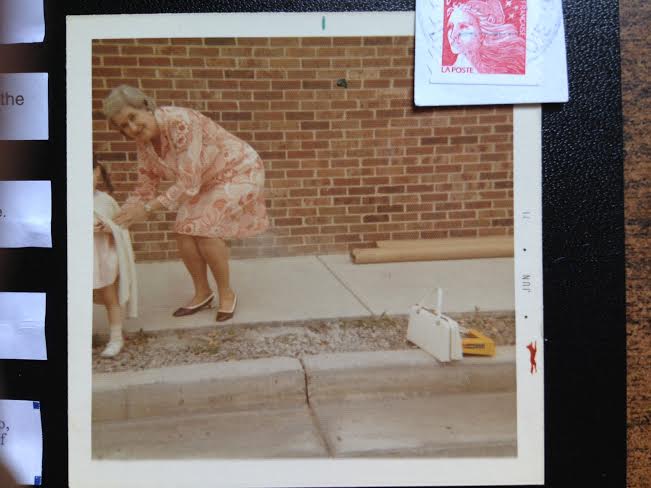
This is a “postcard” of me and my grandmother. She is the only grandmother that I knew. She was my father’s mother, and her name was Mary Frances. I called her Mama. My mother’s mother died before I was born.

My aunt sent me this picture recently. I’d never seen it, but I knew when it was taken. There is another picture of me from that same day, wearing those same clothes. It, however, has all of me and not just half. I’m not sure where that picture is anymore. Probably in a box in a closet. I’d had this picture sitting out for a while. It needed to be put in a frame of some sort. It needed something.

Here’s a closer picture of the photo that started it all.

MP2

The back of the picture says “Betsy and me at the Holiday Inn, Chattanooga”. It is written in blue ballpoint pen in my grandmother’s handwriting. The printing on the side of the picture says “Jun 71”, so I was two years old. I’d been swimming – my hair is wet. I was cold, and my grandmother has put her ever-present white sweater on me to keep me warm. Yes, my hair is wet, and I’m not wearing a swimsuit. So that means I was changed into normal clothes and nobody dried my hair. My grandmother has her handbag nearby. This is big and stiff and white, like all of her purses. The one I remember the most was a white wicker contraption. It was fascinating.

I spent most of yesterday sorting my stamp collection and my collection of fortunes from fortune cookies. I have a slightly disturbing amount of both. Fortunately they are tiny paper things, so having a lot of them doesn’t take up a lot of space. I pulled out ones I liked as I was sorting, with no particular idea what I was going to do with them. At night I knew – put some of them together with this picture. It is like a postcard of memories.

The fortunes all have meanings for me. They are like pithy snapshots all to themselves.

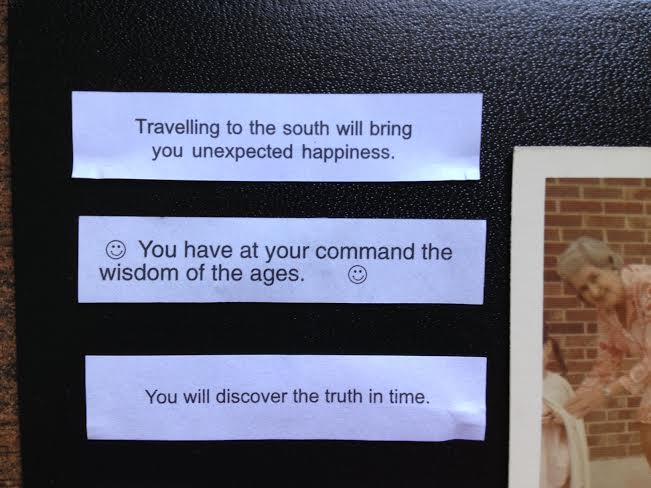
Here’s a closer picture of the first three.

MP4

“Travelling to the south will bring you unexpected happiness.”
There were two of these fortunes in the collection, and I’m amused by how specific they are. The south – not the north, not just traveling, but the south. I found it interesting, so I pulled them aside. Now I know why. I went south to visit my grandparents every summer for two weeks while I was growing up. We’d drive down as a family to meet up with my grandparents in Gadsden, Alabama and go to Noccalula Falls. It was halfway. Then my parents would drive back home, and my grandparents would drive the rest of the way to Birmingham with me in the car. Two weeks later they would reverse the procedure to return me.

Was it unexpected happiness? It was certainly different from the norm. My grandparents slept in separate rooms. My grandmother had two single beds in her room. I’d sleep in the one closest to the wall. The blankets were white with pom poms on them. The “Birmingham fairy” would visit and there would be a present under my pillow. Was it every night? Or just the first night? I don’t remember. No teeth had to fall out to get a present. It was just for being there. I remember being stunned how it happened. I’d see something I liked at a store we would visit and it would show up under my pillow the next morning. It was magic. I never saw my grandmother buy anything that I later got under my pillow. She was part elf, I think. She taught me how to palm money, but that is another story.

At night she would give me chocolate milk to drink, and in the morning she would put sugar in my orange juice. She’d also put a packet of sugar in my applesauce when we went out to eat. We went out to eat every meal. Really. Every meal. “Grandmother’s cooking” means nothing to me. When I think of food associated with my grandmother, I think of the Piccadilly café. Buffet lines were the norm. She didn’t cook. The only time I saw her use the stove was to dry of my shoes if I’d played outside in the rain, or to heat up mud pies that I made in little cast iron skillets.

Real mud. In the stove. Why she didn’t insist that I put them outside in the sun to dry is beyond me. That was my grandmother.

We slept with the windows open. There was no central air in that house. That wasn’t a problem for me because I grew up that way. I’d go to sleep listening to the sound of the train whistles nearby. It is part of why I got a house close to trains. I love that sound. It reminds me of those summers, sleeping in her room, getting presents under my pillow.

“You have at your command the wisdom of the ages”
I bought my first real computer, a Gateway, with the money from my grandparent’s estate. I’d gotten this Chinese fortune around the same time. It seemed an appropriate thing to tape to the monitor. I also taped my grandmother’s name to it, as a reminder of who to be thankful to. I wrote it out in a fancy old script.

“You will discover the truth in time.”
I feel there are a lot of things I don’t know about my family. Something about this speaks to me. I’m uncovering and recovering a lot about my history through writing, art, and prayer. Things are coming back to me, things I never knew were lost. It is beautiful and difficult at the same time. There is a lot that is hidden, that I intentionally forgot. I ask Jesus into it, and it helps.

Here’s a closer picture of the last ones.

MP5

“You find beauty in ordinary things. Do not lose this ability.”
My grandmother was very child-like. Not childish. She knew how to play. She was clever and creative and fun and whimsical. She wasn’t an adult, really, but I don’t know whether that was intentional or was the result of my grandfather’s overbearing nature. Or, was that simply the side of her that I saw?

I like this fortune because it speaks to how I make jewelry, seeing beauty in the everyday. I make treasures out of things that other people see as trash or overlook. Alchemy is part of it – turning lead into gold.

“Choosing what you want to do, and when to do it, is an act of creation.”
I feel this is a message to me from my grandmother. It and the stamp speak to me about the same thing.

Here’s a closer picture of the stamp.

MP3

The stamp is a French stamp, and it reminds me that my grandmother was fluent in French and German, and taught both of them before she got married. When she got married, her husband insisted that she not work. He felt it was shameful to him for his wife to have to work- that it said that he was not a good provider.

Problem is, she liked teaching. She liked translating. She wanted to. But he didn’t want her to, and he won.

This reminds me of the fact that her mother wasn’t allowed to be who she wanted to be either. She wasn’t allowed to work or even to cook. It too was seen as shameful for the woman of the house to work, outside or inside the house. Her husband owned several pipe foundries and made lots of money. He hired cooks and maids. She was allowed to do needlepoint. It wasn’t pretty. It was brittle, and stiff. I feel like she was that way too. A person’s art tells you a lot about the person.

They both were stunted. It was a bonsai kind of a life. But not beautiful, like a bonsai.

This is interesting to me to realize. Both women were “free” of the traditional roles of women, and they suffered because of it. One wanted to work outside of the home. One wanted to cook and take care of the house. Neither woman was allowed to, because it would hurt the pride of their husbands.

This is what I mean about how I’m uncovering the truth through my artwork. I’ve learned quite a bit and put together quite a number of pieces this way. Things make more sense.

So then I look up how to spell Noccalula, and I find out more about the story. This is from Wikipedia. She was a “Cherokee maiden who, according to local legends, plunged to her death after being ordered by her father to marry a man she didn’t love.” Fascinating. It ties into these other women -my grandmother, and her mother. They didn’t kill themselves, but they let a part of themselves die when they got married.

I’m not anti-marriage at all. And I’m not saying that women need to work or cook to feel fulfilled. But what I am saying is that people should feel free to be who they are, and do what they want. Other people should not make decisions for them as to what they think is best for them. This applies to parents and spouses, regardless of gender. To suppress yourself in order to appease a family member is the most damaging thing you can do. It is the heart of codependency.

(I have this collage framed in a simple pop-together frame. I’ve taken it out of the frame for the pictures.)

Father’s Day, 2014. Eulogy, epiphany

Here’s to all the fathers –
Those who are here, and those who aren’t.
Those who show up every day, and those who were never there.
Those who abandoned us, and those who have died.

They have made us who we are.

It doesn’t take a license to be a father. There is no training for it. Fatherhood can be done by amateurs, and often is. Even having had other children doesn’t prepare you for having more. Every time is a new time, with new challenges.

I had an uneasy relationship with my father. He was emotionally distant. He hadn’t been nurtured by his parents, and he didn’t know how to nurture his children. Is this an excuse? Is this an explanation? Or is it just the way it is?

There are plenty of guys who left when they found out they were going to be fathers. Some stayed, but only half-heartedly. Some initially wanted to be fathers, but found out they weren’t up to the task.

Let us forgive them all. Not excuse them. Forgive them.

The best thing I ever was able to do was to forgive my father. He never knew about that bit of grace that happened that day. Shortly before he unexpectedly died, I finally saw him as just a person, and not my Dad. He didn’t owe me anything. There were no expectations to be unmet. There were no promise to be broken. I saw him as broken and sad and hurting. I finally realized he had done the best he could, with what tools he had.

I’m grateful to have gotten to that point. It took a lot of work.

I’d realized years before that if I wanted to have a relationship with my father, I was going to have to find something we could both do together. He seemed unable to connect with me, so I had to make the effort. Eating out seemed to be the way. We would meet for Sunday brunch at Ruby Tuesday’s, or Bob Evan’s. Every Sunday I would go to church alone, and then come back home and we would go together out to eat.

It was his choice to not go to church, even though he was an ordained minister, even though the church I went to was the one he had gotten married in. It was kind of an awkward routine on Sundays. It would have been easier if we had gone to church together and then to brunch afterwards, but that wasn’t going to happen. I took what I could get.

He didn’t come up with the idea of us eating out together, I did. I saw it as a point of agreement, something we could both enjoy. His other interest was classical music, and that wasn’t really something we could meet on. I didn’t love it like he did, and he would always be the expert on it. We wouldn’t have been on equal ground.

When we ate out, it was our time together, just us. It wasn’t always easy. He was a sloppy eater, a bit greedy. I remember when we would eat at home he would finish his food first and then look at my plate and ask to finish it for me. I ate slowly, carefully. He ate ravenously, like a dog. He was willing to take food from his child. This pattern happened in other areas of my life too.

This is who he was. This is how he was raised. He wasn’t allowed to grow up true and strong. His parents were either overbearing (his dad) or flighty (his mom). There was no healthy role model. It was military precision and perfection, or playtime. He never had a childhood, not really. His dreams were squashed as being unreasonable and unrealistic.

One day, over a mid-day breakfast of pancakes and sausage, it clicked. I stopped seeing him as somebody who owed me a good childhood. I stopped seeing how he had failed me. I stopped expecting anything from him. I started seeing him as just a person.

He died twenty years ago. There was no more time to work on our relationship. There was no more time to rebuild it. I was grateful that I’d had that epiphany while he was still alive. I was grateful that I’d had all those Sunday brunches with him to build up to that point. I wanted more. I wanted to rediscover my Dad as a person, but there wasn’t time. He died unexpectedly, just six weeks after Mom died.

My brother never made the time to get to know Dad as a person. That is his fault. That is his loss. He’d threatened to kill Dad when he was 17, and the relationship had never gotten better. Dad’s will reflected that. My brother blamed Dad for the bad relationship, but it takes two to have a good one. And Dad didn’t threaten to kill his son.

My brother insisted on an etching as part of the estate. It was of “The Prodigal Son” by Rembrandt.

It was worth a lot of money. It was worth nothing. It was a piece of paper.

I had the “returning” in reality, because I’d worked on it. In the story, the son returns, and the father welcomes him. But my brother hadn’t worked on it, hadn’t returned. He had the image, but not what it represents. It is sad, but not tragic. Perhaps he thought he’d have more time. Perhaps he didn’t think about it at all.

When Dad died suddenly, there was no more time to work on the relationship. Tomorrow is never guaranteed. We didn’t know he was that ill. In a way, it wasn’t a surprise – he’d never taken care of himself. He smoked two packs a day. He never exercised. He ate whatever he wanted and it was never fresh.

Relationships transform after death. I’ve come to see that every time I think about him, he’s thinking about me. People who die don’t leave, so much as change state.

Death is freeing – a person is not limited to the body anymore. Your loved one is always with you.

There is a time of transition, surely. There is grief, and acceptance, and anger. There is a time of growth and deepening after that. It isn’t all pain.

Our society doesn’t teach us how to deal with death and grief. It doesn’t teach us how to transform it. It doesn’t teach us the other side of it.

Here it is –

After death, you can ask your Dad anything and he will answer. He is part of you now, just like you were always part of him. All of your ancestors are with you now – even the ones that you never met, even the ones that you don’t even know the name of. Your presence is the sum result of all their efforts. You are the end of the relay race. The baton has been handed to you. They passed on their genes, their knowledge, their fears and hopes – to you.

They are all with you, now.

Death isn’t an end. It is just a beginning.

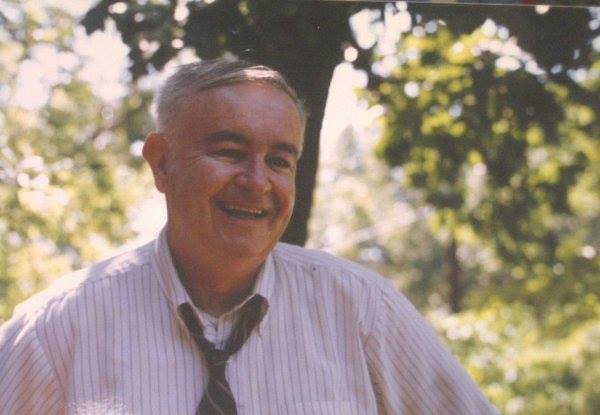
My Dad.
Dad

Playing rich

I talked with my Mom while I was baking today. And of course, I didn’t talk to her in the normal way. She’s been dead for 20 years. But we talked, just the same. You might understand.

I asked her about “real” cooking, instead of basically reheating frozen food. A lot of what we ate came from boxes, and tasted like it. A lot was brown.

I said, if you’d practiced more, then cooking wouldn’t have been such a burden to you. It wouldn’t have been so hard.

She pointed out that they didn’t have much money. My Dad was chronically underpaid as an English teacher. He never got his full professorship. He never got tenure. Every semester it was a challenge to see if he had three classes to teach or none. He had started to teach long-distance. This was in the days before the internet. He couldn’t teach at home with everyone Skyping in. He drove. He drove long distances and late in the day, so that he could teach adult students who were juggling college with a career. They met in high schools after hours. Sometimes he taught in prison. He taught wherever he could – in part because he loved to teach, but also in part because we needed the money.

So we didn’t have much.

But it also wasn’t spent well.

I remember that Mom lived rich. She didn’t get much love from Dad. It was a cold marriage, one of duty. They didn’t have to marry, but they had married fast, without much time to get to know each other. She certainly didn’t know that he was mentally ill and not properly medicated. Not like the medications back then were any good. Mostly they turned you into a zombie, a shell of your former self. No wonder the compliance rate was so low.

My Mom stayed with the marriage out of a sense of obligation, and perhaps out of fear. What was a woman with no training supposed to do on her own? How was she supposed to support herself and two children? So she stayed. It wasn’t bad enough to leave. They didn’t yell at each other. They just didn’t speak either.

So she got what she felt she was owed through material things.

There were expensive perfumes. There were jewels. There were nice clothes. There was even a mink stole.

She didn’t feel loved in a non-tangible way, so she demanded it in a tangible way. This is so sad. It was like she was a prostitute in her own marriage.

So we were shortchanged on actual nutrition because my Mom felt slighted. She didn’t feel nourished, so we didn’t get nourished. I know this wasn’t intentional. I know she didn’t think of it like this. She didn’t see the connection at all.

If she’d worked on the real problem, she wouldn’t have had to supplement with things. If they’d gone to marriage counseling, then there might have been something real there.

And then she reminds me that they did go to marriage counseling. It was through their church. It was with the priest, who had taken a vow of celibacy. This man knew nothing about how to live with another person. He’d never been married. They didn’t get the help they needed. So instead of finding a real counselor, they just left the church.

And just existed, together, in a sad way. For years.

Money doesn’t buy happiness, true. And happiness sometimes is hard work. It is hard to fight for yourself. It is hard to stand up for yourself when you feel beaten down. It is hard, and it is tiring.

The more I dig, the more I uncover. The more I uncover, the more compassion I feel for my parents. The more I understand why they made the choices they did. The more I am determined not to make the same mistakes.

I’m sure I will. Not all, but some. Nobody is perfect. That is impossible. But intentional living and mindfulness are showing me things I never saw before. Perhaps things I never wanted to look at before.

Healing through food – personally, generationally

I come from a long line of women who had an adversarial relationship with food. My Mom learned how to cook from her Mom, who cooked for a man with an ulcer. My father’s mother never learned how to cook. Her Mom married a wealthy man, who thought it was beneath him to have a wife who cooked. My father’s Dad thought the same thing. They didn’t quite make enough money for a maid who cooked, but they did make enough money to eat out. For every meal.

My Mom only really cooked when company came over. She had a few recipes that she would trot out, like prize winning horses. There was chicken rosemary, and steak Diane, and Italian braised beef. It was tasty, but belied the reality of our everyday existence. Cold cereal for breakfast. A plain sandwich on white bread for lunch. Bland, brown meals at supper.

Nothing was ever fresh. Nothing was ever from scratch. Cooking was something you did, like a duty. Perhaps she thought the same about cooking that she did about sex. She told me that sex was a wife’s duty. It was once a week, like clockwork. No spontaneity, no fun, and no love. Not really. Food was the same way.

If we are what we eat, then what are we if what we eat isn’t that much? I’m not talking about quantity, but quality. Eating wasn’t ever fun in my house when I was growing up. We ate at the dinner table, but it was a quiet affair. Well, quiet except for my father’s loud slurping. He ate greedily and ravenously. It wasn’t out of a love for food. It was about eating quickly and piggishly. If I didn’t eat fast enough he would start to eye my food and ask if I was done yet. He wanted what was on my plate. He’d had a full serving and wanted more. He was willing to try to take away my nourishment to feed his insatiable appetite.

He was like that with a lot of things. He smoked two packs of cigarettes a day. He drank coffee nonstop. He ate whatever and whenever, without regard to actual hunger. He ate out of an addiction. What he was hungry for wasn’t to be found on a plate, but he didn’t know that. I didn’t know it either. I knew something was wrong, but I didn’t have the words for it then.

When our grandmother (his mother) would send Christmas money, he would expect my Mom to give him her share. We each got separate checks from her. He never asked me for my check. I guess he thought asking me for my food was enough.

Food is life. We have to eat to live. But not only in what we eat but how we eat are we shaped. Every cell of our body is composed of the minerals and vitamins that are in the food we eat. So if you eat better food, you are improving your body cell by cell.

I realized this while I was baking banana bread today. I make it every week now. It is part of our breakfast nourishment at our house. Instead of eating a banana each, we eat a slice of banana bread. This works out better for many reasons. A whole banana is just too much sugar. I always felt a little spacey after eating one, but there isn’t a good way of saving half a banana. Having a slice of banana bread does the trick nicely. Plus, we are saving money. One loaf of banana bread uses four bananas, and lasts us a week. If we both eat a banana a day for a week, that is fourteen bananas. Flour is cheap. Bananas aren’t.

Somehow in the middle of my mixing and blending today, I decided to dedicate this loaf to my grandmothers. I decided to heal them, through me. I decided that the legacy of being afraid of cooking, of thinking it is something only poor people do, is gone.

Alone again

Until very recently I used to make sure that I had plans for a day or a weekend off. I always had to be doing something outside of the house. Errands to run, people to meet – something needed to occupy my time. I just realized yesterday how excited I was to not have any plans to go anywhere for today. I thought this was a good sign.

But then I realized that I still had plans. Make hummus and pesto. Work on the condensed Gospel (still an active project). Make jewelry. Paint my toenails. Write. Cook supper. Organize the fridge.

I realized that I was still packing my day full of stuff. The only difference was that I wasn’t going anywhere.

I know some of my need to stay busy has to do with my awareness of time, and how little of it there is available to us in our lives. I know some of it is my realization that if I don’t keep up some level of activity then depression will sneak in and set up camp. But this need to stay busy busy busy is in itself a symptom of a deeper problem.

Being still is, at the heart of it all, being alone. Deep down, I don’t like to be alone. Thus, deep down, I’m not comfortable with myself.

This is hard to admit, and hard to live with.

It, in itself, isn’t a bad thing. Different ways of living are just as valid as having different hair colors or textures. Different isn’t bad or good. It is just different.

What matters is that I am conscious of it, and aware. Do I let this way of being rule my actions? Do I let it decide for me what I am going to do? Do I live my life by reflex, on autopilot? To unconsciously act, whether directed by a crowd or an unnoticed impulse, is the same. It is, at the heart, to not be fully alive but to have your actions taken out of your control.

My need to stay busy is a need to fill up my time and my head with stuff. It is a need to get away from myself, even if I am the only person in the room.

There is strength in being independent. I’ve gained a real sense of power from preparing food for myself and my husband. I’ve also learned valuable lessons about myself and about life from doing this.

But still, even in this lesson, I’ve not really been awake. It is still a method to stay busy, and thus ultimately stay distracted.

I’ve heard “Hell is other people.” Perhaps for me, right now, hell is myself.

I don’t hate myself, not at all. That isn’t it. I have a good life and I’m grateful for my many blessings. But if I still feel empty in the midst of busyness, then something is wrong. My plan for this past year or so has been to uncover, and recover. It has been to dig up and dig out. Simultaneously I have been reforming and recreating myself by becoming more aware and awake.

Some of this is teaching me to be more conscious, while some of this is teaching me to let go. Some of it is about living in the moment as completely as possible. Some of it is about seeing the path ahead and planning wisely. And some of it is just simply about learning to be me.

You’d think I’d know how to do this by now. I’ve had 45 years to practice. But not really. For many of those years I wasn’t really awake, and that isn’t even including the years I spent in a pot-cloud. Or grieving. Or both. I’ve spent a long time running away from myself. Now that I’m conscious, I feel I’ve got a lot of catching up to do.

And that is part of it too. Being patient with myself, in the middle, in the mess. Being patient, and knowing that this is where I need to be, and who I need to be right now.

Learned helplessness – victimhood and the Siren song.

Learned helplessness is a terrible thing.

Thinking you are a victim makes you so.

Blaming others for your sad state of affairs keeps you trapped there.

Whether you think you can, or you think you can’t, you are right.

I knew a lady who once complained that there was a roach in her house. She was concerned about how filthy and dirty they are. She said that she was so upset about it that she had to have a smoke. I told her that the cigarette would cause her far more damage to her health than the roach. She got very angry with me and then told me that my saying that made her have to smoke even more.

It has to be terrible to live your life like a puppet.

I did not make her smoke. I did not force her to do anything. That was her choice.

Look at the Nazis. They said they had to commit all those atrocities because otherwise they would be killed. But it is better to die clean than live dirty. They made their choice.

To smoke is to commit an atrocity against yourself.

I knew a guy who weighed over 500 pounds. He said that he couldn’t help it. Everybody in his family was that large. If everybody in his family was as inactive as him, it makes sense. He even had a free membership to the Y and spent his whole time either drinking coffee or floating around in the pool. There were many opportunities for him to get healthy and he chose to not take them. He ate terribly, he refused to exercise. He acted as if he had no choice in the matter. That too was his choice.

It is all about choices. Sometimes people make bad choices. Then there are repercussions. It isn’t fate. It isn’t being unlucky. It is a direct correlation to an action or inaction.

You reap what you sow. If you don’t sow anything, you don’t reap anything. Simple.

I knew a guy who said that he wanted to quit smoking. And then he took another puff of his cigarette. If you want to quit smoking, quit smoking. Really. You are the one buying the cigarettes, lighting them, and bringing them up to your mouth and inhaling. These are all conscious acts. It is all something you are doing. It isn’t something that happens to you. It is your choice.

Whatever you want to be, you have to do. If you want to be healthy, you have to do the things that healthy people do. You have to eat healthy food. You have to eat a reasonable amount of it. You have to exercise daily. You have to get enough sleep.

You can’t wish it into being. You have to do it.

To get jealous of someone who has something you don’t is to paint yourself as a victim. It is in fact why you don’t have what they do – because you have given your power away. You have said that you can’t do it. You have chosen that.

You will either find a way or find an excuse.

Look at what you can do and do it.

I used to be obese. I used to smoke pot daily. I used to smoke clove cigarettes. I wallowed in my helplessness.

I remember one time I decided to at least slow down on my pot smoking. I put the supplies in a plastic bag and sealed it with rubber bands. I put it up in my closet. I had to get a chair to pull it down. It took me quite a bit of time to get to it.

Then I’d climb up there and pull it all apart, and smoke anyway. All along I felt helpless, in the thrall of my desire for that drug. I’d feel guilty and upset and angry at myself. But I’d seal it up again, and it would slow me down a little. That step alone was a step towards getting free.

No change happens immediately. It is all made of little steps.

I even moved two hours away from the person I bought pot from so that it would be harder for me to smoke. I had to drive a long way to get pot. I did that on purpose, to make it harder for myself. That too was a step.

Lao Tzu says that the journey of a thousand miles begins with a single step. And then there is another step. And another. You just have to keep walking towards your goal, one step at a time.

I remember one time I was making a rosary. I worked on it a little. Then I put it aside. A lot of time went by and I didn’t work on it. But then when I came back to it I realized that all the work I had done was still there. It hadn’t lost anything. So I added to it.

Positive actions towards a goal are the same.

You don’t abuse drugs, or food, or sex, or whatever. You abuse yourself. You are insulting your soul. You are abusing the gift that God has given you.

Look at Ulysses. He wanted to hear the sound of the Sirens. He knew that hearing it might drive him insane. He told his men to put wax in their ears so they would be safe, and to tie him to the mast so he couldn’t jump into the sea and drown.

Our addictions are like the Siren song. They draw us away from our rational selves. When we are sober, when we are free of the pull, we have the chance to make a decision to make it harder on ourselves to succumb.

My putting the supply of pot further away from myself was my lashing myself to the mast. It slowed me down and made me think. Ideally, yes, I would have thrown it away. At times I did that too, and I just bought more. At that time, I thought I could control it. Just like Ulysses, I wanted to hear that Siren song, just not succumb to it. It is a dangerous game.

Jesus says in Matthew 5:29-30 (ESV)
29 If your right eye causes you to sin, tear it out and throw it away. For it is better that you lose one of your members than that your whole body be thrown into hell. 30 And if your right hand causes you to sin, cut it off and throw it away. For it is better that you lose one of your members than that your whole body go into hell.

Sometimes we have to make hard choices in order to get healthy.

It is hard to be addicted, but it is still a conscious choice. The addiction is like nothing else. It consumes you. Ideally, it is better to not start. I don’t think anybody will ever tell you that smoking cigarettes, doing drugs, and eating junk food is good for you. We all delude ourselves when we think we can do these things and not get hurt. But if we do succumb, and fall into that pit, there is a way out.

It is step, by step, by step.

But first you have to stop being a victim.

I knew a guy who abused prescription drugs. They weren’t even his drugs. It wasn’t an accident. He didn’t develop an addiction from taking a prescription drug that was for him. He voluntarily and soberly took the first pill or four. He wasn’t an addict when he started.

He knew the risks. He thought it couldn’t happen to him. He thought he was special.

He ended up going to rehab twice. His wife left him. His brother started abusing drugs along with him. His father got sick from all the stress. And then he actually had the nerve to say “Why does all this bad stuff keep happening to us?” and “Why does God hate us so much?”

This passive attitude was the reason he was in that mess. He was the cause of all that mess, not God.

We are the cause of our own problems – not others. We are the solution too, not others.