Notice how unusual it is to say that someone is a “successful” artist. Usually they are a “starving” artist. You never have to say that someone is a successful doctor or successful engineer or a successful plumber. It is assumed that they are successful. But artist? It is assumed that an artist isn’t successful. It is assumed that they are scraping by, just barely making it.
Why don’t we put more value on art? I mean real art. Art that is one of a kind, not mass produced. Art that is so amazing that it doesn’t match your sofa and you don’t even care. Art that is so amazing that maybe you even buy a new sofa to match it instead of the other way around.
Real art is one of a kind, just like the artists. It takes time to make and it takes love. That is worth supporting.
When you buy original art, you aren’t just buying the materials. You are buying the artist’s time and dedication to her craft. In the same way an Olympic athlete has to train many hours to get good at what she does, an artist has to work many long hours to get good at her craft. Good artists, like good athletes just make it look easy. It isn’t.
Notice that very few people get art scholarships, and many people get athletic scholarships. What do we need more of, arts or sports? What lifts our spirits and helps us see beyond ourselves? What shows us how we are all connected? I’m not saying to get rid of sports. I’m saying that arts need to be equally supported.
So go buy some art today. Or better yet – go make some. Art is for everyone, and it makes us better people.
Home » Posts tagged 'Creating a Life' (Page 3)
Tag Archives: Creating a Life
Artist/whore
When you are an artist you have to sell yourself. When I say “sell yourself”, I mean be a prostitute. Now it is up to you how you view that.
There are different levels of prostitutes. There are whores, of course, but there are also call girls and courtesans. They all provide the same service. The difference is that they put different values on themselves. Artists have to do this too.
When I say “artist” I mean any creative person. Musician, painter, writer, whatever. If you create, you are an artist. If you are just creating for yourself then life is easy. You can create whatever you want. It is when you start selling to other people that things get complicated.
Consider Jackson Pollock’s art. It’s just paint, dripped on a canvas. It sells for millions of dollars. A child could do this. The only difference between him and any other artist is that he didn’t blink when he told a buyer his expected price, and the buyer agreed. And then he kept doing this.
If he’d sold his works for the price of the paint and the canvas, we’d never even know his name. You, as an artist, have to demand more for your work too. Don’t just give it away. Otherwise you are being a whore.
I don’t price my jewelry nearly high enough most of the time. Sometimes I cringe when I price something. I think there is no way that people will understand the value of what I made, so I under price it. I’ve done this for years. Every now and then I’ll find someone who appreciates what I make and pays full price.
But otherwise I feel like gutter trash. And I’m just going to have to get over that. I do stand up for myself when someone asks for a discount on something that is already very reasonably priced. I’d rather not sell it at all than be insulted.
This stuff doesn’t sell itself. Being an artist isn’t like working a regular job. You have to be the boss and the hired hand and the janitor. You have to get the sales and make the art.
Now, I’m not in business of making jewelry. It is a sideline. It isn’t my livelihood. I do it because I enjoy it. But I still have to hustle to sell it. This alone can be quite daunting, and overwhelming. Making art is very solitary, and perfect for an introvert. Selling art is the exact opposite, however.
This “prostitute” motif makes a lot of sense. You have to look for clients. Sometimes this means going into unfamiliar or even dangerous territory. It often means creating relationships with strangers.
You have to show off what you’ve got. The client needs to see an example of your work before he will consider looking at more.
You have to schmooze with the client. Flattery helps. It is up to you how much or how little you do this. But there is certainly some energy exchange.
You have to put a price on your goods. This is the hard part. You have to value yourself, and be willing to take no sale at all rather than a sale at a price that is insulting to you.
In short, don’t be an artist who is a whore. Sell yourself like a courtesan. Put a high value on yourself. If you demand it, the customer will rise to the occasion.
Thoughts on art – heavy vs. light
Sometimes I think that I just like buying beads. The potential is always more interesting than the reality. Seeing all the beads together in the bin- I go a little wild.
When I have to pick what I’m going to work with, I am a little overwhelmed. There are so many choices, but I can’t use them all. I like that at least if I change my mind I can take the necklace apart and do something else. Somehow that makes it easier to get started.
Sometimes I just want minions. I’ll finally work out the pattern that will use the beads in a way I like, and then it is all about just doing the work. This is so boring. This part is not the part that keeps me beading.
Some of what I make is really boring. Sadly, this kind of stuff sells well, so I make a fair amount of it. Sometimes I think I make it so that I can afford to make what I really want to make.
Figuring out the pattern can be the hardest part, yet the most rewarding. There are a lot of factors to consider. Necklaces have weight that is both physical and visual. I don’t want to make something that is very heavy and thus a pain to wear. Some designers don’t seem to ever wear what they make, so they don’t get that this “art” piece is completely impractical to wear longer than twenty minutes.
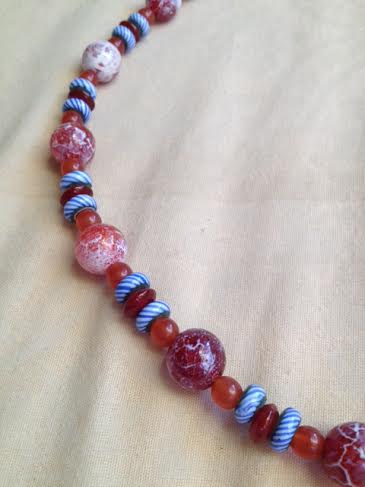
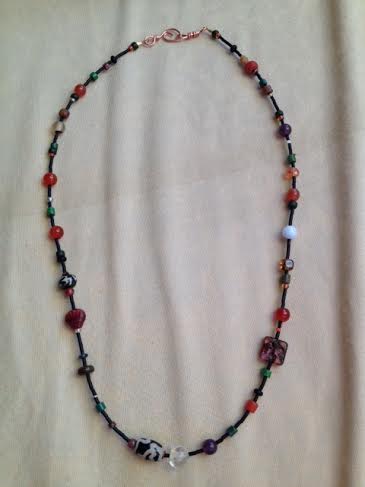
Then there is visual weight. If there are a lot of large beads very close to each other, the necklace will look heavy. This is ok for certain people, but not others. In general, older and larger women like “heavy” designs, while younger and thinner women like “lighter” designs.
Here is an example of a “heavy” design –
Here is an example of a “light” design. This is an end-of-week necklace, made with leftover bits of other projects.
Making a heavy piece lighter often just means adding some plain glass beads into the pattern. This also reduces the cost, which is another factor. You may make the most beautiful necklace ever, but people will simply not want to pay for it.
These are heavy beads, but I’ve watered it down by adding some plain glass beads.
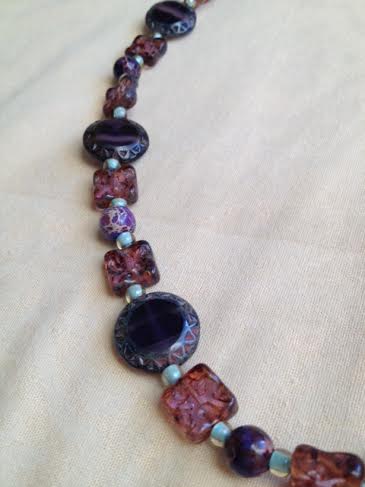
I was interested in making a big chunky necklace but didn’t have enough of the big beads to make it work. I’m trying to not get obsessive about what I make to the point that I have to go to the bead store to finish out a design. If I really want to make that specific piece a specific way, I’ll remember it the next time I’m at the store and just make a second version of the necklace.
Would you believe that the cost of just the beads alone in this necklace is $80?

And that is just the ones I used. I had to buy the whole strand of antique chevron beads. That was $200. The strand of pre-Islamic cut lapis lazuli wasn’t cheap either. I did manage to get the centerpiece for free. There is something to be said for not being pretentious at a bead show.

Sometimes I have just a few beads for a necklace and I want to use them up. I’ll work out a decent pattern and then be short a few inches. Then I have a choice. Take the whole thing apart and figure out another design, or just add some filler beads to the end. Nobody looks at the back of the necklace anyway, right? And, after all, it isn’t like I’m going by a pattern that anybody knows. They won’t know I didn’t mean for it to look like that.

I guess that is part of it. Nobody knows what I’m aiming for, so when I miss they don’t know. I think that is true with everything. Just do it anyway. Keep on trying. Keep on making and writing and drawing and beading. Keep on putting it out there.
Maybe one in twenty is a keeper, is one that I think ended up somewhere near what I was aiming for. But I think that is the trick. If I don’t keep trying, I won’t keep getting that one at all. The funny part is “the one” is the least likely to sell if it is jewelry. In my writing, “the one” that really matters is only rarely noticed. I have to remember that even if others don’t get it, I do, and that is good with me.
If you don’t love your art, quit doing it, because it isn’t about the money. Well, getting money helps. Don’t get me wrong. I love it when my jewelry sells. Now, in part I love it because it means I can buy more beads to make more jewelry. It is about the chance to create, and thus the chance to get it right.
Creating is like mastering a language. You’ll get really frustrated trying to express yourself until you figure it out. Either you need a new set of words or a new phrase or a different way to communicate. Perhaps you need sign language, or poetry, or email. Perhaps you just need to keep slogging away at it until you figure it out.
Supper surprise – limits create art.
Sometimes random things create the best results. We are in a “rustic” cabin. There is no food here save what we brought. Even basics like milk, butter, and seasonings are absent. It means we have to make do with very little and get really creative if we want something palatable.
What was supposed to be the main part of the meal wasn’t. It paled in comparison to what was the side dish. We brought potatoes to cook. We had a bag of new potatoes at home, so I pulled out five large ones. It was definitely time to eat them. They were starting to grow eyes. We mixed in a can of beans from our kit, but it just wasn’t that interesting.
We brought our kit we take to Grandfather Mountain, but slightly modified. We didn’t know what was going to be provided here, so we had to pack a lot. It is really a mind bending experience trying to figure out what two people will need to survive for a couple of days. We can’t take the whole kitchen. What is enough, and what is too much? What is essential, and what can be used for several things?
Our kit has a can opener, a bottle opener, a pair of scissors, clips, reseal-able bags of various sizes, reusable plastic bowls and cutlery, ceramic mugs (good for hot foods as well as drinks). There is also jar of honey, a jar of cooking oil (does not need refrigeration and substitutes for butter in many cases). A can of beans, a can of corn. Triscuits. Tea bags. Instant coffee. A sauté pan, and a pan for boiling or steaming. A wooden spoon, a spatula, a teapot. A pencil sharpener and pencils.
It sounds like a lot. But it all is needed and all will be used. Miss one thing and life could get complicated. No matter what, we are guaranteed to be short something.
We discovered that the lighter I brought had just enough in it to light once. So much for the fireplace. Tomorrow we will have to buy another lighter. My husband has bought survival firestarters but of course they are all at home. We don’t need to have a fire to cook – the cabin has a nicer stove than we have at home. But having a fireplace was part of the selling point of this cabin.
But then again, having a restaurant was part of the selling point of this site. Too bad the restaurant is closed for the season. So now we have to feed ourselves the whole time. We could go out, but then again, we could do that at home. The point is to stay in as much as possible, and to make ourselves make do with what we have.
We went to the grocery store. It was a Food Land, just up the road. Turns out we paid dearly for the convenience. We’ll remember this for the future. Shop at home for the stuff that can travel, and shop local for the perishables. We didn’t have a menu either. We got what looked good.
The result of the experiment the first night was toasted whole-wheat hoagie rolls with melted Colby-Jack cheese, with avocado spread and crumbly salmon. It was fabulous. We never would have come up with this at home, where we had lots of choices.
Now, it turns out that food and art have a lot to do with each other. Limits are good.
I can only bring a very limited amount of beads when I travel. Because of the canvas bag I have, the most I could bring is six of the 18 bins I have. But even six is too much for a trip, so I take one and some essentials. This forces me to edit and limit, and see things in new ways. It forces me to not be so picky and to just create. It is kind of like the challenges on “Project Runway”. You have to make something amazing but you have only three of the six things you need. ”Make it work”, and sometimes they do.
Sometimes having too much choice means you don’t create or innovate. Sometimes it is best to strip away everything and start again from scratch, just so you learn what is really important.
Art and alternative reality
I could barely sleep last night. The older I get, the harder it is to rest comfortably. But, then the more important it is to do so. I’m not sure at what point the weirdness starts. Maybe because of the medicine I’m on it will keep it at bay.
It sure was weird at Cursillo. I was on my medicine then and it still happened. But then again I think that is the point of that retreat. I think they want to inspire alternative consciousness through sleep deprivation and constant emotional highs.
My only problem with alternative consciousness is that I can’t guarantee when it will end now. I want it to end so I can return to normal. With pot it was about 3 hours. With acid it was about 8. I don’t do drugs anymore. I don’t have to. The madness comes on its own these days if I don’t take care of myself. Perhaps it always was there, and I just didn’t notice it because I was self-medicating.
Alternative consciousness isn’t that great for driving or for work. Somebody has to pay the bills, and keeping up with time and days just isn’t part of the package when your head is in the clouds.
It is why I’m resistant to create before work. Art creates its own alternative reality. That mindset is difficult to switch out of. But maybe that is the trick. Create something every morning and train myself to switch back and forth.
I’ve already written about not waiting for the muse. So maybe this is the other side. Seek out creativity all the time. Do it every day. Write, bead, paint, draw – whatever. Set a time limit. Learn how to switch back to “normal” or whatever suffices for normal in my world. Keep a constant flow of creativity going. Then, I’ll learn how to balance myself.
I think the only thing that separates productive, functional artists and raving lunatics is this skill. I believe that it can be learned and improved upon. I believe that just like shamans, we can go into that realm of spirit and come back different, but intact. I think it is just like yoga – you don’t take yoga because you are flexible and have good balance. You take yoga because you want to have these skills.
The only problem is that I don’t think there is a class on this. I might just have to figure it out on my own. I am coming to realize that this is my normal way of being. That this life, this creative life – isn’t one that has a road map.
Special orders
I’m not a fan of special orders. I’d rather people buy what I have created. But I understand the need for special orders. People want something they have in mind, but they don’t know how to do it themselves.
Special orders are hard because people don’t really know how to ask for what they want. They don’t know the range of beads that are available, and the range that isn’t. I’ve been making jewelry for over 20 years and there are many beads I’ve only seen once. If I buy them and use them, I can’t find them again. They may exist, but I don’t know where. Going back to the same store doesn’t help. They may be sold out and their supplier can’t get any more.
That is part of what makes beading exciting. It is fun to find something that other people will love and is unique. It is also part of what makes it frustrating.
It is sometimes very hard to understand exactly what someone wants when they ask for something special. When Sally asks for a green necklace – what does she mean? Opaque? Translucent? What shade of green – olive, emerald, avocado, mint…? There are hundreds of shades of color. And then what shape? Round, faceted, tube, flat…? Then what size – tiny, medium, large?
The best is when a customer sets some parameters and trusts me with the rest, and are willing to pay for whatever I make. The worst is when they say “surprise me” and really they mean “read my mind”. Once a necklace is created, it can’t be easily modified. Sure, beads aren’t like paint. I can take the whole thing apart and reuse the beads. I haven’t wasted my money on the beads. But I still have to take the thing apart. If it is too long or too short, or the pattern isn’t what they expected, then what was wasted is my time, and that is very valuable to me.
I’ve made necklaces for people I’ve not met. I’ve not even talked to them. There was a lady who I knew over the phone. She wanted a necklace for her Mom. She described her Mom and I made a necklace and she was thrilled. Rarely is it this simple.
Sometimes I’ll pull together beads that are in the neighborhood of what the person wants, and let them look at them first. This seems to save a lot of frustration. I get a better idea of what they mean. The problem is that sometimes that doesn’t work, because the beads they have in mind aren’t ones that I have access to. I’ve got a lot of beads, and there are some pretty amazing bead stores here, but they don’t have everything.
Ideally, people would buy what I made. Barring that, in the second best situation they’d say something like “I’d like a red necklace that is 22 inches long” and let me figure out the rest. Otherwise, it isn’t worth it. The joy of making is the joy of discovering. It is hard to discover with a lot of limitations. When that starts happening, it would be easier to just teach them how to make their own jewelry.
I do teach people how to make jewelry, but not a lot. Nobody taught me. I took apart old necklaces from thrift stores and figured it out. I tried stuff and learned what worked and what didn’t. Bead books didn’t exist when I started making jewelry, and bead stores were few and far between. Now anybody can figure it out easily with YouTube and beading books from the library, but they still ask me. I can teach the mechanics of it, but I can’t teach design. That is something I just know, and I’m not sure how to teach it.
Art-spiration
Feeling the art blues? Haven’t made anything in a while? What do you do when you need to get your creative juices flowing?
Inspiration comes from many places. Try something different.
Go to a museum.
Go for a walk. Look at the colors. Look at your neighbor’s houses. Look at your neighbor’s dog. Take pictures to remind yourself later when you get home.
Read a book and make something the main character would wear.
Look at a magazine that has nothing to do with art. I find a lot of inspiration from architecture magazines.
Watch a movie and try to replicate something you see there with the supplies you have. Don’t replicate it literally, replicate how it makes you feel.
Try limiting yourself. Some of the most amazing pieces were ones I made from using just two (of the 14) bead bins I have. I decided I could not get any other beads – I had to use just those.
Make up a rule – only two colors, or only two textures.
Only use beads that were purchased from the same store, or the same state.
Use only one kind of art supply.
Use all the beads you can’t stand and put them together and see what happens.
Set a deadline – five things must be made by a week from now.
Sign up to do a show. That will force you to make stuff.
Have an art-date with a crafty friend. You both get together to make something, and you’ll be inspired seeing what the other person makes.
Buy more art supplies. Nothing inspires me more than getting new beads or a new tool.
Buy art supplies in places that don’t sell art supplies – like the grocery or the hardware store.
Only use materials that you found, or were given.
Have an art-swap, where your fellow crafty friends bring all the art supplies they don’t want or use. Trade. Make something.
Organize the supplies you have – you’ll find stuff you’ve forgotten and see combinations you’ve never noticed.
And just make. Make something, even if you don’t feel it. Sometimes the stuff that people are most impressed by is the stuff that I made in 10 minutes without thinking about it. Put something together, then put something else together.
Hide the bad stuff.
Smart artists hide the bad stuff, like how smart criminals hide the dead bodies. Part of being a good artist (or writer, or musician) is not showing people your false starts. And there are a lot of false starts in being an artist. There is a lot of “I wonder what this does” or “I wonder how this looks”. Those questions are the same as “Hey, watch this” and result in the same number of skinned knees and broken bones. But they also lead to amazing discoveries.
Part of being an artist is trying out new things. Part of it is just being willing to try. Part of being an artist is being willing to make really amazing mistakes. Part of being an artist is learning from those mistakes and not doing them again. Part of being an artist is discovering something entirely new and amazing and wonderful from those mistakes.
Sometimes I’ll show off something that I think is “eh” and others think is “oh yeah!” And other times I’ll put out something that I think is “wow” and others think is “meh”. You really never know. The audience always brings itself to your art.
What you meant to say is never what they hear. Ever. Get used to it. Even of you go out of your way to make what you mean to say as crystal clear as a lake on a still summer’s day, it still won’t mean that to the audience. Because the audience brings its own past and impressions and feelings to the table and sees your art through different eyes.
So just create. Learn to edit. Try. Show off the good stuff. Realize that some of what you think is the bad stuff isn’t that bad. Show it off too.
Artists just make creativity look easy. It isn’t. What the audience sees is the result of many years of work and refining. The audience sees the tip of the iceberg, while the artist sees all that ice. The artist scaled that ice, clawing and scraping to the top, step by agonizing step.
Consider Bruce Lee. He made martial arts look so easy and effortless. It wasn’t effortless or easy. He practiced all day. When he broke his back and was immobile he thought about his practice and had his wife write down his ideas. He was constantly working on his art.
So go make stuff. Make more stuff. Show it off. Make more stuff. But keep practicing your art, no matter what.
Thoughts on jewelry making – price and selling.
It is really hard to price my work. Do I price it based on how much I love it, how much the materials cost, or how much I think I can get for it? Often it is a combination of all of these.
Sometimes I have something I call “the annoyment factor” to deal with. In part that refers to how annoying it was to make. Either it took me a lot of time because the process is fiddly or the materials are hard to work with. Stringing things on Tigertail is easy and cheap. Using the same beads but using copper wire, where I have to hand link is hard. I love making jewelry this way but very few people appreciate the labor involved.
Sometimes the annoying part is the person. The beads might be inexpensive and the process might be easy, but the person might be difficult. Sometimes it costs me a lot of energy to deal with certain people. I want to be reimbursed for that. Sometimes I don’t want to ever deal with that person again and so I put a high price on my work.
Sometimes I have the “don’t blink” price. I’ll have a really high price on something and I know that the people looking at it don’t know what was involved. For instance, I made a bead once that looked like a woman. Because I was working with MAPP gas and not oxy-propane it was even more difficult. I had only 40 minutes to finish it, rather than hours. I could only make it an inch long. There are a lot of limitations working with that medium, but it is a lot safer and cheaper than the other. People tried to bargain down the price I quoted and I didn’t budge. I stood with the price because I knew the amount of effort involved.
I don’t make jewelry as my job. I do it for fun. I’d like to get at least the price of the beads back. I certainly want to get paid for my time and my creativity. I’d also appreciate getting paid for my knowledge too.
I put a lot of energy into making jewelry. I read books about beads and gemstones. I know the hidden meaning and I’m aware of the history and energy behind the beads. I don’t just string beads. I create. I shape. I like to think of it as something like a shaman’s work. When I’m making something for a specific person I match the beads to them not just by color but by intent. For instance, a bead may be black, but it is also made of lava, and as such has deep significance.
One time a guy was asking about the price of some beads I had made. I used to do lampworking, so these were unique beads. He had an assortment of them picked out. I wanted to give him a good price that was fair to both of us. Because I’d made them at work the only investment I had in them was my time and ability. The glass and gas were free to me. I said “How about $23?” He countered with “How about $20? He thought when I said “How about…” that meant that there was wiggle room, but he was wrong. I got very cold and said “How about $25?” That surprised him. I don’t like being insulted about my work. I’d given him a very reasonable price, in fact far too low for the time I’d spent.
I don’t really want to take the time necessary to teach people about beads. I want them to appreciate the value that they have, but they don’t. In order to get the price I’m asking I have to teach them and be patient. I got great prices when I bought necklaces at thrift stores and then redesigned them. A 25¢ necklace could be remade into a $15 necklace with a little time and a few extra beads. But now I’m going to bead shows and getting strands that are imported and sometimes antique, so the prices have to go up. I don’t have a wholesale license, and I really don’t want one. That would take some of the fun out of it.
One person messaged me about a necklace on my Etsy page. She wanted me to either drop the shipping cost or lower the price of the necklace. If the necklace had been full price I would have worked with her, but it was just $5 over the price of the beads as it was. My shopping charge isn’t high. It is the price of the packing material and the average shipping price. I decided that I would rather not sell it at all than feel like I’m being insulted.
Some shops on Etsy offer free shipping but really nothing is free. The cost is always factored in somewhere. I’d rather be honest and charge a fair shipping charge than have to raise my prices to cover it.
Sometimes people want a high price. They think it has more value if it is high. Maybe I should raise all my prices so people value my work. They certainly aren’t buying as is – I might as well get a good price when they do. Perhaps they will take my work seriously if it costs more.
Then sometimes people will want to trade beads for beads. I’ll do this occasionally, but they better be beads I can use. Plastic beads are never considered. Weird shapes, the same. Otherwise I have beads that I can’t use taking up space in my bins.
Consignment is the worst. I understand how it benefits the shop – they don’t have to pay anything for the merchandise until it sells. Too often, I get stuff lost or stolen, and I’m out money. It requires too much effort to keep up with.
On art – collage, time, and audience.
I’m working on a new art style. I’m trying to do collage and it is testing my patience. I love the art of Nick Bantock, of the “Griffin and Sabine” series. I don’t want to replicate his work but I do want to try to approach its emotion and depth. The problem is that it takes a long time and you can’t erase.
When making jewelry using beads, if the pattern doesn’t work out you can always take it apart and redo it. Even years later you can always try again if the design gets old. Not so with collage. Once you paint something or glue it down it is done. You can’t go backwards and change things if it looks weird later. You can’t reposition it. You are stuck. You’ve used up the materials too – you are out that money. It also takes a long time. If you have multiple layers, you have to let each one dry for hours. I’m not really that patient, but I have to be to make this work.
This has stopped me from even trying this style for a long time. I’ve got lots of art materials that I’ve not used at all for fear of doing it wrong. So I’m wasting them even more so. It would be better to use them and figure out what works and what doesn’t work than to not use them at all.
Boats are safe in the harbor, but that isn’t what boats are made for. The same is true of collage. The same is true of life.
I’ve decided with collage the best thing is to just get over my “need” to start something and finish it in the same sitting. I certainly don’t feel that I have to do that with beads or with writing, so I don’t know why I think my painting has to be the same way. Maybe I want to see results fast. Maybe it is because I don’t have a lot of time to work on my art.
I think part of it might be that I resent the amount of time my job takes from me having time to do what I want. I just don’t seem to have a lot of time to do “me” things. I know I’m not alone in this thought. Nobody gets up and says “Yeah! I get to go be a cube-farmer today!” Don’t get me wrong – I like my job. I like the people I help. I just don’t think it requires 40 hours a week to do it. After 40 hours of work and the time required for sleep, there isn’t a lot of time for “me” stuff.
I’d rather work 30 hours than 40. I’ve asked if it is possible and they don’t think so. So I shoehorn in my “me” things – writing, exercise, art. I love the space I go to in my head when I create, and it is hard to wrestle myself back to a clock and a schedule and go to work after being in that space.
I’m starting to see collage as a good middle ground. Since I simply can’t do it all in one sitting, it works well with not having much time. I’ll do a layer, wait, do another layer, wait, and do another layer. I can’t work on it for hours at a time, and that works because I don’t have hours to work on it.
Collage is strange to work with because I don’t know how it is going to look until I’m done. I have some general idea but then when I add another element it changes everything. I can get an idea of where things are going before I glue a piece down but then sometimes when the glue dries it changes the effect. It is always a surprise. Sometimes it isn’t a welcome surprise.
But then I remember that with writing and with beads, the stuff that I really planned out and really love how meticulous and amazing it turned out happens to be the stuff that nobody “gets”. Nobody likes it or appreciates the work involved except me. Conversely, the stuff that I really don’t care about much – the stuff that I worked on and just don’t like as much is the stuff that people rave over. That is the stuff that I think is OK enough for others to see, but it just doesn’t get my idea across the way I meant to.
There are plenty of pieces of writing and pieces of jewelry and other artwork that I’ve created that nobody has ever seen. I feel like I show a lot of what I make, but what people see is just half of what I’ve produced. Some things I feel are just warm-ups, just stretching. Some things are simply exercises that help strengthen me for something better later.
I don’t feel like this about my art at the time. I want everything to be a marathon win, but some things just peter out about the three-mile mark. Or maybe that is just me. Maybe I need to show it anyway. Following the usual trend, they will be the things that people will really “get”. But for now, I don’t want to show them because I don’t want to put my name on them.
When you show any art – be it writing or visual art, you put your name on it. You say “this is me”. For good or for bad, you are showing off what you have made. People will judge you by it, for good or for bad. So you have to be careful what you show. You want to be known for good work so people will seek you out and buy what you have made. You want to get a reputation as a maker of good things. Do you keep with one motif, or do you have a range? Do you create for an audience, or create for yourself? Whatever you decide, you have to be mindful of who is going to see it and what they are going to think. Does this cause you fear, so you edit? Does this cause you excitement, so you embellish? Your relationship with the audience will influence your work.
Art isn’t yours anymore when you let other people see it. It changes. The meaning changes. What you thought it meant doesn’t matter anymore. When another person sees it, she brings herself to it. She brings what she loves and hates to it and sees that in it. Art is a mirror. It isn’t something that stands on its own and speaks for itself. It would be great if it was, but it isn’t.
 betsybeadhead
You must be logged in to post a comment.