Real art versus copy

I really like Nick Bantock’s art in the “Griffin and Sabine” series. Something I like about it is it seems so dreamy and ethereal. He uses bits of photographs and stamps and other ephemera in order to create his art. There is acrylic paint, certainly, and tissue paper as well. But the most important part to me is that he uses objects.
I read his book “Urgent 2nd Class” about how he makes his art. He says to make color photocopies of everything you use and not use the originals. I felt cheated when I read that. I thought that everything he was using in his artwork was real. It gave it all a magical, totemic quality, a sense of risk. Now, not so much. Sure, it is beautiful, but it isn’t the same to me.
I’ve been making collage art, inspired by him and others. I’m torn as to whether to use copies or originals. I can see the points for both sides.
It might be easier to not use the real thing because then there’s not as much pressure. If I make a mistake with the real thing, I’m in trouble. There is no going back like with beads or with digital manipulation. Paint is permanent, and so are scissors. One wrong blob or cut and I’ll have to figure out a way around it or scrap the whole thing.
I could certainly play around with a copy first while I figure it out. Then I could make the final version with the real stuff. But I don’t really have time to make multiple versions of the same things, and I know from all my other forays into creating art that whatever I think it is going to be, it never is. So even if I get it “perfect” with the copies, it will look different when I use the real stuff. Plus, half of the reason I create is the discovery. It is nice to get what I see in my head, but it is also nice to be surprised when something works out better than I planned.
Well, I’ll be honest. It wasn’t nice at first to have things not come out the way I’d imagined. But I’ve learned to like it. At first I was pretty upset that what I was aiming for just wouldn’t materialize. I had all the pieces – how come they won’t go together like I think they should? But sometimes what results is far more interesting. Sometimes it isn’t, but then I just don’t tell people what I was aiming for. I act like I meant it to look like that. Even if it does look like what I was planning for, they wouldn’t know anyway.
Using the real thing could certainly be intimidating. It might make me not even start on the piece.
Sometimes when creating art you have to think about what will make the art happen. Sometimes having limits helps, and sometimes it hurts. Sometimes having limits on what tools or techniques you can use will actually make you more creative. Sometimes it might stop you before you even begin.
For now, I’m using originals, but I’m doing it carefully. I’ll try out something with a real piece (like a stamp, or a foreign bank note, or a fortune from a cookie) but maybe it isn’t “the” piece. I’m learning how that kind of paper works with the glue and the paint I’m using. Then I can use that knowledge for when I make a “real” piece, with more meaningful ephemera.
I can see another advantage to using copies – the paper is always the same. So there is no adjustment to be made for different textures or absorption rates. If the materials are all the same, it frees you up to work on composition and style.
But I still feel like that is cheating the audience. I like the idea that what they are looking at can’t be replicated. If there are copies of the ephemera being used, then another copy of the artwork can be made. Sure, it won’t look the same – that is part of the nature of art in general and painting in specific, but it will be close. Part of what I like about creating artwork is that each piece is unique.
A painting that has real things in it has an energy to it, like a shaman’s necklace. Each item has a story, a background, a history. Each piece adds to the song. They aren’t just images, but the actual thing. A picture of a shell isn’t the same as a shell itself. And just any old shell isn’t the same as a special one – say the one you found on your anniversary trip. It is that kind of energy that I’m talking about. You just can’t get that from a copy.

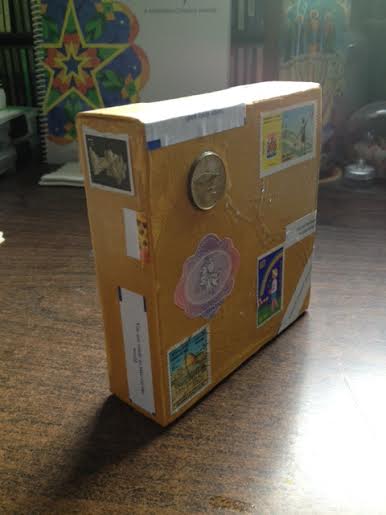
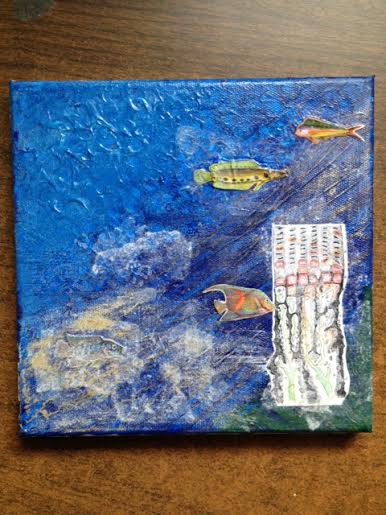
These are some examples of what I’m making.
collage2

collage1

side view –
collage3

Art for free, part two.

I once had a problem with ladies who were looking at my beaded jewelry. They asked how long it took to make. Because it didn’t take long, they didn’t appreciate the cost.
I’ve made jewelry for over 20 years. I know what I am doing by now. It doesn’t take long, once I have the idea in mind. But artistry and the cost of the beads (!!!) has to be factored in.
They don’t get it. They are thinking they get paid $15 an hour, and if this takes me 20 minutes to make, it shouldn’t cost $40.
I could lower my prices, but then I feel like I’m being used. I’ve heard that in Arabic countries you can buy gold jewelry for just the price of the gold. The artist gets nothing. The price is based on the type of gold and how much it weighs. Perhaps that is what people expect me to do with my beads. Just charge them the price of the beads, and nothing for the skill or the creativity.
Perhaps I should start telling people that each necklace takes three days. That would factor in the time involved in getting to the bead store, thinking up a design, trying it, and then finding out it doesn’t work the way I thought it would. Then wait a day fuming about it and rethinking it, and try again and discover what comes out.
Some pieces do take forever. Some go fast. Some never sell. Some sell very quickly. I don’t make anywhere near enough money to make a living at this, but I still don’t want to be insulted. I’d rather rip apart a design and reuse the beads than sell it at just the cost of the beads.

Art for free.

There has been a recent discussion on a creative page I’m a member of. It is about trying to get the public to understand why art costs what it does. People aren’t willing to pay the asking price for art. They want it for free.
People think they can make whatever you have made themselves for cheaper. They don’t understand the time and training necessary to create that piece of art. Or, they try to talk you down on the price. They want Tiffany quality work for Wal-Mart prices.
Now, it doesn’t help that there are a lot of people who say they are artists who put out terrible work and charge high prices. Millions of dollars for a Jackson Pollack piece? Really? It is paint, thrown at a canvas. A child could do better.
I once read a story about a jewelry designer who was dealing with a difficult customer. The customer balked at the price of a wire and stone necklace – pointing out that the price of the items was a lot less than the price on the necklace. The artist sent her a box with a spool of wire and the stones. The necklace was reduced to its parts. The customer called and complained. The artist pointed out that if she wanted it to be put together, she could do it herself, since all she was willing to pay for was the materials.
There is a lot more to art than materials. There are the years of learning and polishing the craft. There are all the mistakes and wasted supplies, learning how to perfect a new technique. There’s a lot of time and energy put into being an artist. It isn’t something that just happens. A good artist makes it look easy. It isn’t.
There are also incidental costs to art. Shipping supplies aren’t free. Marketing isn’t free. Display racks aren’t free. The same is true for pop up tents for art shows. Entry fees are rather steep. Then you have to schlep your stuff to the show and back, in containers, that again, aren’t free. There is wear and tear on your vehicle and yourself. It all adds up and has to get factored into the cost of the art.
I have found that I enjoy the transaction more if I’m selling to another creative person. S/he understands value and doesn’t haggle. So maybe that is it. We need to actively teach other people to engage with their artistic side. They will understand how much work is involved, what quality is and isn’t, and they will become artists to boot.
Perhaps some artists won’t like that idea. Perhaps they think there will be competition. Perhaps they think that if everybody can do it, then they won’t have a monopoly on art. But then I think they might make art for the wrong reason. Everybody should make art. It is healing to do.
I honestly think that if more artists taught other people to be artists, then the public would be happier to start off with, and more understanding of what goes into making quality art. Then they’d be willing to pay real prices for real art.

Blob art.

There seems to be two ways that art is going these days: hyper-realistic and blob. Either people are painting reality better than reality or they are painting blobs.
Me, I’m in the blob category. Sure, it is fun. And nobody will know when I don’t get what I was aiming for, because what they see looks nothing like anything else anyway. When you try to replicate something that is real, it is easy to tell when you have missed the mark. Blob art is free from this constraint.
But then I see other blob painters charging hundreds, even thousands of dollars for what they made, and I wonder. Is someone actually buying this?
Blob art can be made by toddlers. The more you think, the less it works. In fact, part of the reason I paint blob art is because I want to not think. I want to disengage. I have tried to paint blob art with brushes and other paint tools and I just don’t like it. It is fingers all the way for me.
I call it blob art because that is how I make it. I pick up a tube of paint that looks nice and I squish out a blob of paint on the canvas. Then I pick up another tube and squish it out too. I’ll keep adding blobs until I feel I might have something to work with. Then I smear the blobs around and mix them together until I like the blend and the swirls. Sometimes I add in a few more blobs and mix them in.
It is kind of like how I cook. Spices, colors – it is really all the same. I’m heading towards a goal, and I take whatever I need to get there.
Painting realistically has never made sense to me. Just take a picture. It is faster. Sure, it is pretty impressive to find someone who can paint a picture that looks like it is a photograph. But to me it seems like a waste of time.
Now, one advantage to painting is that you can paint what isn’t there. You can paint all the good stuff and leave all the bad stuff out. This is especially appropriate when you are painting a family portrait and not everybody is available to sit for it at the same time. Or it also works if you are painting something that would be good for a science fiction illustration.
While you can create some pretty amazing things with photo manipulation software, there isn’t really “art” in that. You aren’t making something new, so much as working with what is already there.
Is blob art really art? Sometimes it just looks like someone shoved paint around a canvas. Sometimes they did. Sometimes I do. So is it worth a lot of money?
Sure, the materials are expensive. Paint and canvasses are stunningly expensive. Framing is insane. Sometimes you can get deals on supplies but not often. So there is something about the actual physicality of the piece that will raise the price.
Sometimes what inspires people to admire artwork or writing or music is what it reminds them of. What they see in it has little to do with what the artist put into it. Some swirl, phrase, or riff catches their attention in just such a way and they find that a doorway has opened in their mind, or a bridge has been created.
That is one of the most frustrating things to me as a creator. I really feel like I’ve expressed something well, and people just don’t get it. They may like it, but what they like isn’t what I was trying to express.
Maybe that is why I make blob art. I don’t have as much invested in it. It doesn’t matter if they see something different in it, because I didn’t put anything in it. It is more about what I got out of it.
I discover when I create blob art. I play, too. I learn how the colors go together, and I relax during the creation. There is no stress because there is no specific goal to be reached. Just enjoying putting paint on the canvas is the goal. It isn’t about creating anything. It is about creating me.

The artistic life

I’m on vacation, and I just haven’t written as much as I normally do. I’ve taken the time to draw, which is nice. It seems to take just as long to draw as to write. I’m not sure how I’d find the time to do both.
What is more important? Isn’t it just important that I’m engaging in art? Art of any sort is healing. The ideal is to have time to write, sketch, paint, drum… But then there is a job I have to go to.
I have a few friends who essentially have said that art is more important than a job. They have made art their job. They say things like “money is evil”. While I agree that loving money isn’t great, I do like the things that money can buy, like food, shelter, and clothing.
While I don’t live large, I do like to live comfortably. I have a small house. Most of my clothes come from thrift stores. I eat well, in part because I’ve learned how to cook. While I admire the gumption of people who have decided to strike out on their own, I feel a little like they are saying that my path isn’t valid, isn’t authentic. I feel a little like a meat eater versus a vegetarian.
Their way is seen as higher evolved or more mindful. My way is seen as hedging my bets and unwilling to cut loose from the shore. My way is seen as being a slave to “the man”, whoever that is.
They wonder why their friends and relatives don’t support their choice to follow their dreams. The only problem is that “support” means “pay for”. They expect their friends and relatives to buy what they’ve made or go to their seminars. Meanwhile they mock them on social media for staying with their secure job. You know, that job where they earn money to buy their art.
If we all quit our jobs and start making art, then how are we going to pay our bills? Because who is going to come to our our seminars and concerts? Who is going to buy our books and artwork? We will all be starving artists because we won’t have an audience to buy our stuff.
I feel it is very dangerous for an artist to mock her audience, or to make them feel like suckers. If everybody could draw or write or bead or dance then why would they need to see you do it? Why would they need to pay you to do it?
We need gas station attendants. We need janitors. We need garbage truck drivers. We need them the same as we need teachers, doctors, lawyers, and diplomats. Saying that someone is less evolved, less mindful, or is just plain less because they have a “real” job and haven’t cut loose and created a non-profit or live in a commune is thoughtless and cruel, and wrong. It is wrong in the sense of “mean”, but it is also wrong in the sense of “incorrect”.
You can be creative while working for “the man”. It just takes a little figuring out. And to knock down someone else’s lifestyle choice as being less enlightened than yours is, in itself, less enlightened.

Addiction and creativity

Back when I smoked pot, I was very creative. I actually got to the point that I was afraid to quit smoking for fear I wouldn’t be creative anymore. That, of course, is silly. Pot doesn’t make you creative. I was already creative. Pot just gave me an excuse to be creative.
I knew someone who smoked pot and thought that music sounded better when he was high. He listened to an album that he’d listened to many times and heard parts of it he’d never heard before. That music was always there. Pot didn’t bring it out. He just expected that things would be different, so he was paying more attention. The music was his focus, instead of in the background.
I knew a guy who had learned how to play the drums while he was stoned. He said he couldn’t play when he was sober. This, too, isn’t true. It is something that he had taught himself to believe. Pot just made him relax and not think about things too much. Or rather, he thought that it would do that. It is all a mind game. It isn’t the thing you use, it is what you think it will do that does the trick.

Start where you are.

Start where you are. It is uniquely yours.

Describe what you see if you are a writer. Take pictures if you are a photographer. Paint it, draw it, make a song of it.

This isn’t just physically. This isn’t just a place. Not only where, but how, you live. This includes who you know, what you do, how you play, all of it. Describe your environment inside and out. Show it off, and turn it around. Explain it, excuse it, defend it.

What was life like growing up in your house? What was your family like? What do these things look like now?

Tell what is and what was. Tell the actual, the way you remember it.

You may think that nobody cares about what you have to say, but strangely they do. Your perspective isn’t their perspective, so no matter how boring it may seem to you, it is entirely foreign to someone else. This is true even if they are from the same country, or same state, or same town. This is true even if they live right next door to you. This is true even if they are a sibling and grew up in the same house as you.

Your story is uniquely yours, and is for you to tell. Or paint. Or photograph. Or dance. Or sing. Or bead.

There are as many ways to tell your story as there are faces, as there are flowers. Try one or three. What can be expressed in one format can’t in another. What makes sense in one is senseless in another. Some are better at expressing different feelings. Try them all. Make up a new one.

But start where you are, because that is where you are. Start where you are and tell what you see. Start where you are and share it with the world. Because we are waiting to hear it.

On cheap beads and cheap jewelry

There weren’t many bead stores when I first started making jewelry over twenty years ago. I hadn’t even thought about making my own jewelry until I met someone who did. She took me to a bead store in DuPont circle in Washington DC, near where I was living at the time. When I moved back home to Chattanooga there weren’t many options to get supplies for my new hobby.
There was one bead store, way out in the middle of nowhere, thirty minutes away from my house. It was a rarity for that time. That lady was forward thinking. It was called Fat Jane’s beads, and while the owner was named Jane, she wasn’t fat. It was a joke from when she was pregnant. Her store stocked a lot of beads, but they were all in containers and all the containers were in display cabinets. It was a long drive to get there, and a lot of work to find the beads I wanted while there.
I prefer to look for beads unmolested. I like to study each strand for as long as I want to pick out the exact shade and variety I require without having a shopkeeper stare at me. I also don’t want to have to ask for each box to be pulled out of the cabinet. It is as if she didn’t want to sell the beads at all. Beads were the main focus of the store, not a sideline, but it didn’t feel like that at times.
Another place that sold beads was called the New Moon Gallery. They didn’t have many beads, but at least they left me alone to study them. Beads were not their main source of income. They sold books and clothing and music and jewelry to the New Age crowd. I even sold jewelry to them for a while.
The best place to buy beads was Goodwill. I bought necklaces and tore them apart carefully to learn how to make my own. There weren’t books or classes about how to make jewelry then. I figured it out in my own. Goodwill was the best for beads. Not really for selection, but for price. I could buy a necklace for a quarter and redesign it into a triple stranded bracelet and sell it for $15. Cheap price, huge profit. The ladies at the one I frequented knew me and saved off the good stuff just for me so I’d have first dibs.
Too bad people don’t understand how much beads cost these days. They aren’t cheap at all. Goodwill sells all the really good stuff online now. Plastic junk is all you’ll find when you go into the store. Bead stores are more plentiful, but the prices are much higher. At the price per amount of space in the bag, beads cost way more than I remember pot ever costing.
Back when I first started making jewelry, the two went hand in hand. I’d smoke a bit and bead a bit. Creativity flowed. Now I’m sober, I don’t create with beads near as often. I’m just as likely to write or paint or draw now. But I still like creating jewelry and I still like selling it, but the prices have had to go up because the cost of the beads has gone up.
I can certainly make everything cost $20 or less but it will be watered down. There will be lots of cheap glass filler beads. There will be very little design. Boring. Bland. Blah. People have to understand that they get what they pay for.
Who am I kidding? This is a society that eats food with artificial colors and flavors and chock full of preservatives. They don’t like homemade, organic, good for you. They don’t appreciate individual, artisan work. They don’t get one of a kind. It appears I have two choices – I could lower my standards or just expect people to raise theirs.

Painting and drinking

I keep finding out about opportunities to paint and drink at the same time. This seems like a fairly new idea. You get together with other people and you all paint the same thing and you either bring your own alcohol or the venue provides it. All the instruction and paint and canvas and brushes are normally provided.
For me, alcohol would just get in the way, but I see the point. Plenty of people have a hard time getting in touch with their inner artist. They essentially need permission to create. They’ve shut that side of themselves down for so long they’ve forgotten it is there. Drinking a little helps people unwind. It doesn’t make them creative – it lets them be creative.
It is like drinking when I paint. When I paint I get high, no alcohol needed. I step into a new world where the rules change and anything can happen. There are always surprises. That is why I paint. Painting is an escape.
I don’t paint very often though. Painting is messy. Painting takes up a lot of space. I can’t do it just anywhere. I need to have enough room to put down a tarp, so that is always in my craft room. I don’t spend a lot of time in there actually crafting though. I should probably call it my craft supply room instead. It is mostly where I keep the materials, but not use them. I’m getting over that.
I’ve thought about going to one of these classes and not drinking. But then I remember that the classes aren’t free form. There is a goal. There is a pattern. We are expected to copy the pattern as best we can.
For me, the best part of painting is the discovery. I don’t want to walk along a set path with a guide and a bunch of other tourists. I want to wander. I want to wonder. I want to find new things and be amazed by them.
Perhaps I’m making my life more difficult with this attitude. Perhaps if I learn from someone else how to paint I might learn something that would help me when I’m painting on my own. Perhaps I’ll learn some tip or trick or technique, in much the same way that I learn when I watch cooking shows. I rarely cook what they cook, but I learn how to cook what I want in a different way.
I resist following others. I resist fitting myself to another’s pattern. But then I struggle with things on my own because I don’t know how to do them. I’m realizing this and adjusting accordingly. I can learn from others without copying them.

Self made self.

I find it fascinating how easy it is to create a brand identity. You can print your own business cards, address labels, and letterhead. You can put your logo on hats, t-shirts, and water bottles. Anything that you can imagine can be printed with your own name and logo. You can print your own book and publish your own website and blog. It is all very easy and inexpensive, and pretty amazing. So where is the line, or does there need to be one? What makes someone official? The logo? The certification? The experience?
For some jobs they ask for four years of school or four years of equivalent experience. They are considered equal. However, way too many people go through four years of school and they still don’t know anything when they graduate and get hired. Another person at the same job can have four years of experience behind her, but no diploma. So what does the diploma mean? Somebody else thinks you might know how to do something? You test well?
Maybe there is something to just doing it anyway and not waiting for someone to give you permission or certification or credentials. They say the suit makes the man, after all. So maybe the book makes the author.
Maybe we have entered into a time when people don’t have to do it the old way. Maybe we have entered into a time where self publishing doesn’t have the air of desperation it used to. It used to be called a “vanity press”, but now famous people are self-publishing and essentially giving the finger to the big publishing houses. They are doing it all themselves and taking all the money.
Maybe people have just gotten tired of waiting for someone to invite them to the dance and they decided to put on their favorite shoes and go and have a great time. The more you do for yourself, the more control you have over it.
I sold beaded jewelry I made on my college campus. I had all my creations in a metal Bahlsen cookie tin. I did fairly well, and learned a lot about human psychology. It was amazing how many women were so proud of my creativity and entrepreneurship. It was also amazing how many men wanted a piece of the action.
Several men said they could “help” me sell my jewelry, for a cut. They said would show off and take anywhere up to 25%. They never volunteered to help me for free, or take the time to help me make the jewelry in the first place. I felt like they were being pimps. I’d do all the hard work and they’d get some money. This hardly seemed fair. I always said no.
So maybe it is the same with schools and credentialing. Maybe they just want their cut. You do all the work and they give you a piece of paper for all your trouble. Maybe it is the same with publishing houses. I do all the writing and they get all the money.