Room at the table.

I was in a pastoral care class last year. A guy from another church started talking about the Christian church today. He was really afraid for how far out the church had gone, trying to make it open to everybody. He was afraid that we “had pushed the boat out so far from the shore” that we couldn’t even call ourselves Christian anymore.

He was afraid that making the church “all things to all people” watered it down so much that the message was lost.

Deep down, he was afraid that anybody could do anything and still say they were Christian.

They could be women and want to be ministers. Not deaconess, not pastor’s wife, but honest-to-God minister. Women are supposed to support men in their ministry, not be ministers Women are supposed to be like children – sit down and shut up. They are supposed to cover their heads and be silent in church and be submissive to their husbands.

Or they could be gay, and not only gay but openly gay, holding hands with their partner in public. There is a bit of “don’t ask don’t tell” going on with homosexuality in the church. Some people are ok if you are gay, as long as you aren’t open about it. They may understand that homosexuality isn’t a “lifestyle choice” in the same way getting a tattoo is, but they still don’t want to see it. They want to at least pretend that you are gay, but celibate. They want to think that you have at least stopped acting gay.

While we are on the subject of tattoos, there is that too. For some people who go to church, they are uncomfortable with you saying you are Christian if you have tattoos. They know in the back of their heads somewhere that it is wrong. They can’t tell you the verse that mentions it, or explain it even if they knew it, but they know it is wrong, because they were told it was. So they want to close the doors to you.

I wonder how they would handle a gay woman with tattoos in the ministry.

The trouble is that Jesus didn’t give us any of those rules as to who was in and who was out. Those rules came from the Old Testament and from Paul. Not Jesus. Jesus leveled the playing field.

I wonder what their fear is? What are they afraid of if we open church up to everybody? If we are to find the lost sheep, who are we to tell this one that he isn’t good enough? This sheep is black, this one has a limp, this one is blind in one eye, this one has a strange smell, this one sounds different when he bleats. Sorry – you aren’t like the rest of the sheep that are here. You are out.

If Jesus calls them to him, who are we to stand in the way?

When Jesus multiplied the loaves and the fishes, he made enough for everybody there and lots left over. He didn’t feed just his disciples. He provided for everybody, no exceptions. Nobody was asked if they were worthy, if they were contrite, if they were holy enough.

Nobody was asked anything about their sins and what they planned on doing about them.

They were there for Jesus. They were there to hear his message. Jesus spoke to them all, and fed them all.

We are to do the same.

Instead of members of the church worrying about watering the message down by allowing “just anybody” to be a member, we need to worry about our own actions. Are we holding on to the bread, thinking it is ours alone?

Jesus hung out with the hooligans, the misfits, the has-beens and the never-was. He hung out with the outcasts, the lepers, the last on the list. He touched people he wasn’t allowed to touch. He broke all the rules.

He gave us a new kind of math. His cross is a plus sign, and an equals sign. Jesus is the centerpoint – where Heaven meets Human. Jesus is the epicenter, where God came down here, to be with us, as we are. No longer was God up there, out of reach, rarified and separate. No longer was there a division between God and us. This is the plus sign. This is the cross.

And he made us all equal – all forgiven, all blessed, all loved. We are all equal in God’s eyes. We are all his children, not the chosen few who look the part, but all of us, as we are, right here, right now.

Jesus made enough room for all of us at his table.

“All Are Welcome” – on Communion, and limits.

I was at a retreat and heard the sound of Mass. The songs were familiar. The words were familiar. I have spent many years as an Episcopalian. The Catholic service is close. It is like the difference between England and America – everything is almost the same. I could have joined in and faked it. I could have taken Communion. It has been four months since I’ve had the sacrament of Communion. I miss it.

I wanted to join in, but knew I shouldn’t. Catholic rules say only Catholics can get Communion. Jesus didn’t make any such rules, but when in Rome…or dealing with Roman Catholicism…it is best to play by their rules, even if I think the rules are wrong. Even if I know the rules are wrong.

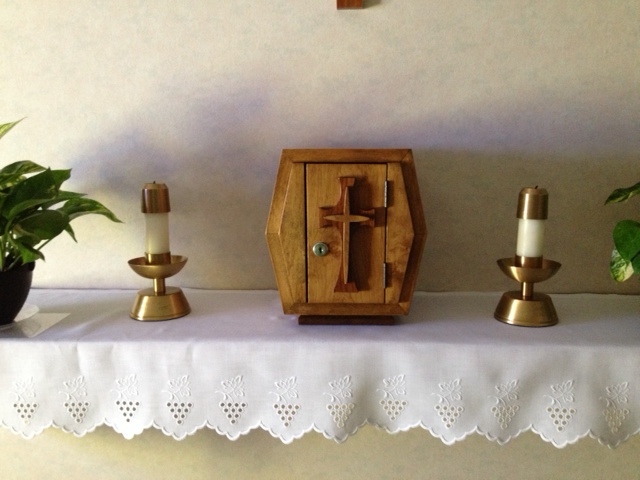
I’ve spent the past day at a convent for retired Catholic nuns. There are two chapels – one big and one small. They both have a box called an aumbry or tabernacle for the reserved sacrament. It is where you put consecrated Communion wafers. Before they are consecrated they are just wafers. After a priest has blessed them, they are different. They are so different that they are separated from the others in a special box. The Catholics believe that the wafers become the actual flesh of Jesus when they are blessed by the priest.

Here is a picture of the altar in the little chapel.

box 5

Here’s slightly closer.

box 1

I know that consecrated wafers were in them because the candle beside the altar was lit.

box 2

The candle means Jesus is in.

I can’t even tell you how tempted I was to see if the box was locked. Yes, these boxes have locks on them, but often they are open. If I tried the door and it opened, would I have taken a wafer?

Here’s a picture closer up of the box, showing the lock.

box 4

Taking one out would be stealing. That would have been the same as attending Mass and going up to take Communion, knowing full well that their rules say I can’t. No – actually, it would have been worse. It would have been sneaky and sly. It would have been taking something like a thief.

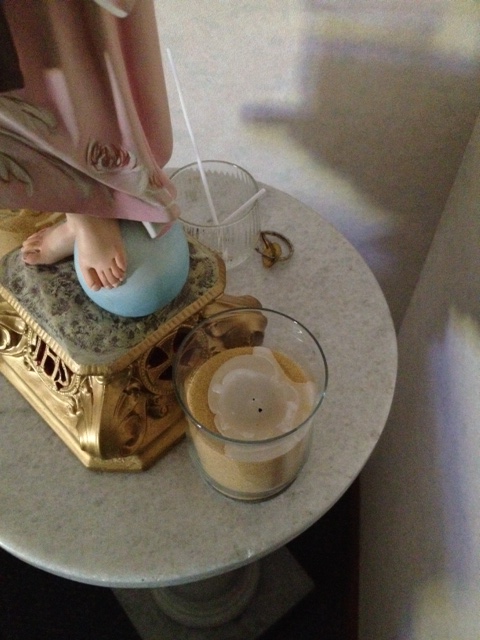
When I was wandering around the room, I came across a little statue with some candles around it. I saw the key behind the statue.

box 3

I felt like I was part of some adventure game, where you find the key to the locked door with the treasure. Remember those? You’d use simple instructions with a verb and a noun to get across what you wanted to do.

Take Key. Go East. Go to Box. Use Key. Open Box. Take Wafer. Eat Wafer.

And then I’d win a bonus life in the game.

But I didn’t. I didn’t do any of that. I didn’t even touch the key.

The Methodist church that sponsored the retreat has Communion every Sunday. They say on their website that their Communion is open to all. “All are welcome” is their motto. They even go so far as to explain that this means everybody – members of that church, members of other churches, and people who have never been to church. This is a welcome surprise. This means that people who aren’t baptized can take Communion there.

This is a radical departure from the Episcopal Church. This is right up my alley.

I’m all for opening up Communion to everyone. While I was part of a church that allowed people from other denominations to take Communion there, it still didn’t allow unbaptized people to. Sure, there is nobody checking baptismal records at the altar rail, but still, the rule is there, printed in the church bulletin you got when you came in the front door. When you read it, you know you’re out. You know you are breaking a rule if you put out your hands for a wafer.

It isn’t the role of Christians to stand in the way of Christ. Who are we to set rules and parameters as to who is worthy? If someone is called to the table, who are we to stand in their way?

Jesus is all about welcoming and including. Jesus is all about breaking down barriers. Jesus is all about leveling the playing field. Jesus is all about opening doors wide open and inviting everybody in.

Bonus life, indeed. This is a game where all can play. It isn’t a game of musical chairs, where there are limits on who is in. We all win. We all are invited, and blessed, and loved. We all are. No exceptions.

On Communion, and worthiness, and leftovers, and grief.

Some people won’t take communion. They will go to church and say all the creeds, but they won’t go to the altar rail. When asked, they say they aren’t worthy of it.

Some feel that they are too much of a sinner to take communion, even while hearing the words that Jesus erased that concept. Jesus died for their sins. That debt is paid.

Some people will come to receive communion, but will not touch the chalice. They feel that it is too holy to touch.

Strangely, it is helpful if they do touch the chalice. Being a chalice bearer is weird. The angles are strange. It is hard to serve wine to someone who is kneeling while you are standing. It is weird to have to hold onto the chalice with one hand while they drink. It is hard to make sure they get a sip of wine, while making sure that they don’t get wine spilled on them. So for them to guide the cup is really a good idea.

For those who approach but won’t touch, I wonder how they can justify eating the bread and drinking the wine. Eating and drinking is far more intimate than just touching. For those who don’t approach at all I wonder what it is about the Passion that they aren’t getting.

It is like being invited to a banquet and refusing to go in. All that work has already been done. The bill has already been paid. You are invited, and you showed up, so some part of you accepted the invitation.

To not partake of it isn’t polite, it is rude. It is the exact opposite of the intent of the sacrifice. It doesn’t make sense. But then I also think of people who say they want to go to church but don’t because they feel they aren’t good enough. This is like saying you want to go to the gym, but you aren’t in shape. You go to both places to get better. You go to both places to transform yourself. You go to both places because you think you can’t do it on your own so you go where other people are trying to figure it out too.

But I wonder how much of this feeling comes from our society’s obsession with guilt, or with making people feel like they aren’t worthy. Nothing healthy comes out of this. There is a lot of control wrapped up in this too. Some families are like this, and some institutions are like this. But the institutions are just made up of people who are operating out of their own insecurities.

Jesus wasn’t like this, but the church has become this way. I think a lot of that is because the church is full of people, and people aren’t perfect. I no longer take Communion because I no longer go to church. It isn’t because I feel unworthy but because I can no longer participate in something I feel is a sham.

I’m the kind of person who used to eat the last piece of pie in the break room. There is this strange habit of people to not eat the last piece of something. They don’t want to finish it off. They think it is rude. I feel it is rude to be wasteful. I used to look at that last piece and think “hey, thanks for saving that for me!”. But I’ve changed. I exercise now, and I care about what I eat. Every calorie needs to be helpful. Every calorie extra is that much further away from my goal. Sometimes I’ll eat a cupcake, but I think of how much exercise I have to do to burn it off. There is a connection here. I don’t go to church anymore because I don’t feel it is helpful or valuable. I feel I’m getting further away from my goal.

I can’t be part of something where people aren’t taught how to hear from God. I can’t be part of something where there is a hierarchy of lay and ordained, of us and them. I can’t be part of something where it is more social club than social outreach.

I’m not sure where I’m headed. I miss going to church. I mourn in a way. There was a lot of my identity wrapped up in going to church. But the more I read of the Gospels, the more I felt that I was being pulled away from what Jesus meant. When he said “Upon this rock I will build my church” he was talking about Peter, the person. Peter was a person, a faulty, Jesus-denying person. But people misunderstood, and made a grave for Peter, then put an altar over his grave, and put a building over that. When you take Communion in St. Peter’s Basilica in Rome, you are consuming something that has been consecrated over a grave. That is creepy.

That alone would stop me from taking Communion.

“In Full Communion”

Why would anybody want to even think about joining the Christian church with so much animosity going on between the different denominations? We can’t agree on how we are supposed to love God and serve our neighbors. We can’t agree on how we are supposed to live our lives. We can’t even agree that everybody who is baptized can take communion. We don’t even call it “communion” in all churches. In some it is called “the Lord’s Supper”.

I’m going to use the word “communion” here because of the full meaning of the word. Not only does it refer to unity with God, but it also refers to the Body of Christ, which is the membership. The Body is made up of every person who believes in Jesus as the Son of God. In communion we are symbolically all eating at the same table as a family.

There is a concept that some churches are “in full communion” with other churches. In the Catholic Church, for example, only a few other denomination’s members can take communion at a Catholic church. Not Episcopal or Lutheran or Baptist or Methodist or Jehovah’s Witness, for example. In the Orthodox Church there are similar rules. This is really odd to me, since Jesus didn’t make up any rules as to who could take communion.

I can understand if they feel like they need to deny communion to people who aren’t baptized. I personally think everybody who feels called to the table should get communion, but I’ve already written about that. But going with the basic premise of baptism as being a public declaration of membership into the Body of Christ, then I don’t understand why a different part of the Body would say that another part isn’t included.

And there are other rules. Some say women should dress modestly and cover their hair. Some say that it doesn’t matter. Some say that it is OK to drink, while some say drinking will lead you to hell. Some discourage their members from questioning anything. Some allow questions but they are short on answers. Some are not allowed to vote, while some use their ability to vote to lobby for the social causes they feel are in line with their faith. Some are vegetarian as part of their observance. Some are heavy on the meat casseroles for potlucks.

Each different church has its own way of doing things and we end up focusing on the differences rather than the unity. And sadly, these divisions are what people who aren’t Christians see the most of. Christians are rude and divisive and judgmental and condescending with other Christians. They are exactly the same to non-Christians. Who would want to join such a dysfunctional family?

I remember when I was working at a craft store in Chattanooga and a coworker said that I should go to her church. I told her that I already went to church. She said she knew that, but she thought there was better preaching at her church. By “better” I got the idea that she meant “more accurate”. As if God can only be found in one place. As if God’s Word can only be found in a few locations at a time.

I went with another friend to her church one day and a lady in the pew invited me to become a member there. When I told her that I already had a church home I got the same kind of reply. It was that I needed to go to this particular church because the Word was spoken more clearly there.

God is so much bigger than that. When we reduce God to only being able to get his message across in only one denomination or only one building, we are doing ourselves a huge disservice. We are reducing God to our size, and forgetting how infinite God is. We are playing petty politics with God.

I’m embarrassed by Christians all the time, and I am Christian. These women were being rude and exclusive to me, and I’m in the club. Imagine how non-Christians would feel. Imagine how they feel when they see a person waving a sign saying that God hates anybody. Imagine how they feel when they hear a Baptist say that Catholics aren’t Christian. Imagine how they feel when they see how one church has rules on how to live life that another church laughs at. They have no idea what being “Christian” means, and I’m starting to think that we don’t either.

There are so many different denominations that the faith looks schizophrenic. Sure, we are all different members in the same body, but this body has a bad case of a seizure disorder. It does not work as one. We aren’t going anywhere. We are fighting against ourselves.

It is as if there is a three-legged race going on and the two people are trying to go different directions. But this race is divided up between a hundred different denominations. And even different parishes within denominations have the opinion that they have it right and the others don’t. If you say that your parish or your denomination has it right and the others don’t and just need to catch up with you, you are part of the problem.

What did Jesus say? Love. If it isn’t loving and kind, don’t do it. And I don’t mean “telling others they are wrong so they can get back on the right track” kind of loving. Remember the verse about the speck and the plank? That isn’t love. “Do unto others” is a good start. If you don’t want other people bossing you around, they probably don’t want it either, so don’t do it.

Let’s consider all those different rules the different denominations have about how to live your life. Concerning what to eat, whether to drink alcohol or not, how modestly to dress, or how to style your hair, just measure it against Jesus words. Does it show love? If you need to refrain from eating meat or you need to cover your hair to remind yourself to love your God and your neighbor, do it. But if these actions cause a division between the two of you, don’t. But then remember that none of this really matters. None of this has anything to do with what Jesus wants us do.

Forget about world peace. We need to get our own selves together first.

On communion for non-baptized people.

I was talking to a friend a few months back and I decided to mention that I’m opposed to people having to be baptized before they get communion.

To say he was opposed to my idea is putting it mildly. He strongly feels that people must be baptized before they get communion, and anything less is fraud. He got a little hostile in his response, and very defensive.

He compared it to when his sister got a mail order ministry certificate and a journalist press pass. She didn’t go to school for these things, so she is saying she is something she isn’t in his opinion. To him, to take communion without being baptized is to say that you are a Christian when you aren’t.

Who would be hurt by a non baptized person taking communion? Who is defrauded? What would be taken away from a person who was baptized if a non-baptized person took communion? And what is the definition of “Christian” – someone who has had the sacraments, or someone who acts in the manner of Jesus?

He got really angry about this topic. I’m starting to learn that anger is a sign of fear, and of a sign of feeling a lack of control.

I wonder what he was so afraid of. I wonder why he feels a need to control who gets communion. Perhaps one day I’ll ask. Perhaps one day I’ll be brave. I’m not sure how to explain my view on this so I’m still working it out. It has taken me several months of working on this to get to this point. I probably have more to say on this subject later.

Baptism is a public declaration of membership into the Body of Christ. Communion is remembering the sacrifice that Jesus made and it is reuniting with him, so that he abides in us, and we in him. It is reuniting to the vine, as we are the branches and we cannot bear fruit if we are not connected to the life-giving vine.

If people can be baptized as infants – this decision is made for them – then why do others have to be baptized to take communion? Baptism is a passive action in denominations that allow infant baptism. Communion is active – you have to intentionally do it. It is something that can’t be done to you or for you. I feel like the very act of wanting to take communion means that you were called to it.

There is a Christian author I like who is named Sara Miles. Her parents are atheists and she was raised to be highly skeptical of organized religion. Sara decided to walk into the church near her house one Sunday. She went in, participated in the service, and when it was time to take communion, she did so. This was a church where you have to get up to go get communion – it wasn’t one where the plate comes by you while you sit in your pew. You have to make an effort. She felt called to take part in this sacrament.

When she took the bread and the wine, she got “it”. She got it harder than people who have been raised in the church. She got it harder than most people who go every week. She met Jesus there at that altar rail, and started a food bank. She realized that it is all about feeding people, about taking care of people. That it is all about love and healing and compassion. Nobody is turned away, and nobody has to “prove” that they are poor. Anybody who wants food gets it, and it is real food, not canned.

Here’s the point. She wasn’t baptized. She continued to go to church for a year before she decided to get baptized.

What if the minister had said beforehand – by the way, you have to be baptized to get this? She most likely would have stayed in her pew, feeling like an outsider. She wouldn’t have had that conversion experience. The food bank wouldn’t have started.

Part of the reason you have to be not only baptized but Catholic to get communion at a Catholic church is the idea of transubstantiation. Transubstantiation means that you believe that the bread and the wine actually become the body and blood of Jesus. The problem is that the majority of Catholics don’t even understand this or believe this – but they still get to take communion.

But forget it if you are from another denomination. I wrote a local Catholic church once and asked if I (at the time an Episcopalian) could take communion there. I was sent a link that explained that because of “the sad divisions” in the Body of Christ, only Catholics could take communion at a Catholic church. The part that drives me up the wall about this is that it is because of rules like this that we have “sad divisions.” Get rid of the rule and stop being sad.

Look at the story of the loaves and fishes. Jesus blessed what was offered, and broke it, and it multiplied. This is a miracle, but it is also real. It is to show us to not be stingy with our gifts. The same message is throughout the Gospels. Give what you have away. Don’t hoard it up. Let your gifts (which are freely given to you by God) be multiplied and then give them away.

God gives us what He gives us because he wants us to give it away to others. It isn’t for keeping. The light of a candle is not diminished by sharing.

So why has the church put a rule on who can take communion? How is the church hurt by a non-baptized person taking communion? Let’s turn that around and ask what is the harm in refusing communion to someone who isn’t baptized? Everything.

We are called to welcome the stranger. We are called to build bridges, not walls. Anything we do that excludes is bad. We are to gather up the lost sheep.

I remember one time I was on a road trip with a boyfriend. We were both kind of hippy-looking, with long hair and tie-dye t-shirts. We stopped at a truck stop to get something to eat and to use the bathroom. Out of the blue, a huge gruff man came up to us and told us that we weren’t welcome there. He was a customer, not an employee. He made it very clear that we weren’t part of the mix of people he expected to see there.

I feel like we are doing the same thing to people when we say they can’t take communion unless they are baptized. We are saying that we are in a special club and it is very nice and you can join too but only if you do it our way. We are in, and you are out.

I don’t want to be part of a club that does that.

I feel that if a person feels called to take communion, they should take communion. Who are we to stand in the way between a person and Jesus?

Now, it isn’t like they check baptism records at the door. It isn’t like there is a mark on you that lets others know that you are part of the club. There isn’t a secret handshake. So you could take communion and not be baptized, but that isn’t the point. The point is that officially, you aren’t supposed to. And that is hurtful.

And it isn’t Christ-like.

The Christian church has to stop acting like it is part of a special exclusive club where we’ve won the game of musical chairs. So sorry – we’ve got it and you don’t. Too bad.

That isn’t what this faith is supposed to be about at all.

If church isn’t about love, and I mean real, deep-down, honest to goodness nonjudgmental welcoming love, then it isn’t really what Jesus died for.

How to pray – it isn’t the words or the ritual. It is a feeling.

Prayer is communicating with God. God wants to hear from us, and for us to hear from him. But how do we do this?

Communicating with God is real. Everyone can do it. It isn’t for the chosen few. Not everybody can do it easily, but everybody can learn how. Hearing from God isn’t as easy as picking up the phone. It isn’t the same as turning on the television. But it is a skill that you can learn.

Consider a marathon runner. She doesn’t wake up one day and start running 26 miles. She may not even like to run to start off with. But she hears about a marathon and she thinks about it. She finally decides to start. She trains. She gets better. She may walk more than run at first. First it is a mile run around the block. Then two. Then five. It can take a long time and many setbacks and blisters to get up to 26 miles, but then one day she is there.

This is also true of hearing from God. It requires practice and effort and persistence.

First, it is important for you to know that God loves you. God made you. You are needed and part of God’s plan. This is why you were made. The fact that you are alive is proof that God needs and loves you. Right now. As you are. Warts and all. You may not feel worthy of God, but God thinks otherwise. So God wants to hear from you. God wants to connect with you. This is true communion, or union-with.

The book “The Isaiah Effect” by Gregg Braden says something very interesting about prayer. It says that prayer isn’t something you do, it is something you feel inside your body. This is very important. This totally turns our Western idea of prayer upside down.

It isn’t the vehicle that is the focus. It isn’t the how-to. It is the destination that is important. You have to get to that feeling in your body that indicates you are in the right spot. Prayer is a feeling, not a ritual.

Prayer isn’t the candle or the words or the gestures. It is the connection with God that is produced when you use those things, or anything else that helps you get there. The candle or the words or the gestures are like a car that you get in to go visit a friend. Getting to your friend is the most important part, not how you get there. Perhaps the car breaks down and you have to walk. That is fine. You got there. Don’t focus on the car.

But because we are physical beings, we often need props to help us. Just remember that the prayer isn’t the props.

C.S. Lewis says “You don’t have a soul. You are a soul. You have a body.” Our bodies need reminders of our souls. I’ve written before about how I use prayer bracelets, tattoos, painted toenails, and going barefoot as reminders. There are many different ways to remind you to pray and nourish your soul with a connection with God.

Prayer does not have to be passive. It doesn’t have to be sitting in a chair with your hands in front of you saying a prayer that somebody else wrote. It can be active. There are probably as many different ways of praying as there are people. Painting, walking, singing, doodling, meditation, yoga practice can all be used as forms of prayer, for instance. Compassion in action is also good. Volunteering is a form of prayer.

How often should you pray? If you are Muslim, you are to pray five times a day. Some people pray before every meal. If you are Jewish, you are to give thanks to God at least 100 times a day. All of these practices are ways to remind you to pray. Constantly praying is constantly being in communion with God. The more you pray, the better the connection gets between you and God.

In order to hear from God, you have to put yourself in a place where you can hear from God. It is kind of like you want to get a phone call from a friend, but you don’t realize that your phone is turned off because you didn’t pay the bill. You’ll never hear from your friend with that kind of connection.

This is attributed to Saint Francis – “Pray constantly, and if you must, use words.” Prayer doesn’t have to be words, but it can. Part of my goal here is to open your mind up about what prayer is. It doesn’t have to be what you think it is. Trying other ways can be helpful.

Do you use a prayer book, or not? Do you find it helpful or stiff and canned? Jesus tells us that we are not to mutter the same words over and over again, but to pray from our hearts. We learn this in Matthew 6:7 “And when you are praying, do not use meaningless repetition as the Gentiles do, for they suppose that they will be heard for their many words.” (New American Standard Bible) But sometimes that is hard because we don’t know what to say. Then there is this helpful verse from Romans 8:26 “And the Holy Spirit helps us in our weakness. For example, we don’t know what God wants us to pray for. But the Holy Spirit prays for us with groanings that cannot be expressed in words.” (New Living Translation)

So you don’t have to use a prayer book. God knows what you want to say. But if you feel you need a prayer book, be sure to read every word carefully and feel them, so that the prayer becomes your own. It isn’t the words that get you there, but the feeling that happens when you read the words. A friend told me a Jewish story about a little boy who didn’t know what how to pray so he just recited the alphabet and let God pick out all the right letters. That works too – but again, it isn’t the letters. It is the feeling you get when you are there, talking to God.

Many different faiths use prayer beads. You can study how they use them, or you can make up your own ritual. They can be used to center you and focus you. Just handling beads can be very calming and centering.

When you pray, remember the feeling you get if you ask for something. Then see if your prayer is answered. Compare the feeling with the result. Journaling can help you keep track of the results. This is a way to learn how God is talking to you. God always answers prayers, but they aren’t always “yes”. With practice, you can learn to “hear” the “yes” from the “no” from the “not right now”. I often “hear” the reply as a feeling, rather than a word. This is often the first way that we hear from God, as feeling.

When I pray for a specific intention, I get a feeling of ease when the prayer is going to be answered as a “yes”. I get a feeling of resistance when it is a “no”. It took a while to learn the subtle difference of feeling between the two. It isn’t as easy as “this is hot” and “this is cold” – it was far more subtle. But it is there. It just takes practice to sort out where and how the feeling feels to you.

I think it is essential to always be ok with the idea that you aren’t in charge. Sometimes it is best you don’t get what you prayed for. God is not your waiter. You don’t always get to have it your way.

God can use anything as a way to answer. You can “hear” God all around you. Nothing is a coincidence. We are like fish who are unaware of water. We are surrounded by God, as everything is from God.

It is perfectly ok to pray for the ability to pray. It is OK to ask God for help in how to pray. Just like in the story of the prodigal son, when the son started back towards his Dad, his Dad saw him and went running to meet him. God wants us to pray, to connect with him. He’ll make up the difference in distance between us.

You’ll get stronger the more you do it. So pray constantly. Be patient with yourself if you slack off and get out of your routine. That is normal. Just start doing it again. Nobody is consistent at their prayers. But the more you pray, the better you’ll get at it, and the more you will connect with God.

Read the Bible, and pray beforehand for the Holy Spirit to help you understand. The Bible is the Word of God. If you want to hear from God, it is a good idea to start off with a known good. This way when you get to the point that God is talking to you in words, you’ll be able to measure up and know if it is God talking and not just your imagination.

Read the prayers of other faiths. There might be something that helps. Like buying a one-size fits all suit, sometimes prayer life needs to be altered and adjusted. I’ve found a lot of comfort in reading about other faith systems. There is a lot in Buddhism for instance that helps to inform my Christianity. I’m enjoying a podcast that is all Torah study as well.

Remember to make time for prayer. Turn off the television. Turn off the iPod. We fill our heads with a lot of noise. How can God get a word in edgewise if we are so noisy all the time?

Consider getting a spiritual director. A spiritual director can be a priest or minister, but doesn’t necessarily have to be one. She or he is trained to help you achieve intimacy with God. I consider such a person to be like a guru, but for Western faiths. I’ve learned more from my spiritual director than I’ve ever learned from any minister.

I’ll leave you with a little poem.

Make your life into a prayer,
and everything you do will be a love letter to God.
And God will answer back, I love you, I love you, I love you
from every rock and rainbow,
from every smile from every stranger.