Paint the background first.

I’m not very good at painting yet. I’ve just read a tip that sounds really interesting. Paint the background first. Somehow this seems like it is backwards.

In life, you focus on the main part. You’ll see the building, or the dog, or the person first, and then maybe you’ll see the background. Maybe you’ll see the trees, or the clouds. But you never look at those first and happen to look at what is smack dab in the middle of everything, virtually yelling at you to look at it.

Paint the background first. If you don’t paint the background, you don’t have a way to paint the focal point. If you don’t give it a place to be, there is no place for it. If you paint the main thing first and the background last, you may smear the sky or the trees over it. You may end up leaving a weird edge around it.

This sounds a lot like life.

We have to set up for the big things. We have to make space for them. We don’t just graduate from college. We have to go to high school, and before that, middle school, and before that, elementary school. Maybe even there is kindergarten or pre-K in there too.

In order to write a book, you have to know how to write. In order to know how to write, you have to know words. In order to know words, you have to know letters.

Nothing is in a vacuum. Nothing exists on its own. Everything is connected.

Paint the background first.

Writing and beading – on reusing ideas

Every now and then I think that I shouldn’t start a post because I think I’ve written about it before. Sometimes I have, and I’ve forgotten. Sometimes I have, but I don’t feel like I’ve fully explained my point. I very well might have already written on this exact topic of writing about the same thing multiple times. Wouldn’t that be ironic?

And then I realized it is OK.

I do the same thing when I make jewelry. I don’t use all of a strand of beads up when I make a necklace. I have some left over. I use them again with other beads and I get a different effect. Or I’ll not quite get across the look I was going for and I’ll try again with another creation.

Rarely am I able to get across in reality what I envision in my head. If I can’t do this with beads, than how can I possibly do this with words? If I can’t properly envision how the beads I have right in front of me are going to look together, how can I envision how ideas, which are amorphous at best, are going to look together?

While I don’t want to waste my time writing the same topic over and over, I’m learning that part of the process of being a writer is to just write. Even if I intentionally write about the same topic, I’m going to write about it differently every time, because I’m different every time.

Figuring out the answer to a question is like trying to open a closed door. You’ll try different ways to get in.

Sometimes you can just knock and someone will let you in.
Sometimes you try the doorknob and it opens.
Sometimes you have to pick the lock.
Sometimes you can’t pick the lock so you have to look under the door.
Sometimes you go to see if there is an unlocked window on the side of the building.
Sometimes you have to bring a sledgehammer and just get in by brute force.

And sometimes it is about understanding that the “answer” is just the answer you got right then, and it isn’t THE answer, and it is OK to work on that door again, another day.

Knitting, sewing, and the relay race of knowledge

My Mom tried to teach me how to knit. In a way, she did. She taught me how to knit insofar as she taught me how to move the needles so that I added to the piece.

But she only taught me the fun part of knitting. She didn’t teach me how to cast on (to get started) and she didn’t teach me how to fix the problem when I dropped a stitch or picked up another one. Most of the time I didn’t even know I had a problem. I certainly didn’t learn how to prevent it.

Part of being a good teacher is making sure your student can do everything on her own. If she still needs you around then she hasn’t really learned anything at all. The goal is independence.

I had the same problem with her and sewing. We had an old Singer sewing machine that was in a standalone cabinet. It was a huge piece of furniture. While it was cool how the machine folded up inside this thing that served as a sideboard when it wasn’t in use, it wasn’t cool how it worked as a sewing machine.

Of course, I didn’t know that the problems I was having were the machine’s fault and not mine. I thought that when it would jam up it was because I did something wrong, and not because it had a faulty design.

The problems were that my Mom didn’t tell me this, and that every time there was a problem she would fix it for me, rather than teaching me how to do it myself.

After she died, the sewing machine became my nemesis. A friend had taught me a little bit more about how to sew but I still was having a problem loading the bobbin or with having the top thread get stuck and jammed up with the bottom thread. It seemed like I spent more time fixing problems than sewing.

Somehow I came up with the idea of buying a used, portable sewing machine rather than getting that one fixed. It think it was cheaper to get a used one that works than fix the one I had. The new (-ish) one came with a manual. With pictures. I read it and understood how a sewing machine worked for a change. Somehow in time I learned that the Singer sewing machines were known for bobbin and thread problems. If you have bobbin and thread problems, you don’t really have a sewing machine.

I learned that my problems with that machine were not because of me. I learned how to work my new machine. I learned how to sew, for real.

To be a good teacher, you have to teach the good and the bad. You have to show the student the fun parts of the subject to get her interest, sure, but you also have to show her everything else. She has to be able to do it all on her own. Ideally, you’ll teach her everything you know, all your tricks and tips, all your hard earned knowledge, so that she will then be able to learn even more and pass that on.

It is the only form of immortality we have.

We can’t live forever. Our lives are far shorter than we realize. But our knowledge can last far beyond our bodies. If we pass it on well, then we have improved the lives of everyone who lives past us.

It is like a relay race. Every person does her best so that the next person can do her best. The team gets further along with each person who pushes herself. But if we are stingy with our knowledge or are just inept, we might as well not have been in the race at all.

Finding patience in a Monet painting.

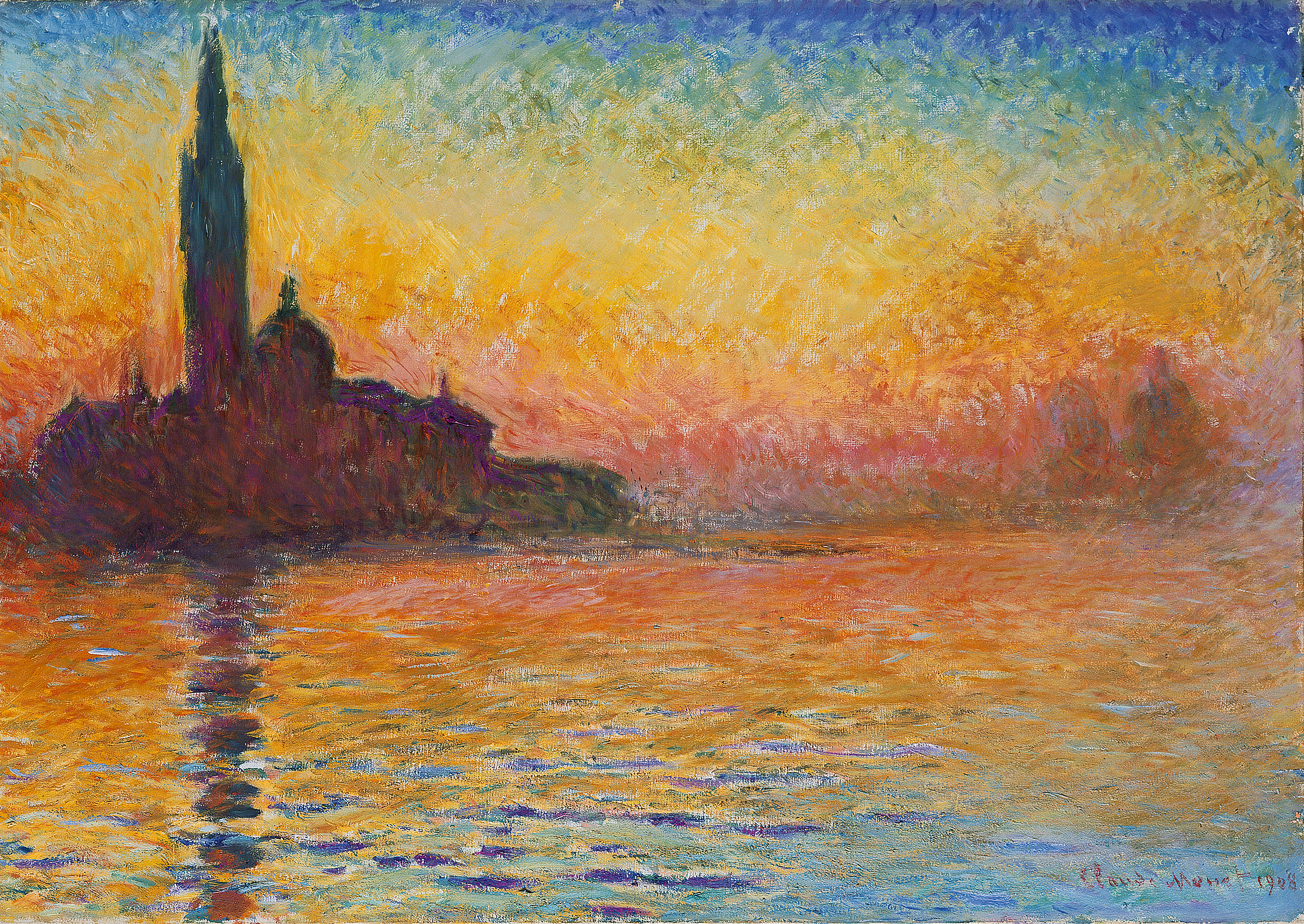
I came across a Monet painting recently and noticed the date. I was surprised to find out that it was completed over the course of four years. I’d always thought that I was a slacker if I didn’t finish an art project in a few days.

The painting is this –
Claude_Monet,_Saint-Georges_majeur_au_crépuscule

It is called “San Giorgio Maggiore at Dusk”, or in the original French, “Saint-Georges Majeur au Crepuscule”. The dates are 1908-1912.

This looks like a pretty simple piece to me. This looks like something that could be knocked out in an afternoon. But then again, I’m not a famous artist. Maybe the trick is that he just makes it look simple.

I’ve decided to take this to heart. I’ve decided to be more patient with my art and with myself. This is a dangerous place to be for me. If I don’t push myself enough I won’t do anything. I’ll let projects sit half completed. I’ll start things and not finish them.

But then again, if I do things too fast, I’ll not have time to do them well. I’ll not take the time to let them digest, or ferment, or mellow. Some things are better if they are done slowly. Some things have to be done slowly if they are going to be done right.

I’m not in a race. I don’t have any assignments. Creating isn’t my job. There aren’t any deadlines. The only rules I have are ones I’ve created.

I’m reminded of Luke Skywalker about to enter the cave on Dagobah. The only thing he took in there was himself. Sometimes that is the scariest thing of all.

When I create, I take with me all the rules that I’ve been given of how things have to be and all the rules I’ve made up. I put limits on myself before I’ve even begun. I have expectations that prevent me from finding innovations.

Part of my practice this year is to not limit anything, anymore. It is to be open and trusting to what God is leading me to be and to become. Part of that practice is to encourage you to do the same.

Thoughts on art – heavy vs. light

Sometimes I think that I just like buying beads.  The potential is always more interesting than the reality.  Seeing all the beads together in the bin- I go a little wild.

When I have to pick what I’m going to work with, I am a little overwhelmed.  There are so many choices, but I can’t use them all.  I like that at least if I change my mind I can take the necklace apart and do something else.  Somehow that makes it easier to get started.

Sometimes I just want minions.  I’ll finally work out the pattern that will use the beads in a way I like, and then it is all about just doing the work.  This is so boring.  This part is not the part that keeps me beading.

          Some of what I make is really boring.  Sadly, this kind of stuff sells well, so I make a fair amount of it.  Sometimes I think I make it so that I can afford to make what I really want to make.

Figuring out the pattern can be the hardest part, yet the most rewarding.  There are a lot of factors to consider.  Necklaces have weight that is both physical and visual.  I don’t want to make something that is very heavy and thus a pain to wear.  Some designers don’t seem to ever wear what they make, so they don’t get that this “art” piece is completely impractical to wear longer than twenty minutes.

Then there is visual weight.  If there are a lot of large beads very close to each other, the necklace will look heavy.  This is ok for certain people, but not others.  In general, older and larger women like “heavy” designs, while younger and thinner women like “lighter” designs.

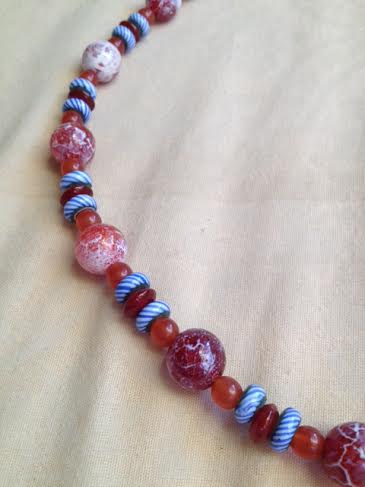
Here is an example of a “heavy” design –
jan1

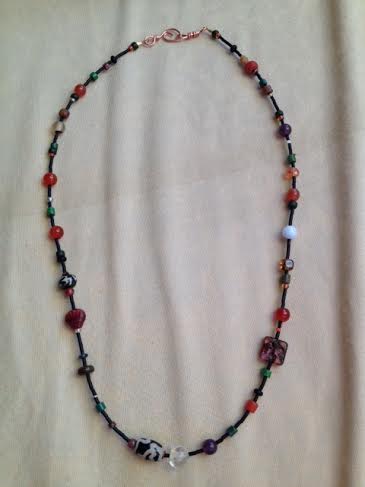
Here is an example of a “light” design. This is an end-of-week necklace, made with leftover bits of other projects.

jan5

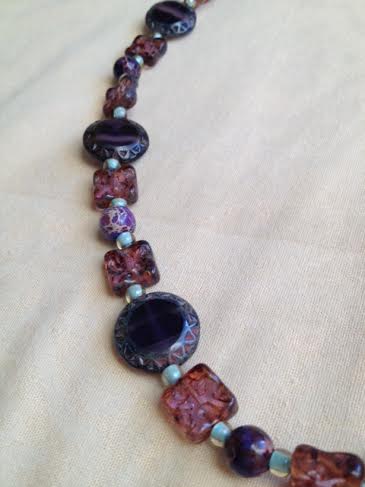
Making a heavy piece lighter often just means adding some plain glass beads into the pattern.   This also reduces the cost, which is another factor.  You may make the most beautiful necklace ever, but people will simply not want to pay for it.

These are heavy beads, but I’ve watered it down by adding some plain glass beads.


jan2

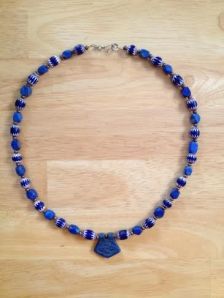
I was interested in making a big chunky necklace but didn’t have enough of the big beads to make it work. I’m trying to not get obsessive about what I make to the point that I have to go to the bead store to finish out a design.  If I really want to make that specific piece a specific way, I’ll remember it the next time I’m at the store and just make a second version of the necklace.

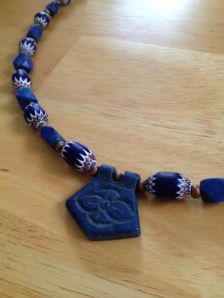
Would you believe that the cost of just the beads alone in this necklace is $80?
 

jan6

And that is just the ones I used.  I had to buy the whole strand of antique chevron beads.  That was $200.  The strand of pre-Islamic cut lapis lazuli wasn’t cheap either. I did manage to get the centerpiece for free.  There is something to be said for not being pretentious at a bead show.
 

jan7

Sometimes I have just a few beads for a necklace and I want to use them up.  I’ll work out a decent pattern and then be short a few inches.  Then I have a choice.  Take the whole thing apart and figure out another design, or just add some filler beads to the end.  Nobody looks at the back of the necklace anyway, right?  And, after all, it isn’t like I’m going by a pattern that anybody knows.  They won’t know I didn’t mean for it to look like that.

jan3


I guess that is part of it.  Nobody knows what I’m aiming for, so when I miss they don’t know.  I think that is true with everything.   Just do it anyway.  Keep on trying.  Keep on making and writing and drawing and beading.   Keep on putting it out there.

Maybe one in twenty is a keeper, is one that I think ended up somewhere near what I was aiming for.  But I think that is the trick. If I don’t keep trying, I won’t keep getting that one at all. The funny part is “the one” is the least likely to sell if it is jewelry. In my writing, “the one” that really matters is only rarely noticed.  I have to remember that even if others don’t get it, I do, and that is good with me.

If you don’t love your art, quit doing it, because it isn’t about the money.  Well, getting money helps.  Don’t get me wrong.  I love it when my jewelry sells.  Now, in part I love it because it means I can buy more beads to make more jewelry.   It is about the chance to create, and thus the chance to get it right.

Creating is like mastering a language.  You’ll get really frustrated trying to express yourself until you figure it out.  Either you need a new set of words or a new phrase or a different way to communicate. Perhaps you need sign language, or poetry, or email.  Perhaps you just need to keep slogging away at it until you figure it out.
On art – collage, time, and audience.

I’m working on a new art style. I’m trying to do collage and it is testing my patience. I love the art of Nick Bantock, of the “Griffin and Sabine” series. I don’t want to replicate his work but I do want to try to approach its emotion and depth. The problem is that it takes a long time and you can’t erase.
When making jewelry using beads, if the pattern doesn’t work out you can always take it apart and redo it. Even years later you can always try again if the design gets old. Not so with collage. Once you paint something or glue it down it is done. You can’t go backwards and change things if it looks weird later. You can’t reposition it. You are stuck. You’ve used up the materials too – you are out that money. It also takes a long time. If you have multiple layers, you have to let each one dry for hours. I’m not really that patient, but I have to be to make this work.
This has stopped me from even trying this style for a long time. I’ve got lots of art materials that I’ve not used at all for fear of doing it wrong. So I’m wasting them even more so. It would be better to use them and figure out what works and what doesn’t work than to not use them at all.
Boats are safe in the harbor, but that isn’t what boats are made for. The same is true of collage. The same is true of life.
I’ve decided with collage the best thing is to just get over my “need” to start something and finish it in the same sitting. I certainly don’t feel that I have to do that with beads or with writing, so I don’t know why I think my painting has to be the same way. Maybe I want to see results fast. Maybe it is because I don’t have a lot of time to work on my art.
I think part of it might be that I resent the amount of time my job takes from me having time to do what I want. I just don’t seem to have a lot of time to do “me” things. I know I’m not alone in this thought. Nobody gets up and says “Yeah! I get to go be a cube-farmer today!” Don’t get me wrong – I like my job. I like the people I help. I just don’t think it requires 40 hours a week to do it. After 40 hours of work and the time required for sleep, there isn’t a lot of time for “me” stuff.
I’d rather work 30 hours than 40. I’ve asked if it is possible and they don’t think so. So I shoehorn in my “me” things – writing, exercise, art. I love the space I go to in my head when I create, and it is hard to wrestle myself back to a clock and a schedule and go to work after being in that space.
I’m starting to see collage as a good middle ground. Since I simply can’t do it all in one sitting, it works well with not having much time. I’ll do a layer, wait, do another layer, wait, and do another layer. I can’t work on it for hours at a time, and that works because I don’t have hours to work on it.
Collage is strange to work with because I don’t know how it is going to look until I’m done. I have some general idea but then when I add another element it changes everything. I can get an idea of where things are going before I glue a piece down but then sometimes when the glue dries it changes the effect. It is always a surprise. Sometimes it isn’t a welcome surprise.
But then I remember that with writing and with beads, the stuff that I really planned out and really love how meticulous and amazing it turned out happens to be the stuff that nobody “gets”. Nobody likes it or appreciates the work involved except me. Conversely, the stuff that I really don’t care about much – the stuff that I worked on and just don’t like as much is the stuff that people rave over. That is the stuff that I think is OK enough for others to see, but it just doesn’t get my idea across the way I meant to.
There are plenty of pieces of writing and pieces of jewelry and other artwork that I’ve created that nobody has ever seen. I feel like I show a lot of what I make, but what people see is just half of what I’ve produced. Some things I feel are just warm-ups, just stretching. Some things are simply exercises that help strengthen me for something better later.
I don’t feel like this about my art at the time. I want everything to be a marathon win, but some things just peter out about the three-mile mark. Or maybe that is just me. Maybe I need to show it anyway. Following the usual trend, they will be the things that people will really “get”. But for now, I don’t want to show them because I don’t want to put my name on them.
When you show any art – be it writing or visual art, you put your name on it. You say “this is me”. For good or for bad, you are showing off what you have made. People will judge you by it, for good or for bad. So you have to be careful what you show. You want to be known for good work so people will seek you out and buy what you have made. You want to get a reputation as a maker of good things. Do you keep with one motif, or do you have a range? Do you create for an audience, or create for yourself? Whatever you decide, you have to be mindful of who is going to see it and what they are going to think. Does this cause you fear, so you edit? Does this cause you excitement, so you embellish? Your relationship with the audience will influence your work.
Art isn’t yours anymore when you let other people see it. It changes. The meaning changes. What you thought it meant doesn’t matter anymore. When another person sees it, she brings herself to it. She brings what she loves and hates to it and sees that in it. Art is a mirror. It isn’t something that stands on its own and speaks for itself. It would be great if it was, but it isn’t.