A punch to the head woke me up.

If you have told someone that something they do makes you uncomfortable, and they keep on doing it, then it is up to you to terminate the relationship.

That may sound harsh.

But it is as if you’ve put up your feelings for a vote. Who wins? Their needs or yours? Ideally, you’d both win. Ideally, everybody would be happy.

But if they feel they need to continue doing something that you have said is distressing or harmful to you, then they have voted. Their needs are more important than yours.

I went to a gathering once and I brought a jewelry project to work on. It is like a security blanket to me. I like having projects because it makes me feel more comfortable. I feel more exposed when I have nothing to work on.

A lady there wasn’t comfortable with me working on a project. I wasn’t right next to her. The project wasn’t loud or big. It wasn’t like I was taking notes. But she felt that in order for her to share her thoughts she needed me to not be doing anything and to look right at her.

She didn’t ask me directly. She mentioned casually, to the air it seemed, that she would rather each person pay full attention and not work on anything. It took me a little bit to understand that she meant me, she was so vague.

So I had a choice. Make her feel comfortable, and me feel uncomfortable, and stop working on my project. Or, pretend I didn’t hear her and keep on working. I’d feel a little comfortable because I’d have my project, but a little less than before she spoke because I would know that I was making someone else feel uncomfortable.

But really, I wasn’t making her feel uncomfortable. That was her choice.

I put my project up. And I developed a small amount of resentment to her, and a little bit to myself. I was upset that I didn’t stand up for myself. I was upset with her that she confronted me at all, and that she did it in such a passive-aggressive kind of way. It was my choice not to tell her how I felt. It was my choice to let her needs be more important than mine.

I had a coworker who thought it was funny to hit me on the back of my head when she walked by. She wouldn’t hit hard – she would often just catch my hair. That is an invasion of my personal space. That is a violation of social rules – we don’t touch each other unless it is mutual.

Now, I hate having people walk behind me anyway, but there is nothing I can do about it at work because of the arrangement of the desks. I don’t have an office. I don’t really even have a desk. I have a space that I usually work at when nobody else is around. It is a little discomforting to work in a place for many years and not really have a “place” to be, but that is for another post.

I first thought she was getting a rise out of it, out of getting in my personal space. So I dealt with her like I dealt with my big brother – pretend that I liked it. I figured that she’d stop because that works with big brothers. Don’t let them get the satisfaction of seeing you upset. Pretend it doesn’t bother you. It didn’t work. I had to tell her to quit, and in telling her I learned something very telling about my boss.

She laughed at me for telling this lady to quit hitting me. I should have seen that as the sign that it is. Hindsight is 20/20 they say. I learned this lesson later – don’t trust her with anything real. She isn’t really human.

I knew a guy in college named Carson who hurt me badly. He and I were sitting in a friend’s dorm room. I was sitting on the bed and he was sitting in a chair facing me. I don’t remember what we were talking about, but at some point in the conversation he reached over and pushed me sideways. My back was against the wall, and being pushed sideways meant that my head caught the part of the doorjamb where the doorknob was. It hurt a lot. I pulled forward, turned around, and saw what had caused the pain in my head. I told Carson to be careful – I’d gotten hurt from his shove. I figured it was an accident.

The second push wasn’t an accident. He took my shoulder, pulled me back to see where the doorjamb was, and then shoved my head sideways into the doorjamb.

Without thinking, I hit him as hard as I could right between the eyes. Every bit of energy and force I had in me was directed into that punch. I’m grateful that I didn’t hit him anywhere where it could have caused actual damage. I could have bloodied his nose, broken his teeth, bruised his eye. I could have killed him if I’d hit the right spot with that much force. It was an instinctive punch, and it did the job.

We stared at each other for what seemed like ten minutes. I’m sure it was only a minute, but time had slowed down. It does that when crazy things happen.

He broke the silence. “Don’t ever do that again.” He glowered at me.

“Don’t ever do that again.” I responded, indignant. He’d hurt me intentionally. There was no reason for it. I’d never done anything to him to deserve that. I’d never done anything to anybody to deserve that.

The first time is free. The first time is an accident. Once you’ve been told that you’ve harmed me, and you do it again, everything is over.

If they hurt you and you don’t tell them, then it is on you. If you tell them and they continue to hurt you, then they have made their choice. It is on you if you stay after that.

Repress – self-care, and boundaries

At what point do you stop being yourself so that somebody else can feel comfortable? All the time? Half the time? Never?

Is it antisocial to do your own thing? Is a violence against your soul to not?

I’ve suppressed myself a lot throughout my life. I’ve been taught directly and indirectly that everybody else’s needs are always more important than my own. Perhaps some of it is just part of the training that every woman gets. Perhaps part is what I learned out of self defense from being raised in a house with a father who wasn’t emotionally there. We either walked on eggshells or just walked around him. We never really knew who he was going to be from day to day. Perhaps part of it is from having a brother who was the master of manipulation. The only trips he took me on were of the guilt variety.

I remember when I went to college in another town I realized I could be anybody I wanted to be. Nobody knew me. I didn’t have a history. I wasn’t Ian’s kid sister. I wasn’t Joan’s daughter. I wasn’t Pat’s kid. All of them had gone before me in that town and in that high school. They’d either taken classes there or had worked there. I had a sort of hand me down life, a sort of leftover existence, a sort of filtered reality. My life was not my own. People judged me based on what their experiences were with my family.

When I moved to another state I realized I could be anyone I wanted. So I decided to be myself. I stripped away everything that didn’t serve or suit me, and grew a new me from the inside out.

I’m doing that again now. I’ve been recreating myself over the past several years.

I deleted my sister in law as a “friend” on FB in part because she was always disagreeing with me. She often felt that my posts were going to upset her husband, or my husband. She asked me to delete the posts.

She reminds me a lot of how my brother tried to control me. Shame. Family honor. Secrets. Guilt. Don’t air the family business. Keep a stiff upper lip. Hold it in. What will “they” think?

I found myself thinking before many posts – what would she think? Would she censure me? Would she censor me? I took to posting some posts on my blog only, rather than on my FB page. I still got to speak, I just didn’t have to worry about her reading it.

Funny, she never commented on anything that she agreed with. It was always “I disagree” or “I respectfully disagree”, as if saying “respectfully” takes the sting out of the slap.

I can handle constructive criticism. I just can’t handle constant criticism.

So I had a choice. Her or me. Make her happy, or make me happy. I chose me.

It made her go a little spare for a bit.

It was one of the best decisions I’ve made in a while. Reminds me of when I deleted my brother. It was a little terrifying and a little bit exhilarating at the same time.

She now thinks I’ve gone mental, that something is wrong with me. She’s a therapist, so she should know, right? I think she’s putting the blame on me because it takes it off her. If she’d asked me privately if there was a problem, and listened to my feelings when I answered, then it would be different. Her reaction just proved to me that my decision was right.

Self-care is a sign of mental health. I will no longer allow abusive people into my life, regardless of who they are. Family members do not get free passes. In fact, I expect better from them.

I chose my husband. I did not choose his family, or who his family chose.

Disagree – words and food

I’m OK with people disagreeing with me, just not all the time. I certainly don’t want people around who only agree with me. That isn’t healthy. It is important to have friends who can help keep you from doing something stupid.

But it also isn’t healthy to have people around who constantly disagree, even if they try to soften the disagreement by saying they “respectfully” disagree. This is like saying I’m going to hit you, so brace for it. It is for your own good.

People who constantly disagree are like food that disagrees with you. If you know that eating pepperoni always gives you heartburn, you will (hopefully) stop eating pepperoni. The pain and discomfort just isn’t worth it. If you go over to your aunt’s house and she always serves you pepperoni, then do you eat it, out of respect to her? What if eating pepperoni was part of her childhood and serving it is how she shows love?

Yet eating it makes you sick. Do you tell her, and break her heart, or do you eat it, and get heartburn? Somebody is going to get hurt either way.

Does it matter who serves you? Are you more likely to take something disagreeable from a relative, or from a long-term friend?

The same is true with words. If you have someone who constantly disagrees with you, you don’t have to take it. Balance is good. If all that person does is disagree with you, you are not obliged to “eat” it, no matter who they are.

Ideally, it would be great if people were thoughtful enough and considerate enough to not “feed” you anything that makes you sick. Ideally, people would be mindful and look out for each other. Ideally, we wouldn’t have to tell people to stop hurting us.

Sometimes they don’t know they are being harmful. Then it is on us to tell them. Then it is up to them.

Sadly, there are people in this world who know what our triggers are and they ignore them. There are people who just don’t care what our needs are and they do their own thing anyway. There are people who feel that our boundaries are suggestions rather than rules. They are the same kind of people who if you tell them you are allergic to a particular food, they will serve it to you anyway.

Whether they do it intentionally or accidentally makes no difference. They are harming you. They are either being malicious or mindless. The result is the same. You are harmed.

Then it is up to you to decide – continue the relationship, or terminate it? Is it worth getting sick to be around this person? You may love them, but by their actions they are proving that they don’t love you. Is it worth that sick feeling you have in your stomach every time you are around them?

Death, or not.

My mother-in-law is dying. Or isn’t.

She has pancreatic cancer. She was diagnosed in December of last year. It was stage three, possibly stage four. There is no stage five. She was given until about May. It is now late December. We are planning to have Thanksgiving at her house. We are talking about having Christmas this year too.

A year ago, just thinking about how that particular Christmas was going to be her last Christmas just tore her up. She was very teary. She didn’t think she’d even make it to another birthday, which was in November. She’s made it, and made it better than anybody expected. She’s still driving herself to her doctor’s appointments. She’s still at home, sleeping in her own bed. Hospice has not been called.

The trouble is, she has changed personality, and it really isn’t for the better. She was married young, and married to a very domineering man. She was very submissive. Her own personality was overshadowed by his. She grew up stunted, with all her energy being focused on one thing – the house.

She has spent her entire adult life playing house. She paints the rooms, again and again. She redecorates. She buys knickknacks. Decorating the house is all she talks about. All of her energy has gone into decorating her house. The results aren’t anything exciting. It is hard to believe her life energy has been spent in this way and there isn’t anything real to show for it. It is hard to believe that God put her on this earth to do this.

So she now has become assertive. She still works on the house, but she has gone from being passive to being pushy. She uses the fact that she has pancreatic cancer to push people around. She has cancer, so nobody else’s plans matter. Everyone else has to drop whatever they are doing and drive over and visit with her or do her bidding. She doesn’t ask, she commands. The fact that she has a limited lifespan is always part of it. You’d better do this, or else.

Or else what? She’ll die? You’ll feel guilty that you didn’t spend more time with her?

While I’m glad that she is starting to wake up to who she is, I wish she’d have gotten past the toddler stage a little sooner in life. Toddlers are always about me me me, and they never care about anybody else’s feelings or plans.

The problem is, she is in her 70s. She has had plenty of time to grow up, and she hasn’t. She has had plenty of time to be a productive person, and she hasn’t.

We all are dying. Being born is the beginning of death. None of us have any guarantees on how long we will live.

So there is nothing especially sad about a 70-plus year old woman getting cancer, even cancer that has a high rate of death. Death comes to us all. Many people don’t make it to her age.

What is tragic is that she didn’t wake up to the fact of her mortality sooner and do something useful with her life. What is tragic is that she didn’t stand up to her abusive, bullying husband earlier and leave him, taking their two sons with her. That would have saved them from years of being harmed in every way possible. What is tragic is that she is treating this time as a time to push other people around, when life isn’t ever about that. What is tragic is that when told she had cancer, she kept on decorating her house.

Maybe I’m reading this wrong. Or maybe I’m not. I’m angry at her acting hurt and put upon that she has a death sentence, when my own Mom died at 53. My mother in law has lived nearly 20 years longer than my Mom, and has nothing to show for it. My Mom volunteered all the time. She made the world better for other people. She wasn’t well educated, but she had an open heart and gave constantly. This woman, however, is a little child in an adult’s body.

I’m tired of her. I’m tired of her neediness. I’m tired of how shallow she is.

And I’m sick of myself for feeling this way. It isn’t very Christ-like. It isn’t very nice.

I wish she would have protected her son, my husband, when he was a child. To stand by while your child is being abused is to condone it. I don’t think she understands the depth of damage that caused. I don’t think she understood that her inaction was just as abusive because it translates to abandonment.

I wish she would have grown up sooner. I wish that she would have woken up to the truth of her mortality sooner. I wish that she would have become a human being sooner.

I guess late is better than never, but it still isn’t happening. She’s not blooming very well. She’s stunted and warped from her life, the life that she chose. There is nothing passive about this. She chose to marry him. She chose to continue to live with him. She chose to raise two boys when she herself was still a child. She chose to do what everybody else did rather than think for herself.

She chose to stay asleep.

She’s mirroring what she has seen her whole adult life, living with her husband. Her role model is a self-centered man who beats up on anyone he finds weaker than him. So she is blooming into a self-centered woman who pushes everybody around and expects them to drop whatever they are doing to take care of her.

God help us all.

Write it out, and the yoke.

Sometimes I write to get into a problem. Sometimes I write to run away from it.

I process information by writing. I learn a lot. It is paradoxical. I am not writing things down. I am pulling them down into a language I can understand. I will often write a question down and pry at it from different perspectives in order to find out the answer. It is always surprising to me.

But them sometimes I need to be quiet and just be with the question. I need to actually live through the experience rather than trying to document it as it happens.

I’m trying to do this with my abuse as a child. I’m tired of continually facing these doors and walls in my life. I’m tired of these trials. I’ve really worked hard recently, and I’m just tired right now. Sometimes I want to sit down and just cry rather than work on it and be brave. Sometimes I would rather be blissfully ignorant.

Sometimes when I do decide to work on a problem, I don’t know whether to lean into the problem or push at it really hard. So I wait and I pray and then I find myself doing whatever it is that I should be doing.

A little bit of the disease will heal you. That is how antibiotics work. This is how immunosuppressive therapy works. A controlled amount, administered with a healing intent, will build up a tolerance in you that will make you stronger. Avoidance is not the answer.

I’m tired of these doors. I’ve asked Jesus into it, and he says we can sit right here beside this door as long as I need. I don’t have to knock them all down right now. I don’t have to do this hard work all at once, or alone. I can take some time off and pace myself. It is ok to wait. And he will wait with me.

This is part of what Jesus means when He says “take up my yoke”.

Jesus says in Matthew 11:28-30
“28 “Come to me, all of you who are weary and burdened, and I will give you rest. 29 All of you, take up my yoke and learn from me, because I am gentle and humble in heart, and you will find rest for yourselves. 30 For my yoke is easy and my burden is light.”

He’ll carry our burdens with us. He won’t carry them for us. We’ll work together. But it is heartening to know that when we are working with Jesus, we’ll get a lot further than we would alone.

In my face.

I was at a buffet a few months ago and saw a brother playing with his baby sister. She was in a baby carrier, sitting on a chair. The brother kept leaning in, right up in her face. He would grab the sides of the carrier with his hands and pull in, speaking loudly to his sister, getting nose to nose with her.

I felt great anxiety at this. I guess it is triggering a memory. I felt for the little girl, unable to say that she didn’t like this, unable to get away from him. Again and again he was putting his face right up into hers. Again and again I felt that I should say something. He was so forceful that he was pushing her carrier further back each time.

The parents were there. I’m sure they thought he was just playing with her. I’m sure they didn’t think of the psychological trauma this might be causing. They were chatting with their friends and ignoring their children. They didn’t notice how forceful he was.

Perhaps the daughter enjoyed this. Perhaps I was overreacting. But every time I felt breathless and anxious. Every time I felt that someone should get him to think about how this would look from her perspective. She can’t back away – she’s trapped in her carrier. She can’t tell him no – she is an infant and cannot speak. Sure, she could make a noise to show her disapproval. But my concern is that she was being “taught” that being attacked is normal, that being pushed up against a wall is how she should be treated.

I’d also be concerned if this was a sister doing this to a baby brother. But I feel I’m more sensitive to this particular situation because I feel that I was treated like this. I feel that I was treated as a thing, an object, and not a person.

My brother was not my friend. He was my tormentor. He was my enemy. I don’t understand when people say how wonderful and protective their brothers are, how they can always call them for help and always count on them. It just sounds like a fairy tale.

I’m starting to understand that it isn’t my fault that I had a terrible relationship with my brother. I was taught by my culture and my religion that it was my responsibility to try harder to have a better relationship with him. Codependency comes free with a church membership. I’m starting to understand that he is just a narcissistic jerk, and I had the misfortune of having him as a big brother. I’m grateful that I severed all ties with him.

I wonder what our childhood would have been like if I had been born first?

After a while, I did say something to the boy. I felt like I had to. I asked him to be gentle with his sister. His father whipped around and stared at me. I’m sure he was thinking how dare this stranger tell his children what to do. I just smiled sweetly back. He turned back around to his plateful of food and his ball cap wearing friends.

So much for “It takes a village.”

“While you’re up…”

When I was growing up, I thought “While you’re up” was my father’s name for me.

He sat. A lot. He sat so much that he got a new recliner every few years or so. I got the box.

I loved getting those boxes. I could make a house out of them, and did. I would drag the box down under the porch where the dog sheltered. I cut out windows and I drew in art on the walls. I spent as much time in that box as I was allowed. When I wasn’t in school or in bed, I was there. Until the box rotted from the exposure to the elements, that was my home away from home.

The more I think about my childhood, the more I understand why I escaped so much.

But I digress.

My Dad would sit in that recliner, staring at the TV, seemingly waiting for me to get up so he could ask me to get something for him. More coffee. Wash his glasses. A snack. Whatever. He never did any of these things for himself. He didn’t even know how to put a band-aid on himself.

How he managed to survive to adulthood escapes me.

Meanwhile he gained more and more weight, and smoked more and more cigarettes.

He said “while you’re up” until the day I stood my ground. I’d sprained my ankle, and was hopping around. Everywhere I went, I hopped. I was a teenager by this point, so I’d had a few years of getting used to this phrase.

I wanted a glass of lemonade, and I had sat for quite a while figuring out how I could get it from the kitchen to the living room with a minimum of mess. Once I decided on getting half a cup, and in a plastic cup, not a glass, I was set. Then I thought about it a little more.

I braced myself. I knew, deep down, like how the shore knows the tide will come in, that my father would say those inevitable words, those fateful words. I knew all the way down to my core that he would be totally oblivious to the fact that I couldn’t walk and everything was that much harder. I knew that he wouldn’t say “Oh, let me help you – what do you need?” That makes me laugh just thinking about that. I would have known that aliens had possessed my Dad if he had said that.

I prepared for that eventuality with the same planning I’d used to figure out how I was going to get a glass of lemonade while hopping.

I got up. Payoff. He said it. “While you’re up…”

And I let him have it. I let him know about how insensitive he was. I let him know that he could very well get up and get his own whatever-it-was. I probably put in something about how it would do him some good to get up and move every now and then.

He never asked me again.

Yes, children should respect their parents. But parents also need to respect their children, and teach them through their actions about self-respect and discipline and fortitude. Sure, there is a Commandment saying that children should honor their mother and father. But there is also Jesus saying that we need to love each other. There is nothing loving about using your child as a servant. There is nothing loving about expecting someone else to do everything for you.

In fact, being an enabler isn’t being loving at all.

“The Prodigal Son”

There is nothing like a will to bring out the true side of people. My brother was left out of our Dad’s will because he tried to kill Dad when he was 17. They never reconciled. There was nothing but mistrust and animosity after that.

It wasn’t great before that. They’d never had a good relationship. Ian blamed Dad for the fact that he didn’t have money to go to college. Dad’s story was that Ian begged him for the money so he could buy a car. Because of Ian’s lifelong habit of lying to benefit himself, I believe Dad’s side of the story.

Ian felt slighted most of his life. He probably feels this way now, but I no longer talk to him. He felt that everything bad happened to him, that everyone, (especially me) conspired against him. He felt that I was the wanted child and he was the accident. He didn’t realize that we both had a pretty unhealthy childhood, so neither one of us got the silver spoon. We both got the shaft instead.

He blamed me for his fourth wife leaving him. He blamed me for him getting a quarter of a million dollars in debt. He was always a victim, a bystander, a passive observer. Perhaps that is the reason for all of his failures – he never took the blame for anything.

We were still talking when our parents died. He’d been very abusive to me during that time, but I still wanted to have some sort of relationship with him. I suspect a lot of it has to do with Christian guilt, saying that I was supposed to love my brother. I didn’t understand yet that there has to be a measure of reciprocity. Love has to go both ways. It can’t all be take-take-take.

During that time he managed to guilt-trip me out of a Rembrandt etching we had of “The Prodigal Son” saying that it symbolized the relationship that he and Dad had. The irony did not escape me. They didn’t have a relationship.

Our grandmother had given the etching to the family. It sat over the mantle. The story was that Rembrandt created the etching, printed a limited number of prints, and then destroyed the plate with acid. So it was worth a lot of money. It wasn’t listed in the will, specifically, so I could do with it whatever I wanted. I was the executrix of the estate because I was the only person named in the will who was still alive. I was 25, handling a will on my own, getting pressured by my brother. He wanted me to sell the house (my home at that point) and give him half the money. He wanted me to give him half the insurance money too. He’d done nothing to earn it. He hadn’t visited and he hadn’t helped Mom and I while we were struggling with bills when she was sick. He hadn’t done anything at all except harass me to tell me that I wasn’t doing enough. Meanwhile he was doing nothing. So how did he think he was entitled to any of the estate, especially an etching of “The Prodigal Son”?

I gave the etching to him anyway, out of spite. I figured that eventually he’d wake up to the fact that the son has to return for the story to work, and he never returned. It was easier to give him that picture once I realized that. If I’d kept it I would be constantly reminded of him. If he had it, he would be constantly reminded of himself. That specific etching just bolsters his lies. It is right up there with the certificates he has framed of the classes he took when he was in the Air Force. He was only in for one year, then he got kicked out. But he still proudly displays those certificates. There is something deeply wrong going on with him, where his reality doesn’t mesh up with actual reality.

I wanted my brother to become a real human being. I still want him to. I finally realized that I couldn’t be part of that process though. It was like he wanted me to be an accessory to his insanity. I couldn’t participate in it. Talking to him was making me crazy because he was crazy. Getting into conversations with him was like getting in the car with a drunk behind the wheel. Everywhere we went in our conversations was wrong. I knew I had to get out for my own safety.

There aren’t any easy instructions on how to deal with an abusive family. All the Hallmark movies make us think that families are loving and brothers look out for their little sisters. All the mythology of family in American society tells us that everything is wonderful and everybody is happy. This is great when it is true, and it is harmful when it isn’t. All too often our reality doesn’t mesh up with what we are told we should be experiencing, and we feel pain. We feel like we are wrong, and not that the prepackaged image of “happy family” is wrong.

Bears.

My husband and I are nurturing our inner children. We both had difficult childhoods. It may seem strange but it is never too late to reinvent yourself.

There is nothing about being a parent that means you are competent at it. Often you just continue doing the same stupid thoughtless things that were done to you. You don’t stop being selfish or needy or controlling. So you raise children who are broken because you were broken.

It wasn’t all bad. There were trips to cultural events. Education was encouraged. But how to be human? How to deal with emotions? That was too hard. They didn’t know how to do that.

They did the best they could with what they had. They didn’t know there was more to being an adult than paying the mortgage and cooking dinner. They weren’t intentionally neglectful or abusive. But the damage was still done. And it still has to be undone.

I’m grateful that we both were aware enough of our weaknesses to decide to never have children. We didn’t want to continue the cycle. Slowly we are learning ways to heal ourselves.

We have teddy bears. They have names and stories. We drink tea every Sunday evening with the bears, and afterwards we read a children’s story. This may not be what adults usually do, but it is healing. I’m starting to think that everybody should keep their teddy bears. More bears, less drug abuse. We all need something to hold on to when times get difficult.

There is a lot that is hard about being an adult who never had a healthy childhood. There aren’t a lot of instructions on how to heal your inner child. There is a lot of shame involved. It is hard to admit that you need help. You have to learn how to grow up backwards. I think there are a lot of people who have to do this. Maybe we should start a club so we don’t feel alone.

Maybe we should also start a 12 step program for people who have escaped from church, for the same reasons.

Home remodeling for the soul.

I’ve realized that some of what I’m writing in this blog is like the “how-to” articles in home-repair magazines. They show you how to build a deck or remodel your kitchen. They show you the tools to buy and all the insider tricks to make it come together well. There are pictures and words, and somehow in the middle of it you figure out how to do it in your own home. Perhaps you don’t have a square deck – yours is rectangular. Perhaps you don’t want granite countertops in your kitchen, but the pictures of the cabinets going in explain something that you needed. This is that, but for the rooms in your heart and head.

Sometimes “home remodeling” hits closer to home. Your first and truest home is you.

This is my journey, and my work. If any of this helps you figure out things, all the better. Our paths will be different, but there will be some similar landmarks along the way.

I’m “growing up in public” as one friend tells me. Either he learned it from his therapist or from group work. Either way, it is a good phrase. It isn’t easy when you haven’t gotten all of your growing-up out of the way when you should, but late is better than never. Writing, beading, and drawing are how I do my growth-work these days. I use eating well and regular exercise to help keep me on this path. It is all connected, body-mind-spirit.

Recently I went to my spiritual director (kind of like a personal trainer for the soul) and she told me that there are many rooms our hearts, and Jesus wants to enter into all of them. This includes the good and the bad, the happy and the sad. Hmm. Kind of sounds like wedding vows when I phrase it that way.

One room we are working on is my childhood, and feelings of loss. I’m angry about the bad choices my parents made. I’m angry that they smoked themselves to death. I’m angry that they died young, leaving me to defend myself against a predatory brother and an insensitive, bossy aunt. I’m angry that they weren’t there for my graduation and my wedding, because of their bad choices and their lack of self-control. I’m angry that they left me alone a lot, even when they were alive.

But she pointed out that anger is a symptom. There is always something that comes before anger. I’ve been working on this technique recently, so I understood where she was going. Trace it back to the root. Dig down to the source.

The feeling before anger in all of this is sadness. It is grief. It is loss.

Instead of dealing with my sadness, my grief, my loss, I went straight to anger. Anger is useful but you can get stuck there. If you don’t dig out the root cause of anger, and dig down to the grief, you’ll be treating the symptom and not the cause.

She asked me to name this room. I call it “The Room of Abandonment”. I spent a lot of time alone as a child. There were a lot of things that I wasn’t taught before they died – basic things like taking care of a house inside and outside. How to cook, how to garden. I’m learning these things backwards. I still am terrible at plants, but I can get by without a garden. I’m not great at cooking, but I make do. I celebrate everything that I do figure out. I’m pretty awesome with hedge shears. I make a pretty fabulous stir-fry. My hummus is getting better too.

I felt abandoned before they died. I felt abandoned after they died too. I was just 25, so I was old enough to take care of myself. But being the youngest in a family where the older brother is abusive is hard. It was hard to claw myself out from underneath his mountain of lies. I didn’t have any perspective on what “normal” was.

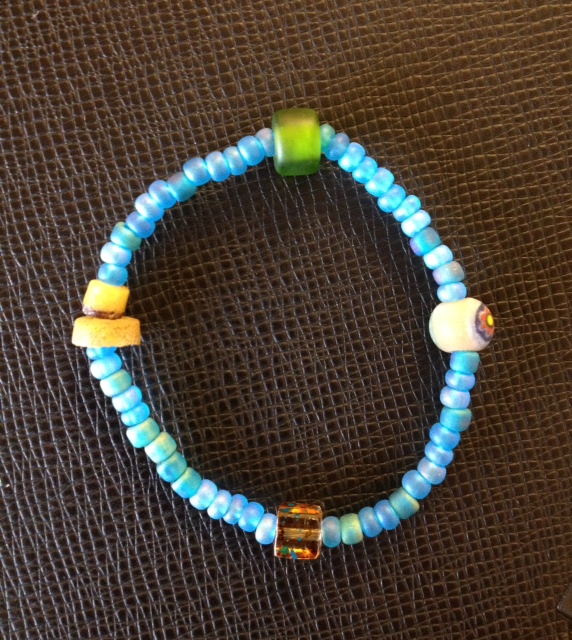
So. This room. Look how I’m not really dealing with this room. This is normal. We want to turn away from hard things. So I’ve drawn it. I’ve made it into a prayer bracelet as well. I have reminders of it to force me to look at it. These are like writing notes to myself on my hand – “pick up spinach and cheese and Triscuits”. They are reminders for what I’m trying to forget.

She asked me to visualize what it would look like. I saw a light-blue room, empty, save for a chair. The walls are blue like a robin’s egg. The walls are windowless, but there is light. I’m not sure where the light is coming from, but the room feels clean and bright. The chair is an old wooden chair, like the one I rescued from my grandmother’s house when the time came for her to be put into a nursing home.

WP room 2.
(The drawing of the room)

My director told me to invite Jesus into the room, and to invite Him into any hard feelings. He wants to be there, to help me with them. This is some pretty foreign stuff. Jesus as a friend? Jesus wants to heal me? Jesus wants to hang out with me, in the boring times as well as the beautiful times? She says that Jesus wants to be with me all the time, in all the rooms of my heart. He wants to be with all of us like this.

It is like getting a notice that the President of the United States, or the Queen of England, or the Pope is coming over to my house and wants to hang out in my basement. I want to say no – come sit over here in my living room. It doesn’t have a lot of clutter. There are comfy chairs. There is natural light. Surely you don’t want to hang out in the basement with the spiders and the one overhead fluorescent light. There is a lot of clutter in the basement. It is really embarrassing. Nope- that is where Jesus wants to go. Not only does he want to hang out there, he wants to help me with it. He wants to help me clean it out, or be OK with it as it is.

When she asked me to invite Jesus into it, and I felt that while I wasn’t ready for Him to be in the room with me, He came in and put a fuzzy green shawl around my shoulders while I sat in the chair. The shawl was a reminder of His presence, and it was comforting.

While there in that visualization, with that shawl, I worked on my feelings. I’ve been working on this for days. I return to it again and again, refusing to turn aside. I’m trying not to obsess about it because that isn’t healthy either. Just like with yoga, it is important to have rest periods in this work.

When I started drawing the room, I felt that it needed something extra. I was wary of putting too much in the room. If I clutter it up with tools or toys then I’m being distracted from the work at hand. Often it is so easy to use noise and activity as an escape from being by ourselves. There is a lot of fear of silence in our society. We don’t like to be alone with our thoughts. This room needs to be quiet and clear, so I can process this feeling.

When I was thinking about it, trying to remember what events made me feel abandoned, I felt that I had to draw a rug under the chair. While I was drawing it, the events came to me. While inviting Jesus in, I started to see things clearer. He is helping me to deal with these feelings. I wasn’t ready to process this years ago. I’d put a wall around it because I wasn’t strong enough to deal with it. I don’t feel like I’m ready yet either, but I think that is normal. There are a lot of things that God calls me to that I don’t think I’m ready for.

One of the biggest things I realized was that I was taught shame about my body, and of being female. This was taught to me by my mother. Ignorance was masked by fear, which lead to more ignorance and fear. The body was always to be clothed, and periods and sex where embarrassments. Necklines were always high, and bras were always padded so no nipple showed. I learned about the mechanics of sex from a library book. I learned about how to deal with periods by accident, on the sly. Bodies and how they worked were seen as disgusting, shameful, wrong.

And then I dug down further, past the grief. All of it traces back to a feeling that I didn’t get something that I thought I deserved. All of it traces back to not being OK with things as they were, as they are. It has to do with not trusting the process, and the Director of the process, God. All of it has to do with not being ok with the Now. Anger comes from grief. Grief is a sense of loss. It is an unwillingness to accept change. That is an unwillingness to accept things as they are. It is a desire to shape the world to fit me. Nothing is ever “good” or “bad” or “half-full” or “half-empty”. It just is.

It is our society that trains us to define things as good or bad. We can unlearn this. I believe that all the sages from all the ages have been trying to teach us this.

Jonah praised God in the whale. Jesus tells us to turn the other cheek. The apostle Paul tells us that all things work together for good, for those called by God. There is something in these ideas that is so revolutionary and yet so simple.

Sometimes I feel that I’m trying to make wine out of grapes, and it just isn’t ready yet. I’m reminded of my story of when I tried to encourage the tadpoles to be frogs sooner than they were ready by pulling on their tails. I think I need to hang out in that room for a little more, and let things ferment. I’m not very good with waiting, but I’m inviting Jesus into that too. I think He understands the quiet times, the waiting times.

WP room 3

Here’s the bracelet I made to remind me to work on this. The blue beads are for the walls in the room. The Green bead at the top is the green shawl from Jesus, to remind me that He is there with me. Going clockwise, the white bead is me. It has two millefiori on it, one on either side. The square brown bead represents the chair. The broken-looking beads represent the “stuff” that created the need for the room. They are made from recycled glass from Africa.