Prison of cancer, and thankfulness.

I know two people who have cancer right now. It doesn’t look like they are winning the battle. One is a friend from high school, so she is my age. One is my mother in law. Sandy, my friend, has brain cancer. The doctors have recently told her that they are not going to continue treatment. Chris, my mother in law, is still undergoing chemotherapy.

Both don’t want to die, of course.

Prayers are going up, out, across, and within for them. Prayers asking for relief, for healing. But healing comes in many ways. When we pray, it is useful to remember that God isn’t our waiter. God does what is necessary for The Plan. We aren’t big enough to see The Plan. We are part of it. We are inside it. We are pawns on this board.

I offer you a story from the New Testament.

Acts 12:1-17 (NRSV)
1 About that time King Herod laid violent hands upon some who belonged to the church. 2 He had James, the brother of John, killed with the sword. 3 After he saw that it pleased the Jews, he proceeded to arrest Peter also. (This was during the festival of Unleavened Bread.) 4 When he had seized him, he put him in prison and handed him over to four squads of soldiers to guard him, intending to bring him out to the people after the Passover. 5 While Peter was kept in prison, the church prayed fervently to God for him. 6 The very night before Herod was going to bring him out, Peter, bound with two chains, was sleeping between two soldiers, while guards in front of the door were keeping watch over the prison. 7 Suddenly an angel of the Lord appeared and a light shone in the cell. He tapped Peter on the side and woke him, saying, “Get up quickly.” And the chains fell off his wrists. 8 The angel said to him, “Fasten your belt and put on your sandals.” He did so. Then he said to him, “Wrap your cloak around you and follow me.” 9 Peter went out and followed him; he did not realize that what was happening with the angel’s help was real; he thought he was seeing a vision. 10 After they had passed the first and the second guard, they came before the iron gate leading into the city. It opened for them of its own accord, and they went outside and walked along a lane, when suddenly the angel left him. 11 Then Peter came to himself and said, “Now I am sure that the Lord has sent his angel and rescued me from the hands of Herod and from all that the Jewish people were expecting.” 12 As soon as he realized this, he went to the house of Mary, the mother of John whose other name was Mark, where many had gathered and were praying. 13 When he knocked at the outer gate, a maid named Rhoda came to answer. 14 On recognizing Peter’s voice, she was so overjoyed that, instead of opening the gate, she ran in and announced that Peter was standing at the gate. 15 They said to her, “You are out of your mind!” But she insisted that it was so. They said, “It is his angel.” 16 Meanwhile Peter continued knocking; and when they opened the gate, they saw him and were amazed. 17 He motioned to them with his hand to be silent, and described for them how the Lord had brought him out of the prison. And he added, “Tell this to James and to the believers.” Then he left and went to another place.

Notice that “the church prayed fervently to God for him” in verse 5. God sent an angel to free him. He didn’t recognize it was an angel. He thought it was a vision, but he did what he was told. He walked past the prison guards. Iron gates opened on their own.

Who is to say that prison and cancer aren’t the same? Both hold you hostage. Both stop your progress. Both can be the end of you. So I’ve thought about this story and linked the two. Peter was freed from prison because of intercessory prayers. God heard the prayers and sent an angel.

Who is to say that angels don’t take the form of doctors and nurses? God works through us. Healing can come in surprising ways. We are constantly looking for miracles, while not noticing the ones that happen around us all the time.

I prayed for Sandy in earnest when I found that the doctors had decided to cancel treatment. They feel that there is no point. I’ve been praying for her off and on in the meanwhile, but this renewed my efforts. While I was praying I asked God to heal her. I got the decided feeling back from God – “why should I?”

This stumped me. This is God? This is the all-loving, all-merciful God? I said in reply that it was because He would be praised and thanked for it. He said “Why? She hasn’t thanked me yet.”

I thought, really? Is that true?

Then I thought, how petty.

Do I want to worship a God that has to be appeased? Do I want to worship a god that essentially says “What’s in it for me?” when you ask for a boon?

I grumbled about this.

And, then, as usual, I started writing. I understand things by writing. Writing isn’t about pinning things down all the time. For me, it uncovers. It digs down. I learn things when I write about them. So I wrote. And something amazing came to me.

God wants us to be thankful because that is what separates us from animals.

God made all of the earth, and all that is in it, but he made us separate. He commanded the Jews to say at least 100 blessings every day – to constantly be on the lookout for ways to say thanks. Christians are adopted Jews, yet we somehow forgot that command.

We are commanded to be thankful, not because God needs it, but because we need it. We need to be thankful, to be aware, to be alert. We need to not take anything for granted. We need to be awake to the beauty of life and be grateful constantly.

Otherwise we become like animals. We forget who we are. We forget where we came from. We forget where we are going. We spend our days being asleep even when we are awake.

God wants us to be fully alive. There is something to this life that is interesting. You can be alive, but not living. You can go through you days, all day and all life, and never really live.

Who cares about “life after death” if we never even lived while we were alive? If there is “life after death” would we waste it as well, being mindless?

Thankfulness keeps us alive.

Don’t wait to be thankful. Don’t wait until your prayer is answered. Be thankful now. Be thankful for what you have. If you are a good steward of a little, then you will be given more. Remember the story of the servants who were given different amounts of money to keep for their master? It isn’t about money at all.

Religious books

When I say “religious” I don’t mean just Christian. I mean “follower of God”, the Creator, the Divine Spirit – whatever you name the Force that animates us and created us and loves us.

These are books I’ve read that I find useful or helpful. They are in no particular order. They speak to what it means to have an active faith. They are about living a life that is directed by love and service. There is a lot of questioning in there too. If you local library does not have these books you can ask them to order them via Inter Library Loan.

CALL # 277.3 M6437t.
AUTHOR Miles, Sara, 1952-
TITLE Take this bread : a radical conversion / Sara Miles.
EDITION 1st ed.
IMPRINT New York : Ballantine Books, c2007.
DESCRIPT xviii, 283 p. ; 22 cm.
SUBJECT Christian converts — United States — Biography.
SUBJECT Church work with the poor — United States.
SUBJECT Food relief — United States.
ISBN/ISSN 0345486927.
ISBN/ISSN 9780345486929.

CALL # 248.32 B87717p.
AUTHOR Brown, Patricia D., 1953-
TITLE Paths to prayer : finding your own way to the presence of God / Patricia D. Brown.
EDITION 1st ed.
IMPRINT San Francisco, Calif. : Jossey-Bass, c2003.
DESCRIPT vii, 343 p. : ill. ; 19 cm.
SUBJECT Prayer.
ISBN/ISSN 0787965650 (alk. paper)

CALL # 248.4 C4542c.
AUTHOR Chan, Francis, 1967-
TITLE Crazy love : overwhelmed by a relentless God / Francis Chan ; with Danae Yankoski.
IMPRINT Colorado Springs, Colo. : David C. Cook, 2008.
DESCRIPT 205 p. ; 21 cm.
SUBJECT Christian life.
ALT AUTHOR Yankoski, Danae.
ISBN/ISSN 9781434768513 (trade pbk.)
ISBN/ISSN 1434768511 (trade pbk.)

CALL # 242 S8442s.
AUTHOR Stevens, Becca, 1963-
TITLE Sanctuary : unexpected places where God found me / Becca Stevens.
IMPRINT Nashville, TN : Dimensions for Living, 2005.
DESCRIPT 125 p. ; 18 cm.
SUBJECT Stevens, Becca, 1963-
SUBJECT Meditations.
ISBN/ISSN 0687494206 (pbk. : alk. paper)

CALL # Fiction Kazantz.
AUTHOR Kazantzakis, Nikos, 1883-1957.
TITLE Saint Francis : a novel / by Niko Kazantzakis ; translated from the Greek by P. A. Bien.
IMPRINT New York : Simon and Schuster, 1962.
DESCRIPT 379 p. ; 22 cm.
SUBJECT Francesco d’Assisi, Saint, 1182-1226 — Fiction.
ADD TITLE PhtŻochoulŻes tou Theou. English.

CALL # 231.3 C4542f.
AUTHOR Chan, Francis, 1967-
TITLE Forgotten God : reversing our tragic neglect of the Holy Spirit / Francis Chan with Danae Yankoski.
EDITION 1st ed.
IMPRINT Colorado Springs, CO : David C. Cook, 2009.
DESCRIPT 186 p. ; 21 cm.
NOTE Includes bibliographical references (p. 167)
NOTE It doesn’t make sense that Almighty God would have children
characterized by fear and insecurity. Could it be that we’ve
forgotten the One who distinguishes us from every other
religion and cult in the world? Chan returns us to the Holy
Spirit as the Bible describes Him.
SUBJECT Holy Spirit.
SUBJECT Spiritual life — Christianity.
ALT AUTHOR Yankoski, Danae.
ISBN/ISSN 9781434767950 (trade pbk.)
ISBN/ISSN 1434767957 (trade pbk.)

CALL # 813.54 L235g.
AUTHOR Lamott, Anne.
TITLE Grace (eventually) : thoughts on faith / Anne Lamott.
IMPRINT New York : Riverhead Books, 2007.
DESCRIPT 253 p. ; 21 cm.
SUBJECT Lamott, Anne — Religion.
SUBJECT Novelists, American — 20th century — Biography.
SUBJECT Christian biography — United States.
SUBJECT Faith.
ISBN/ISSN 9781594489426.
ISBN/ISSN 1594489424.

CALL # j248.32 M118p.
AUTHOR MacBeth, Sybil.
TITLE Praying in color / Sybil MacBeth.
EDITION Kids’ ed.
IMPRINT Brewster, Mass. : Paraclete Press, c2009.
DESCRIPT 38 p. : col. ill. ; 26 cm.
SUBJECT Prayer — Christianity — Juvenile literature.
SUBJECT Color drawing — Religious aspects — Christianity — Juvenile
literature.
ISBN/ISSN 9781557255952 (pbk.) :
ISBN/ISSN 1557255954 (pbk.)

CALL # 291.43 S9744p.
AUTHOR Sweeney, Jon M., 1967-
TITLE Praying with our hands : 21 practices of embodied prayer from the world’s spiritual traditions / Jon M. Sweeney ; photographs by Jennifer J. Wilson ; foreword by Tessa Bielecki ; afterword byTaitetsu Unno.
IMPRINT Woodstock, Vt. : SkyLight Paths Pub., c2000.
DESCRIPT 83 p. : ill. ; 21 cm.
NOTE Includes bibliographical references (p. 83)
SUBJECT Prayer.
SUBJECT Body, Human — Religious aspects.
SUBJECT Hand — Religious aspects.
ISBN/ISSN 1893361160 (pbk.)

CALL # 283.092 M6437j.
AUTHOR Miles, Sara, 1952-
TITLE Jesus freak : feeding, healing, raising the dead / Sara Miles.
EDITION 1st ed.
IMPRINT San Francisco, CA : Jossey-Bass, c2010.
DESCRIPT xx, 171 p. ; 22 cm.
SUBJECT Miles, Sara, 1952-
SUBJECT Saint Gregory of Nyssa Episcopal Church (San Francisco,
Calif.) — Biography.
SUBJECT Christian converts — United States — Biography.
SUBJECT Church work with the poor — California — San Francisco.
SUBJECT Food banks — California — San Francisco.
SUBJECT Christian life — Anglican authors.
ISBN/ISSN 9780470481660.
ISBN/ISSN 0470481668.

CALL # 801.9 L5662w.
AUTHOR L’Engle, Madeleine.
TITLE Walking on water : reflections on faith & art / Madeleine L’Engle.
IMPRINT Wheaton, Ill. : H. Shaw, c1980.
DESCRIPT 198 p. ; 22 cm.
SUBJECT L’Engle, Madeleine.
SUBJECT Christianity and the arts.
ISBN/ISSN 0865474877.
ISBN/ISSN 087788918X.
ISBN/ISSN 0877888965.

CALL # 299 H69t 1982.
AUTHOR Hoff, Benjamin, 1946-
TITLE The Tao of Pooh / Benjamin Hoff ; illustrated by Ernest H. Shepard.
EDITION 1st ed.
IMPRINT New York : E.P. Dutton, c1982.
DESCRIPT x, 158 p. : ill. ; 19 cm.
SUBJECT Milne, A. A. (Alan Alexander), 1882-1956 — Characters — Winnie
the Pooh.
SUBJECT Milne, A. A. (Alan Alexander), 1882-1956 — Religion.
SUBJECT Children’s stories, English — History and criticism.
SUBJECT Winnie-the-Pooh (Fictitious character)
SUBJECT Teddy bears in literature.
SUBJECT Taoism in literature.
SUBJECT Taoism.
ISBN/ISSN 0525244581.
ISBN/ISSN $0525244581.

LOCATIONS Goodlettsville-Suppression & Main
CALL # 248.32 S5419i.
AUTHOR Sheets, Dutch.
TITLE Intercessory prayer / Dutch Sheets.
IMPRINT Ventura, Calif., U.S.A. : Regal, c1996.
DESCRIPT 275 p. ; 22 cm.
NOTE Includes bibliographical references (p. [263]-264) and indexes.
SUBJECT Intercessory prayer.
ISBN/ISSN 0830718885 (hardcover)
ISBN/ISSN 0830719008 (trade paper)

CALL # 296.4 D261t.
AUTHOR Shendelman, Sara.
TITLE Traditions : the complete book of prayers, rituals, and blessings for every Jewish home / Sara Shendelman and Avram Davis.
EDITION 1st ed.
IMPRINT New York : Hyperion, c1998.
DESCRIPT 255 p. : col. ill. ; 22 cm.
NOTE Includes bibliographical references (p. 239-243)
SUBJECT Judaism — Customs and practices.
SUBJECT Fasts and feasts — Judaism.
SUBJECT Jewish families — Prayer-books and devotions — English.
ALT AUTHOR Davis, Avram.
ISBN/ISSN 0786863811 :

CALL # 813.54 L235p.
AUTHOR Lamott, Anne.
TITLE Plan B : further thoughts on faith / Anne Lamott.
IMPRINT New York: Riverhead Books, 2005.
DESCRIPT 320 p. ; 21 cm.
SUBJECT Lamott, Anne — Religion.
SUBJECT Novelists, American — 20th century — Biography.
SUBJECT Christian biography — United States.
SUBJECT Faith.
ISBN/ISSN 1573222992 (alk. paper)
ISBN/ISSN 0739457985 (pbk.)
ISBN/ISSN 9780739457986 (pbk.)

CALL # 813.54 L235t.
AUTHOR Lamott, Anne.
TITLE Traveling mercies : some thoughts on faith / Anne Lamott.
EDITION 1st ed.
IMPRINT New York : Pantheon Books, c1999.
DESCRIPT x, 275 p. ; 22 cm.
SUBJECT Lamott, Anne — Religion.
SUBJECT Women novelists, American — 20th century — Biography.
SUBJECT Christian biography — United States.
SUBJECT Mothers and sons — United States.
SUBJECT Faith.
ISBN/ISSN 0385496095 (Anchor pbk.)
ISBN/ISSN 0679442405.

CALL # 283.092 T2386a.
AUTHOR Taylor, Barbara Brown.
TITLE An altar in the world : a geography of faith / Barbara Brown Taylor.
EDITION 1st ed.
IMPRINT New York : HarperOne, 2009.
DESCRIPT xvii, 216 p. ; 22 cm.
NOTE Includes bibliographical references (p. [213]-216)
SUBJECT Taylor, Barbara Brown.
SUBJECT Episcopal Church — Clergy — Biography.
SUBJECT Anglican Communion — United States — Clergy — Biography.
SUBJECT Spiritual life — Christianity.
ISBN/ISSN 9780061370465.
ISBN/ISSN 0061370460.

CALL # 283.092 T2386L.
AUTHOR Taylor, Barbara Brown.
TITLE Leaving church : a memoir of faith / Barbara Brown Taylor.
EDITION 1st ed.
IMPRINT [San Francisco] : HarperSanFrancisco, c2006.
DESCRIPT xiii, 234, [1] p. ; 22 cm.
NOTE Includes bibliographical references (p. [235])
SUBJECT Taylor, Barbara Brown.
SUBJECT Episcopal Church — Clergy — Biography.
SUBJECT Anglican Communion — United States — Clergy — Biography.
ISBN/ISSN 0060771747.
ISBN/ISSN 9780060771744.

CALL # 253.53 G92h.
AUTHOR Guenther, Margaret, 1930-
TITLE Holy listening : the art of spiritual direction / Margaret Guenther.
IMPRINT Cambridge, Mass. : Cowley Publications, c1992.
DESCRIPT 146 p. ; 22 cm.
NOTE Includes index.
NOTE 92-27431BL.
SUBJECT Guenther, Margaret, 1930-
SUBJECT Spiritual direction.
SUBJECT Women — Religious life.
ISBN/ISSN 1561010561 :

CALL # 283.092 P96414d.
AUTHOR Proctor, Minna.
TITLE Do you hear what I hear? : religious calling, the priesthood, and my father / Minna Proctor.
IMPRINT New York : Viking, 2005.
DESCRIPT xiv, 274 p. ; 24 cm.
NOTE Includes bibliographical references (p. [257]-262) and index.
SUBJECT Proctor, Gregory, 1941-
SUBJECT Episcopal Church — Clergy.
ISBN/ISSN 067003326X (alk. paper)

Lightning bug.

I have a special place in my heart for lightning bugs.

I love when I see the first ones of the year. A spark here, a flash there, I’m not sure what I’ve really seen. Is it a trick of the eye? Perhaps a reflection on my glasses? I have to see the bug to know it is real. Then I have to catch one.

It isn’t summer until I have caught my first lightning bug.

They fly so slowly it is as if they want to be caught. They drift along, aimlessly, like a leaf in a gentle stream. They aren’t in any hurry, and they never fly very high.

Perhaps you are wondering what I’m talking about. Perhaps you call them fireflies. Perhaps you don’t have them where you are. They are in the beetle family and they have bioluminescent butts. They flash light to call a mate. They come out in June usually.

This year, the first one I caught I looked at when it was on my hand, facing away from me, and I said “I love you!” It flew up and backwards and landed on me, over my heart. I felt it was giving me a hug.

The first ones are magic. They herald the explosion of them. One becomes a thousand in a smattering of days. Driving home in the evening this year was like driving through a field of stars.

I feel a little sad for the last ones. They have played a game of musical chairs and they are the losers. They have such a short life span. Hatch, find a mate, lay eggs, and die. If they hatch early they have a huge choice of mates. Towards the end it is slim pickings. I wonder if the cycle just continues like this. Hatch late, lay eggs late, and then those eggs will also hatch late. No fun.

There’s no philosophy here. I just want to share my love of lightning bugs with you.

Help!

There are some people who seem to have an issue with asking for help. We all need help on one way or another. Some people are really good at it. They ask a question without hesitation and without fear.

Then there are some people who don’t know how to ask for help. They feel like they are causing a bother. They feel like they are interrupting. They feel like they shouldn’t ask. They feel their question is stupid. They feel like asking a question will make them look stupid.

So they don’t ask for help, and they fall further behind. They don’t ask for assistance or advice. They try to do it all themselves. This rarely works out well.

Then there are those who ask for help but are really arrogant about it. They will treat the helper like a servant. Like a slave. Like a lesser-than. They feel like they have to put the helper “in their place.” They talk down to the helper in order to feel more important. They want to feel like they are higher, more important.

These two situations are the same thing.

In both they feel that they are in a lower position. In both they feel like it is shameful or embarrassing to ask for help. One deals with it by simply not asking for help. The other deals with it by asking but doing it in a way that “saves face.”

The cure? Just ask for help. People like to help. Remember when someone has sincerely asked you for help? Remember how that made you feel? It might have made you feel important or special. This means that you have information or assistance that is needed. This means you are valuable.

You might have wanted to help them all along and they were stubborn, and you were relieved that they finally asked.

So take that feeling and turn it around. Give that gift to another person. Ask for help and they will feel important and useful. You are doing them a favor by asking for help.

Sometimes we have to turn things around to understand them.

Often at the library I’ll be helping a patron who obviously can’t carry all those books out to her car. I’ll ask if I can walk the books out for her. Invariably she will say no. She doesn’t want to be a bother. She doesn’t want to be beholden. She doesn’t want to be a burden. So I’ll turn it around. I’ll point out that she will be doing me a favor because I’ll get to walk outside and get some sunshine.

This usually works.

Once that wasn’t enough. The lady was very Southern. She was also very feeble.

Now, you never want to take away a person’s dignity. People don’t like to feel helpless. They don’t want to feel beholden. They want to be independent.

But sometimes that is all a ruse because they just don’t feel worthy.

I thought about it. I wondered what would work. There was no way I could let her take those books out by herself. Well, I could, but my upbringing would have smacked me upside the head. I figured out the magic formula. I out-Southerned her. I said “I would be offended if you didn’t let me take these books for you.” She broke out into a huge smile and let me help.

We both got what we wanted.

Thanks!

Knowing how to say thanks in someone else’s language is one of the most useful things you can do. These are the ones I’ve learned, that I have need of. I’ve written them out phonetically.

Chinese – sheh sheh

Russian – spa-SEE-bow

Arabic – shoe-CRAHN

Ethiopian – ah-mee-sahg-NAH-loo

Indian – SHOO-kree-ah

Korean – kan ma HAM ne dah

Laotian – hope guy YEAH

Greek- eh-fah-ri-STO

German – DAHN- keh

Spanish – GRAH-see-ass

French- mare-SEE

Swahili – ah-SHAN-tea

Japanese- dough-moe ah-ree-GAH-toe

Bully

I’m often torn about the best way to deal with a bully. Do you call attention to the fact that he is being a bully, or do you ignore it?

The point of calling attention to it is to say you don’t agree with it. You speak up because to be silent is to participate. You speak up to stop the abuse.

But to be silent is to not give attention to the bully. A bully, at the heart of the matter, is someone who wants attention. It is someone who didn’t get enough attention for doing good things, so he does bad things. 6 or 60, it makes no difference. A bully is a bully if he is harmful to another person, either mentally, physically, or emotionally.

So if you ignore the bully’s misplaced attempt at a way to get attention, will it go away? Will he figure out another way to get the attention he craves?

We all want attention. We all want to feel special and important. A mark of a well adjusted person is that she does not constantly need validation from others in order to feel this way. She is comfortable as is. A well adjusted person can self-soothe, and knows on her own that she has done well. She doesn’t have to seek approval and encouragement from others constantly. She doesn’t have to tell stories about all the important things she has done or all the famous people she has met.

But a bully hasn’t gotten to that point yet. Perhaps he was bullied as a child by his father. Perhaps this is just normal to him. Perhaps he will always be an emotionally stunted person. Perhaps everyone is afraid of telling him he is wrong, so he has never gotten the feedback he needs. As far as he knows, he is OK. He feels big by making someone else feel small.

The few times I’ve stood up to bullies it terrified me. I was afraid of the repercussions. All were authority figures, and I had something to lose in every situation. But in every situation I’d finally had enough of being pushed around and lorded over.

A funny thing happened, every time. I spoke up, calmly, and respectfully, but assuredly. I pointed out how my point of view coincided with reality, and how it differed from the point of view of the bully. And every time the bully backed down. Every time it was like deflating a balloon. Every time the bully developed a new respect for me and never pushed me that way again. It doesn’t mean that the bully suddenly became a great human being. But it is as if I drew a line. I said I’m not willing to take this, and he never went there again.

Now my dilemma is when I see another person being bullied. Say it is an adult child of a bully. This person has been bullied his whole life by his father. This abuse is normal. The adult child has been taught that he is not worthy of love. He has been taught that he deserves to be treated badly. He has been taught that he has caused his father’s anger, that he is responsible for the abuse he gets.

If I stand up for him, am I short changing his growth? Baby birds have to peck their own way out of their shell or they won’t be able to make it in the world.

I remember a time when I lived near Washington DC. The lady I lived
with had three cats. Two were Siamese, and they were siblings. One was a Main Coon. His name was Bill. Those crazy Siamese cats were newcomers to this home, but they ganged up and made sure to get in the way every time food was put out. There were three bowls, but they would make sure they ate first and Bill ate last.

I felt this was monstrously unfair. One day I put out their food and held back those two punks. Bill just stared at me. I sang out to him, encouraging him. I told him to go ahead and eat. Hesitantly, he did. After about five minutes, I released the Siamese siblings. They looked at me in amazement. Bill didn’t get in their way, and Bill didn’t eat their food. They had theirs, and he had his. It was as it should be. This was all it took. They got the clue, and shared from then on. Bill didn’t become a bully to them out of revenge. Harmony was restored.

But it isn’t that easy with people. You’d think it would be easier. I couldn’t speak to these animals – I showed them how to behave. I showed Bill that he was valuable, that he had a right to eat. Not first, not better, just the same.

I think there is some lesson in here for me. Perhaps I have to do a little of both. Perhaps I have to stand up to the bully, to let him know that his actions aren’t OK, and show the victim that he has value. And then I have to wait, to let this seed take root. You can’t force growth, and you can’t change a lifetime of being oppressed overnight.

I believe in the power of prayer, but I believe in prayer made visible more. Sometimes I’m impatient for change.

Resurrection

I’m not about “the resurrection of the dead”. That line in the Nicene Creed I fumble over. I say it half heartedly. Maybe I do mean it, but not in the way that it is meant. I’m not really interested in dead people coming back to life, but people who are already alive being really alive, being fully present, being intentional about their lives.

I think this is much more meaningful than the idea of the Resurrection that is currently sold to us.

The current idea of the Resurrection is concerned with a future that we can’t see. We can’t know when it is going to happen. And it doesn’t make for any real changes now. The current idea of the Resurrection is something so far out there that it sounds like science fiction.

Maybe it is possible. Maybe it will happen. But how does that make the world better now?

Sure, I believe in it, in the same way that I believe that Jesus was born of a virgin, and that he walked on water. I believe it because it doesn’t hurt to believe it, and because I was told it by people who mean well. I believe it because it is there, as part of my faith structure.

But I’m more mystical. I dig further. I dig deeper. I start to wonder how far this idea can go, because God is quantum. God has revealed things to me to be far bigger than I ever imagined. When God says something is going to happen and it does, it is always more surprising and amazing and complete than my little head can grasp.

I believe in a resurrection of the dead right now, right here. I believe in a God who wakes us up to our calling, who fills us, who animates us. I believe in a God who created the world and filled it with all sorts of living things, and who does the same for us. I believe in a God who loves us and calls us and wants us to be active participants in this world, who wants us to show love by being love.

I believe in a resurrection of the dead in the biggest sense. I believe that God is here, right now, and is on our side. I believe in letting others know that God is real and created each person because each person is needed and wanted. I believe in sharing the idea that nothing God made is an accident.

I believe in a God who is approachable by us, on our feet, faces upturned. There are too many stories of people who threw themselves to the ground when they were approached by God or God’s messengers – and they were repeatedly told not to do that. They were told to not be afraid.

I believe in a God who forgives us, who seeks us, who celebrates when we wake up to our full, true nature of being daughters and sons of God. I believe in a God who sees us all as equal, and wants us to do the same.

I believe in a resurrection of the spirit, right here, right now, no waiting.

Neil Gaiman in Nashville – July 10th, 2013

We’d waited months to see him. Neil Gaiman, my favorite author, was coming to Nashville. This was unheard of. He rarely got anywhere near the South before.

I got out of work at 4 and drove downtown. I’d decided to park at the Main library, partly because it was just a block away and partly because I just don’t understand downtown Nashville at all. It is too crowded, the roads are too narrow, and Nashville drivers aren’t that alert or considerate.

The show started at 6, with the doors opening at 5.

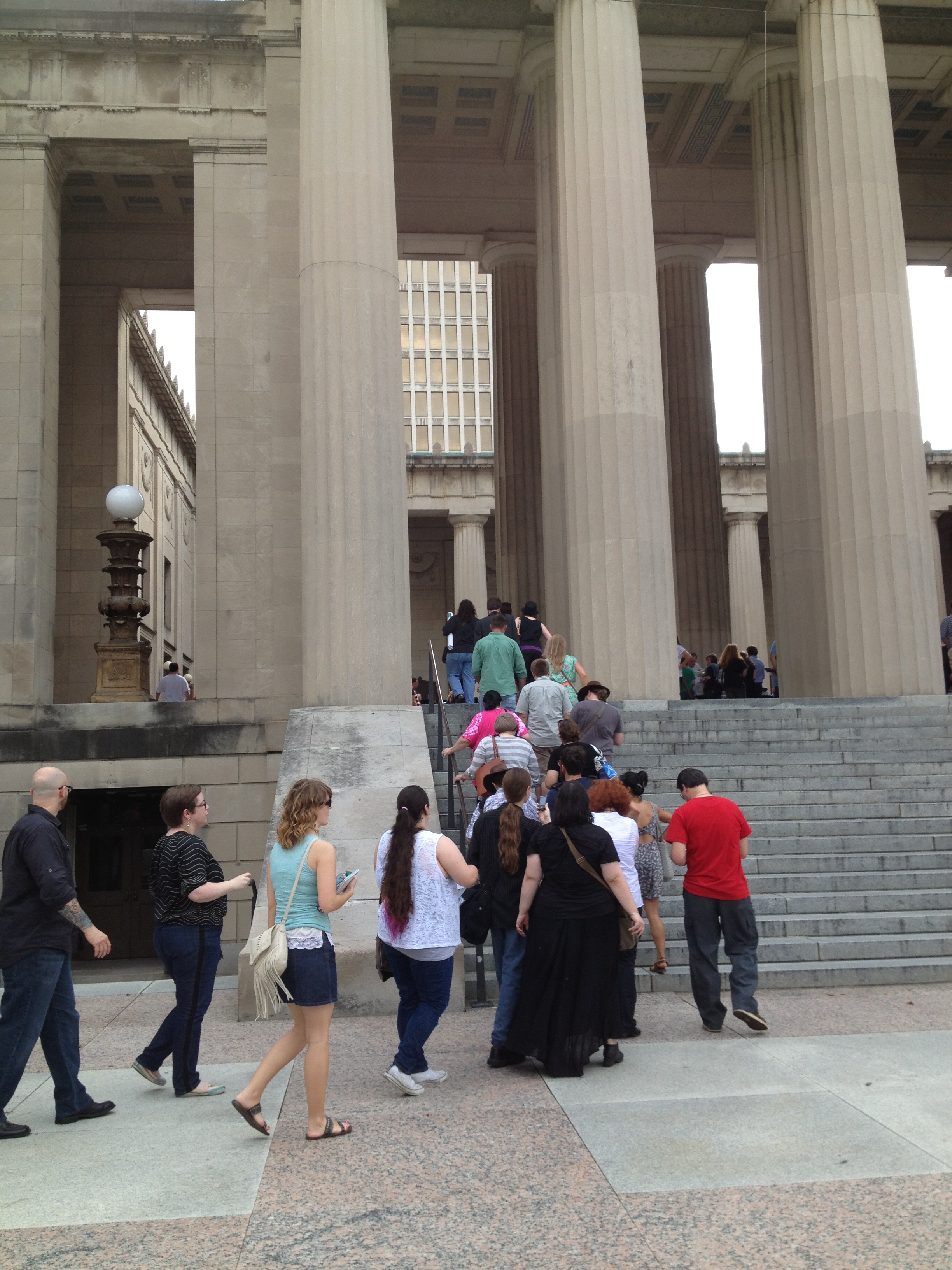
Here is the line for the show. Walking from where I am to the front door took about 10 minutes. This wraps up and around and over and across and through.

wordpress 5

Here is more of the line.

gaiman 3

The War Memorial Auditorium is an older facility, where the comfort of the audience was not really considered. The bathrooms are in the basement, so if you are in the balcony (which we were) that meant going down and then back up four flights of stairs. The only concessions are from a vending machine (in the basement) or beer, wine, and sodas in the lobby. This whole arrangement was very tedious for trying to endure the evening. It started at 6, and we finally left at 11:30, having still not had our section called for the signing line.

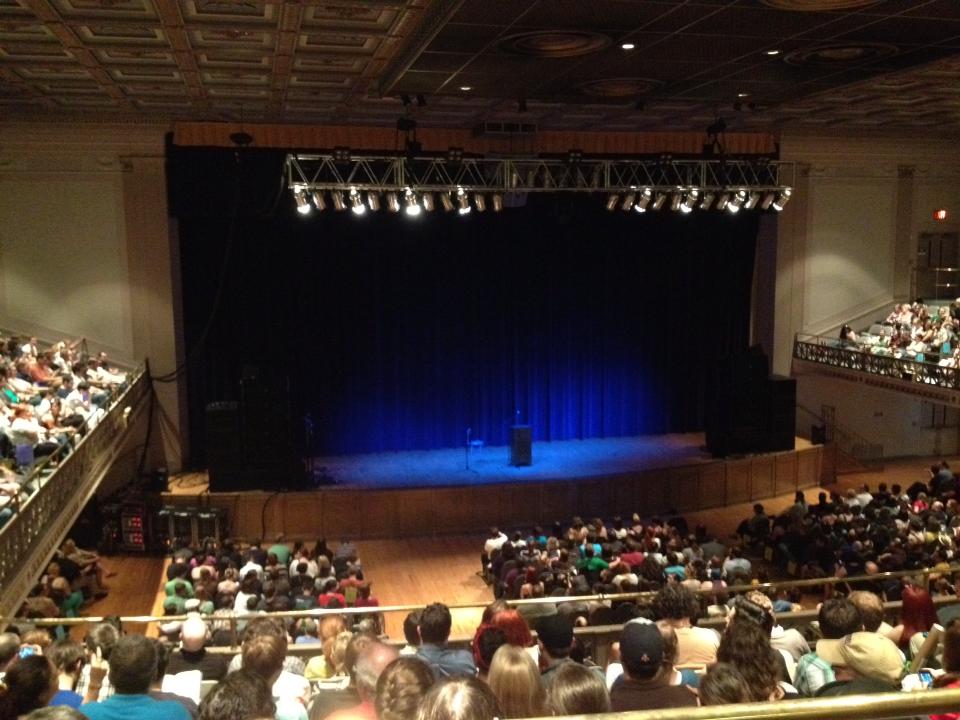
This view is from our seats, waiting for him to come on stage.

wordpress 4

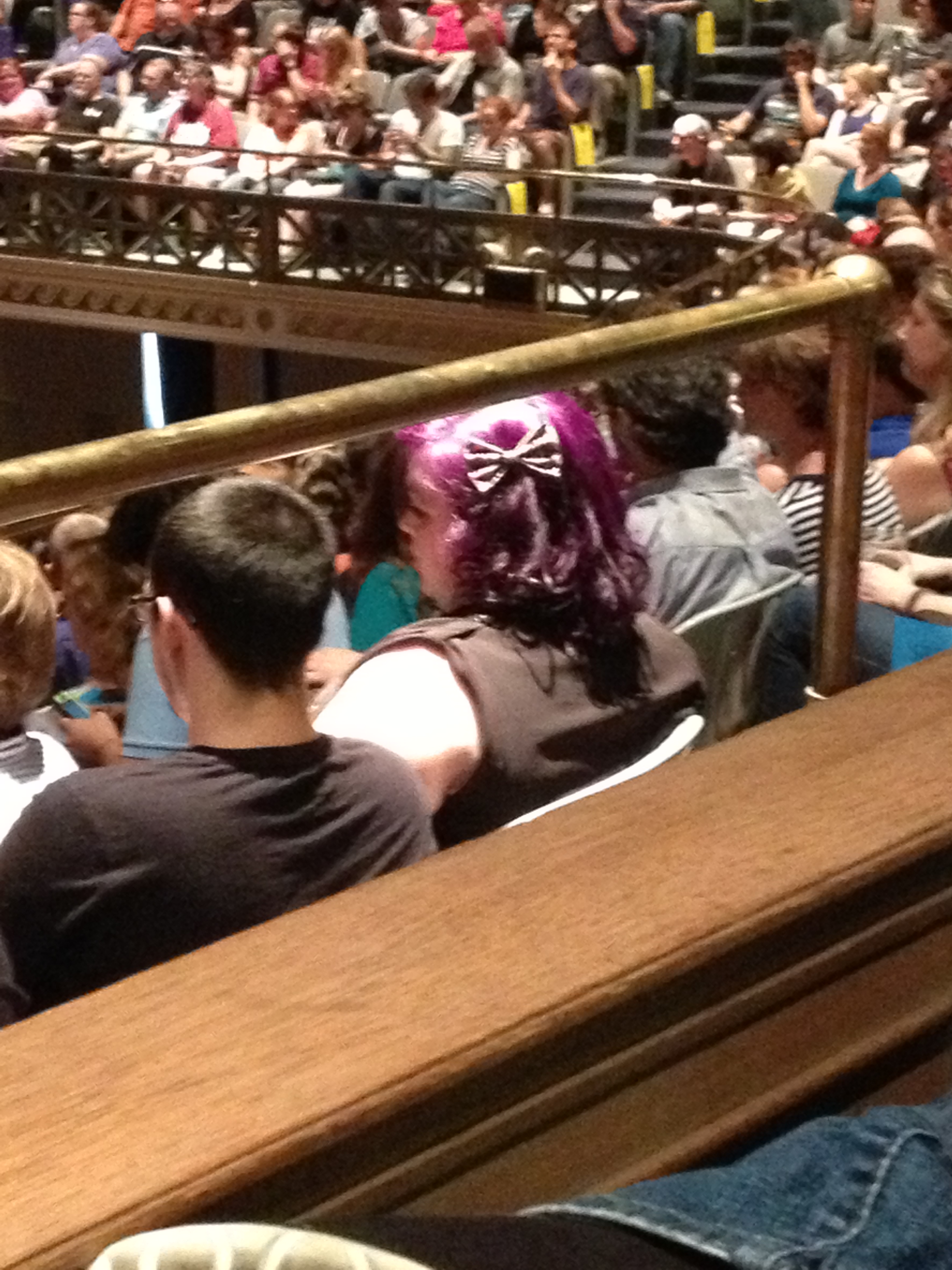
Here is a girl with cool purple hair and a smart bow (which she made). There were many people with alternative hair color at this show. Bright pink was very popular.

gaiman 4

And, here he is on stage.

photo 1

In the biggest sense I’m glad we didn’t stay until the end, because we could have been there until 1 in the morning (he said that was common). He mentioned that this was his last signing tour because it was just getting too hard to manage. There were about 1600 people there at this show alone, and at the last show he’d had to ice his hand because he’d signed so much. I felt a little guilty even thinking about getting him to sign my book at this point. He writes longhand – this is the hand he’ll use to write the next book. So really, I’d rather him write a book than write his name. Plus, I was really tired. I would have loved to just have seen him up close, and said thank you, and given him a smile. But, it was not to be. It isn’t like we would have had a long, meaningful chat or anything. I’m sad, but I’m realistic.

He said that sometimes people would say “Your book changed my life”. He usually dismissed this, until after his Dad died. His Dad had died suddenly, when Neil was on tour, and he put off his grieving. There was just too much that had to be done with the tour. He didn’t have time to grieve. But then after the tour, while at home he read a book where a fictional character died, and that opened him up. He started to grieve for that character, and through that, grieve for his father. So he started to understand how fiction can be healing for people.

He mentioned that when he first started signing tours he was writing the “Sandman” series, and there were “very few people with a pair of X chromosomes in the audience”. Later, as his writing diversified, his audience diversified. Occasionally he’d notice a huge man come up to him in a smelly dirty t-shirt who would say he owned a comic book store. The man would say “You brought girls into my shop!” (He did this in a great accent). To which he mused to himself “Maybe if you washed your shirt more often girls would come into your shop more often.”

He read from “The Ocean at the End of the Lane” We got a bit towards the end of the book. There was a thunderstorm going on, and we could hear the “boom!” from inside the auditorium. It was a section of the story that took place during a thunderstorm and it is very scary. He was waiting the entire tour to be able to read that bit during a thunderstorm -so we were in luck. This special performance was just for us. The thunder was perfectly done. He gave thanks “to the effects department” at the end.

About writing “The Ocean at the End of the Lane” – He feels he is in a three way relationship, himself, Amanda, and her album, and the album is winning. She went away to Australia to record her new album, and this time he’s only getting occasional emails, and they usually are very short and say “the album is doing fine”. So he decided to write a short story for her, that was very personal and had a lot of feelings in it, because that is what she liked. He wasn’t sure if he could pull off feelings, because “Well, I’m English, and I’m male.”

He started writing it as just a short story, and it kept going, and kept going, and it ended up being a novella which was far more than he meant. He sent it on to his publisher and said “Well, I seem to have written a novella, and I’m very sorry and it won’t happen again.”

It was amazing to find out how much of this story is real. There really was a Hempstock family that lived at the end of the lane that he lived at when he was a child. Their farmstead really was in the Domesday Book. There really was a South African lodger who killed himself in a white Mini, for the same reason, who lived at Neil’s house. In fact, when he finally found out, as an adult, why that Mini went away so suddenly, he was really upset. His take on it was “Something interesting happened to my family and I didn’t know?!”

This is his kind of humor. Dark. Real. Strange.

The way he wove in reality with fantasy makes both a little mixed up. How real is the fantasy? How fantastic is the reality?

He talked about writing in general.

He writes in longhand so he doesn’t get distracted. He stays away from the computer while writing. He said he might go look up how many Ps and Ls are in ‘apparently’ and then end up 90 minutes later finding himself buying something on Ebay that he doesn’t want. Also, he changes pen colors every day, so he can see what progress he’s made. He found out that Neil Stephenson does the same, but he uses expensive paper from Italy that comes sealed up with wax.

A fan gave him a handmade book at a signing once, with handmade paper made with rosepetals. He knew that this would be perfect for writing a sequel to “Neverwhere” – “How the Marquis got his coat back” He started writing it with a fountain pen (his normal tool of choice) and found that every time he hit a rose petal the pen would create a huge blot and he’d have to clean up the mess. He got about a page written and never finished. He realized that he could have switched to a ball point pen, or regular paper, but he just wasn’t in the mood at that point.

He wrote on Coraline for quite a while, and then let it sit for several years. Then he wrote a little more, and let it sit for a few more years. He finally sent it off to his editor who loved what was there and she said “What happens next?” He said “Send me a contract and we’ll both find out.”

He wants to write sequels – “…it isn’t like I think I am better than people who write sequels. It is just that there are so many other characters that have stories that want to be told.”

After the reading, he answered questions from the audience. There were 3×5 notecards on each seat when we arrived for us to write questions. Here are some that I remember. They aren’t exact quotes, just what I recall. A. stands for audience, NG is Neil Gaiman.

A. “Who is your favorite Doctor?”
NG. “Yes, Who is my favorite Doctor.”

(Earlier on he said after mentioning Doctor Who – “How about we make a deal? Every time I say ‘Doctor Who’, you don’t go ‘Wooo!’ , or we will be here until Friday. (Personally, I don’t have a problem with this, as I’d happily hang out listening to Neil Gaiman for a month at least…))

A. “What would you do if you drove 2 hours to get here, and you’ve forgotten where you parked.?”
He then told us that he doesn’t have this problem, because after many years of touring and staying up late signing, and then having to be at an airport very early to check in, he decided to use a tourbus. He goes outside to the bus, gets in, and goes to sleep. He wakes up ten hours later in another town, showers and changes, and is ready to go.
So at the end, his reply to the question was “Me, I’d look for the bus. You, you’re screwed.”

A.“I’m thinking of a number between 1 and 10”.
NG. “No, you’re not. You’re thinking ‘He read my card!’.”

A. “Why?”
NG. “Why not?”

There were other cards that said “Why?” on them and he commented that we were very existential here in Nashville.

A. “You are married to a much younger wife. Are you going to have another child?”
NG. “Well, that is very personal. But, then again, I’m married to Amanda, who blogs about everything we do, so I’ll probably find out that we are going to have a child by reading her blog.”

Here was the final question –

A. “So, you’re in Nashville, and you might not like country music. But if you did, what country music artist would you have dinner with?”

NG. “Well, I’m not going to be having dinner with anyone tonight because I’ll be here signing, but if I did, it would be Bela Fleck.”

The crowd erupted in a roar of approval. Bela Fleck isn’t quite country, and he isn’t really pop, or rock. He’s unique. He does things with a banjo that humans don’t normally do. He created a banjo version of “The Danse Macabre” for Neil’s “The Graveyard Book” Bela Fleck is cool.

Then Neil went on to say that it might be possible that Bela was there that night. He was being coy. There had been a chair set up next to the podium all night, and most of us had just assumed that Neil would sit in it if needed. No. It was for Bela. He came out with his banjo. This was a Nashville-only event. We were treated to Neil reading a section from “Fortunately, the Milk” (not yet published) with Bela Fleck doing his own special accompaniment to it. There were aliens and pirates and fathers, oh my! And Bela made all the noises and it was wonderful.

wordpress 3

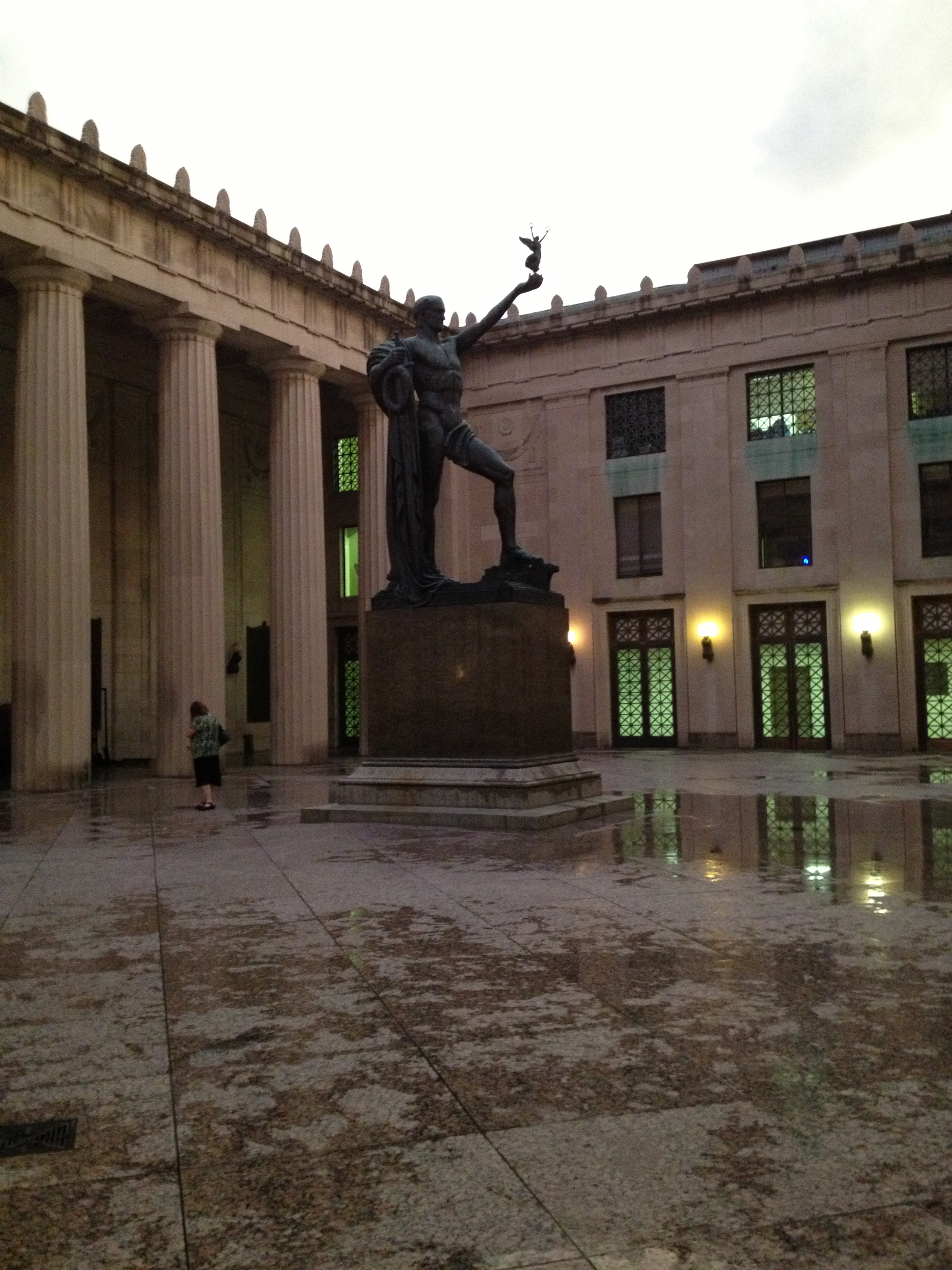
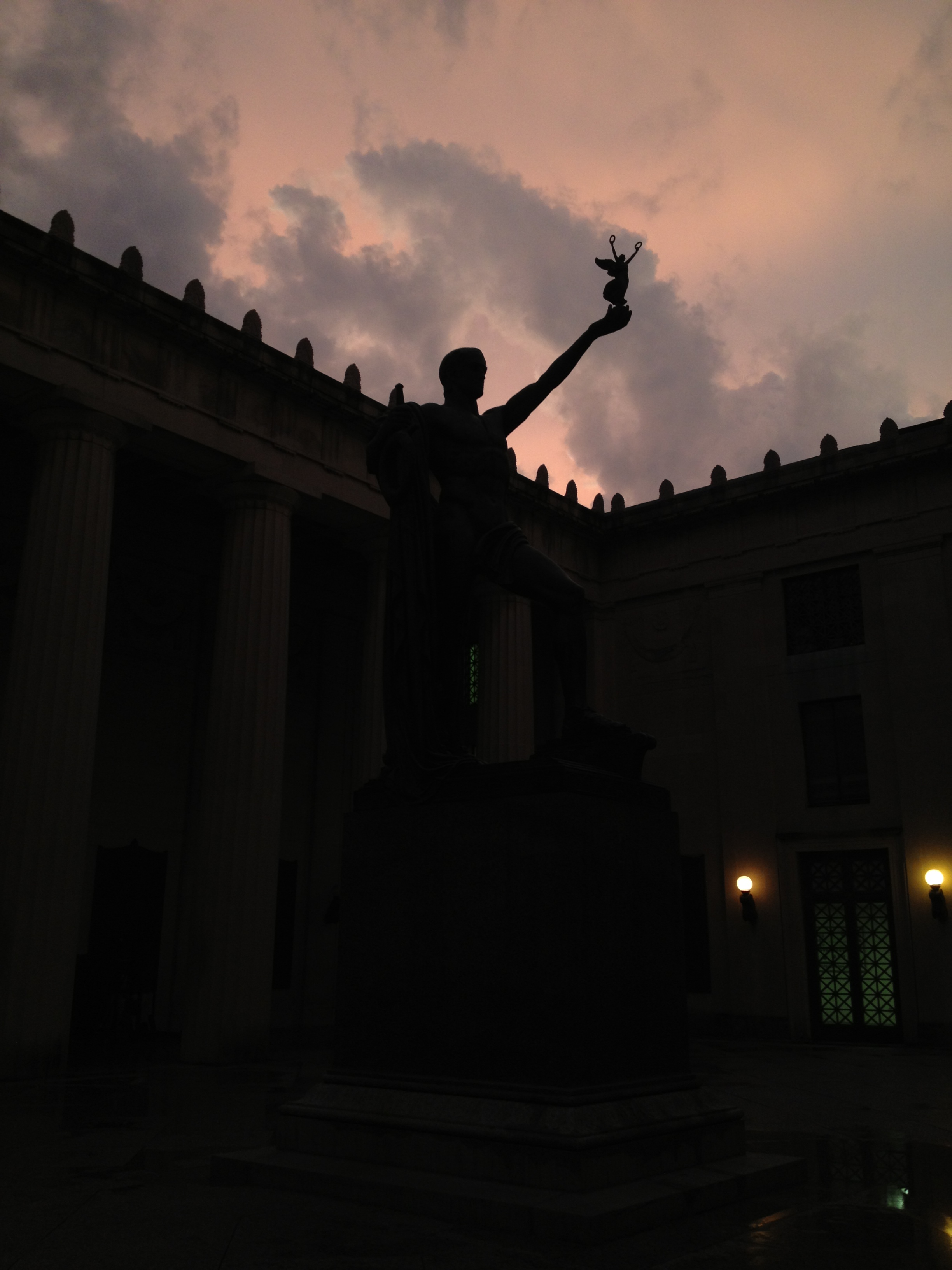
I went downstairs, all those stairs, to go to the bathroom. I looked outside. There is an immense statue just outside the doors. It was pretty cool when we came in, but after the rain it was really intense. It was hard to get the camera to handle the weird lighting.

This is my favorite view. It is not altered at all.

wordpress war memorial 1

Here is a view with the focus on the statue and the courtyard.

photo 2

Here is a view with the focus on the sky. photo 3

You can kind of combine them together in your head to get an idea how awesome it was. I’m pretty sure Neil would have been impressed – if only he’d been able to take time away from the adoring fans.

The storm had created an amazing sky. It was a pretty cool evening.

wordpress war memorial 2

Zero

Zero calories. Fat free. Gluten free.

This doesn’t mean it is healthy. Look at the label. It can have healthy claims and be totally devoid of nutrition. So what if it has no calories if it also has no vitamins or minerals?

I remember one time when I was working at the craft store in Chattanooga. We got in a shipment of pottery that was packed in these new cellulose packing peanuts. The owner of the store got really excited and said they were edible. He started eating them like they were cheese puffs. Just because something is edible doesn’t mean you should eat it.

There are plenty of snacks that are being sold in pre-portioned packs, usually 100 calories. Partly this is because we have no idea what a proper portion is, and we are gluttons. We’ll eat the entire bag of chips or cookies in one sitting without thinking twice about it. So we need limits. But so what if it is 100 calories, when is 100 calories of nothing? Empty calories fill you up fast and don’t leave any room for actual food.

Something can be gluten free or kosher or organic or any other health buzz word and be high in cholesterol or fat or salt. It can be totally devoid of fiber and nutrients.

I’ve never understood why someone would pick an “energy bar” when they can just eat an Apple and some almonds instead. You’ll get the same results with no preservatives and no packaging, and a lot cheaper.

We are being deceived. We are being tricked. We no longer know what food is, and how to cook it. We are letting corporations make our food. To paraphrase Michael Pollan in “Food Rules”, our food comes from plants, and isn’t plants.

I have relatives who put out bowls of apples for decoration, rather than for eating. Then they realize that the apples go bad, so they have to buy more. Then they decide to buy fake ones. Only in America would we decorate with fake food. Meanwhile people are dying of malnutrition across the country and across the world.

All you can eat doesn’t mean all you should eat. Sure, you want to get your money’s worth when you go to a buffet, but if you overeat, you’ll pay for it in more than money. That dozen doughnuts costs less than a half dozen, but how long will it take you to burn off those calories? So, really, it costs more.

Nametag

I wear a nametag at work. I guess it is better than wearing a uniform. It identifies me as an employee, as someone helpful.

But I hate wearing it. I’m all for people knowing I work there. I’m for people asking me questions. I also stand behind my actions so I don’t care if someone feels the need to call downtown to the Main library and complain that I wouldn’t let them do something which is against policy or illegal.

But I do mind the over familiarity this encourages. I don’t like strangers calling me by name. That seems like a huge boundary violation to me. This may not be a problem for other people, but it is a problem for me. Perhaps it has to do with how I was raised, where my space, my thoughts, and my body weren’t mine. I was stolen from in many ways as a child. It has taken me many years to come to terms with the amount of damage that was done to me, intentionally or not.

Or perhaps I’m not alone in feeling creeped out when someone I don’t know acts like he knows me.

I’m glad that my legal name is Elizabeth, but I go by Betsy. So there is a layer of distance there. It isn’t an easily guessable nickname either. It is a way of differentiating. When a stranger says “Hey, Elizabeth” I know they aren’t real. I know they only have my name from my nametag.

They think they are being personable, but they are actually being the exact opposite. They didn’t get my name from a person (me), they got it from a piece of plastic.

It is important to call people what they want to be called, if you want to be personable. I knew a guy named Michael who would get really violent if someone called him Mike, or Mikey. It was too intimate, too casual, too familiar for him to handle. He once told a story about slamming a guy’s head into a table for calling him Mike, after being told not to.

That is a bit extreme. He has anger management issues. But hopefully you get the idea. Names matter.

We don’t have a naming practice in the average American culture in that you get to pick your own name. It isn’t really yours, so much as something that was assigned to you. But it is yours, in that it differentiates you from everybody else in your family.

Sometimes people will call me by another variant of Elizabeth – I’ll get Liz, or Lizzy. I think this is a terrible nickname. I hate how it sounds. And also – it isn’t my name. Why would I respond to it? You might as well call me Donna. Once again, people are trying to be familiar and they haven’t been given that permission.

The bad part about my job is that I am expected to be friendly with everyone. That in and of itself isn’t bad – it is where that goes. I think people are interesting, and I like being friendly with people. I don’t like it when they assume that my being friendly with them means that I am their friend.

Because I’m not. I’m not their friend. Sometimes I am, and sometimes I enjoy it when they come in. I enjoy talking to them. Those are the people who get “Betsy” as the name to use.

So, be mindful when you use the name of someone who works at a store. When you use their name because you’ve gotten it from their nametag, you aren’t being friendly. Oftentimes, you are at an advantage. Often, they don’t have your name. It isn’t friendly – it is a power play.

Here, I use Betsy, because I’m being very personal here. I’m sharing myself. I’m trying to be as real and as open as possible. And, well, it goes well with Beadhead, which has been my nickname for over half my life. So, in a way, I have named myself, and I have given you permission to use my “real” name.

Writing a blog is very public and very private at the same time.