Ah! God!

I’m noticing a connection in the different names for God. Jehovah. Allah. Yahweh. Hosanna. Adonai. All have the sound “ah” as part of them. Is there something we should notice here?

Is God, (which is not a name so much as a descriptive) the surprise, the awakening? When we are surprised in a gentle way we often say “Ah-ha!” It is a sound of coming to ourselves, of waking up. It is a sound of an awareness that is deepening. It is a sound of new understanding and growth. It is a good sound. It means that we are stretching ourselves and growing into awareness and consciousness.

Or, another idea, do we find God in the exhalation? A breath out is an “ah”. Of course, God breathed life into us, so the sound we breathe out is that same breath. It didn’t change from going into us to going out of us. And when God was breathing into us, God was actually breathing out. God breathes out, and we breathe in.

Another idea, is God to be found hiding in “amen” and “alleluia”? In our giving thanks, we are pointing back to God. With our God-given breath we are giving it back in praise. I’m reminded of the idea of giving up the first born of the livestock. It takes a lot to give up the firstborn – you aren’t guaranteed a second. It takes a lot to give up your breath, for the same reason.

There are no guarantees. But we are made to love and serve God, and not to hoard up any of the gifts we have been given by God. To use our breath to praise God is the simplest and most honest gift we can offer.

Wherever we go, there we are. Wherever we go, there is God with us.

There is a Jewish podcast that I listen to a lot. The writer/speaker likes to talk a lot about the first word in the Torah. The word is b’reishit. It sounds a bit like “Bray-sheese.” It is often translated as “in the beginning”, but the author says that “with beginnings” is better. It isn’t about the beginning of time, but beginning itself. Every moment is a new beginning, a new chance.

He has said that if you rearrange the letters of the first word, it spells the “song of the aleph-bet (the alphabet)”. That is pretty poetic, and it makes a lot of sense. I’ve heard that the Jews believe that God spoke or sang the world into existence with the Torah.

The writer/speaker has talked about many different meanings and depths to this word, this beginning of beginnings, but I don’t think he has ever talked about the fact that the Torah begins with the second letter of the alphabet and not the first. So I will.

Why would the Torah’s first word start with B, and not A? For starters, God is always surprising us. The underdog is constantly getting promoted in the Bible stories. The second son gets the inheritance most of the time. The last shall be first.

I think God wants us to not expect things with God to be the same pattern as it does with the world. God’s ways are not our ways. The rules change. Don’t become complacent. What you thought was going to happen isn’t always what is going to happen. You are not in charge.

But then, it all goes back to the sound, Ah. Sometimes you only notice something when it is missing. By having B as the first letter and not A, it points back to A. And A, “ah,” points back to God. And God is the beginning of everything.
Mantra – arrive on the mat

My current yoga mantra is “Arrive on the mat.” It is the same as “be here now.” It isn’t an intention or prayer. It is a reminder.

It is like “return to the breath.” It is so easy to get off center, off focus, off kilter, just off. It is so easy to get distracted and discombobulated. In those times we need to remember to return to our breathing, because it will bring us back to ourselves.

We plan on one thing, and then another thing comes up. I hate it when I’m trying to do tree pose and the teacher keeps talking. I can have the most awesome “drishti” (focus point for my eyes) but the more she keeps chattering about how to keep my balance, the less balance I have.

So maybe “drishti” isn’t about an external thing to look at. Maybe it isn’t finding a spot on the floor or the wall to stare at. Maybe it is about finding that still, small, quiet place inside me that is calm and centered. Maybe it is about being at the eye of the storm, rather than in the storm.

The eye of the storm is right in the middle of everything, yet it is calm. That sounds good. Well, not being in the storm at all sounds better, but I’m not seeing a way to avoid that. Work, bills, family, chores, retirement plans, homework – there is a lot going on. We can’t just chuck it all and run away. Sometimes we do run away. We go on a vacation, but then we come back everything has piled up just a little more.

Some people leave everything and become monks or nuns or hermits or hippies. Some people leave literally, some just leave mentally. There are many ways of leaving. You can be there but just not care because you’ve chemically altered yourself.

I don’t want that. I did that for years. My problems didn’t go away, they just got fuzzier, and I just didn’t care about them as much.

That is why my mantra is “arrive on the mat”. The mat is like an altar. It is a sacred space where I prepare myself. I shape myself into a calm, centered person. I mold myself into a vessel for the Spirit. I remind myself that I must take care of this gift of my body, this house of my soul.

I want to be here, be present, be open to the opportunities that life offers. I don’t want to miss a thing. I want to observe but not obsess. I want to be there in the good and bad, in the rich and poor, in the better and worse, in living and in dying.

Because to arrive on the mat is to be there, as you are, right then. Shaggy hair, ragged toenail polish, unwashed face, or clean and scrubbed and fed. Either way. There. In the moment.

Let us begin.

In memorium.

Should we grieve more for one person and not another?

Is the death more tragic if it is a young mother, or if it is an old spinster?

Is it more sad if a child dies or if an adult dies having never really lived?

Is it more tragic if a famous person or an unknown dies?

All deaths are meaningful. All deaths are sad. All are different. The homeless woman’s death is just as important as the Queen’s. Death will take us all. Death is the great equalizer. Death wins.

We can pretend that death is far away. We can pretend that it will happen another day, to another person. We are special. We are different.

We aren’t. All of us are going to die, one way or another. Like it or not, you can’t escape it. You can’t take your toys with you. There are no guarantees of life, no do-overs.

Tomorrow never comes.

Until it does. Don’t take it for granted. Take it as a gift. Don’t waste it.

Every day is a new gift. Every day is another chance. Make that phone call. Write that book. Start that search for the job where you feel useful and needed and worthwhile, where you get to do what you feel called to do. Go back to school. Whatever. Or learn how to be happy where you are.

One of my friends from high school died today. She was in her mid 40s. Young. With children. A beautiful soul. We hadn’t seen each other since then, and had only recently found each other in the past few years on Facebook. She had brain cancer. Cancer is a terrible way to go. It eats you up, slowly transforming your cells into cancer cells. The treatment is barbaric. Slash and burn, poison and cut. Sometimes the treatment is worse than the disease.

Sandy and I first knew that we had something in common while we were in Economics class. We were bored. We were sitting several rows apart. Somehow I caught that she was quietly singing a Violent Femmes song with a friend of hers. I knew it – and I started singing along. “I take one, one, one cause you left me, and two, two, two for my family…” I knew it, and I was in. I had the secret code that let her know I was weird. Once you were in, you were there. We were great friends after that. The last thing I remember doing is going trick-or-treating with her and two other friends. We were too old to go, really, but we went anyway. Sandy drove, and we picked the rich neighborhoods for our hunt that night. We did well.

I’m grateful to have known her. I’m sad, not really for me, but for her family. I hadn’t seen her in many years. We’d grown apart, like people do. Her loss won’t hurt me as much as it hurts them. But I hope to remember something of her spark, her spirit, her smile. She was funny, and snarky, and smart, and beautiful in all the right ways.

Rest in peace, Sandy Scott. May your memory be a blessing to all who knew you.

Kindergarten 8-21-13

Today in kindergarten we were working on spelling our name. Well, when I say we I mean the children I’m assigned were working on their names and I was helping. And when I say helping I mean keeping them on task, opening the marker, cheering them on, and realizing when they have had enough and then sending them back to class. There is only so much one-on-one work you can take when you are five.

Kindergarten is hard work. There are a lot of distractions. Today the biggest distraction was that I have a bandage on my thumb. I had cut my thumb while cooking a few days ago and I wanted to keep it clean and dry. Plus, it was a bit ugly, so I didn’t want to distract them. This didn’t work. The girls were fascinated, and asked about it. One even wanted me to show her the cut. They boys didn’t even notice it. While the lesson was supposed to be about how to write your name it veered off into a lesson about cooking safety.

I was bored with the lesson anyway. We did this last week. Can’t they write their names already? But I’m not there for me. And if you can’t write your own name then you are not going to do well with much else.

Not all children grow at the same level. Sometimes it is really hard to wait through the dry patches, the quiet time. Sometimes there is a lot of waiting. Sometimes progress stops and everything seems to go backwards.

And that is ok. That is part of it all. Sometimes I’m not very patient with the slow times. I want to know I’m on the right path. I want to know I am having some positive impact. I want to know there is a happy ending, that everybody comes out OK in the end. This isn’t just about kindergarten.

Not every kid gets it. Not every kid gets it in the time period allotted. Sometimes they have to repeat a grade. It isn’t a sign of failure, in spite of what some parents think. It would be a huge disservice to the child to push her when she just isn’t ready yet.

I’m here for the stragglers. I’m here for the ones who need a little extra attention. If they can be helped now, they are more likely to do well in the future.

Don’t we all need this? A little time, a little attention, a little love? Because this is love, and this is real. I pray for these children. I pray in words and action. I encourage them and celebrate their successes. Being able to write your name is a big thing. I’m proud when they can, and I’m proud to see them try so hard.

I’m grateful for the chance to help them grow. I’m grateful that the Mayor lets Metro employees volunteer in the schools on work time. I’m grateful that my workplace can spare me. I’m grateful I found a teacher to work with who is enthusiastic and kind.

And I’m grateful for every little success I see. I don’t get to see a child “get” reading every day, but just being able to write her name without tracing it is a beautiful thing. Baby steps.

Mourning church

So many of us are disillusioned with church. We want to love Jesus but we can’t stand what we are being told. The more we read of the Gospel the more we feel that church isn’t where we will see it lived out.

We’re angry. We feel duped. We feel deceived. We feel like we have wasted years of our lives in the service of an institution, a machine, rather than a living God.

We feel that we have been controlled and manipulated, not to shape us into stronger members of the Body of Christ, but to make us more docile and compliant.

We are grieving. We love Jesus, and we feel that the only route we have been offered to find Him has taken us far away from Him.

So we leave church. We’ve left with fear and trembling. We’ve left because we feel that to stay is to get even further away from what we know to be true.

There are many of us.

We are slowly finding each other, the misfits, the outcasts. Some of us left church of our own accord, some of us were asked to leave.

But we still need community.

Remember how Jesus says that if two or more are gathered in his name, he is there? He says nothing about doing it on your own. Jesus came to gather up all the lost sheep, the lost crumbs, the lost coins. He came to unite us. So it is important for us to join together.

There are virtual communities of us, who find each other on social websites under the banner of “Progressive Christian.” A lot of us are sad that there has to be a way of separating us from “those” people who say they are Christian but use it as a social club, or as a club to attack anyone who isn’t them. Can’t we all get along? That is what Jesus wanted – for us to join together. But we don’t feel we can be silent anymore in denominations that are anti- any of God’s children. We don’t feel we can be silent when our faith is more interested in stopping gay people from being married than stopping children from starving. Women’s reproductive rights are important, but environmental destruction is more important. We are being distracted as to what the important issues really are.

We feel that our faith has been hijacked. We feel that the wool is being pulled over our eyes. We feel that we are being sold a bill of goods that we know to be bad. We feel that we are expected to be quiet little sheep.

We need to take time to grieve. And then we need to move forward.

We are angry at how many people are being mislead. This is not just by the prosperity preachers. It is not just by the ministers who preach hate and intolerance. It is even by the liberal churches who welcome everybody. I feel that we have been lulled into a false sense of security, and we’ve given up our own power. We’ve forgotten how to follow Jesus when we follow others. When we put our faith and our trust in authority figures and in the establishment, rather than in Jesus we will always be mislead.

We’ve not been taught how to hear from God. We’ve not been taught to trust that still small voice. We’ve been put down and ignored. We are embarrassed to talk about God in church. We have been told that we are crazy.

We know we aren’t.

We are starting to think that we’ve been ignored and mistreated and abused and talked down to enough. We are realizing that the church hasn’t been a good parent to us. We are divorcing ourselves from this dysfunctional family, and going out on our own.

Big library/little library

There are twenty branches and one main library in our system in Davidson County. One of them is closed for the foreseeable future because of flooding. The entire basement flooded, six feet up the walls. Men in hazmat suits have had to go in and clean things out. All the books have been removed to prevent them getting moldy. The employees have been reassigned to other branches.

This is a big deal. The branch that closed was a tiny branch, and my branch is a huge branch. There are patrons that went to my branch when it opened and shortly learned that it is not their style. They now are having to come back to us. It isn’t very easy for them.

It reminds me of when I tried to leave Bank of America. I was sick of being treated like a number. I was sick of stupid rules that made no sense. I should be able to write my account number on a check I’m depositing when I go through the drive through, rather than park my car and come in to get a deposit slip. But, they didn’t see things my way. They have a lot of customers. They can’t make exceptions. I opened an account at a smaller branch and was greeted by name every time I went in. The turnover of the tellers was minimal. I got to know them, and enjoy going in. I refinanced my mortgage that was with BoA in order to begin the process of leaving BoA. Sadly, the mortgage was resold to BoA within two weeks. My master plan was foiled. I was stuck dealing with a huge entity.

These patrons are in the same boat. They want the personal service of a tiny branch, but that is impossible with a large branch. The employee who has been reassigned to us said that two hours on the desk at my branch was like a whole week at his branch. We serve 800 people a day. We can’t take the time to learn your name and the name of your children and husband and what books you like to read and how your medical history is going. We just can’t.

And I’m OK with that. It is a library. It isn’t a bar and we aren’t bartenders. It isn’t church and we aren’t priests. People forget that sometimes. There is something about a library that makes people think we want to hear all about their problems.

Sure, we care. We do. We are human. We enjoy stories. If we didn’t, we wouldn’t read books. Books are full of stories. But people aren’t like books. We can’t close them when they get to be too much. Books don’t get their feelings hurt when we get overwhelmed with what is going on. We don’t feel trapped when the problems in books are too big for us to handle. It is human nature to want to handle problems, to fix them, to make things better. That expectation isn’t there with books. Books are books, and people are people.

People are messy things. People are difficult and complicated and weird. They are amazing too. But there isn’t any training when you go to work for the library that tells you how to deal with people who feel that they need to tell you everything about their lives.

I don’t remember this happening in retail. Working in the library is a lot like retail and yet different. People treat you better, for starters. But they also share a lot of deeply personal stuff. Sometimes it is too much, too deep, too personal. Sometimes I want to run away. Sometimes I’m fascinated. Sometimes I’m grateful for the pastoral care training I’ve had that helps me to just be a calm presence for them.

Death books

Books on death, dying, and funeral customs. Face your fear. These are in no particular order. I’ve read most of them. Some look interesting and I’ll get to. There is enough information here for you to get them from Inter-Library Loan (ILL) if your local library does not have them.

CALL # 611 R6282s.
AUTHOR Roach, Mary.
TITLE Stiff : the curious lives of human cadavers
ISBN/ISSN 0393050939 (hc : alk. paper)
ISBN/ISSN 0393324826 (pbk.)

CALL # 393.9 P9772f.
AUTHOR Puckle, Bertram S.
TITLE Funeral customs : their origin and development
ISBN/ISSN 1558887504 :

CALL # 393 M6475f.
AUTHOR Miller, Clarence W.
TITLE The funeral book
ISBN/ISSN 1885003021 (pbk.) :

CALL # 155.937 C69h.
AUTHOR Colgrove, Melba.
TITLE How to survive the loss of a love
ISBN/ISSN 0553077600 (pbk.) :

CALL # 152.4 J279g 2009.
AUTHOR James, John W.
TITLE The grief recovery handbook : the action program for moving
beyond death, divorce, and other losses including health
career, and faith
ISBN/ISSN 0061686077 (pbk.)
ISBN/ISSN 9780061686078 (pbk.)

CALL # 362.14 S92m.
AUTHOR Strong, Maggie.
TITLE Mainstay : for the well spouse of the chronically ill
ISBN/ISSN 0316819239 :

CALL # YA 306.903 M6138t.
AUTHOR Meyers, Karen, 1948-
TITLE The truth about death and dying
ISBN/ISSN 9780816076314 (hardcover : alk. paper)
ISBN/ISSN 0816076316 (hardcover : alk. paper)

CALL # 393.9 M9841m.
AUTHOR Murray, Sarah (Sarah Elizabeth)
TITLE Making an exit : from the magnificent to the macabre-how we
dignify the dead
ISBN/ISSN 9780312533021.
ISBN/ISSN 0312533020.

CALL # 362.1756 H4342.
TITLE A healing touch : true stories of life, death, and hospice
ISBN/ISSN 9780892727513 (hardcover : alk. paper)
ISBN/ISSN 0892727519 (hardcover : alk. paper)

CALL # 616.078 N969h.
AUTHOR Nuland, Sherwin B.
TITLE How we die : reflections on life’s final chapter
ISBN/ISSN 0679414614.

CALL # 155.937 L8499f.
AUTHOR Longaker, Christine.
TITLE Facing death and finding hope : a guide to the emotional and
spiritual care of the dying
ISBN/ISSN 0385483325 (pbk.) :

CALL # 155.937 K95od.
AUTHOR Kübler-Ross, Elisabeth, 1926-2004.
TITLE On death and dying : what the dying have to teach doctors,
nurses, clergy, and their families
ISBN/ISSN 9780684839387 (trade pbk.)
ISBN/ISSN 0684839385 (trade pbk.)

CALL # 344.7304 U78L.
AUTHOR Urofsky, Melvin I.
TITLE Letting go : death, dying, and the law
ISBN/ISSN 0806126353 (pbk.)
ISBN/ISSN 0684193442.

CALL # 155.937 B398i.
AUTHOR Becvar, Dorothy Stroh.
TITLE In the presence of grief : helping family members resolve death,
dying, and bereavement issues
ISBN/ISSN 1572306971 (pbk.)
ISBN/ISSN 1572309377.

CALL # 393 E845.
TITLE Ethnic variations in dying, death, and grief : diversity in
universality
ISBN/ISSN 1560322780 (pbk.)

Greening Death: Reclaiming Burial Practices and Restoring Our Tie to the Earth by Suzanne Kelly

When We Die: The Science, Culture, and Rituals of Death by Cedric Mims

Saying Goodbye Your Way: Planning or Buying a Funeral or Cremation for Yourself or Someone You Love by John F. Llewellyn

Grave Matters: A Journey Through the Modern Funeral Industry to a Natural Way of Burial by Mark Harris

The American Way of Death Revisited by Jessica Mitford

Smoke Gets in Your Eyes: And Other Lessons from the Crematory by Caitlin Doughty

Dealing Creatively with Death: A Manual of Death Education and Simple Burial by Ernest Morgan

When Death Occurs: A Practical Consumer’s Guide Funerals, Memorials, Burial, Cremation, Body Donation by John Reigle

The Funeral Book: An Insider Reveals How to Save Money and Reduce Stress While Planning a Funeral by William Miller

Final Gifts: Understanding the Special Awareness, Needs, and Communications of the Dying by Maggie Callanan

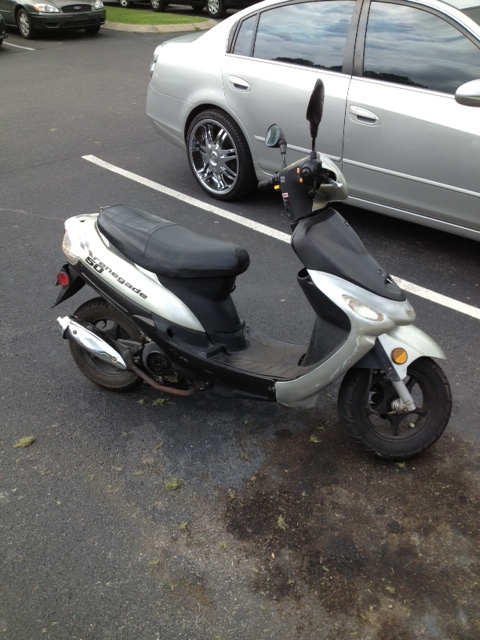
Renegade – meditation on a scooter.

I saw a scooter parked at my work. The make was “Renegade”. My first thought was that the manufacturer was trying to make a scooter seem tough. A scooter isn’t like a motorcycle. Motorcycles are for renegades. But scooters? Not so much.

renegade

But then I thought again. It takes a bit of counter-cultural thinking to drive a scooter. It uses less gas. Some are electric. So you are as far away from the Hummer mentality as possible. You are being environmentally conscious in a society that prides itself on big cars and big debt.

You are also risking your life. You don’t have two tons of 14 gauge steel insulating you from the vagaries of drivers. Driving in Nashville is risky business. People don’t pay attention normally, even when they aren’t texting and updating their Facebook and eating their lunch. Zipping around on a scooter is pretty brave.

So perhaps it is a renegade act to drive a scooter. I still think scooters look funny. But perhaps that is my problem. I think “tough” should look a certain way. I forget that Mother Teresa was tough, and so was Gandhi. “Renegade” isn’t about looks but action.

Who is in charge here?

Jesus didn’t come to make a religion. He didn’t come to establish rules of who was in charge. God is in charge. God is the teacher. But then, as now, people can’t handle that. They want to have proof, and documentation, and certificates of training. They want to control and limit. Jesus wanted nothing to do with that.

In Mark 11:27-33 we read about an interaction between Jesus and the authorities of the day.
“27 Again they came to Jerusalem. As he was walking in the temple, the chief priests, the scribes, and the elders came to him 28and said, ‘By what authority are you doing these things? Who gave you this authority to do them?’ 29Jesus said to them, ‘I will ask you one question; answer me, and I will tell you by what authority I do these things. 30Did the baptism of John come from heaven, or was it of human origin? Answer me.’ 31They argued with one another, ‘If we say, “From heaven,” he will say, “Why then did you not believe him?” 32But shall we say, “Of human origin”?’ -they were afraid of the crowd, for all regarded John as truly a prophet. 33So they answered Jesus, ‘We do not know.’ And Jesus said to them, ‘Neither will I tell you by what authority I am doing these things.’”

Even Jesus was questioned. How could he possibly have the authority to heal people and to forgive them their sins? This was radical. This still is radical. Healing? Without medical training? Forgiving sins, without theological training? Are you kidding?

Then others started taking Jesus’ lead. They realized that they had the power to heal too. This concerned the disciples.

In Luke 9:49-50 we hear this conversation between Jesus and his disciples – 49 John spoke up, “Master, we saw a man using your name to expel demons and we stopped him because he wasn’t of our group.” 50 Jesus said, “Don’t stop him. If he’s not an enemy, he’s an ally.”

Perhaps this is how we got to where we are today. Jesus’ disciples didn’t like the idea of someone else getting in on the action. This was their thing. This was special, and they’d left their homes and jobs and families to join him. They were in the club. Then these strangers started doing what they were supposed to be doing, and they got angry. I suspect they thought “How dare they – they aren’t part of our club!”

But Jesus didn’t come to create a club, or a clique, or a church full of rules. Jesus came to wake us all up. Jesus came to let us know that we all are children of God, and we all can call on Him. With Jesus, we can heal the wounds of the world.

Then Jesus says in Matthew 23:8-12
8 “But as for you, do not be called ‘Rabbi,’ because you have one Teacher, and you are all brothers.9 Do not call anyone on earth your father, because you have one Father, who is in heaven. 10 And do not be called masters either, because you have one Master, the Messiah. 11 The greatest among you will be your servant. 12 Whoever exalts himself will be humbled, and whoever humbles himself will be exalted.”

So why do we have ordained people? Why do we have priests and ministers, who are set aside and separate? Why isn’t everyone trained, instead of just a few? How much of this is about control?

What of this is in line with what Jesus taught?

Jesus called us all to be part of the Body. We are all to work together. No one is greater than another.

In Matthew 20:16 we hear this from Jesus – 16 So the last shall be first, and the first last: for many be called, but few chosen.”

We aren’t to raise ourselves up over each other. We are all equal in the eyes of God. We are all called to love and serve the Lord.

A million dollars worth of enlightenment.

What would you do if you were given a million dollars? A lot of people say that they would give it to charity. They’d spend it on something good or worthwhile – defeat cancer, solve hunger, stop war. Maybe they’d also give some to family members who were in debt.

Sometimes I think they are lying for the sake of sounding like they are nicer than they are. Would any of us, really, give away all that money to help others? Wouldn’t we spend some of it on ourselves first? I know I would. Perhaps I want everybody else to be honest. Or perhaps I don’t want to think I’m the only selfish person around.

Sure, I’m not entirely self-centered. I want to learn how to do conflict negotiation. I want to be a peacemaker. Learning how to do that will take time and money – and I won’t get that money back. The peacemaking I’ll do will be for free. And I want to learn how to perform life-cycle ceremonies for people, like weddings and funerals. There are plenty of people who need these ceremonies but they don’t belong to a faith community. I would perform those ceremonies for free. The classes and time to learn how to do that are not cheap, however.

If a million dollars came my way I’d show it a good time. I’d pay off the cars and the house. I’d build a storm shelter in the basement. I’d put away a large chunk in savings. I doubt I’d quit my job because I like having some structure to my days, but I might go part time and spend the rest of the time taking classes or volunteering. I certainly would take more time to work on my art.

But I wouldn’t just give it away. There are so many things that might be helped with a judicious application of money, but they won’t be cured. Throw a million dollars at the homeless problem and you’ll just have another batch of homeless people in a year. Throw a million dollars to solving child abuse and you’ll have more abused children later. Sometimes it isn’t about money, but about attitude. So often we are trying to fix something with a band-aid when really only an amputation will cure it. So often we treat the symptom rather than the cure.

I’ve heard of people making “blessing bags” for homeless people. The bags have food for a day, along with toiletries and some underwear and socks. That is something – and I’ve long said it is better to do something than nothing. But that is only for that day. And meanwhile, the person still will be sleeping in the cold and the rain.

Maybe it is the yetzer hara speaking. Maybe I’m getting frustrated because I think the goal should be to prevent people becoming homeless, and I can’t figure out the solution. But I also want to prevent people becoming drug addicts, or bullies, or child abusers, or rapists, or prostitutes. I want to prevent the problem, and it seems so much bigger than I can possibly get my head around. I’d rather prevent someone becoming a child abuser than say I want to prevent child abuse. See the difference? It is the difference between teaching women to not be a target for a rapist, and teaching men to not rape. The person being attacked has a problem, certainly. But the person who is the attacker has a problem too. Stop the problem at the source and you’ve fixed two problems rather than one.

I have some ideas about this. The attacker feels lesser-than. The attacker feels that the other person has something that they need. The attacker often does not feel that the other person is a person at all – and that is why it is OK to attack them. Empathy is part of the solution. How do we teach this?

I don’t think money is the cure for this. I think some of it is an attitude shift in our society that needs to help people feel comfortable expressing themselves. They also need to be comfortable with other people being different and having different opinions. Teaching people dialogue versus debate would be helpful. But that isn’t money, but time and mindset. It is time for a different way of thinking.

Money just short-changes growth. It is like putting training wheels on a bike. You may be able to ride that bike, but you don’t really have the balance necessary. You haven’t built up those muscles yet. You ran right past the experience of falling down (many) times. So you can ride, but you have to have the training wheels to do it, and you can’t empathize with people who had to do it the hard way.

I’ve heard that people who have a lot of money are the least likely to volunteer or to donate money to charity. Perhaps something about having it easy makes it harder to understand those who have it hard.