Room at the table.

I was in a pastoral care class last year. A guy from another church started talking about the Christian church today. He was really afraid for how far out the church had gone, trying to make it open to everybody. He was afraid that we “had pushed the boat out so far from the shore” that we couldn’t even call ourselves Christian anymore.

He was afraid that making the church “all things to all people” watered it down so much that the message was lost.

Deep down, he was afraid that anybody could do anything and still say they were Christian.

They could be women and want to be ministers. Not deaconess, not pastor’s wife, but honest-to-God minister. Women are supposed to support men in their ministry, not be ministers Women are supposed to be like children – sit down and shut up. They are supposed to cover their heads and be silent in church and be submissive to their husbands.

Or they could be gay, and not only gay but openly gay, holding hands with their partner in public. There is a bit of “don’t ask don’t tell” going on with homosexuality in the church. Some people are ok if you are gay, as long as you aren’t open about it. They may understand that homosexuality isn’t a “lifestyle choice” in the same way getting a tattoo is, but they still don’t want to see it. They want to at least pretend that you are gay, but celibate. They want to think that you have at least stopped acting gay.

While we are on the subject of tattoos, there is that too. For some people who go to church, they are uncomfortable with you saying you are Christian if you have tattoos. They know in the back of their heads somewhere that it is wrong. They can’t tell you the verse that mentions it, or explain it even if they knew it, but they know it is wrong, because they were told it was. So they want to close the doors to you.

I wonder how they would handle a gay woman with tattoos in the ministry.

The trouble is that Jesus didn’t give us any of those rules as to who was in and who was out. Those rules came from the Old Testament and from Paul. Not Jesus. Jesus leveled the playing field.

I wonder what their fear is? What are they afraid of if we open church up to everybody? If we are to find the lost sheep, who are we to tell this one that he isn’t good enough? This sheep is black, this one has a limp, this one is blind in one eye, this one has a strange smell, this one sounds different when he bleats. Sorry – you aren’t like the rest of the sheep that are here. You are out.

If Jesus calls them to him, who are we to stand in the way?

When Jesus multiplied the loaves and the fishes, he made enough for everybody there and lots left over. He didn’t feed just his disciples. He provided for everybody, no exceptions. Nobody was asked if they were worthy, if they were contrite, if they were holy enough.

Nobody was asked anything about their sins and what they planned on doing about them.

They were there for Jesus. They were there to hear his message. Jesus spoke to them all, and fed them all.

We are to do the same.

Instead of members of the church worrying about watering the message down by allowing “just anybody” to be a member, we need to worry about our own actions. Are we holding on to the bread, thinking it is ours alone?

Jesus hung out with the hooligans, the misfits, the has-beens and the never-was. He hung out with the outcasts, the lepers, the last on the list. He touched people he wasn’t allowed to touch. He broke all the rules.

He gave us a new kind of math. His cross is a plus sign, and an equals sign. Jesus is the centerpoint – where Heaven meets Human. Jesus is the epicenter, where God came down here, to be with us, as we are. No longer was God up there, out of reach, rarified and separate. No longer was there a division between God and us. This is the plus sign. This is the cross.

And he made us all equal – all forgiven, all blessed, all loved. We are all equal in God’s eyes. We are all his children, not the chosen few who look the part, but all of us, as we are, right here, right now.

Jesus made enough room for all of us at his table.

Mother Mary

There was a massive stature of Mary sitting in a throne holding baby Jesus at the convent I was at this weekend on retreat. When I say massive, I mean life-size. Their eyes were human-looking. Perhaps they were prosthetic. They looked real. Both Mary and Jesus looked a little sad though. They were right in the front, facing the door as you enter. You had to pass by them to get to the chapel or the dining room. There was a triangle tile area in front of them too, which set off that area even more. The rest of the area was carpet.

I spent a lot of years in a medieval reenactment group, so seeing this human-looking statue that looks like royalty kind of messed with my head. She’s in a throne. She’s wearing a crown. She looks real. Do I bow? Do I at least pause? How close can I walk to her? She was kind of in the way. There was no easy way to get around her. To just walk by like she wasn’t there felt a little rude. So I at least paused.

Here’s what you see when you come in, showing the statue and the tile area.
Mary 3

Here’s a little closer.
Mary 2

Here’s her sad face.
Mary 1

I was fascinated by her, and a little creeped out. Mid-way through the retreat I had run out of things to write and I was getting a little bored. I’d thought earlier about drawing her. But drawing her meant getting in the way. The best way for me to draw her was to sit in front of her, at the tip of the tile triangle. And that meant that I’d be sitting in the middle of everything.

I’d be obvious. I’d be in the way. People would have to go around me. They would know what I was doing.

Would this annoy the nuns? Would they be upset with me? They might get annoyed that I was in the way. They might get annoyed that I was drawing their statue of Mary and Jesus.

I thought about it some more. It was the middle of the day. Most of them spent their time in their rooms. It wasn’t supper time or chapel time, so there was a good chance that I’d have the hall to myself. And if they didn’t like me doing it they could tell me to move.

I’m working on this part of my internal dialogue. I’m trying to be mindful of other’s feelings, but also mindful of my needs. I’m trying to not let imagined censorship make me stop doing something. All too often I make up what people say before I even start something, and I assume they are going to say no so I never start. I’m pushing past that and finding out that they rarely say no.

Turns out, while I was drawing, the nuns smiled at me. A fellow retreat member admired my work. Sure, I was in the middle of the hall, but I wasn’t completely in the way, and I wasn’t there long. So I kept drawing.

Here’s the picture of what I drew. My paper isn’t big – maybe 4 inches by 6. I didn’t have space for faces.
Mary 4

I used watercolor pencils, but I’ve not added the water yet. This looks like regular colored pencil this way.

After I drew it, I sat there for a bit, and I talked quietly to Mary. “Should I draw your face? You look so sad.” And she answered. She told me to draw her the way a child would draw her Mom, if her Mom wasn’t around. She told me to not look at the stature of her, but see the image of her face in my heart. Imagine if you are in school and the teacher tells you to draw your Mom. You have to draw her from memory. But in this case, I’m drawing not my Mom, but Jesus’ Mom, but by extension, sort of my adopted Mom. It is hard to explain. Sometimes I realize that I didn’t get comforted by my Mom in the way I needed, and I’m realizing that Mary is there to comfort me. It is very soothing.

So I drew. I drew her the way I see her looking at me. She doesn’t look like any images of Mary I’ve ever seen before, but she does look beautiful and kind. And that is what I needed to see.
Mary 5

She said “My child, I am giving birth to you too.” She is nurturing me like my mother couldn’t. I sat there, in tears, drawing her, washed by her love and compassion. Her arms are wide enough for me too.

“Get thee to a nunnery”?

So how come nuns get a special place to retire to? It is a lot nicer than a retirement home. Cleaner, smells better, better lit. Better food. There are no special codes to get in and out either. There isn’t a feeling of being trapped.

They have donated their lives to serving those who suffer from “poverty, sickness, and ignorance.” Their whole lives have been given up in the service of the church. No husband, no income, no possessions; they have sacrificed themselves to serve others.

How is this different from a teacher, or a police officer, or a nurse? How are their lives of service different? Their lives, the lives of the secular who serve, are harder in fact. They have to secure for themselves a home. They have to buy their clothes. They have to pay for the electricity, the water, the gas. They have to do upkeep on their homes. They have to pay for their training. If they are smart they save for their retirement. Then they have to find a place that has an opening that is nice to retire to.

This is a beautiful convent that just happens to be a nursing home. The grass is lush. The rooms are pleasant. It was built as a retirement home for aging Sisters of Mercy. Not all nuns, just these particular kind of nuns. The sister who welcomed us said that they had served the poor and the homeless all their lives, and now with their convent they are still serving them. But then she got a little quiet. How? By letting people come here on retreat.

Now, they aren’t leading the retreats. They are allowing people to come and have their retreats here. They didn’t initiate it. They had 41 sisters to start with and are now left with 18. Other people started calling, wondering if they could use the space. There are a lot of empty rooms.

This makes me wonder about the ranks of nuns. Surely there should be others who are ready to retire. A steady influx of novitiates would result in a steady stream of retirees 50 years later. But the stream is drying up.

Do people not want to serve God by being a nun? Is it too much of a commitment? Is it a stigma attached to the Catholic Church, and church in general? Or are people choosing to serve God in less open ways?

You don’t have to be a sister to serve. You can be married or not, female or not, Catholic or not. You can work in a church or a school or a department store. You can work anywhere where you can use your talents and your gifts to help others.

God wants each of us right where we are, right as we are.

Be honest in your dealings. Treat every person fairly. Speak truthfully and kindly. In these ways you are serving God.

You don’t have to join a nonprofit. You don’t have to give all your money away. You don’t have to go on a missions trip to Belize or the Congo or Africa.

God is here. The poor are here. You are here. Get going. You don’t even have to “get thee to a nunnery.” Just go.

(Started 9-14-13 at 11:30 am, middle of a 26 hour silent retreat. Expanded 9-16-13)

Temporary nuns.

I know a lady whose friend thinks she is being called to be a nun. She is about to enter a year-long discernment process to determine if she is indeed being called. If it is anything like the Sisters of Mercy process it could take a minimum of seven years before she is able to fully be accepted as a sister.

Why? Why this long? But then again, wouldn’t it be helpful if all people went through a process to see if they were suited for their professions? I’ve lost track of the number of people I know who spent many years and many more dollars to get an education to get professionally certified; only to find out when they actually entered their chosen field they hated it. They trained to be teachers or nurses and found they couldn’t stand it in reality. When it came time to do the work they were trained for, they found that they didn’t love it.

That is a lot of time and money and energy wasted. A little discernment beforehand would have helped a lot.

Of course, deciding to be a nun isn’t the same as deciding to be a nurse or a teacher. Well, actually it is. A lot of nuns end up doing those very jobs. They are both service jobs.

But nuns don’t get paid. They don’t get to marry. They don’t get to own anything either. There is a lot more commitment to being a nun.

I’ve heard that very few young women are entering the convent these days. Perhaps the Catholic Church should rethink this whole thing.

Let people have 5 year runs. Let young women sign up to serve the poor, the homeless, the sick for five years. During that time their “pay” is room and board, just like regular nuns. During that time they are single, so they can dedicate all of their time to their mission and not a family.

After that time they can leave. It is kind of like the Peace Corps, but with church training and oversight. This would bolster the ranks of the nuns and give young women who want to help a way to do so without the lifetime commitment.

They might also have the opportunity of renewing their contract. Either way, they will have training and on the job experience that can translate into a job in the secular world.

Seems like a winning solution to the shortage of help.

Grieving the parents that never were. On death, and healing when your experience doesn’t match up with the self-help books.

So many self-help books tell you how to deal with your parent’s death if it was a good relationship. What if it wasn’t good? What if it was terrible?

If your parents were less than ideal, you aren’t alone. Parents are people, and people aren’t perfect. But when a self-help book assumes you are sad and distraught because your “pillar of the family” of “chief cheerleader” dies, you may be feeling even more lost. Your feelings don’t match up with what it says in the book.

Sometimes your grief comes from the fact that you are now doubly missing a parent. The person who gave birth to you is now no longer physically present, while they never were emotionally present. When an emotionally distant or abusive parent dies there is no longer any hope of having a healthy relationship with her or him. All bets are off, all chances are over.

Some books say that you can create a healthy relationship with the person even after the person has died, but this honestly makes no sense. It takes two to have a conversation and work on a relationship. The only thing left to fix is yourself and your understanding of the relationship. Do you let this bad start stop you from going any further? Or do you learn from it and go on?

There are a lot of conflicting emotions when your parents die, and it is made even worse when the self-help books make it worse by making you feel like something is wrong. Worse, it is not only that something is wrong, but something is wrong with you in particular. It is like opening up an instruction manual on how to put together a piece of furniture and the box is missing the bag of nuts and bolts. You don’t have everything necessary to make it work. The instruction booklet assumes you do. The booklet plunges right in, assuming you have all the parts. You read along, trying to make it work, trying to learn how to heal this rift, this grief, all the meantime you didn’t start out on the same ground that it assumes you did. When you get to the end, the picture of the finished product looks nothing like your result.

It can’t. You are missing some important parts that hold things together.

I’m not sure how to tell you how to find those nuts and bolts. I’m just trying to honor where you are coming from, because it is where I am coming from. I think a lot of us had less than ideal relationships with our parents.

I think it is totally normal to be sad that your parents died because now you will never have them as the kind of parents you need. That relationship has ended. They weren’t there for you, and now they never will be.

I also think it is totally normal to be relieved that your parents have died if the household was abusive. I know that there is a sense of guilt for feeling this. I think that is because society assumes you should be sad, when really you can’t be sad. I think to be sad that you are free of an unhealthy relationship is insane.

I think it is healthy to feel however you feel you need to feel, without regard to what people think you should feel. It think it is very healthy to get these feelings out – don’t bottle them in, and don’t deny them. If you stuff them down they will come out in ugly ways later. Trust me on this.

There are a few ways I’ve learned to deal with these feelings. Pick a couple. Try them out. If it doesn’t work, try something else. This is by no means an all-encompassing list.

Talk to a therapist or a counselor or a faith leader or a compassionate friend. Go for a walk or a run. Punch a pillow. Cry, sing, wail. Jump up and down. Dance. Journal – write it out. It doesn’t matter if you are good writer or not – you don’t even have to use sentences. Create – use non-word activities to get it out. Sometimes words fail us. Draw, paint, garden, make jewelry – anything where you can get your feelings out.

Most importantly, have patience with yourself. This work of grief, especially grief concerning a broken relationship, is hard, and it takes a long time. Know that what you are going through is normal. You aren’t alone. It is hard work, and it is important work.

What the books don’t tell you is that this isn’t the end. Just because your biological parent wasn’t up to snuff doesn’t mean you can’t find new role models. You can have second third and fourth parents. You get to pick your parents this way.

You can have one friend teach you how to cook. Another can teach you how to sew. Another can teach you everything you want to know about fly fishing. You can take a class too, or read a book, or watch a video. You aren’t stuck with just one set of parents. There are hundreds of people who are able and happy to teach you whatever skills you need to know.

“All Are Welcome” – on Communion, and limits.

I was at a retreat and heard the sound of Mass. The songs were familiar. The words were familiar. I have spent many years as an Episcopalian. The Catholic service is close. It is like the difference between England and America – everything is almost the same. I could have joined in and faked it. I could have taken Communion. It has been four months since I’ve had the sacrament of Communion. I miss it.

I wanted to join in, but knew I shouldn’t. Catholic rules say only Catholics can get Communion. Jesus didn’t make any such rules, but when in Rome…or dealing with Roman Catholicism…it is best to play by their rules, even if I think the rules are wrong. Even if I know the rules are wrong.

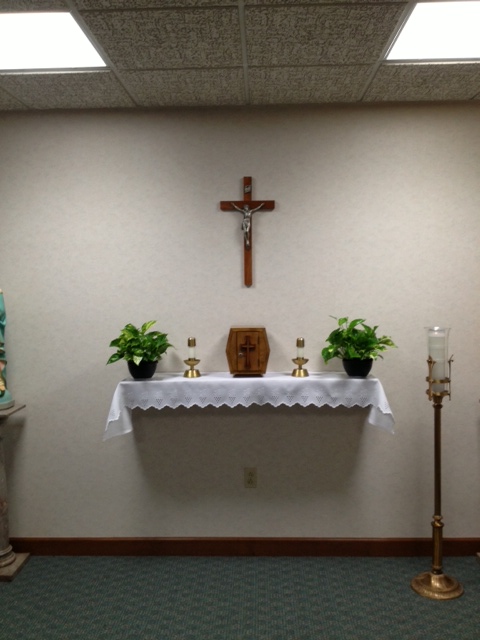
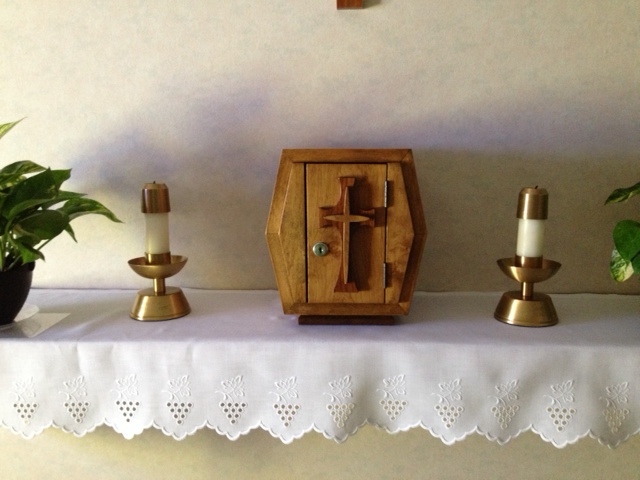
I’ve spent the past day at a convent for retired Catholic nuns. There are two chapels – one big and one small. They both have a box called an aumbry or tabernacle for the reserved sacrament. It is where you put consecrated Communion wafers. Before they are consecrated they are just wafers. After a priest has blessed them, they are different. They are so different that they are separated from the others in a special box. The Catholics believe that the wafers become the actual flesh of Jesus when they are blessed by the priest.

Here is a picture of the altar in the little chapel.

box 5

Here’s slightly closer.

box 1

I know that consecrated wafers were in them because the candle beside the altar was lit.

box 2

The candle means Jesus is in.

I can’t even tell you how tempted I was to see if the box was locked. Yes, these boxes have locks on them, but often they are open. If I tried the door and it opened, would I have taken a wafer?

Here’s a picture closer up of the box, showing the lock.

box 4

Taking one out would be stealing. That would have been the same as attending Mass and going up to take Communion, knowing full well that their rules say I can’t. No – actually, it would have been worse. It would have been sneaky and sly. It would have been taking something like a thief.

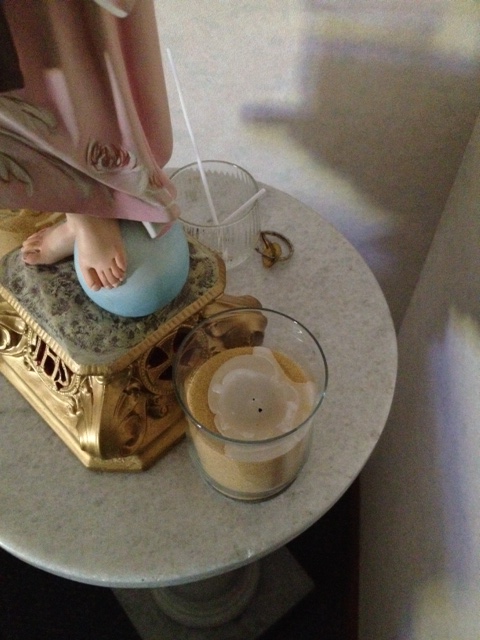
When I was wandering around the room, I came across a little statue with some candles around it. I saw the key behind the statue.

box 3

I felt like I was part of some adventure game, where you find the key to the locked door with the treasure. Remember those? You’d use simple instructions with a verb and a noun to get across what you wanted to do.

Take Key. Go East. Go to Box. Use Key. Open Box. Take Wafer. Eat Wafer.

And then I’d win a bonus life in the game.

But I didn’t. I didn’t do any of that. I didn’t even touch the key.

The Methodist church that sponsored the retreat has Communion every Sunday. They say on their website that their Communion is open to all. “All are welcome” is their motto. They even go so far as to explain that this means everybody – members of that church, members of other churches, and people who have never been to church. This is a welcome surprise. This means that people who aren’t baptized can take Communion there.

This is a radical departure from the Episcopal Church. This is right up my alley.

I’m all for opening up Communion to everyone. While I was part of a church that allowed people from other denominations to take Communion there, it still didn’t allow unbaptized people to. Sure, there is nobody checking baptismal records at the altar rail, but still, the rule is there, printed in the church bulletin you got when you came in the front door. When you read it, you know you’re out. You know you are breaking a rule if you put out your hands for a wafer.

It isn’t the role of Christians to stand in the way of Christ. Who are we to set rules and parameters as to who is worthy? If someone is called to the table, who are we to stand in their way?

Jesus is all about welcoming and including. Jesus is all about breaking down barriers. Jesus is all about leveling the playing field. Jesus is all about opening doors wide open and inviting everybody in.

Bonus life, indeed. This is a game where all can play. It isn’t a game of musical chairs, where there are limits on who is in. We all win. We all are invited, and blessed, and loved. We all are. No exceptions.

Mary holding Jesus.

We often see Mary holding Jesus. She is either holding him as an infant or holding him as he came off the cross.

It had to be hard to be Mary.

I cannot imagine her anguish holding Jesus after his crucifixion. So much injustice. So unfair. His life did not warrant death. In the image of the Pieta, all looks lost. His ministry seems over. All that work, all those followers, and now nothing. Jesus is dead, his disciples have scattered. Nobody wants to be associated with him because that would mean death for them too.

This is us. This is us, in the middle of the story, in the middle of the night. This is us, not knowing what is going to happen next. When all looks lost, when everything is dark, when nothing makes sense, we aren’t alone.

We know the end of that story. Jesus rise from the dead. Jesus rose and continues to live. He lives on, alive, continuing to heal and teach, through us, his Body, his Church. And because he rose, we know that he will work through this story too.

When we can’t see what is next, call on Jesus. When we don’t know where to go, call on Jesus. When we don’t know what to do, call on Jesus.

Perhaps that time when all seems lost is a time to wait. There were three days in the tomb. There were forty days in the desert. It can’t all be go go go.

Waiting can be holy time.

There is a lot of time between seed and flower. There is a lot of time between grape and wine. Jesus is there in those times too.

(Written 9-14-13, 11:45 a.m, about 16 hours into a 26 hour silent retreat. I’d wandered around before bed the night before and sat for a while before a statue of the Pieta.)

Talking to myself.

Oh my God. I still have another 3 and a half hours until supper. Then two more hours until we leave. So maybe less than 5 hours of having to be by myself.

How will I stand retirement? How will I stand my vacation coming up? At least half of that I will be alone. How will I stand being a widow, if that is to be?

I’m not really by myself, but I am. We can’t talk. There are others here, but the convent is big enough with enough areas that we can wander around and have space to ourselves. There are porches, and swings, and trees, and libraries, and snack areas that we can go to. Or we can stay in our rooms. But we can’t talk. So it feels like I’m alone.

Perhaps I don’t like being alone and silent because I’ve just not done it before. The day here is broken up with meals. We see each other then, but we still don’t talk. I write. Boy, have I written. I’ve wandered around outside. I took some pictures. I read two “elf-help” books. I did scrapbooking for the first time.

And I listened.

And God listened with me.

I’m waking up to the voice. I’m hearing the echo. Rumi says “Who is speaking with my mouth?” and it makes sense.

I’m afraid to say that the voice is me, and I am the voice. It sounds vain, petty, selfish. It sounds crazy. Yet if “I am my beloved and my beloved is mine”, it makes sense.

If we are a way for the universe to know itself, then this praying to God is self-reflective. God is within all of us. God created us, and gave us life. When we slow down the noise of our lives we hear God’s voice. It is inside us, as close as our breath, as essential as our heartbeats.

We aren’t God. But we are part of God. And God dwells within us, every one of us. God is within all things. It all came from God.

There is no division between living and not, animate and not. Everything has value. Everything has a purpose. It does not matter if it benefits humans in general or you in particular. God made it for a reason.

(Written 9-14-13, at 2 pm. Three quarters of the way through a silent retreat.)

Maps and schedules, and getting lost and found.

Sometimes the scariest trip is the trip you make alone. Alone, in a room, no props, no safety net. Stripped of all your toys, your familiar things. Everything taken away, and all that is left is you and God.

That’s all there ever was anyway.

Everything we do, we buy, we read, we are, is an escape from God. We are constantly filling our heads with noise so we can’t hear the still small voice that is God.

I’m doing it now. I’m afraid of the silence. When is the next part of the retreat? Where is it? What if I need something? Where’s my map? Where’s my schedule?

I want to catalogue this experience. I want to lay out words like breadcrumbs so I can find my way back. But what am I finding my way back to? Am I finding my way back to where I was before the retreat? Or am I leaving a trail so I can find my way back to God?

Breadcrumb trails work both ways.

Words are my lifeline. I’m afraid of silence. I’m not talking, and I don’t have anything on – no podcast, no music. I’ve turned off my phone. I just remembered to turn off my wireless signal on my Kindle.

I did notice there is wireless here for the guests. I did try it. I admit it. I don’t have the password. This is a good thing. Temptation, thy name is the internet.

So, silence. Am I obeying the rules? We can have our journals so we can write. I have made a commitment to not send anything out (no posts) and not take anything in (no email, no Facebook). So writing on my Kindle – is that cheating?

Words are Jesus’ way in for me. And beads. And painting. And music, dance, yoga. He isn’t picky. He wants it all. But I like words. I’ve used them for many years. And he is the Word made flesh after all.

I’m afraid. The first retreat I went on in my adult life, I got woken up in the middle of the night to have a chapel call, only I didn’t know that was what it was. It was strange. It was beautiful. It resulted in the diaconal discernment program I was in being put on hold. I came back a little more Pentecostal than the Episcopal priest could handle. I was made to feel that I was being done a favor by the program being put on hold. It could have been stopped forever. Once you get told “no,” there is no going back.

The second retreat after that resulted in me writing a post about how I believe that we as a church are doing everything wrong. Jesus didn’t come to create an organization with denominations and hierarchies and committees. He didn’t want us to have ministers separate from lay. We are all ministers. We are all the body of Christ. That post got me in trouble with the priest and the head of the pastoral care committee. They were angry and hurt. They took it personally. I’ve not been back to church at all since then.

But I’ve not left God.

I’m wandering in the wilderness. I’ve left a ritual heavy church, where moment to moment you know what is going to happen next. There’s a program. There’s a script.

Now I’m adrift, at sea. And Jesus is standing twenty feet away, his feet lapped by the waves, saying “Follow me.”

(Written 9-13-13, 8pm, at the beginning of a 26 hour silent retreat.)

Retreat! A trip of a different sort.

Going on retreat is like going on a trip. In some ways it is like going on a trip like the kind you would need a suitcase for. But this time I mean like one where the only place you go is in your mind.

When I was in college, I went to the mountains with some friends. We rented a cabin and we “tripped”. We took our candles and our snacks and some acid. Nothing was how we expected it to be. But that was the point. We were used to things as they were. We wanted something different. Or really, we wanted to see what was there all along for a change.

I knew a guy who listened to his favorite album when stoned. He heard parts to that album he’d never heard before. He thought it was the pot that brought it out. It wasn’t. He was simply in a state of mind where he was open to new experiences. He was looking for something to happen. Those notes were always there. He was just too distracted to notice. With pot, because he was expecting something different, he noticed what he’d been missing. Pot didn’t do it. His expectation did.

Don Juan, in Carlos Castaneda’s books drugged Carlos for the first few years. He wanted him to see what the reality that was beside our reality was. After a while, Carlos got to the point that he could see unusual things all the time, sober. When he asked Don Juan about this, he said that those things were there all the time. Carlos was just too pig headed to see them. Don Juan drugged him up so he would stop paying attention to the expected, and start seeing things for a change.

We are all like this. We practice closure. We see what we expect to see. We look over what doesn’t fit unless it is glaring. We race through our days, unaware, unawake.

Retreats take things away from us, so we have to look. We have to take time off. We have to slow down. We have to be, alone, quiet.

We sit waiting for something to happen. Our senses are wide open. Will Jesus talk to us? Will we see hear smell touch taste differently? How will we be after? What will happen?

We sanctify this time. We set it aside, expectant, hopeful.

What if we did this all the time?

God is constantly present. God is constantly communicating with us. We just have to slow down and listen.

Wait with me. Watch with me.

(Written 9-13-13. 11 pm, on retreat at the Sisters of Mercy Convent.)