On Jews and Jesus

There are several reasons that Jews do not claim Jesus as the Messiah.

One reason is that Jews say it is sacrilegious for a person to claim to be God.  It is a violation of the first three Commandments for God to be depicted, so a person could not be God.

Exodus 20:1-6

Then God spoke all these words: I am the Lord your God, who brought you out of the land of Egypt, out of the place of slavery. Do not have other gods besides Me. Do not make an idol for yourself, whether in the shape of anything in the heavens above or on the earth below or in the waters under the earth. You must not bow down to them or worship them; for I, the Lord your God, am a jealous God, punishing the children for the fathers’ sin, to the third and fourth generations of those who hate Me, but showing faithful love to a thousand generations of those who love Me and keep My commands.

However, Jesus never said he was God.  He said he was the Son of God – and also said that we all are if we do God’s will.  More often, he referred to himself as the Son of Man.

Now, Christianity says that Jesus is God, but Jesus himself never said this.  Jesus prayed to God all the time. This would be pointless if he was God.  However, he is united with God. The next point will illustrate this.

Another issue is that Jews deny the Trinity of God.

Let’s look at some points in Genesis that prove that God is more than we think.

Genesis 1:26

26 Then God said, “Let Us make man in Our image, according to Our likeness. They will rule the fish of the sea, the birds of the sky, the livestock, all the earth, and the creatures that crawl on the earth.”

Who is God talking to when God says “in Our image”?

And here, God appears as three men in Genesis 18:1-2

“Then the Lord appeared to Abraham at the oaks of Mamre while he was sitting in the entrance of his tent during the heat of the day. 2 He looked up, and he saw three men standing near him. When he saw them, he ran from the entrance of the tent to meet them and bowed to the ground.”

Even the name “Elohim”, a word commonly used in the Hebrew Scriptures to refer to God, is a plural word.

Essential to the belief of every Jew is the idea that God is one – and this is true.  At least twice a day observant Jews say the Shema, which proclaims that God is one.  However – the word “one” that is used in the Shema is “echad” – which is a composite unity.  An indivisible unity is “achid”.   “Echad” would be used to describe a bunch of grapes.  It is one thing, made up of different parts.  “Echad” would be used to describe how all of Israel was united around Mount Sinai when they received the Torah.

Yes, God is One, but that One is composed of many parts.  Essentially, God is everything, as everything came from God.

Another example of this is in Genesis 2:24

24 This is why a man leaves his father and mother and bonds with his wife, and they become one flesh.

“Echad” is used in the original in this verse, to mean “one”.  They are two people, but they are united.

Jews say that Jesus violated the commandments by working on the Sabbath and saying that people could eat food that wasn’t kosher. The Messiah would never break the commandments, so Jesus can’t be the Messiah. But God said through the prophet Jeremiah that a new covenant was to come.  The old ways weren’t going to stay that way forever.

Jeremiah 31:31-34

31 “Look, the days are coming”—this is the Lord’s declaration—“when I will make a new covenant with the house of Israel and with the house of Judah. 32 This one will not be like the covenant I made with their ancestors when I took them by the hand to bring them out of the land of Egypt—a covenant they broke even though I had married them”—the Lord’s declaration. 33 “Instead, this is the covenant I will make with the house of Israel after those days”—the Lord’s declaration. “I will put My teaching within them and write it on their hearts. I will be their God, and they will be My people. 34 No longer will one teach his neighbor or his brother, saying, ‘Know the Lord,’ for they will all know Me, from the least to the greatest of them”—this is the Lord’s declaration. “For I will forgive their wrongdoing and never again remember their sin.”

More importantly, the original message of the commandments had gotten watered down.  There is nothing in the Ten Commandments about keeping kosher, or any of the other 600-plus “commandments” that Orthodox Jews honor.  These extra “commandments” came from interpretations of the Torah by rabbis – and not from God.

Jesus wanted people to focus on what was important – loving God, and treating everyone with kindness.  Everything else was extra – and it was following people, not God.  That way leads to trouble.  Jesus wants to redirect our attention to what matters.

Jews say that one of the hallmarks of the Messiah is that he would be king. 

Look at John 6:14-15 which took place after Jesus fed 5,000 people:

14 When the people saw the sign He had done, they said, “This really is the Prophet who was to come into the world!” 15 Therefore, when Jesus knew that they were about to come and take Him by force to make Him king, He withdrew again to the mountain by Himself.

Why did he refuse to be King?  Because only the immortal God is their King – not a fallible human.

Jesus knew what was in their hearts, and wanted them to search for the right things.  He wanted them to put their faith in God. He wanted them to redirect their love to God, instead of putting their trust in a person.

John 6:26-27

26 Jesus answered, “I assure you: You are looking for Me, not because you saw the signs, but because you ate the loaves and were filled. 27 Don’t work for the food that perishes but for the food that lasts for eternal life, which the Son of Man will give you, because God the Father has set His seal of approval on Him.”

Note that God never wanted Israel to have a human king over them.  Here is the prophet Samuel speaking to the nation:

1 Samuel 12:8-15

“When Jacob went to Egypt, your ancestors cried out to the Lord, and He sent them Moses and Aaron, who led your ancestors out of Egypt and settled them in this place. But they forgot the Lord their God, so He handed them over to Sisera commander of the army of Hazor, to the Philistines, and to the king of Moab. These enemies fought against them. 10 Then they cried out to the Lord and said, ‘We have sinned, for we abandoned the Lord and worshiped the Baals and the Ashtoreths. Now deliver us from the power of our enemies, and we will serve You.’ 11 So the Lord sent Jerubbaal, Barak, Jephthah, and Samuel. He rescued you from the power of the enemies around you, and you lived securely. 12 But when you saw that Nahash king of the Ammonites was coming against you, you said to me, ‘No, we must have a king rule over us’—even though the Lord your God is your king.13 “Now here is the king you’ve chosen, the one you requested. Look, this is the king the Lord has placed over you. 14 If you fear the Lord, worship and obey Him, and if you don’t rebel against the Lord’s command, then both you and the king who rules over you will follow the Lord your God. 15 However, if you disobey the Lord and rebel against His command, the Lord’s hand will be against you and against your ancestors.

When the people called to God for help, he sent them leaders and prophets, but not a king.  But then they saw that other nations had kings, and wanted one – even though God was their king.  The Jews were special, unlike other nations, but wanted to be the same.  Then they chose a king to rule over them.  God did not choose the king.  God told them that if both they and the king follow God, then all will go well.  God didn’t tell them to follow the king. God wanted his people to follow God.

Jesus also told them to follow God.  He drew attention away from himself –

Luke 18:18-19

18 A ruler asked Him, “Good Teacher, what must I do to inherit eternal life?” 19 “Why do you call Me good?” Jesus asked him. “No one is good but One—God. 20 You know the commandments: Do not commit adultery; do not murder; do not steal; do not bear false witness; honor your father and mother.”

Jesus was king, but not of this world. Read what happened in his trial before Pilate:

John 18:33-37

33 Then Pilate went back into the headquarters, summoned Jesus, and said to Him, “Are You the King of the Jews?” 34 Jesus answered, “Are you asking this on your own, or have others told you about Me?” 35 “I’m not a Jew, am I?” Pilate replied. “Your own nation and the chief priests handed You over to me. What have You done?” 36 “My kingdom is not of this world,” said Jesus. “If My kingdom were of this world, My servants would fight, so that I wouldn’t be handed over to the Jews. As it is, My kingdom does not have its origin here.” 37 “You are a king then?” Pilate asked. “You say that I’m a king,” Jesus replied. “I was born for this, and I have come into the world for this: to testify to the truth. Everyone who is of the truth listens to My voice.”

Jews say that it is not acceptable for a human to be sacrificed, yet they do not include the prophecy about Jesus from Isaiah in their readings in synagogue.

Isaiah 53:1-6 is talking about Jesus.

Who has believed what we have heard? And who has the arm of the Lord been revealed to? He grew up before Him like a young plant and like a root out of dry ground. He didn’t have an impressive form or majesty that we should look at Him, no appearance that we should desire Him. He was despised and rejected by men, a man of suffering who knew what sickness was. He was like someone people turned away from; He was despised, and we didn’t value Him. Yet He Himself bore our sicknesses, and He carried our pains; but we in turn regarded Him stricken, struck down by God, and afflicted. But He was pierced because of our transgressions, crushed because of our iniquities; punishment for our peace was on Him, and we are healed by His wounds. We all went astray like sheep; we all have turned to our own way; and the Lord has punished Him for the iniquity of us all.

However, it is important to note that Jesus himself never said that he died for other people’s sins.  That is something that the Christian church says.  What we can learn from what Jesus did was to show complete unwavering loyalty to God.  God asked him to be crucified, and he obeyed.  His resurrection then proves the grace of God, and that even death has no power.  God is powerful over everything.  Jesus proves that if we trust in God and do his will, we have nothing to be afraid of.  A life without trusting in God isn’t a life, after all.

 Jews also say that another reason that Jesus cannot be the Messiah is that he didn’t rebuild the Temple.  It is essential to realize that God never wanted a permanent physical building.  God had them build a travelling tabernacle when the Jews were in the desert.  All of Israel was there, together.

Exodus 25:8

“They are to make a sanctuary for Me so that I may dwell among them.”

Exodus 29:45

“I will dwell among the Israelites and be their God.”

God wants to dwell among us – to be where we are.  How can God dwell among us if we are scattered all over the world?  One building won’t do.

Later, in Leviticus 26:11

“I will place My residence among you, and I will not reject you.”

Jesus speaks about the need to NOT have one place to worship God –

Matthew 6:19-20

19 “Don’t collect for yourselves treasures on earth, where moth and rust destroy and where thieves break in and steal. 20 But collect for yourselves treasures in heaven, where neither moth nor rust destroys, and where thieves don’t break in and steal. 21 For where your treasure is, there your heart will be also.”

It is dangerous to give so much attention to any physical thing.  It becomes an idol.  Instead, Jesus knew that people need to focus on God, and to make a dwelling place for God in our hearts.  That is the true tabernacle – our own selves.


Jews are also concerned that they are being misled – that they are being told to worship another god.

Deuteronomy 12:1-6

“If a prophet or someone who has dreams arises among you and proclaims a sign or wonder to you, and that sign or wonder he has promised you comes about, but he says, ‘Let us follow other gods,’ which you have not known, ‘and let us worship them,’ do not listen to that prophet’s words or to that dreamer. For the Lord your God is testing you to know whether you love the Lord your God with all your heart and all your soul. You must follow the Lord your God and fear Him. You must keep His commands and listen to His voice; you must worship Him and remain faithful to Him. That prophet or dreamer must be put to death, because he has urged rebellion against the Lord your God who brought you out of the land of Egypt and redeemed you from the place of slavery, to turn you from the way the Lord your God has commanded you to walk. You must purge the evil from you.”

However, Jesus consistently said to worship God – the God of Abraham.  Not him.  Jesus never told anyone to worship him.
 

Christian correction

A lot of Christians feel that it is our religious duty to correct other people. Some of us think that we are supposed to tell other people that they are sinners.

This verse is often used to justify this:
15 “If your brother sins against you, go and rebuke him in private. If he listens to you, you have won your brother. 16 But if he won’t listen, take one or two more with you, so that by the testimony of two or three witnesses every fact may be established. 17 If he pays no attention to them, tell the church. But if he doesn’t pay attention even to the church, let him be like an unbeliever and a tax collector to you.” Matthew 18:15-17

Notice that this only refers to fellow Church members. Notice also that the first part is that the member is rebuked privately. This is never a public censoring, to be aired outside of the Church. Also, it most certainly is not meant for unbelievers.

Some of us will also refer to Matthew 5:23-24. I have included the preceding verses to put it in context.
21 “You have heard that it was said to our ancestors, Do not murder, and whoever murders will be subject to judgment. 22 But I tell you, everyone who is angry with his brother will be subject to judgment. And whoever says to his brother, ‘Fool!’ will be subject to the Sanhedrin. But whoever says, ‘You moron!’ will be subject to hellfire. 23 So if you are offering your gift on the altar, and there you remember that your brother has something against you, 24 leave your gift there in front of the altar. First go and be reconciled with your brother, and then come and offer your gift.” Matthew 5:21-24

We are not to insult or attack anyone. We are to reconcile – to balance the accounts. We are to make peace.

The trouble with the usual manner of “correction” by calling someone a sinner is that it isn’t Christ-like. Jesus never called anybody a sinner. Jesus spoke a lot about religious hypocrisy, in fact. He spoke often against religious people who thought they had it all figured out. So what we are doing when we condemn people is not only not correct in the eyes of Jesus, it isn’t building up the kingdom. It is tearing it down. It is pushing people away from wanting to follow Jesus.

Note these words of Jesus, right after the most famous verse in the Gospels –
“For God did not send His Son into the world that He might condemn the world, but that the world might be saved through Him.” John 3:17

Jesus didn’t come to condemn anybody, so neither should we. We represent Christ here on Earth. We serve as his ambassadors. Your face may be the only face of Christ that people see, so make it a good one.

We have certain moral obligations as followers of Jesus, certainly. We are set apart and are commanded to not follow the ways of the world. There is no reason to water down the rules that we are commanded to follow – that is not what I’m saying. But we need to change what we are focusing on when we interact with people who do not yet believe.

Non-believers aren’t obligated to follow our rules, because they aren’t part of the Body of Christ. It is as if we are getting angry with people for breaking contracts they never signed.

“Do not be conformed to this age, but be transformed by the renewing of your mind, so that you may discern what is the good, pleasing, and perfect will of God.” Romans 12:2

Our first goal must be to have the person hear the words of Jesus. Give them a copy of the Gospel. Share verses with them. Pray for them. Because once they have the Lord in their hearts, they will change their ways.

“…whenever a person turns to the Lord, the veil is removed. 17 Now the Lord is the Spirit, and where the Spirit of the Lord is, there is freedom. 18 We all, with unveiled faces, are looking as in a mirror at the glory of the Lord and are being transformed into the same image from glory to glory; this is from the Lord who is the Spirit.” 2 Corinthians 3:16b-18

Don’t focus on other people’s sin at all. Focus on the Spirit. Encourage people. Be a good example.

“Therefore encourage one another and build each other up as you are already doing.” 1 Thessalonians 5:11 HCSB

I’ve heard a story about African Christians who would move to a different village to be missionaries. Instead of preaching to them with their words, they did so with their lives. They lived among them and showed the light of God through everything they did. The other villagers would come up to them and ask them what was the secret for their happiness. Only then would they share the message of Jesus with them in words. All along, they had been sharing it with them by their example.

You know a tree by its fruit. We can see when people are producing good results – fruit of the Spirit.

“22 But the fruit of the Spirit is love, joy, peace, patience, kindness, goodness, faith, 23 gentleness, self-control. Against such things there is no law.” Galatians 5:22-23

Our call is to imitate Christ, who waited for people to ask him to be healed. People had to admit their illness to themselves first, and then to him. He didn’t heal people who weren’t called to him first.

The Hebrew word that is translated in English as “sin” does not have nearly the same weight as it does in English. It is from an archery term, and means “missing the mark”. You aim your intentions, act, and your actions fall short of the goal. It isn’t a moral failing. From observing the result of your action, you learn to aim higher so that you can achieve the goal.

To get better, aim higher. This should always be our goal – to set our sights on Heaven at all times.

“6 So he answered me, “This is the word of the Lord to Zerubbabel: ‘Not by strength or by might, but by My Spirit,’ says the Lord of Hosts.” Zechariah 4:6

May God bless us and strengthen us, and help us to be good shepherds – to feed his sheep with the spiritual food of his Word made flesh, Jesus. I ask this in Jesus’ name.
Amen.

(all Bible translations are HCSB)

The Passion is a code

When Jesus was dying on the cross, he said several things that were direct references to the Psalms.  Those who were nearby would have known the references, having grown up with them just like he did.  Orthodox Jews recite the entirety of the Psalms once a week at a minimum.  These references would have been familiar to his listeners.  He didn’t have time to say the entire Psalm, but he didn’t have to.  One line was sufficient to recall the rest.

In Matthew 27:46 we read

46 About three in the afternoon Jesus cried out with a loud voice, Elí, Elí, lemá sabachtháni? that is, My God, My God, why have You forsaken Me?

This is a reference to Psalm 22:1

“My God, my God, why have You forsaken me?
Why are You so far from my deliverance
and from my words of groaning?”

But it is helpful to read the rest, because within it are more prophecies that were fulfilled at that time.  Notice in particular verses 8, 16, and 18, which perfectly mirror what happened at the crucifixion.

“My God, my God, why have You forsaken me?
Why are You so far from my deliverance
and from my words of groaning?
My God, I cry by day, but You do not answer,
by night, yet I have no rest.
But You are holy,
enthroned on the praises of Israel.
Our fathers trusted in You;
they trusted, and You rescued them.
They cried to You and were set free;
they trusted in You and were not disgraced.

But I am a worm and not a man,
scorned by men and despised by people.
Everyone who sees me mocks me;
they sneer and shake their heads:
“He relies on the Lord;
let Him rescue him;
let the Lord deliver him,
since He takes pleasure in him.”

You took me from the womb,
making me secure while at my mother’s breast.
10 I was given over to You at birth;
You have been my God from my mother’s womb.

11 Do not be far from me, because distress is near
and there is no one to help.

12 Many bulls surround me;
strong ones of Bashan encircle me.
13 They open their mouths against me—
lions, mauling and roaring.
14 I am poured out like water,
and all my bones are disjointed;
my heart is like wax,
melting within me.
15 My strength is dried up like baked clay;
my tongue sticks to the roof of my mouth.
You put me into the dust of death.
16 For dogs have surrounded me;
a gang of evildoers has closed in on me;
they pierced my hands and my feet.
17 I can count all my bones;
people look and stare at me.
18 They divided my garments among themselves,
and they cast lots for my clothing.

19 But You, Lord, don’t be far away.
My strength, come quickly to help me.
20 Deliver my life from the sword,
my only life from the power of these dogs.
21 Save me from the mouth of the lion!
You have rescued me
from the horns of the wild oxen.

22 I will proclaim Your name to my brothers;
I will praise You in the congregation.
23 You who fear Yahweh, praise Him!
All you descendants of Jacob, honor Him!
All you descendants of Israel, revere Him!
24 For He has not despised or detested
the torment of the afflicted.
He did not hide His face from him
but listened when he cried to Him for help.

25 I will give praise in the great congregation
because of You;
I will fulfill my vows
before those who fear You.
26 The humble will eat and be satisfied;
those who seek the Lord will praise Him.
May your hearts live forever!

27 All the ends of the earth will remember
and turn to the Lord.
All the families of the nations
will bow down before You,
28 for kingship belongs to the Lord;
He rules over the nations.
29 All who prosper on earth will eat and bow down;
all those who go down to the dust
will kneel before Him—
even the one who cannot preserve his life.
30 Their descendants will serve Him;
the next generation will be told about the Lord.
31 They will come and tell a people yet to be born
about His righteousness—
what He has done.

So even though this utterance of Jesus seems to indicate that he feels God has abandoned him, he knows that this is not true.  He knows the rest of the Psalm by heart. By verse 22 the Psalmist (and Jesus) is praising the Lord.

The last words Jesus said upon the cross as cited in Luke 23:46 –

46 And Jesus called out with a loud voice, “Father, into Your hands I entrust My spirit.Saying this, He breathed His last.

This too is a reference to a Psalm – in this case the specific verse is Psalm 31:5.

Into Your hand I entrust my spirit;
You redeem me, Lord, God of truth.”

Here too it is worthwhile to read the entire Psalm, because instead of being a sign of resignation, Jesus’ words are a sign of total trust in God.

Lord, I seek refuge in You;
let me never be disgraced.
Save me by Your righteousness.
Listen closely to me; rescue me quickly.
Be a rock of refuge for me,
a mountain fortress to save me.
For You are my rock and my fortress;
You lead and guide me
because of Your name.
You will free me from the net
that is secretly set for me,
for You are my refuge.
Into Your hand I entrust my spirit;
You redeem me, Lord, God of truth.

I hate those who are devoted to worthless idols,
but I trust in the Lord.
I will rejoice and be glad in Your faithful love
because You have seen my affliction.
You have known the troubles of my life
and have not handed me over to the enemy.
You have set my feet in a spacious place.

Be gracious to me, Lord,
because I am in distress;
my eyes are worn out from angry sorrow—
my whole being as well.
10 Indeed, my life is consumed with grief
and my years with groaning;
my strength has failed
because of my sinfulness,
and my bones waste away.
11 I am ridiculed by all my adversaries
and even by my neighbors.
I am dreaded by my acquaintances;
those who see me in the street run from me.
12 I am forgotten: gone from memory
like a dead person—like broken pottery.
13 I have heard the gossip of many;
terror is on every side.
When they conspired against me,
they plotted to take my life.

14 But I trust in You, Lord;
I say, “You are my God.”
15 The course of my life is in Your power;
deliver me from the power of my enemies
and from my persecutors.
16 Show Your favor to Your servant;
save me by Your faithful love.
17 Lord, do not let me be disgraced when I call on You.
Let the wicked be disgraced;
let them be silent in Sheol.
18 Let lying lips be quieted;
they speak arrogantly against the righteous
with pride and contempt.

19 How great is Your goodness
that You have stored up for those who fear You
and accomplished in the sight of everyone
for those who take refuge in You.
20 You hide them in the protection of Your presence;
You conceal them in a shelter
from the schemes of men,
from quarrelsome tongues.
21 May the Lord be praised,
for He has wonderfully shown His faithful love to me
in a city under siege.
22 In my alarm I had said,
“I am cut off from Your sight.”
But You heard the sound of my pleading
when I cried to You for help.

23 Love the Lord, all His faithful ones.
The Lord protects the loyal,
but fully repays the arrogant.
24 Be strong and courageous,
all you who put your hope in the Lord.

(All Bible translations are from the Holman Christian Standard Bible)

The dessert

Remember the Pink Floyd song “The Wall”?   There is a lyric in it that is really meaningful for Holy Week: “If you don’t eat your meat, you can’t have any pudding!”

In some Christian denominations, Maundy Thursday and Good Friday are just days of the week. Nothing special happens.  In others, they are holy days of deep reflection and fasting.  They are dark days right before the biggest celebration of the Christian year – Easter.  Within those denominations are people who don’t make time to go to Maundy Thursday or Good Friday services, and I feel they are shortchanging themselves.

So many people want to skip over the bad and go straight to the good. But if you don’t go through the bad, then the good doesn’t have the same meaning.  They want their pudding, but they don’t want to eat the meat.

The “meat” is Maundy Thursday and Good Friday.  They are hard to chew, and even harder to digest.  They are difficult.  They open us up and break us down.  They take us along with Jesus into the pain and despair of that time, that time of loss, of betrayal, of abandonment.  They take us along with the disciples into that time of fear and confusion.

The “pudding” is Easter – it is sweet and easy to eat.  It is a day of joy, of promises fulfilled, of knowing that God is supreme.

But you have to go through the darkness to appreciate the light.

The Garden

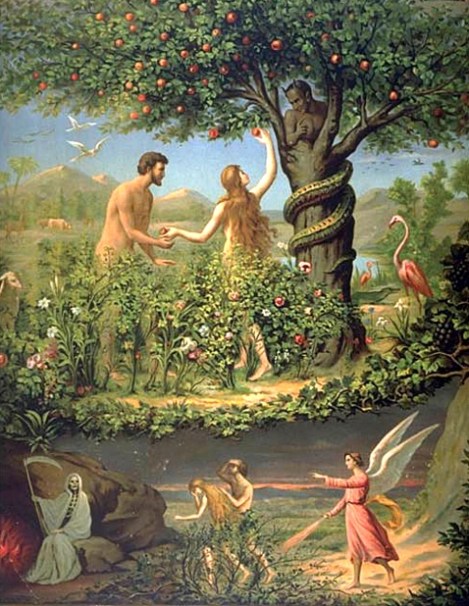
I am struck by the parallel of the story of Adam and Eve, and the story of Jesus.
The very first example of disobedience happened in a garden – the Garden of Eden.

garden-of-eden

Adam and Eve went against the will of God and decided to do things their way.  Because of their choice, they were banished from the place of peace and harmony, where their every need was provided for.  Because of their choice, they were subject to pain and death.

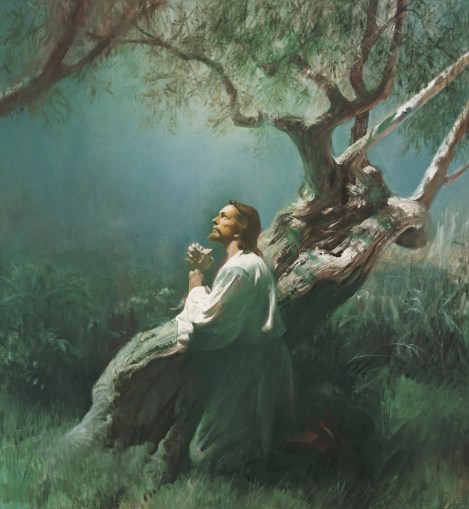
The ultimate expression of obedience to God also took place in a garden – the Garden of Gethsemane.

jesus-praying-in-gethsemane-39591-print

Jesus knew what God wanted him to do.  He’d read the words of the prophets and knew that this is what had to happen.  He didn’t want it.  He said “Father, if you are willing, take this cup from me; yet not my will, but yours be done.” (Luke 22:42, NIV).  He was hoping that there would be a way out, like the ram that appeared when Abraham was about to sacrifice Isaac due to God’s command. He was hoping that there would be another way, that he would not have to suffer and die.

And yet, he accepted what had to happen. Knowing what was going to occur, yet trusting in his Father, he submitted.  He was fully obedient, knowing that it would cost him his life.  Because of God’s love, he gained his life back.

Because of his example of total obedience to God, we now have a pattern for how to live our lives – trusting, without fear, knowing that even death has no hold over us if we are following God’s commands.  The doors to heaven are open to us if we follow his example.


Prophets and priests – not the same

The Jewish priests in the time of the Tabernacle had to use the Urim and Thummim because they could not hear from God themselves. Moses could – all prophets could. Note that Moses was not the high priest – his brother Aaron was. They had separate roles.

They were the “Navi” (the Hebrew word for prophet) – an entirely separate group of people that often lived apart from people, sometimes alone in the wilderness. God could speak at any time, and they had to be ready. It was hard to integrate that task with “real life”. They were not provided for as the priests were. They did not receive the tithe as payment for their services as the priests did.

It is important to note the tithe in the early church was only used to help those in the community who were less fortunate – those who were sick or out of a job, or didn’t have family to help them. It was never intended to pay the salary of a priestly class, as there was not supposed to be such a thing. It was actually forbidden to have priests, as it created a separation in a Body that was meant to be One. We are all meant to be equal like siblings rather than have those who are higher or lower.

Even today, when a prophet hears from God and tells the priest (self-styled, for their authority comes from man and not God) they are ignored along with the message like many prophets in the past were. Of course they are – because the “priests” are incorrectly exercising control over the church. To admit that they are wrong would mean that they must get past their ego and let God be in charge – not them.

Give up sin, not chocolate, for Lent

God has no need for you to give up chocolate, or playing video games, or wine, or meat, or whatever material thing that you’ve picked, for Lent. In fact, Jesus did not create Lent. The whole idea of giving up something for 40 days does not exist in the Gospel at all. Sure, Jesus fasted (unintentionally) for 40 days while he was in the desert being tempted by the devil. But that doesn’t mean you are supposed to.

Sometimes you have to give up something in order to make yourself appreciate what you do have. We need to remember that everything we have comes from God. We need to remember that we do not control our lives, and that we are not the authors of them. God is. But what God really wants is for us to give up our own wants and tend to the needs of others. God wants our sacrifice of time to help other people, instead of money or offerings. You cannot buy your way into heaven.

Psalm 51:16-17

16 You do not want a sacrifice, or I would give it; You are not pleased with a burnt offering. 17 The sacrifice pleasing to God is a broken spirit. God, You will not despise a broken and humbled heart.

1 Samuel 15:22-23 (the prophet Samuel speaking to Saul)

22 Then Samuel said: Does the Lord take pleasure in burnt offerings and sacrifices as much as in obeying the Lord? Look: to obey is better than sacrifice,to pay attention is better than the fat of rams. 23 For rebellion is like the sin of divination,and defiance is like wickedness and idolatry.Because you have rejected the word of the Lord,He has rejected you as king.

Hebrews 13:16

16 Don’t neglect to do what is good and to share, for God is pleased with such sacrifices.

Micah 6:6-8

6 What should I bring before the Lord

when I come to bow before God on high?

Should I come before Him with burnt offerings,

with year-old calves?

7 Would the Lord be pleased with thousands of rams

or with ten thousand streams of oil?

Should I give my firstborn for my transgression,

the child of my body for my own sin?

8 Mankind, He has told you what is good

and what it is the Lord requires of you:

to act justly,

to love faithfulness,

and to walk humbly with your God.

Isaiah 58:3-11

3 “Why have we fasted, but You have not seen?

We have denied ourselves, but You haven’t noticed!”

“Look, you do as you please on the day of your fast,

and oppress all your workers.

4 You fast with contention and strife

to strike viciously with your fist.

You cannot fast as you do today,

hoping to make your voice heard on high.

5 Will the fast I choose be like this:

A day for a person to deny himself,

to bow his head like a reed,

and to spread out sackcloth and ashes?

Will you call this a fast

and a day acceptable to the Lord?

6 Isn’t the fast I choose:

To break the chains of wickedness,

to untie the ropes of the yoke,

to set the oppressed free,

and to tear off every yoke?

7 Is it not to share your bread with the hungry,

to bring the poor and homeless into your house,

to clothe the naked when you see him,

and not to ignore your own flesh and blood?

8 Then your light will appear like the dawn,

and your recovery will come quickly.

Your righteousness will go before you,

and the Lord’s glory will be your rear guard.

9 At that time, when you call, the Lord will answer;

when you cry out, He will say, ‘Here I am.’

If you get rid of the yoke among you,

the finger-pointing and malicious speaking,

10 and if you offer yourself[e] to the hungry,

and satisfy the afflicted one,

then your light will shine in the darkness,

and your night will be like noonday.

11 The Lord will always lead you,

satisfy you in a parched land,

and strengthen your bones.

You will be like a watered garden

and like a spring whose waters never run dry.

Amos 5:21-24
21 I hate, I despise your feasts!
I can’t stand the stench
of your solemn assemblies.
22 Even if you offer Me
your burnt offerings and grain offerings,
I will not accept them;
I will have no regard
for your fellowship offerings of fattened cattle.
23 Take away from Me the noise of your songs!
I will not listen to the music of your harps.
24 But let justice flow like water,
and righteousness, like an unfailing stream.

Zechariah 7:4-10

Then the word of the Lord of Hosts came to me: “Ask all the people of the land and the priests: When you fasted and lamented in the fifth and in the seventh months for these 70 years, did you really fast for Me? When you eat and drink, don’t you eat and drink simply for yourselves? Aren’t these the words that the Lord proclaimed through the earlier prophets when Jerusalem was inhabited and secure, along with its surrounding cities, and when the southern region and the Judean foothills were inhabited?”The word of the Lord came to Zechariah: “The Lord of Hosts says this: Make fair decisions. Show faithful love and compassion to one another. 10 Do not oppress the widow or the fatherless, the foreigner or the poor, and do not plot evil in your hearts against one another.

——-

All Bible translations are HCSB

Redeemer

Stephen Gaskin was the founder of The Farm, an intentional community near Summertown, Tennessee. Before the commune was settled, he embarked on a speaking tour of America to talk about peace. His goal was to wake people up to a healthier way to be together as a society, a nation, and a global community.
He regularly allowed people to ask questions as part of the talks. Occasionally, some of the questioners had issue with him referring to Jesus. Most people who are considered countercultural don’t talk about Jesus at all, and Stephen did. He said that the Sermon on the Mount was the finest example of a guideline for how people can live together in harmony.
In his book “The Caravan”, he talks about Jesus as the Redeemer. In the usual Christian sense, this means that Jesus covers your sins for you. He pays that bill, so you don’t have to. But Stephen took it in a different direction. He said that in order to have a Redeemer, you have to have a Deemer. A Deemer is someone who deems – who makes a judgment as to whether something is good or not. Deemers separate and divide.
A Redeemer comes after that and makes things right. Redeemers make things whole again, by showing the value in all people. Redeemers point out that God made everyone, and God made everyone good. Redeemers reset us by seeing us as we were originally designed to be – whole, complete, and pure.
Additionally – not something said by Stephen but an extension of this thought – this is how Jesus was able to heal people instantly. He saw them as they were designed to be, before they were damaged by the world. Instead of seeing people as sinners, he saw them as Children of God. He didn’t heal them through any special power. He healed them by unlocking the power that God had put in them from the very beginning. He unlocked it by reminding them of it when he saw through their mask of sin to the person beneath.
The most radical part of this is that Jesus tells us that we have this same ability. We can heal the world by choosing to see people as Children of God. No longer dividing them into “good” and “bad” – but simply as people. We too can redeem the world, with Jesus’ help.

Keep calm and trust in God

I was reading this passage from James 1:2-6

2 Consider it a great joy, my brothers, whenever you experience various trials, 3 knowing that the testing of your faith produces endurance. 4 But endurance must do its complete work, so that you may be mature and complete, lacking nothing. 5 Now if any of you lacks wisdom, he should ask God, who gives to all generously and without criticizing, and it will be given to him. 6 But let him ask in faith without doubting. For the doubter is like the surging sea, driven and tossed by the wind. 7 That person should not expect to receive anything from the Lord. 8 An indecisive man is unstable in all his ways.

I was really struck by the verse that says the “doubter is like the surging sea, driven and tossed by the wind.”

It reminded me of these stories from earlier in the New Testament –

Matthew 14:22-33
22 Immediately He made the disciples get into the boat and go ahead of Him to the other side, while He dismissed the crowds. 23 After dismissing the crowds, He went up on the mountain by Himself to pray. When evening came, He was there alone. 24 But the boat was already over a mile from land, battered by the waves, because the wind was against them. 25 Around three in the morning, He came toward them walking on the sea. 26 When the disciples saw Him walking on the sea, they were terrified. “It’s a ghost!” they said, and cried out in fear. 27 Immediately Jesus spoke to them. “Have courage! It is I. Don’t be afraid.” 28 “Lord, if it’s You,” Peter answered Him, “command me to come to You on the water.” 29 “Come!” He said. And climbing out of the boat, Peter started walking on the water and came toward Jesus. 30 But when he saw the strength of the wind, he was afraid. And beginning to sink he cried out, “Lord, save me!” 31 Immediately Jesus reached out His hand, caught hold of him, and said to him, “You of little faith, why did you doubt?” 32 When they got into the boat, the wind ceased. 33 Then those in the boat worshiped Him and said, “Truly You are the Son of God!”

Note verse 30 in particular. Peter becomes afraid – and THEN he begins to sink. He isn’t afraid because he’s sinking. He’s sinking because he’s afraid. The fear came first.

And there is this, an earlier story. This story is in Matthew 8:23-27, but I like the version in Mark 4:35-41 better.

35 On that day, when evening had come, He told them, “Let’s cross over to the other side of the sea.” 36 So they left the crowd and took Him along since He was already in the boat. And other boats were with Him. 37 A fierce windstorm arose, and the waves were breaking over the boat, so that the boat was already being swamped. 38 But He was in the stern, sleeping on the cushion. So they woke Him up and said to Him, “Teacher! Don’t You care that we’re going to die?” 39 He got up, rebuked the wind, and said to the sea, “Silence! Be still!” The wind ceased, and there was a great calm. 40 Then He said to them, “Why are you fearful? Do you still have no faith?” 41 And they were terrified and asked one another, “Who then is this? Even the wind and the sea obey Him!”

Is it possible that the storm came about because of the disciples fear?

Is it possible that if we keep calm, the world around us will keep calm? I feel that the politicians want us to be afraid. When we react in fear or anger or disgust at their actions, they are controlling our behavior. They are calling the shots. They are leading the dance. We are Re-acting, instead of Acting.

Be calm, trusting in the One who is in charge – God. Not a politician. Listen to the still small voice of God to tell you what to do – not the shrill shouts of politicians.

I leave you with these words from the prophet Micah (in Micah 6:8) to know how to act in these difficult times (and every other time)

“Mankind, He has told you what is good and what it is the Lord requires of you:to act justly,to love faithfulness, and to walk humbly with your God.”

If we do these things, we will be fine.

(All Bible verses are from the Holman Christian Standard Bible)