Into the deep (part 2)

deep1
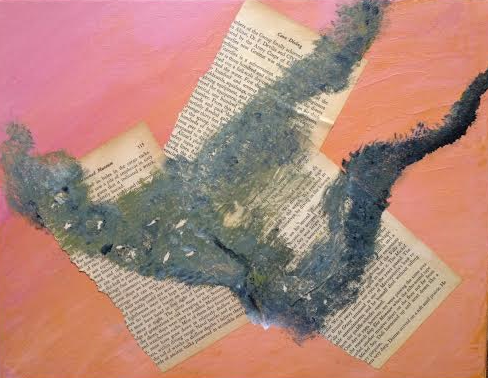
This is the full piece, but just the second layer. More to come. I’m documenting the creation of it.

The base of this was a generic painting background I did maybe a year ago. Yesterday, I was working on another piece and had some spare paint. I fished around the not-yet-completed stack of canvases and found this one. I decided to add some pages to it first because I like the look of words showing through paint. It is hard for me to remember what order things should be done, but I’m getting better. Rather than just gluing or painting on the canvas by feel, I’m trying to think about how I want the finished piece to look.

deep2
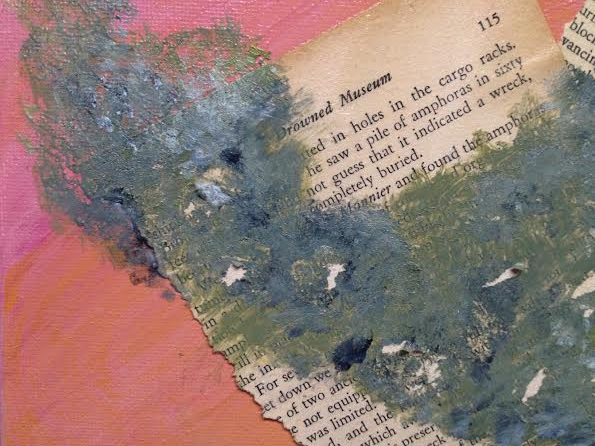
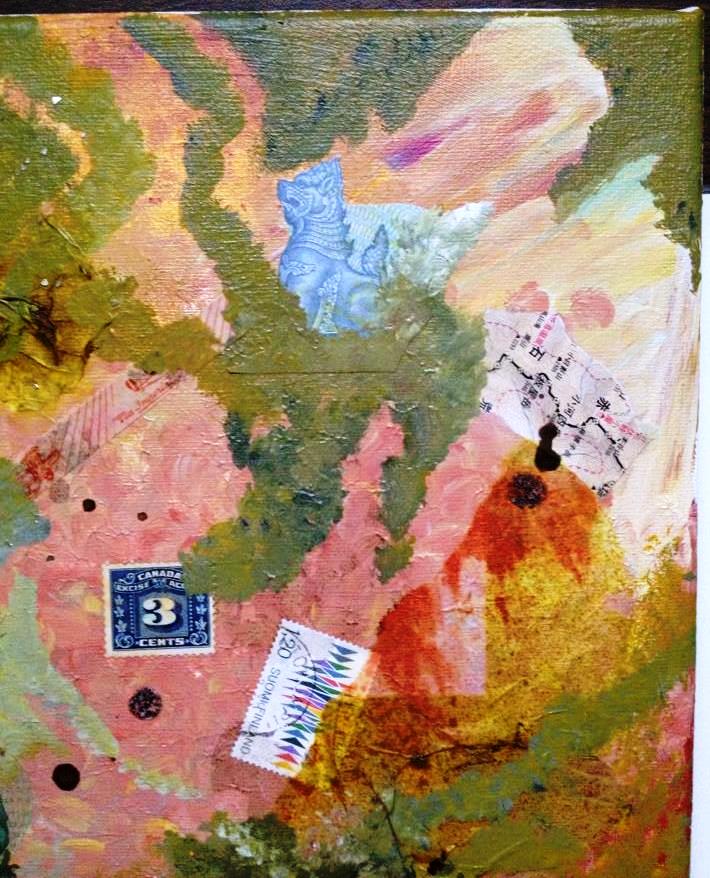
(top left detail)

Sometimes making art is about just going with the feeling, and sometimes it is about trying to say something. Sometimes it is a little of both.

deep3
(top middle detail)

I dug around my “to be torn up” pile of books and chose “The Silent World” by Captain J. Y. Cousteau.

deep4

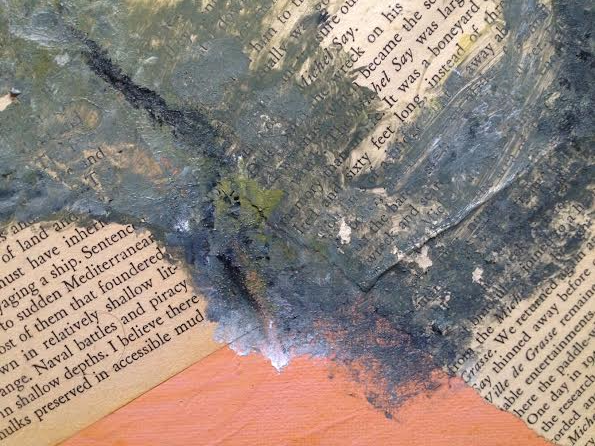
(bottom right detail)

Tearing up books to use in art was a hard thing to get over, being a life-long reader and a library worker. I have about five books to do this with, and I got them all for free. I guess ideally I’d use different books for each piece, but I can’t justify trashing a book for just three or four pages.

deep5

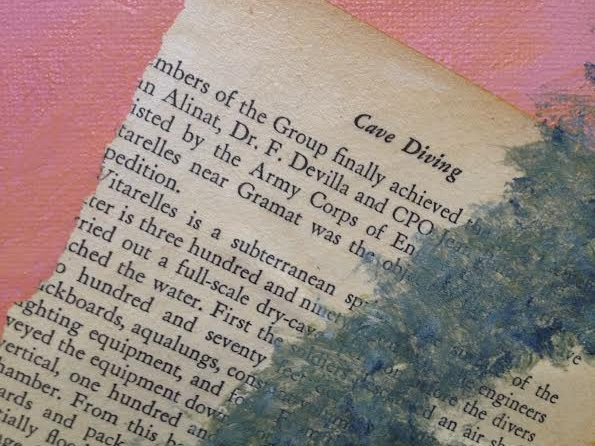
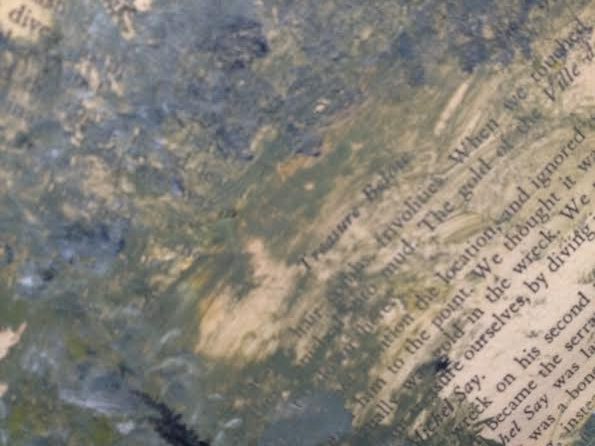
(middle detail)

I pulled out random pages, and here are the chapter titles for the three different pages. I liked them enough to make sure that I don’t totally obscure them.

Drowned museum
Cave diving
Treasure below.

I don’t remember what the base coat colors are. The paint colors that are over the pages are – titanium white, cadmium yellow deep hue, Payne’s grey. I put blobs of them into a large yogurt lid and put some glazing medium on top. I blended them only as I went, using the brush. I was surprised to discover the mix ended up being a mossy green. It looks worn, like rocks with lichens. But it also looks a bit like bird poop. While trying to remove some of the paint from the pages so I could see the words, the paper tore. I liked the look, so I kept doing it.

I’m meditating while working on this about young people who are lost, who haven’t been raised with any moral foundations. They don’t know right from wrong because they weren’t ever taught. After a certain point, a person is too old to be taught this in any meaningful way. On the surface, they look normal, but deep underneath there is darkness. These people are the scariest of all, because they don’t even know when they have crossed a line.

This is a way to meditate and pray yet make something at the same time.

Hidden messages

Hidden messages 031116

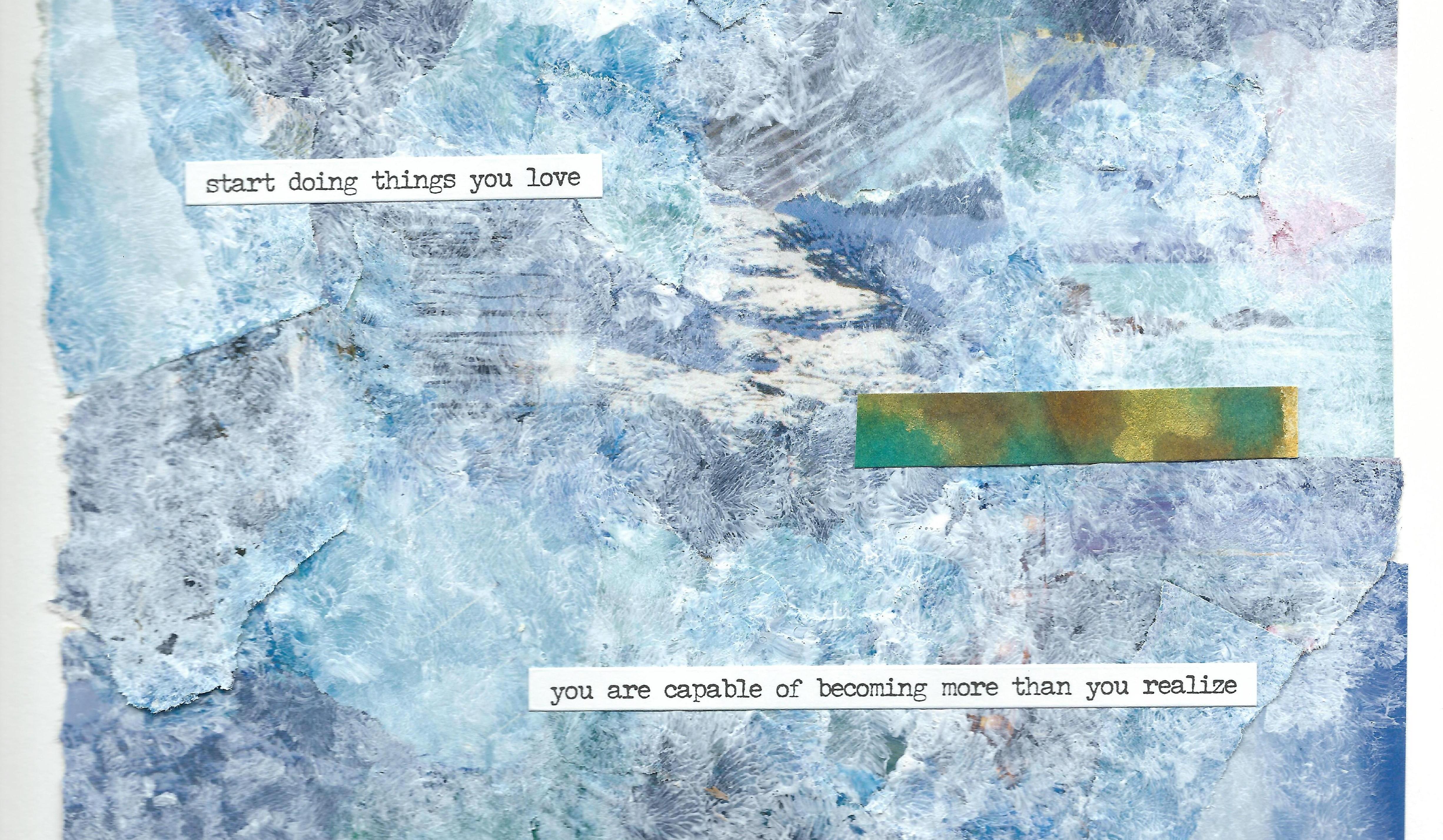
The base of how to do this was inspired by Nick Bantock in his book “The Trickster’s Hat.” My library system did not own this so I used the “suggest a book” feature and they ordered it as an e-book for me. I read it on my device and enjoyed being able to copy the exercises I was interested in trying onto a Note so that I could save them for later. This particular exercise involved tearing out color images from magazines (I used a travel magazine from AAA) and gluing them down. Bantock recommended using only blue and green (with no yellow-green), and then using blue paint to cover up the torn edges. I did this, but wasn’t happy with it after looking at it for a few days. I dabbed titanium white mixed with glazing medium to it to soften it. I like how it looks like fingerprints, because I usually use my fingers when painting, but not this time.

The “filler” paint used was a mix of acrylic – light blue, permanent green, phthalocyanine blue, and white. It was just too bold to blend in with the existing images, but the color mix was excellent so I’ve used it in two other projects I’m working on. I learned in a project from about a year ago that I get excellent and random results from putting the paint blobs on my palette right next to each other but not blending them. I dab the brush between them, picking up random mixes of color. I also enjoy doing this with a brush that is a little beat up, with some bristles missing. This produces unexpected shapes in the painting, depending on the angle I hold the brush.

(detail)
Hidden messages detail

I then added words from Tim Holtz’ “Idea-ology” line along with and paper pieces I created. They are from a previous experiment, using card stock, Distress stains (vintage photo, peeled paint, mermaid lagoon, cracked pistachio) that were then sprinkled with water from a free toothbrush from my dentist. I added gold paint mixed with glazing medium. Once dry, I cut up the art into strips. None of that was intended for this project – I was learning how the stains worked (not like I thought or hoped) and I’d needed gold paint for another project and had some left over and didn’t want to waste it. I picked the best card stock test and added the gold to it.

Projects are not linear. One influences another. Sometimes to complete one, you have to stop it and learn (or discover) an entirely different technique on a separate project. What seems hopeless or at a dead end often just needs to sit aside for a while and be looked at again later with new eyes. Keep working. Keep experimenting. Also, art materials don’t have to be expensive. You can be a “starving artist”, but still be a good one. In fact, a little difficulty/disability/oppression/resistance helps with making art. Contented people don’t make art, because they are happy with things the way they are. Artists show how things can be, but they often have to do that from a place where things aren’t great.

Created 3/7 through 3/11 2016 Base is a Strathmore Visual Journal.

Layered art experiment (version four)

Things are progressing. It is approaching done.

The whole thing
D1

Top left
D2

top right
d3

bottom left
d4

bottom right
d5

middle
d6

Detail, at an angle, of the top
d7

I added
artist-quality gold paint mixed with glazing medium.
More (photocopied) pieces of foreign money and stamps.
art paper
gold oil pastel pencil
white gel pen
Distress Ink crushed olive stain (painted on)
white chalk pen
decoupage glue

I’d started another project and used a bit of paper towel to take off and blend some of the paint on it. I then used that (now paint-blurred) paper to dab on bits of paint to this one.

The gold paint makes the picture change color and tone if you look at it in different angles and lights.

Other paints I have used during this –
a blend of cadmium yellow/ olive green / copper
payne’s grey
deep violet
yellow deep
magenta
manganese blue
burnt sienna

I’m reminded of zen gardens and the ripples on koi ponds on the top area.

I realize there is no focus – it is all interesting. I’ve not tried to draw the eye to just one area, but all of them separately. This is a piece that takes a lot of time to explore.

Layered art experiment (part three)

There are now three to four layers on this. I’ve added more stamps and map bits and parts of money. Gold foil was added.

Part three, whole
c1

whole, enhanced (the colors aren’t quite as bright in real life, but this shows off the gold foil)
c1a

Details –

top left
C2

top right
C3

bottom left
C4

bottom right
C5

middle
C6

middle, enhanced
C6a

I worked on it this morning and will share those pictures once that layer has dried. I used gel medium and gold paint to glaze over some of the darker areas. I’m still not happy with the dark olive green at the top, even though I think it needs some contrast.

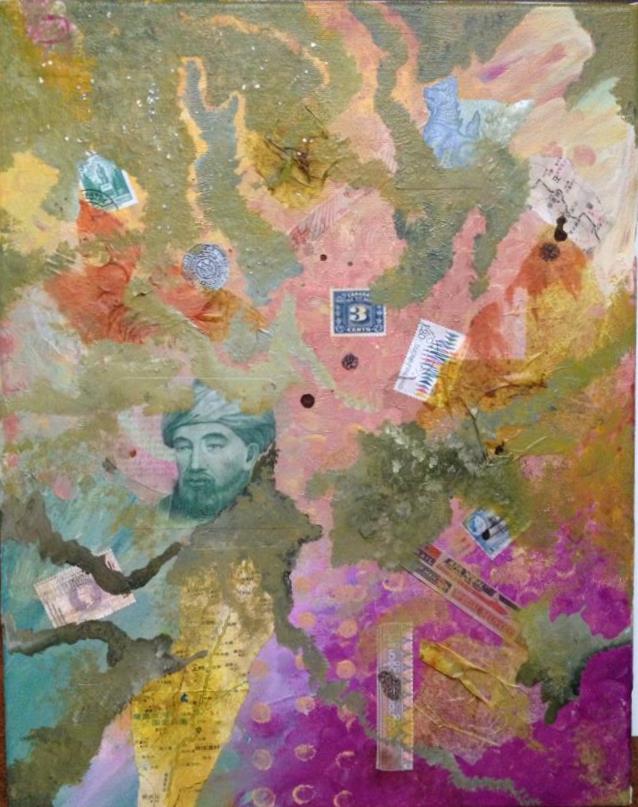
Layered art experiment (part one and two)

I decided that I wanted to try to make art like Nick Bantock does. I still don’t have image transfer down, so I’m using several of his other techniques in the meantime. You can learn a lot about collage and layering art from many other sources, but Mr. Bantock has two different books that will give you an insider’s look into his personal process. They are “Urgent 2nd Class: Creating Curious Collage, Dubious Documents, and Other Art from Ephemera” and “The Trickster’s Hat: A Mischievous Apprenticeship in Creativity”.

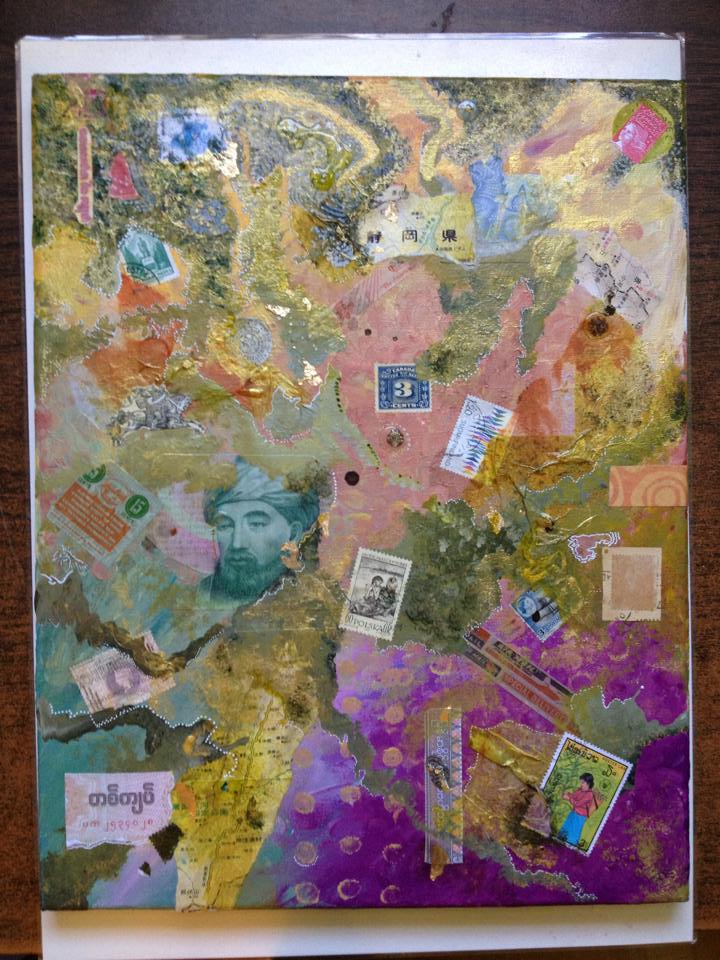
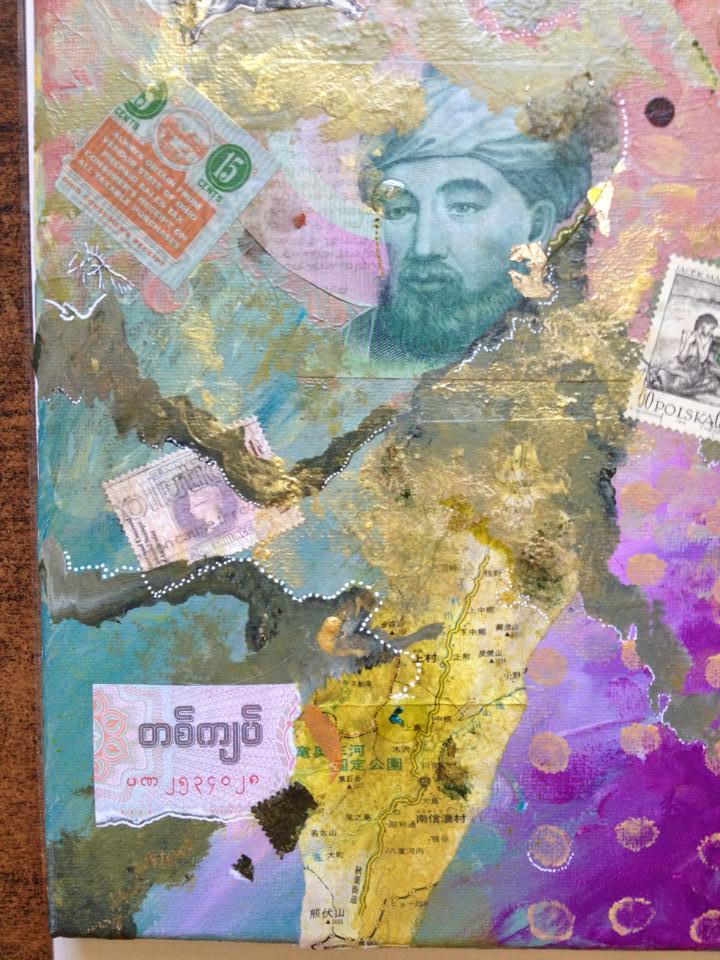
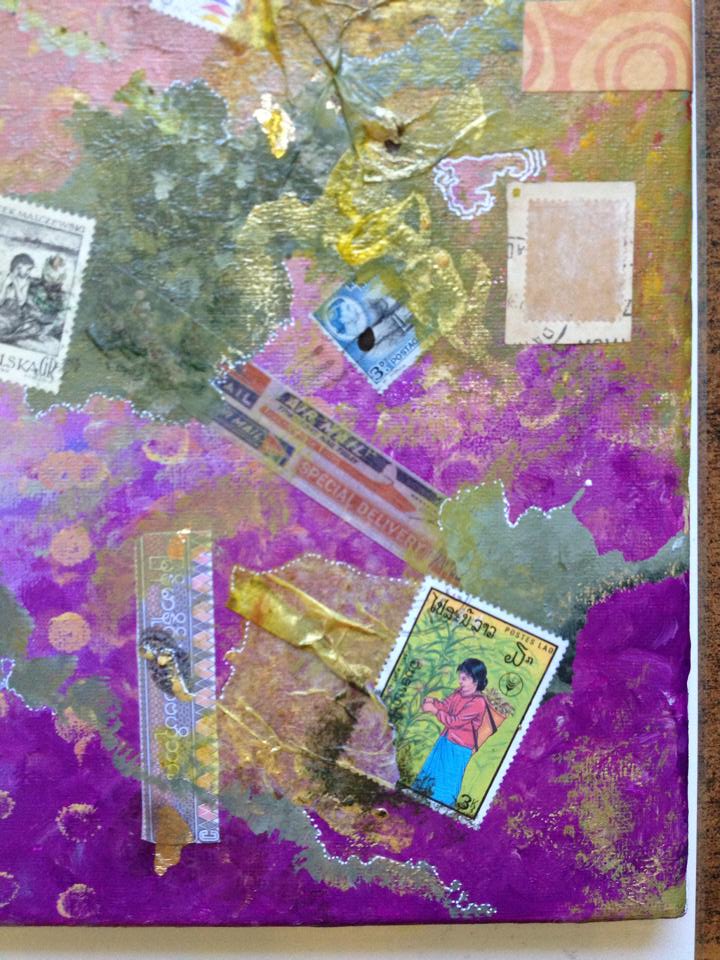
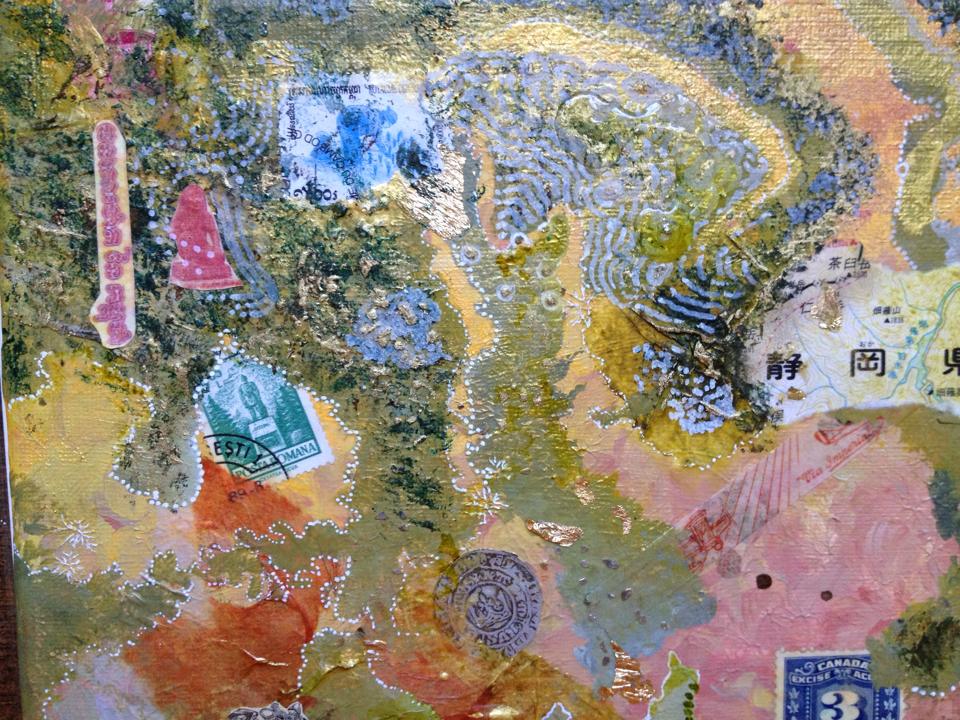
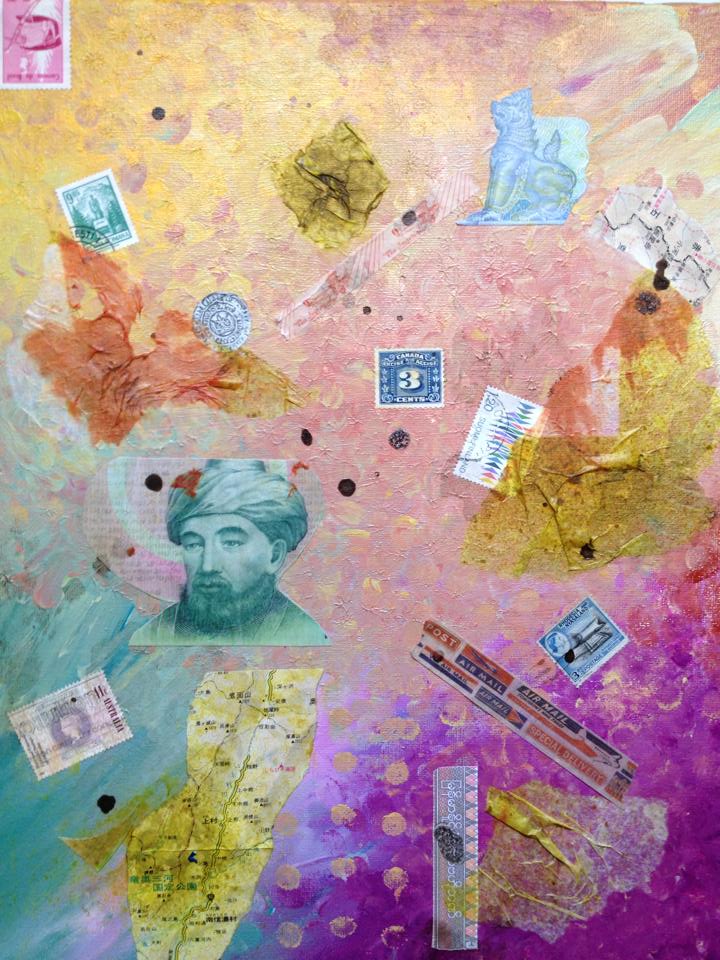
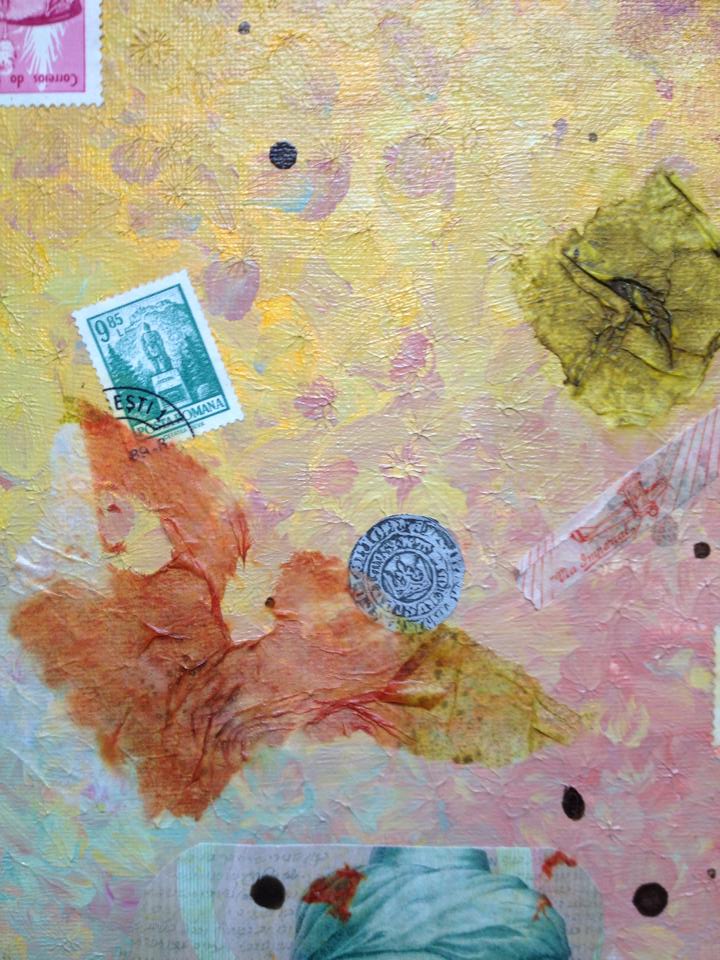
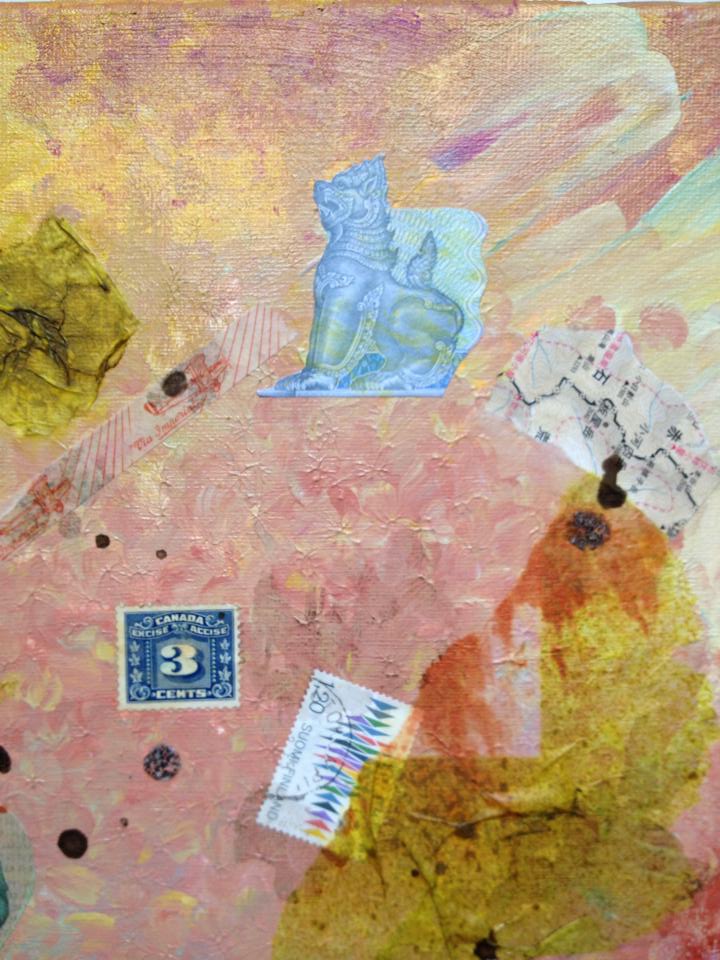
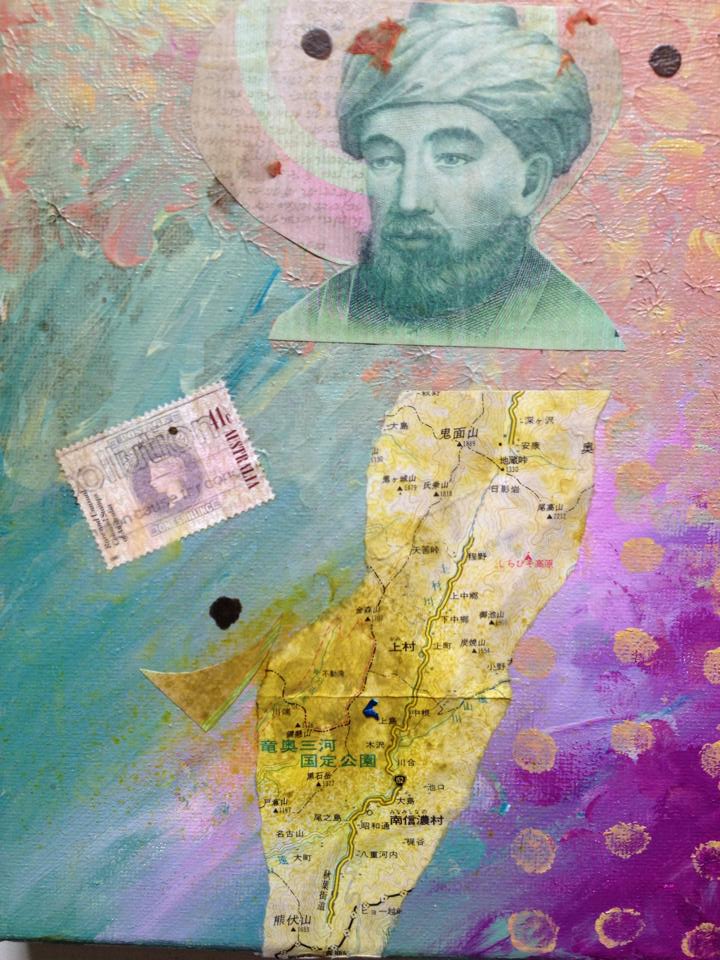
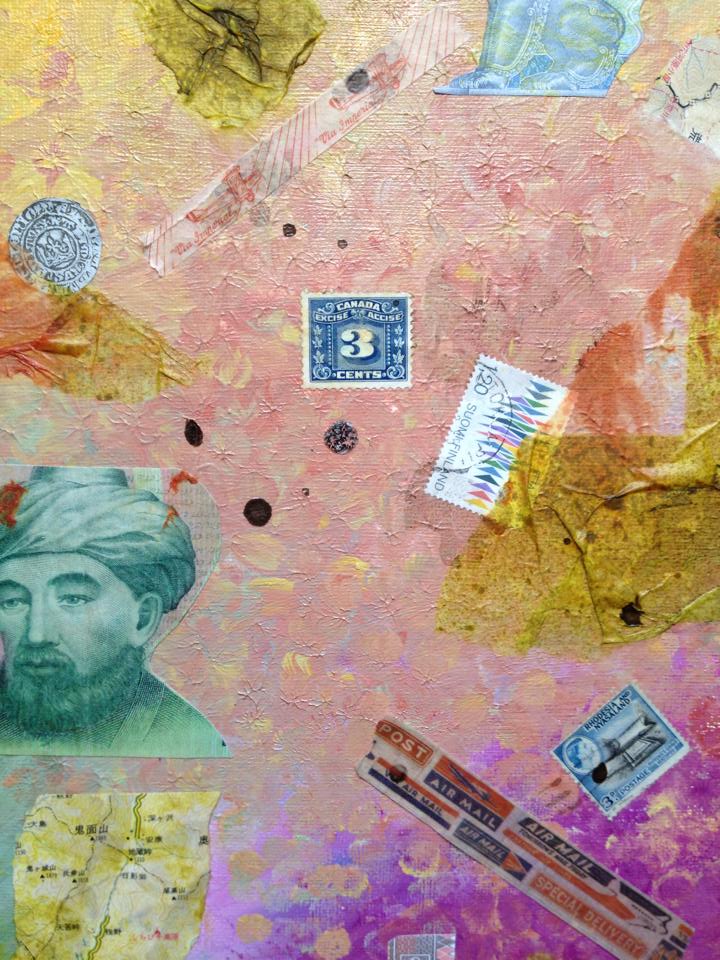
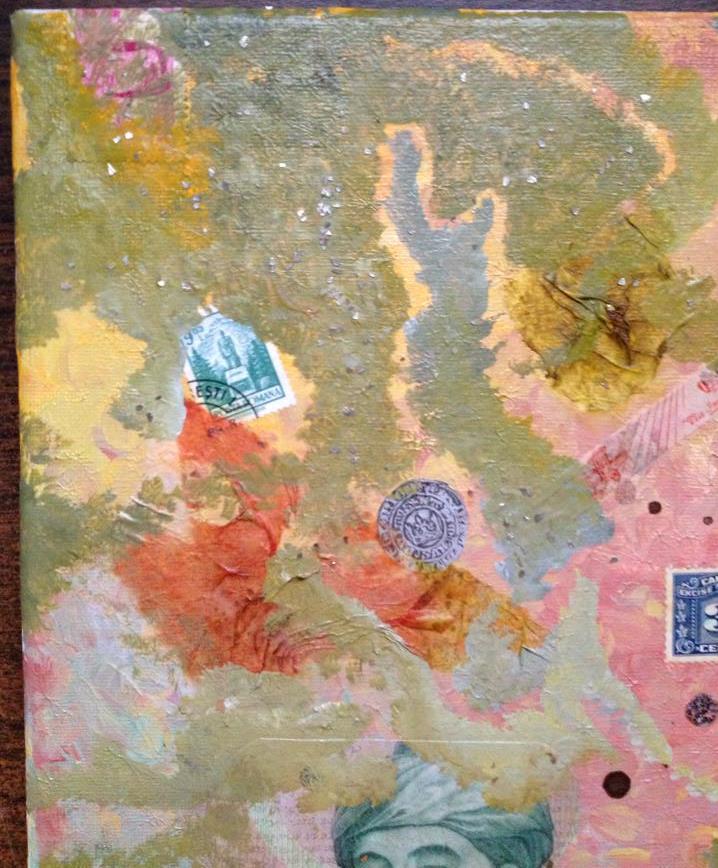
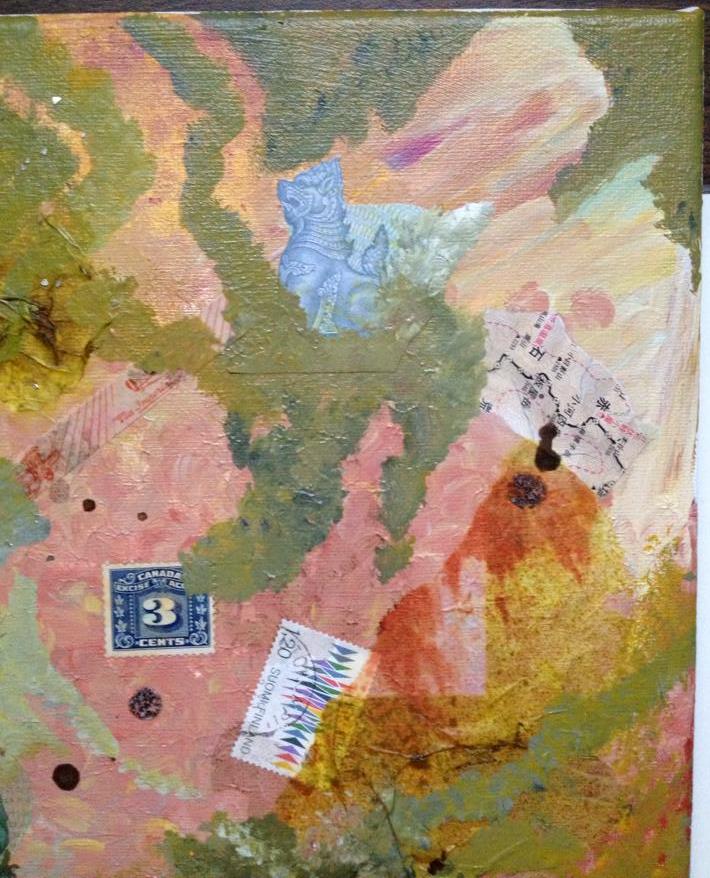
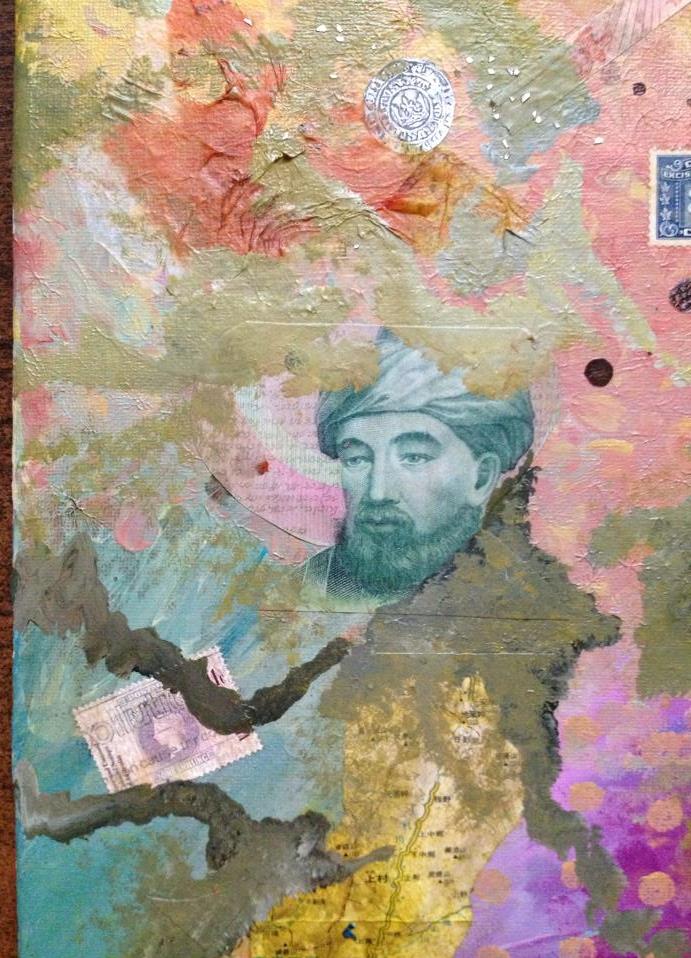
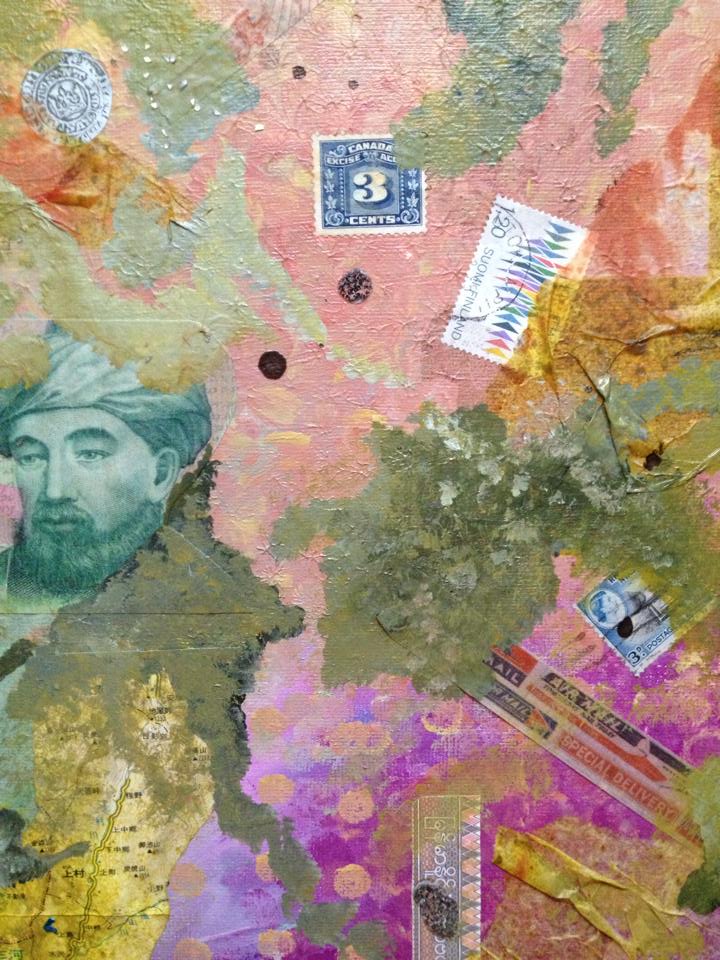
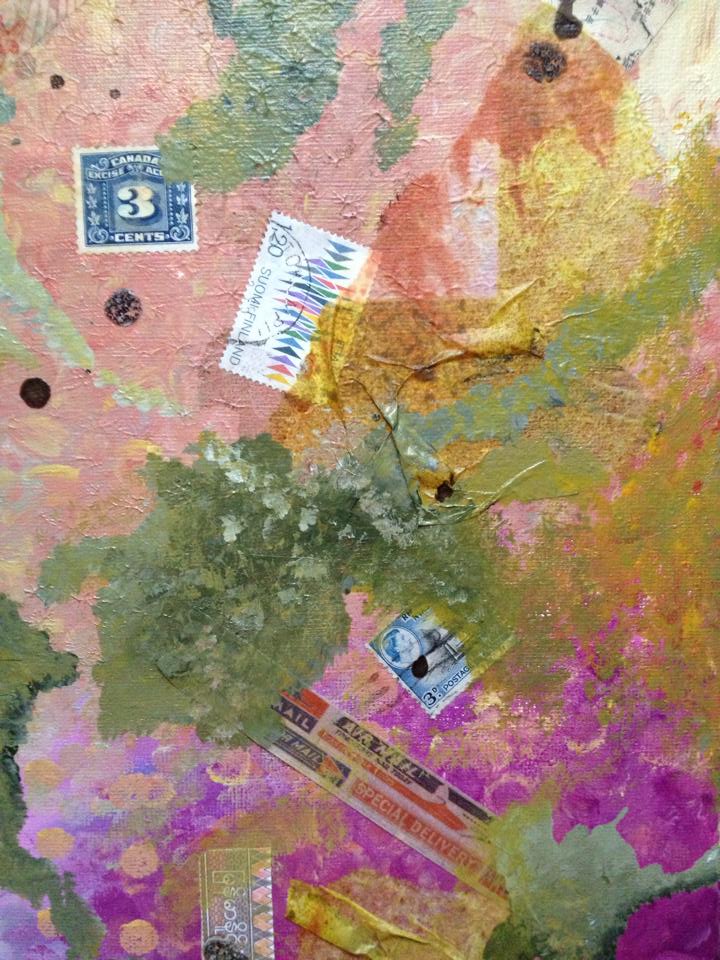
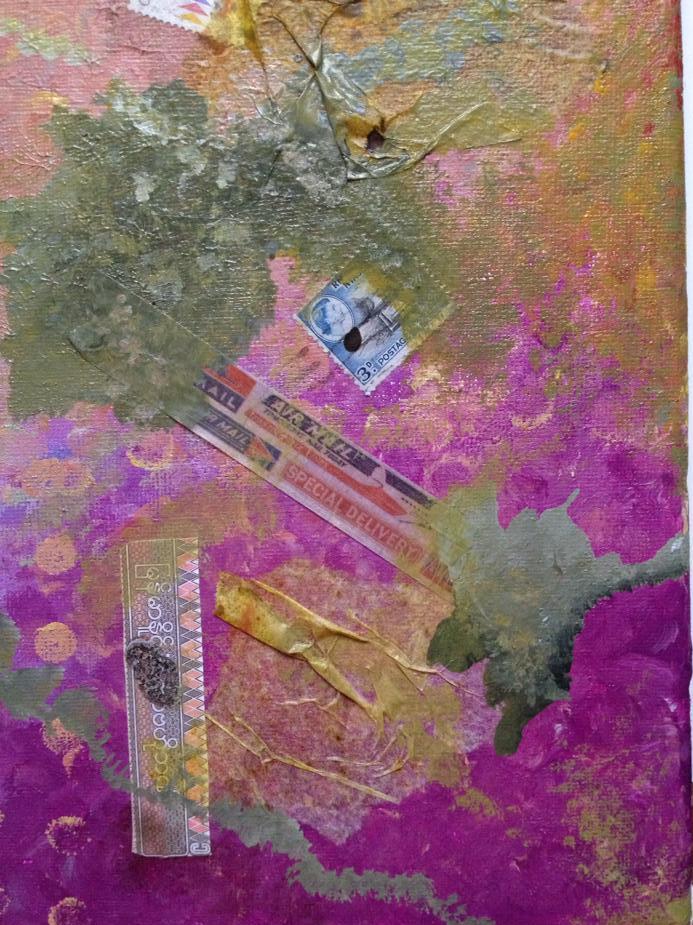
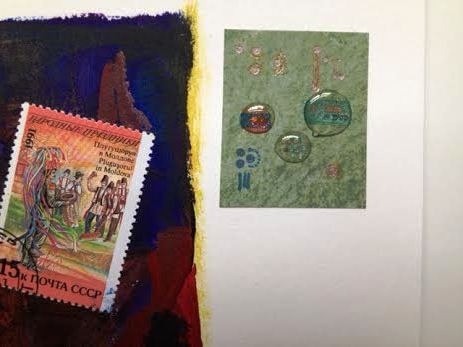
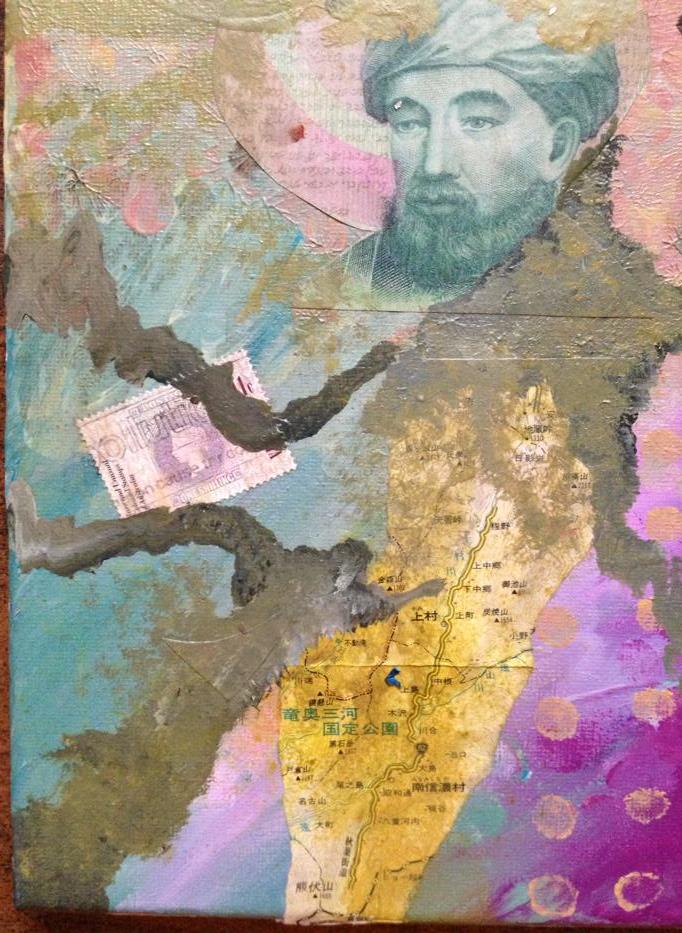
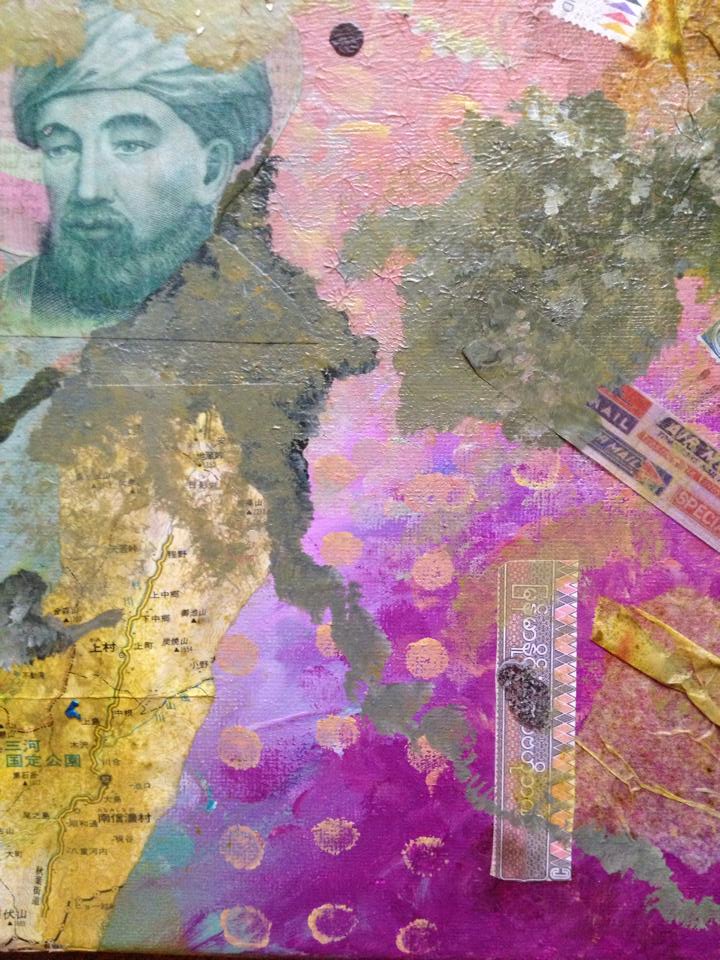
Here is the first bit, which actually has two layers – paint and ephemera such as foreign money, stamps, and maps.

A1

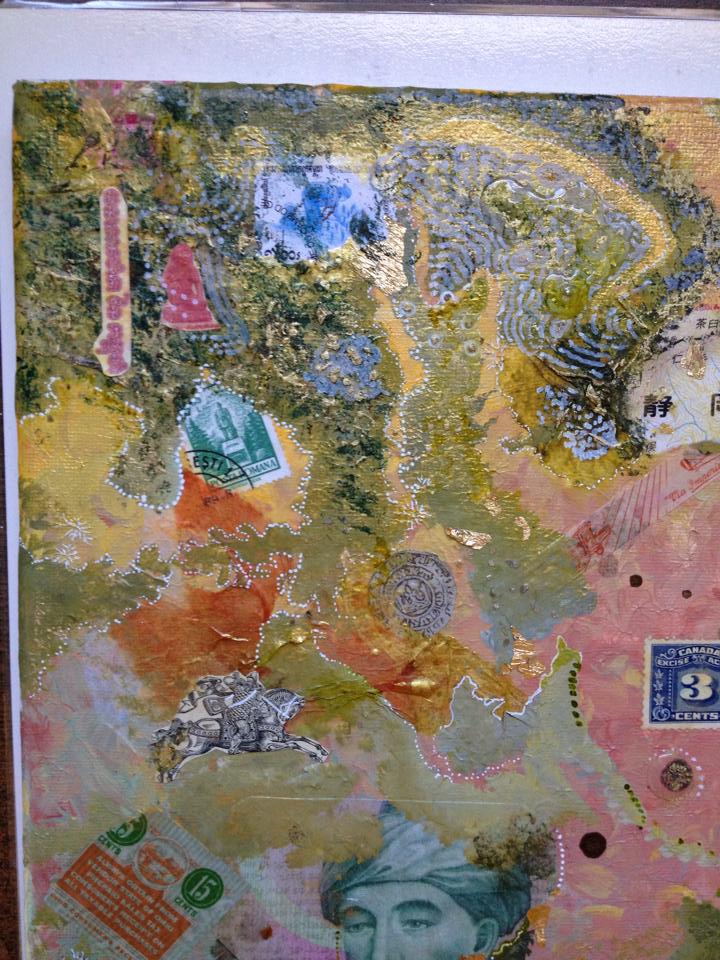
Closeup of top left
a2

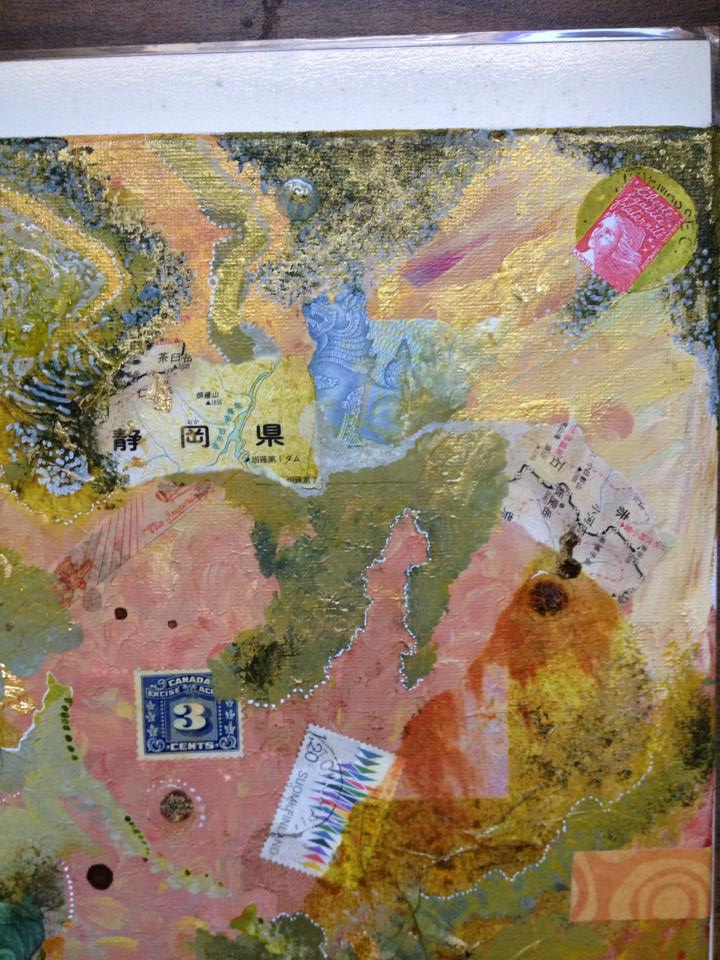
Top right
a3

Bottom right
a4

Bottom left
a5

Middle
a6

It took two days to get to this point. Then it took a few more days of looking at it to start painting over the areas that still needed work. I wanted to darken it at first, but then I decided to work with the colors I had. I mixed together copper and olive paint with some watered down white and got a mix kind of like camouflage and worn American dollars. I started to apply it and then added more of yellow and black to adjust it. It wasn’t the colors I’d used at all, but it was a nice alternative than just painting black.

This is what I got.
b1

When doing the cropping of the photo I decided to enhance the colors a bit digitally to see if I can show what they really look like in person. This is a little much, so you’ll have to kind of imagine that it is a little less than this, and a little more than the previous.

b1b

The idea of continuing to work on it is to make it all good. There are always areas that are better than others when you work on a collage or painting. Keep those, and add to the areas that aren’t so good. Keep editing until it is perfect.

I’m not enjoying this process as much as I’ve been enjoying the art journaling. That is faster, certainly, but it also seems to produce strong emotions and memories while I work. That in itself is the reason to do it. This is not producing many feelings, other than a desire to stop working on it to preserve it as is.

I’m learning that I feel very attached to the layers as I make them. I’ve not wanted to paint over any of it, even the so-so parts, because I don’t want to lose anything. This is the mindset that makes some people keep old things stored away in their basement with the idea that “one day” they will need it. I’m trying to work with and around that, so that is why I decided to take pictures as I work on this.

Here are the detail photos from the second set. There are two to four layers in each photo.

Top left
b2

Top left (enhanced)
b2b

Top right
b3

Top right (enhanced)
b3b

Center left
b4

Center middle
b5

Center right
b6

Bottom left
b7

Bottom center
b8

Bottom right
b9

I’ll add further pictures in a separate post as this progresses.

—-Materials used (so far)—–
Stretched canvas
gesso
Acrylic paint
tissue paper (some with Distress Ink on the underside)
matte medium
stamps
Asian map
photocopies of foreign money
“crushed glass” glitter

tools – fingers, paintbrush, sponge brush, tissue paper

Dark

dark 021516
Inspired by the layered art of Nick Bantock.

Angry that crap art is seen as art, like McDonald’s is seen as gourmet.
The Emperor has no eyes. Jealous. Where is my recognition?

Telling my husband that he cannot vent on me. He cannot tell me just the bad that happened to him that day. I have my own burdens to carry.

The beauty of a circuit board, replicated. What is real?

(Details)
top right corner
dark2

middle left
dark3

bottom right
dark4

dark5

Ingredients:
Goldleaf.
Stamps.
Map.
Paper towel to remove paint.
Gel pens.
Art paper.
Decoupage glue.

Liquitex basics acrylic paint – Phthalocyanine blue, deep violet, copper, cadmium red deep hue

Strathmore art journal

Created 2/15/16

Signals and signs

Signal and sign1

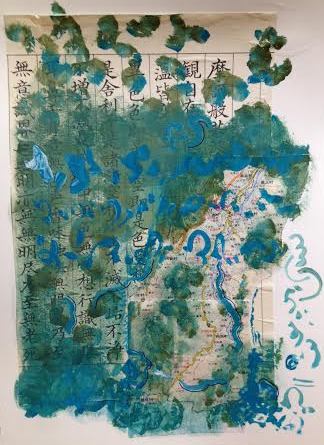
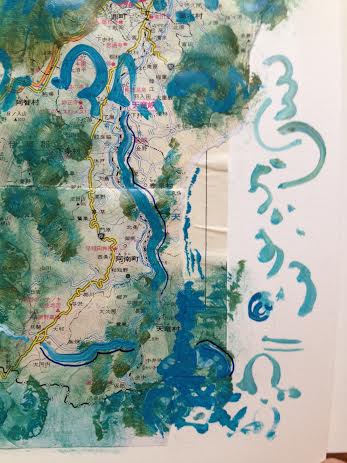
What is message and what is mountain?
What is writing and what is river?
Is a road a word?
Is a map a manuscript?
Signal/noise
Unreferenced symbol
Un-received messages
Lost languages
The boundaries between mountain and lake are often the boundaries between cultures and countries.
Decay of transmission
There must be at least one who can understand for meaning to be transmitted.

Details –
Signals2
(middle)

signals3
(top left)

signals4
(bottom right)

Ingredients –
Bought ephemera – Asian map, page of Asian writing
Paint- olive green, manganese blue, white, mixed with water. Dabbed on mixed very lightly with a smished paint brush and wiped off with paper towel.
Gel pens, matte medium
Strathmore art journal

Created 2-11-16

…what is the speed of mind?

What is the speed of mind 010716

I have decided to start an art journal practice. More often that not, my “art journaling” is more journal than art. I want to strengthen my non-verbal side as well, so I’m committing to making a page like this at least once a week.

The title comes from a part of the page that was left visible, not obscured by paint.

8.5 x 12 Strathmore mixed media visual journal
matte medium
pages from “Sri Isopanisad” paperback
Tim Holtz Distress Ink (rusty hinge)
acrylic paint (Liquitex basics)
water
salt
sparkly bits
Tools used – paper towel, flat brush, yogurt lid

Art project as a distraction.


          So I started an art project.  Some people would call it redecoration.  It was an intentional plan to distract myself, and to give myself something that I could focus on and see progress.  I can’t fix what is going on with my parents-in-law, so I wanted something that I could fix.

          It started off as a need to fix a problem.  We had some ugly grout-tape in the bathroom.  Instead of caulk to bridge the area between the shower surround and the tub, we had this stuff that was in a long strip and it stuck to both things.  It kind of worked, until it didn’t.  It was peeling apart from the shower surround, and mold was developing.

          I was a little afraid to deal with it.  I was concerned that it meant that there was water damage behind it, and this was going to result in a really expensive remodeling project.   Water is as destructive as fire, but slower.   I kept trying to stick it back on the wall, and it kind of worked.  I asked my spouse to fix it and as usual it got put on the back burner.  And as usual, I slowly worried about it more.

          So I did what I do when I worry.  I got books.  Knowledge is power. I got every book on bathroom remodeling that my library branch had.  I decided that this was now a Project.  We’d save up our money and then we could do this right.

          Fortunately, when my spouse got around to pulling the weird tape off, there was no evidence of water damage.  There was a lot of mold, though, so I’m glad that it came down.  He put caulk in there instead.  It looks a lot better.

But by then I’d gotten the bug.  Thankfully it wasn’t an expensive project, but it could still be a Project.  We didn’t have to rip out the entire bathtub and shower and re-frame and put new tile.  That would involve hiring professionals.  There are things we can do, and that kind of stuff isn’t on the list.

          But I saw a picture while I was looking through the books.

bath1

It was beautiful Tromp l’oeil.   It is a koi’s eye-view of a pond.  I went running with it.  But I like goldfish and aquariums.  So that is what I’m doing instead. But you can’t do that to start off with.  Remember – paint the background first.

          So then there had to be a trip to Lowe’s hardware.  I went on my lunch break and picked up a few paint samples that were in the neighborhood of what I wanted.  I brought them home and gave the spouse a choice.

It isn’t really a choice.  I had already decided on what to let him look at.  So no matter what he picked, I would be happy with it.  This is straight out of working with kindergartners.  Too many choices is a sure way to stop any work from going forward.

Then came time to paint.  The room is too small for two people to work, and he doesn’t really “get” painting.  He more than makes up for it in being able to fix minor plumbing and electrical problems, so I was OK with that.  But it took three hours.

I’d forgotten that we had a dinner date with friends on Saturday night, so that meant I had to get this done on Friday to give it time to dry so we could take showers.   That meant I got started on actually painting this project around nine, because we had to have supper first and there is always the prep work to do for painting.

I decided to do this without any music.  I figured that it would disturb him.  I don’t play my music around him, nor do I sing around him.  That is something to write about for another day.

So I was stuck, painting, by myself, in a small room, for three hours, in silence. It was a new kind of hell.

Instead of getting away from my problems, I was right up in them.  Everything I was trying to not think about was right there with me in that tiny room that smelled of latex paint.

I meditated on Jonah, one of my favorite characters who teaches me how to deal with problems.   And I remembered that he was stuck in that whale for three days.  So was Jesus – he was dead for three days.  You can praise God all you want, but you are still going to have to wait until it is time for it to be over.

That helped.  I was still in a foul mood, but at least I knew there was going to be an end to it.  It reminds me of the person who had a ring made that said “This too shall pass” as a reminder for the bad times as well as the good times.

The next day I painted the leaves on the walls, because that had to be done before the fixtures could be put back.  Scott was out of the house, so I put on music and sang along.  It helped my mood a lot.  It was also good that I started with something simple like long twisty leaves.


bath2

The next day I painted some fish.  I didn’t think I could.  I was planning on drawing them on watercolor paper and then gluing them on, or printing some out on inkjet paper and doing the same.   I’m glad I gave painting them a try, because I surprised myself.

bath3           bath4

bath5


I had gone online for some reference pictures and printed them out on my printer.  The resolution wasn’t that great, but it was a good start.   I transferred the outline of the fish to the wall by holding the paper to the wall and tracing the lines Really Hard with a pencil, so it made a dent in the wall.  Ideally, I’d have used carbon paper.  I didn’t have any, and I didn’t feel like slowing down by going and getting some.  Inspiration shouldn’t be messed with.  If I slow down, the whole thing could have come to a complete stop.

The transfer of the lines worked.  I mixed up some paint in a small plastic dish and went at it.  I learned as I went.  I used a dry brush technique for the fins.  I painted seven goldfish.   I plan to paint a castle, an old-time deep sea diver, a treasure chest, and a sunken galleon too.  Later.

Today’s the third day, and I feel better.  The room looks brighter.  I’m still not finished with the fish (they need eyes) but I’m OK with that.  The problems with the parents-in-law continue, but I’ve realized that isn’t my project.  I’m sticking with the stuff that is my responsibility and leaving that to their sons.
Collage, not painting

          I finally figured something out.  I don’t have to paint fine details.  I can do collage.  I can draw what I want separately, using watercolor pencils on watercolor paper.  Then I cut it out and glue it to the painting.  This is such a relief.
          One of my problems is that my ideas far outstretch my abilities.  I’m not very good at painting yet.  I’m trying, but it is going to take a while.  Meanwhile all these ideas keep coming that would work best using painting.

          I have taken only one art class, and that was in high school.  I don’t really know what I’m doing.  I feel like a feral child, wanting to communicate but I don’t have a language.  So I’m making it up as I go.

          One of my fears with painting is there is no “undo” button.  If I make a mistake, it is hard to fix.  It isn’t like working digitally.  Plus, it doesn’t work well with my schedule.  If I only have 20 minutes to work on art, there isn’t really enough time to paint and clean up.

          I have a space painting I was working on.  I’d created the black background earlier.  Just remembering to paint the background first was a big deal.  I thought I was going to paint planets and stars on it.  In the meantime, I started sorting stamps and fortune cookie messages, and came across an old packet of just space stamps.  They are pretty awesome, and I thought I should use them here.  But since they are so rare and I’m so unsure of my abilities, I went ahead and color copied them.

          Yes, I wrote a whole blog post about not doing that.  Yes, I did it.  Whatever makes the art happen counts.  I used funny scrap-booking scissors to cut the edges.  It is more interesting than a plain square cut, and it sort-of gives the impression that it is a stamp.  I looked for scrap-booking scissors that cut like stamp edges, but I didn’t find them.  I had these, and I used them.

          I really liked one stamp of a lady astronaut.   I plan on mixing in other stamps and calling this piece something like “Can’t we all get along / In Space” and having Space be the place where women and men are finally equal and respected.

          The stamp is a bit disembodied though.  I didn’t want just her head floating around.  So I wanted to paint a body for her, but again I felt like I would mess it up.   Then I had a flash.  Draw it separately using watercolor pencils and cut it out.   I put the stamp on the paper for scale and drew around it.  It worked great.

space1

I’ve been using watercolor pencils for a year now, so I’m comfortable with them.  I pulled out an older piece that I don’t really like and tested the fixatives on it.   I used decoupage glue on one section, and matte medium on another.  From that I learned what will work best and how to apply it.  I also used some of the matte medium on a color copied stamp to see if it would affect it.  I know it works great on real stamps, but this is different.  So I put it together and I can’t be more pleased.

          I don’t really know why I didn’t think of this sooner.  Matisse did something like this in his later years.  He cut out construction paper and glued it together.  Eric Carle does this – he paints big pieces of paper and cuts them out.  This isn’t quite the same, but in a way it is.

          I am also working on a painting with inuksuit – the Inuit rock sculptures.   They aren’t just sculptures – they provide direction and tell something about the area.  One will indicate a good place to hunt.  One will indicate a beautiful thing to look at in the distance.  One will mark an initiation area.  Each different shape has meaning, and is often the only way to navigate in a snowy land.

          Here is a picture of one that indicates a direction to travel. It reminds me of a Japanese torii gate.


rock2

I was going to draw the whole thing with this new technique and then I had another idea. Draw the stones separately, and assemble them.

rock1

Sure, I’ll work on getting better at painting using brushes. That is the only way to get in any detail. But in the meantime, I’m glad I’ve discovered this.