Twins.

two

Their mother had always wanted twins, but not like this. Carol’s biological clock was winding down about the time her life was picking up. When she finally had the time, money, and energy to have children, she’d gotten too old to even consider having multiple pregnancies. She wanted at least two children for the same reason people brought home two puppies or kittens – they would always have a playmate. With time slipping away on her, having twins seemed like the best option.

She never even considered adoption. The children had to be hers. She knew that down to her bones. The idea of “family legacy” was so firmly imprinted onto her identity that taking in somebody else’s unwanted children was out of the question. It wasn’t even on the table. It wasn’t even in the room.

She couldn’t afford to chance it. So she went to the local medicine/miracle worker. The gnarled old being was a fixture of the community that everybody knew about but nobody talked about. She? He? Who knew? At that age it was impossible to tell. His? Her? voice was raspy and the clothes were baggy enough to conceal whatever shape s/he might have. Nobody knew, and everyone was afraid to ask. “Doctor” was the being’s title as well as name. Fortunately this language didn’t differentiate gender in its words or it would have been more awkward. Undefined gender seemed somehow appropriate for this profession, one of yes/and, of greys, of liminal spaces, of betweens. The Doctor’s shop/office/home was like that as well, beyond definition.

Carol had written a letter asking for an appointment. This was how it was done, how it always had been done. The Doctor felt that websites were too fiddly, too impersonal. The message would get lost. Even phone lines were eschewed.

Ideally, the client (never “patient”) would happen to meet the Doctor while they were both out doing errands in the village markets. A lot could be done to further the desired outcome if both of them were on the same time-line. Never quite syncing up was a bad sign. But, communicating by letters was a good second choice.

They agreed upon Wednesday the third, at 11:30 in the morning. The Doctor arranged visits by feel, rather than by any usual method. It was the same as how a safecracker worked, or a dowser, or a chef. It was all by feel. No astrology charts or Ouija boards or runes. No Day Planners either. There was never a receptionist or assistant. The Doctor’s motto was do it all yourself, or don’t do it at all. Too many cooks spoil the broth, and all that.

Carol left her house that Wednesday morning very excited and hopeful. She wore her favorite red jumper and galoshes even though the weather forecast promised a partly sunny day with only a 10% chance of snow flurries. They were her favorite galoshes, purchased used at the corner Oxfam three years back. She’d always had great luck when she wore them, so they seemed to fit the bill for the day. She even asked off from work for the rest of the afternoon so she could get started right away on whatever course of action the Doctor recommended.

Everything the Doctor did was by suggestion or recommendation – never an order, never even a request. Everything had to be voluntary. The client had to be a part of the process, never acted upon, but with. If the Doctor decided it was possible to effect a change there was always a list of recommendations. It wasn’t always possible to obtain or do all of them, either due to the time of year or available resources. The client, if accepted, (not a given) would then go out armed with that list.

Instructions could include such varied examples as “Stand barefoot on a newly harvested field for 10 minutes, facing west. Be sure not to be noticed. This must be done sometime between the hours of 8 AM and 3 PM.” Or perhaps something like: “Buy and eat some kind of fruit you have never eaten before.” Or maybe even: “Write down your greatest hope for your future on a piece of borrowed paper. Set it afloat on a stream.” Generally, at least two of the three options must be done, in whatever way the client could. The “how” was up to interpretation, and was part of the cure.

Wearing a certain color for a week (at least) was a common request, although the color changed with the task at hand. Often this was how other people in the community knew you were under the Doctor’s care. They never would ask, though, out of respect, or perhaps fear. It was difficult to not be noticed when someone started wearing shades of teal or salmon or magenta, especially day after day.

Almost immediately after having sex that Friday night a month later, Carol knew she was pregnant. She didn’t dare breathe a word of it to her partner for fear she might jinx it. She didn’t even go to the pharmacy to get a pregnancy test for the same reason.

She wasn’t sure where her self-imposed superstition came from, and that might have caused the aberration. Maybe it was the galoshes. Maybe the orientation of her bed. Maybe she didn’t follow the list correctly.
Later, after the birth, the Doctor consulted with Carol. They both looked at the babies (baby?). They went over everything she did, everything she ate, everything she thought. She was sure she had the right intention during the act. It’d been all she’d been thinking about for months, so how could it be anything else? Twins. Two babies in one pregnancy.

The Doctor had been very insistent with her that intention was important for all pregnancies, but especially for hers since it was so specific. The Doctor explained that ideally, people would have sex only when they wanted to have a child, and then they would do it mindfully and prayerfully. The moment of conception was when the soul chose to incarnate. This is a delicate and perilous time. There were many souls about, of all kinds, waiting to enter a body. Some entered at conception. That was ideal.

Others chose to take up residence afterwards. This resulted in what psychiatrists called “multiple personality disorder”. Priests called it “possession”. New Agers called it “walk-ins”. It was all the same thing, and it was all less than desirable.

The Doctor explained that ideally the potential parents would pray before having sex, alerting the souls, the beings-in-waiting, that an opening, a doorway if you will, was being created for them. The parents would meditate on the characteristics and personality of the child that they hoped to welcome into their lives. They would speak about what kind of home they could provide.

In a way it was like a blind date, or perhaps more like an arranged marriage. They were going to be together a long time. It was important to do this well, rather than leave it to chance.

The trouble is, too many people didn’t think it all before having sex. It was as if they were swept away, like they were in a stagecoach, and the horses got spooked. Before they realized what was happening, they were where they hadn’t planned on being, because they hadn’t planned. Sometimes they got stuck there. Just like with marriage, it is a good idea to choose wisely before this long-term commitment.

Too many babies were being born without souls properly attached to them because of this. Some had very weak souls and had sensory or neurological disorders because they weren’t fully in the body. Some souls weren’t even human.

But that wasn’t the problem here. Carol and her partner had prayed for two souls, alright. The only problem is that they somehow ended up with two souls in one body. This wasn’t uncommon, but could take different forms. The obstetrician had explained that sometimes twins are conceived but one is absorbed. The result? One baby, but it might have its twin as a vestigial part of its body, in the abdominal area, for instance. Or if the fusing is complete, it will have chimerism. Or in this case, conjoined. The obstetrician couldn’t explain why this had happened, but the Doctor could, after consulting with the souls of the twins.

Twins were wanted, and twins came. They were twins in the truest sense this incarnation. They were two, but one. When they were in spirit form, they were separate but they wanted to always be together.

In their previous incarnation they had been twins in the usual sense. That family had also wanted twins, but shortly after their birth the father had gotten laid off from his job. The economy had taken a downturn and he had difficulty finding another job. Months went by and the savings grew smaller. Their mother grew more and more exhausted with caring for them and with worry. Finally the decision was made. It was the same decision that some families made about their pets under similar circumstances. They were “given away to good homes”. Unfortunately in this case, they were separate ones. The children always felt that half of their very being was missing from that point onwards.

After their death, they had waited a long time to find another family that wanted twins. This time, they wanted to make sure they couldn’t be separated ever again.
Care or codependency?

I recently posted a picture of an item I’d bought at Goodwill on my Facebook page. I’m going to use it as a prop for a story I’m writing, but in the meantime I wanted to know what it really was. Several helpful friends let me know that it was a kitchen timer. It looks more like a remote control than a timer, so that is what it will be in the story.

However, one person posted this picture and said “Don’t buy from Goodwill”.

Perhaps it is significant that this is a cousin, from my husband’s side. I’ve never even met him. Perhaps that alone is my problem. Perhaps I need to not “friend” people I don’t know, even if they are family. That is a topic I write about a lot. Boundary lines blur a bit with family.

Here’s my reply to his post (which you might notice didn’t answer my question at all) –

“Too late. I don’t buy from Goodwill with the thought that they will be donating to charity. I am the charity. I benefit because I get to buy something very inexpensive that I need, that I can’t afford to buy new. This is where I buy my clothes. In spite of the fact that the CEO makes lots of bucks – they do provide job training and opportunities to people who normally have a hard time getting a job (those with mental or physical disabilities, or those who are ex-cons). Plus, by their mere existence, they are encouraging people to recycle and reuse – the items don’t go into a garbage dump. Surely these points have to be of value to you. I’ve seen this image before – and I notice that yours does not include the one donation center that does donate a lot to charity and the CEO takes home under $25K a year – and that is the Salvation Army. I’m so tired of messages from people who mean well that say “DON’T do this” but then don’t tell you what is good to do. We cannot live our lives based on fear.”

I thought “How dare he tell me what to do! How dare he try to share his fear!”

His need to “correct” me is a sign of codependency. His way of thinking is the problem, not where I shop.

It reminds me of health book that said to drink lots of clean water – but not from a tap, and not to drink out of plastic water bottles. But what is there other than that? The author didn’t say. So how is that helpful? If all you share is what not to do, you are not helping anyone. In fact, you are making the situation worse. This is part of the current problem our society faces – too many “don’t” and not enough helpful information. We are being lead by fear of everything, with no let up. There is no relief – just more and more fear.

Here are some current fear-based modes of thinking that are going on:

The government is going to take away everything you have.
The government is putting chemicals in your food.
You are under constant surveillance.
Immigrants are going to steal your job and/or kill you.

These ideas are poison, because they don’t offer a cure. They contribute to un-ease, to dis-ease. They are all passive. They are things that are going to happen to you (so they say), rather than things you can do something about. They create fear and disorder.

We are being told we are in a cage and not given a key. The real problem is that we were fine before we were told these lies.

And then I thought more about his message. This was a chance to educate him on the rest of the story. So I shared this picture.

Half information is worse than no information. Whatever we share must be for the good of all. To share mis-information or terror-talk is to BE the problem. Also, it is important to consider before you share anything – are you trying to control the actions of someone else? If so, why? Is it perhaps that You are the one who needs to hear your message – not the other person? Thinking about why you feel the need to control someone else’s actions, even in the guise of caring for them, is a very useful meditation.

Mixed Messages

“People and things don’t stop our pain or heal us. In recovery, we learned that this is our job, and we can do it by using our resources: ourselves, our higher power, our support systems, and our recovery program.” — From “The Language of Letting Go: daily meditations for codependents” by Melody Beattie

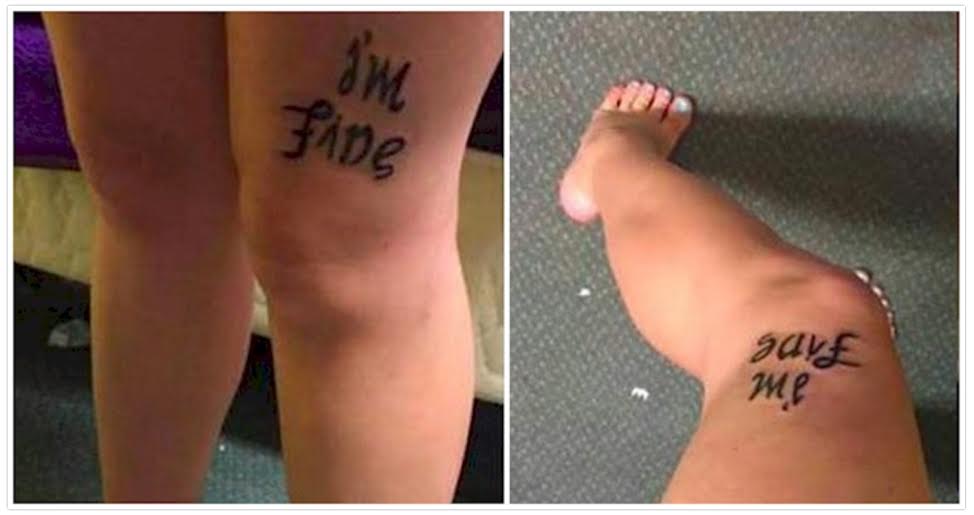
I saw this picture recently.
mixed message

The title of the article is “Her tattoo contains a hidden message, and it started an important conversation.” The tattoo is an ambigram – a message that can be read upside down as well as right-side up. In this case, the message is different when read upside down. The normal way it is viewed by others says “I’m fine”, while the way that she sees it says “Save me”.

The article says that she got it as a way of dealing with her depression. It is her way of asking for help. But there is something very wrong about this. It is passive. Help does not come from other people. If you give away your power to others, you will continually feel powerless.

I find it significant that “Save me” is the view from her perspective. Maybe she will finally read it that way – that she is the only one who can save herself.

She is the one who makes choices.
She can choose
to get enough sleep,
eat healthy food,
exercise,
avoid negative people,
find a job that is meaningful,
learn to speak her truth.

She can choose,
and must,
for her own survival.

Being healthy is a choice, and something each person must do for themselves.

Depression is a symptom, not a disease. It is the result of feeling powerless, disconnected, alone. It is a sign of not owning your own power, using your own voice. The way out of it is not to ask others to save you, but to save yourself. If others have to rescue you, you aren’t healed. They cannot do your work for you.

The giving away of power to others is part of the disease, the dis-ease. Ease, comfort, health, comes from taking responsibility for your own life.

You can ask for help to learn different ways of healing yourself, but you cannot expect others to do it for you. You must own your own power. You must be your own best friend. You must save yourself. This is the cure.

Stop being passive about your life.
Stop expecting others to rescue you.

Signals and signs

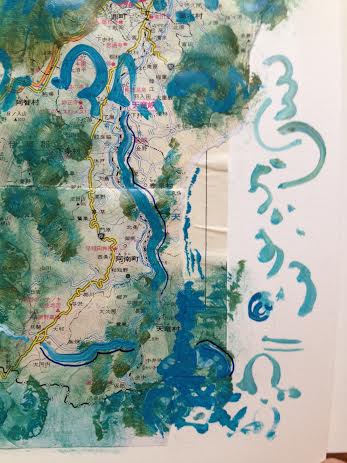
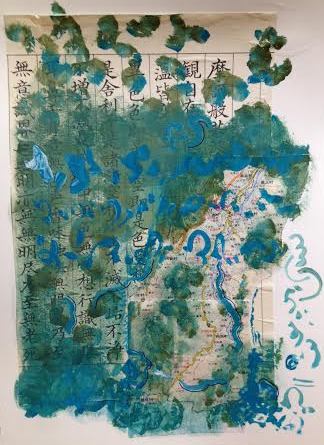
Signal and sign1

What is message and what is mountain?
What is writing and what is river?
Is a road a word?
Is a map a manuscript?
Signal/noise
Unreferenced symbol
Un-received messages
Lost languages
The boundaries between mountain and lake are often the boundaries between cultures and countries.
Decay of transmission
There must be at least one who can understand for meaning to be transmitted.

Details –
Signals2
(middle)

signals3
(top left)

signals4
(bottom right)

Ingredients –
Bought ephemera – Asian map, page of Asian writing
Paint- olive green, manganese blue, white, mixed with water. Dabbed on mixed very lightly with a smished paint brush and wiped off with paper towel.
Gel pens, matte medium
Strathmore art journal

Created 2-11-16

Felix’s last stand

4

Felix was having none of it. His parents had chased him around the house for an hour, trying to snatch him up. This was the day to get his hair cut for the first time.

They had braced him for it for a week – dropping hints as to what to expect, offering promises of treats if he behaved. He knew full well what they were planning to do to him. He knew that of all the things they had done to him in the name of his ‘best interest’, this was the last straw. He had to finally draw the line.

He was sick of being directed, ordered, bossed around. Nobody ever asked him what he wanted to wear. Nobody even cared to know what he wanted to eat. Every day of his three years of being alive was a battle of wills.

Every now and then they got it right and they gave him something that wasn’t tasteless to eat or scratchy to wear. Those days were rare, and on every other dull, grueling day, he felt that his very being was being washed away bit by bit until the rock that he was had worn away to nothingness.

Little Maxie was his only friend, the only one who understood. They’d gotten her when Felix was six months old after a particularly difficult trip to the doctor for booster shots. They hoped she would be a calming influence on him. It turned out that the two had developed a stronger bond than his parents could ever imagine. They both felt the same way.

Both were ordered around. Both were ignored, neglected, relegated to the ‘passive’ pile in their parent’s minds. Felix and Maxie developed a common bond out of their silent mutual suffering.

They forged a method of communication that worked perfectly for them, which his parents were oblivious to. Why wouldn’t they be? They never even thought to speak with either one of them – always at, or to, but never with.

It was funny in a not-so-funny kind of way. Both of his parents were all about communication, but they never thought to apply their skills at home. Mom spent her weekdays teaching dolphins how to communicate, getting them to mimic human speech or to point at symbol boards with their noses or flippers. All day she taught them how to tell her what they were feeling. She constantly modified her techniques to better understand their needs and wishes and thoughts. Never once did she think to learn their language.

These ‘animals’, these beings she and every other scientist thought were lesser than, purely by virtue of the fact they weren’t human, were expected to learn human language rather than the other way around. Who was less intelligent?

Felix’s Dad was equally culpable. He too had no excuse. They both knew better and they both didn’t act upon their knowledge. Ignorance was indeed bliss, but they didn’t have that luxury.

His Dad worked as a counselor with people who had learning disabilities. It had been his passion for a dozen years, far longer than his marriage, a third of his life. He’d even gotten professional recognition for his techniques to reach patients who were considered unreachable by conventional methods.

Neither of the parents thought to take their work home with them. Felix was a child, and that was that. It was unthinkable to them that he should be asked his opinion. Dolphins and profoundly autistic children were paid more heed than him, purely because he was theirs. The idea of trying to communicate with their child was something they never would have considered. Why would they ask him his opinion? They knew that their job as parents was to tell him what to think – not to ask.

Felix and Maxie had refused to budge from the settee. That stiff sofa was the ultimate symbol of all they were fighting against. It had been moved into Felix’s room last winter when the parents had bought a plush leather sofa for themselves. They had decided unequivocally that dogs and children were not allowed on it, out of fear of stains and rips. They were relegated to the board-stiff contraption of cloth and wood that had been in the family longer than anybody could remember. It had stains but no stuffing. In their minds it was perfect for a boy and his dog – they couldn’t wreck it any more than it was.

The boy and his dog thought otherwise. Here they were going to make their final stand. Here was going to be the epicenter of their future, the point where they were going to make their captors listen to them for the first time.

In unison they both peed on the couch.

Horrified, Felix’s parents and Maxie’s owner (or was it the other way around?) stared at them both as the warm pungent liquid seeped into the threadbare cloth. As a communication technique, it wasn’t the best. It got them to be noticed for sure, but not taken as seriously as they had hoped.

Don’t worship the door.

“Jesus once said ‘I am the door’ – and he was correct. A door is something to go through. The church, however, has remained at the threshold of the door, worshiping it, afraid to enter.” – former Episcopal priest Peter Calhoun in his book “Soul on Fire”

“We worshipped Jesus instead of following him on his same path. We made Jesus into a mere religion instead of a journey toward union with God and everything else. This shift made us into a religion of ‘belonging and believing’ instead of a religion of transformation.” – Richard Rohr

“A rich young man approached Jesus, and kneeling down before him, said ‘Good Teacher, what do I have to do to attain eternal life?’ Jesus asked him “Why do you call me good? There’s only One who is good, and that is God. If you want to have eternal life, then keep the Commandments. Do not murder, do not commit adultery, do not steal, do not lie about anyone, honor your parents, and love your neighbor as yourself.” — Matthew 19:16-17, Mark 10:17-19, Luke 18:18-20 (from The Condensed Gospel rendition, in “The Rich Young Man”)

Jesus never wanted us to worship him. Jesus wants us to follow him to God. Only God is above us.

Remember all the times that Jesus walked away from the crowds who were trying to make him king? He didn’t want it. Even today, the Jews use the fact that he wasn’t an earthly king to prove that he was not the Messiah. They also say that it is idolatry to worship Jesus as God.

Jesus would agree.

Remember the commandment to “have no other Gods before Me”? That includes Jesus. He constantly pointed people back towards God. He didn’t want to be worshipped. He wanted people to follow him to God.

Christianity has made an idol out of Jesus, rather than seeing him as a teacher and a guide.

Poem- we are all sheep

One of the problems
with the modern way that church
is done
is that there is a hierarchy
of minister
and congregation,
of leader
and led,
of shepherd
and sheep.

Jesus wants us to feed his sheep,
not be them.

Jesus wants us all
to be equal,
to be strong,
to do the will of God
together.

There is no lesser-than.
We are all servants.

Our only leader is God,
not a minister,
not a bishop,
not a pope.

We must remember
to never let any human
get between us
and God,
even if that person
says
they follow God too.

If s/he really did follow God,
s/he’d remember
that Jesus said
we were all to be equal,
that we weren’t to be
above each other,
that we weren’t to have
titles of authority.

For anyone
to lead in Jesus’ name
is to prove
that they do not know
the message of Jesus
at all.

Jesus came to give us back our power.
Jesus came to teach us
that we are all
equally worthy
before God.
Do not follow anyone
who says
otherwise
through their words
or actions.

Do not give away your power.

Go, feed people.
Clothe them.
Heal them.
Visit them when they are in prison.

But don’t join them in the prison
of following a person,
of feeling second-class,
second-rate.

Your freedom was bought at a high price.
Don’t give it away.

Convergence

Convergence1 020516

detail
convergence2 020516

Thoughts that arose while making it:
Using old ways of measuring (understanding) with new ways of being (experience). Old wine skins and new wine. Abandoning the old that no longer serves. False measurements (weights and measures) – not even allowed to have it in your house (might accidentally use it). Government enforced morality. , overt and covert. What is up and what is down? Words raining from the sky.

Ingredients:
8.5 x 12 inch Strathmore visual journal
Bought ephemera (practice ledger paper) (Asian book page) (Hell money)
Distress ink. Matte medium, glue stick.
White gel pen. Stickers of shoe prints – two kinds.
Created 2/5/16.

Blue Ridge

Blue ridge1 013116

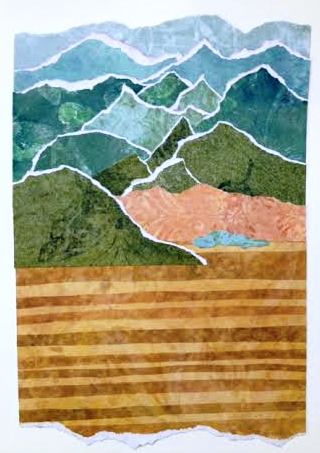
Fall is just beginning in the lower elevations. There is a dusting of snow on the mountain tops. The fields have been harvested and now lie dormant, resting through winter.

Ingredients:
8.5 x 12 inch Strathmore visual journal
Torn Art paper (K and Company designer paper by Susan Winget). Glue stick.
Created 1/31/16.

ONE

One 013016
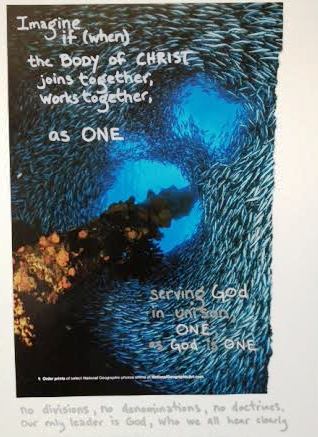
Text reads:
Imagine if (when) the Body of Christ joins together, works together, as ONE, serving God in unison, ONE, as God is ONE.

No divisions, no denominations, no doctrines. Our only leader is God, who we all hear clearly. (May it come speedily and in our time. Amen)

Ingredients:
8.5 x 12 inch Strathmore visual journal
Bought ephemera (magazine page depicting a school of fish swimming in unison)
Silver sharpie. White gel pen.

Created 1/30/16.