“Some for the Road” is now available!

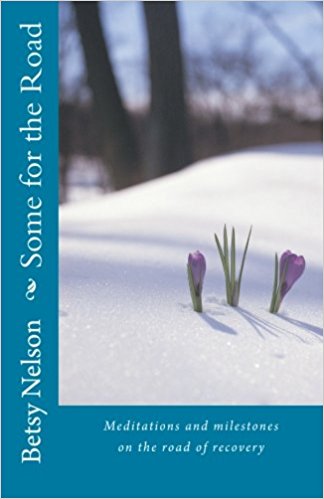
cover of SFtR

“Some for the Road” are meditations and milestones on the road of recovery, in a reading-a-day format. It took me two years to edit and assemble, and two years before that to write. The paperback is 484 pages, in a very readable 11 point font, and costs $25 if you order it from Amazon. The Kindle version is $9.99 to buy, free with Kindle Unlimited.

Bone music

skelhorn

Harold loved playing the French horn. The tone was mellow and warm, inviting. He knew it would never be the lead instrument like the trumpet or guitar was, and he was fine with that. He wasn’t one for being in front, leading the way. No, that was for the peacocks in the world. He was more a pigeon, behind-the-scenes, anonymous. He never wanted to be a manager, bossing people around. He was happy being a team member, a cog in the wheel, someone who got things done without any fanfare.

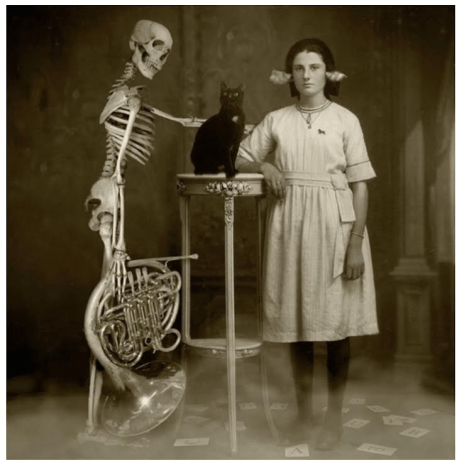
And then he met Lydia. She loved him exactly the way he was, for who he was. She wasn’t put off by his meek nature or unassuming presence. She certainly wasn’t concerned that he was a skeleton, either. While most women were loathe to live with someone who looked like they escaped from an anatomy class, Lydia saw the advantages. Because he had no skin, he was never too hot or too cold. She could adjust the thermostat to whatever she liked and he’d never fuss. He never spent any money on clothes either, so they had plenty set aside to go on vacations.

And go on vacations they did! Every month they ventured to a new part the world, seeing a new place and meeting new people. They picked their destinations from their extensive list of pen-pals, strewn all over the globe like Easter eggs, each one a treasure to discover. Every year they had to get new passports made because they’d filled them up with stamps and visas. Lydia had a plan that the old pages could be used to re-wallpaper her art room one day.

Mr. Buttons, their cat, never got to go on a trip. He never left the house. The vet even came to him. He was terrified of the outside world. Trees sent him into a tizzy. Clouds? Forget about it. He’d run and hide under Lydia’s dress, cowering there until she picked him up and carried him back inside. Otherwise he’d stay there, trembling, paralyzed. It was kind of embarrassing really, but it did mean that they never had to worry about him sneaking out when they opened the door, or be bothered with him asking to go out and come back in every 15 minutes. No, all in all he was a good cat, and he seemed to enjoy Harold’s home recitals almost as much as Lydia did.

They met at one of his performances – that time in a mutual friend’s house. Jane had suspected they’d get along smashingly and set up the recital as an excuse for them to meet. It was the blindest of blind dates – neither one knew that they were being steered toward each other. Harold brought his French horn and Lydia brought her harmonica. While listening to the sousaphonist playing his solo, (a piece he wrote himself for the occasion) they began to talk.

Lydia was certain that she’d heard undertones in Harold’s playing – notes that she was uniquely capable of hearing because of her unusual ears. Nobody in her family talked about her ears, but she knew she was different. She assumed they didn’t want to talk about them out of kindness, to not make her feel different, or perhaps it was out of embarrassment. Nobody really was certain who her father was, after all. Sure there was a man who filled the role, who was married to her mother. Jack had raised her since she was a baby. Everybody knew he was Dad and not her Father.

The only person who knew for sure was Martha, Lydia’s Mom, and she wasn’t saying. She’d retired from the circus when she got pregnant and that was as far as the story went. Sure, there had been a mule act as part of the show, but nobody went so far as to suggest anything that questionable. Maybe it was the illusionist, spurned at the end, and he performed some real magic instead of those sleight-of-hand stunts that were his bread-and-butter. No matter, the family didn’t know and it wasn’t worth the bother of making up a story, so they just acted like everything was normal.

Harold said that yes, he regularly played more notes then were normally heard, basically playing two songs at once. If it was a depressing song, he simultaneously played a cheery one at a subsonic level to even it out. If it was a rousing march, he played a dirge for the same reason. He just felt it wasn’t right to bring people’s emotions too high or too low. Somewhere in the middle was best, and since he could, he did.

Nobody before had discovered the extra song weaving its way into and under the first, like how the framework of the house is hidden yet integral to the house itself. Nobody until now, he thought, and there and then he decided he would have to make her his bride. Partly it was out of admiration for her rare talent. But partly it was out of the desire to keep his actions a secret. No wife could testify against her husband – that was law. It was like testifying against yourself since “the two shall be of one flesh”. It stood to reason she wouldn’t tattle on him either, as a logical extension of that law.

She hadn’t told, and he never had reason to worry. She wouldn’t have anyway. Nobody ever believed her when she told them anything she’d learned from using her unusual talent. They had no way to check if it was true, and honestly they didn’t care. In some ways she was like a five-year-old boy, fascinated with trains or dinosaurs, telling everyone within earshot about the minutest details of her obsession. Even though what Lydia said was true it didn’t really concern them, so it wasn’t worth the bother. “Uh-huh!” and “Is that right?” they’d mumble to not appear rude, but they were already off thinking about their own interests. She never took it personally, knowing their actions said more about them than her, and learned to keep her own counsel early on.

The Clower twins

5

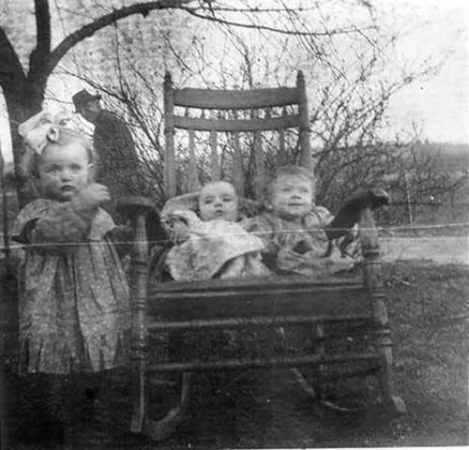
Emma hated her siblings. All day long she had to rock them back and forth. Even if they’d had arms and legs they were too small to do it themselves. Rocking was the only way to keep them content, but more importantly, to keep them quiet. Her shoulder was getting tired, but she kept at it. To stop meant noise either from them or from their parents. Or both. She wasn’t sure which was worse, but she was unwilling to learn the answer right now.
The twins were born three years ago but they looked half that age. They were so tiny, still. The doctor in Millersville was unable to tell Mr. and Mrs. Clower if they would always be this small, or if they would ever catch up. He also had no answer to why they had no arms or legs. He didn’t have a lot of answers for most of their questions, but he was all they had. They couldn’t afford to take the twins into Baltimore to get a second opinion. It was only 22 miles away, but that was forever when you didn’t have a car. Sure, it was only two hours by bicycle, but those babies couldn’t travel that way, no sir! How would they take them – in the basket like they were a package to be mailed or a bag of apples bought at the market? You can’t hold them and steer, either. Plus it would mean that Earl had no way to get to his job at the field, picking beans or tending the goats. No, one opinion would have to do, even though it wasn’t much. If the good Lord had wanted them to know more, He would’ve provided more. This was their burden, and they had to carry it.
Now, to be sure, Mr. and Mrs. Clower never said out loud that their newest children were a burden. They never intentionally sounded ungrateful for any gift the Lord gave them, no matter how odd it seemed. Their pastor had said years ago that nothing from the Lord was bad, only it might be bitter sometimes. Medicine was bitter, but it was good for you. And it took a while to see the effects. They remembered his words when the twins came, and thought about them often.
Why, the Lord Himself was born in a barn. That sure didn’t seem appropriate for God to make an appearance. Surely God would be born in a palace or at least a manor house. Never someplace so anonymous or dirty as a pen for animals. Imagine the noise! Imagine the smell! So if the Lord could be born in less than ideal circumstances, so could their babies. They’d just have to wait and see how things turned out, just like Mary did.
Emma didn’t have the patience to wait. She wanted these babies gone and she wanted them gone right now. They were getting on her nerves. She hadn’t asked to be a big sister. She had been fine being an only child. She sure didn’t want the limelight taken away from her, and even more she didn’t want to have to care for these interlopers.
Her parents never thought twice about making her tend them. It was part of her job as a member of the family. They didn’t charge her rent or expect her to pay for her food or clothing, so how else was she supposed to do her part? The same had been expected of them, both first-borns in large families. Of course you needed large families then. It was free labor. Having children was like printing money. Need more help? Have more babies. Of course you had to plan ahead a bit – look down the road a piece in order to see what you might have need for. It didn’t do to have a baby right when times got tight – then you were doubling your trouble. Best to have one who was at least five, so he was able to feed and clothe himself. It didn’t count as child labor if it was yours, you know.
But these babies weren’t going to be a help to anyone, seeing as how they were born without limbs. They sure were happy, though. That made it a little easier. All day long they laughed and smiled, eyes gleaming at everyone and everything. Some thought they were soft in the head, being so happy and all. It takes smarts to see the troubles in the world. But they really were smart and happy at the same time. It was weird. Maybe that was their gift. They’d been cursed physically, but blessed spiritually. They were happy no matter what was happening, which was good. Now, if only they could rub off some of that spirit onto Emma.

The Passion is a code

When Jesus was dying on the cross, he said several things that were direct references to the Psalms.  Those who were nearby would have known the references, having grown up with them just like he did.  Orthodox Jews recite the entirety of the Psalms once a week at a minimum.  These references would have been familiar to his listeners.  He didn’t have time to say the entire Psalm, but he didn’t have to.  One line was sufficient to recall the rest.

In Matthew 27:46 we read

46 About three in the afternoon Jesus cried out with a loud voice, Elí, Elí, lemá sabachtháni? that is, My God, My God, why have You forsaken Me?

This is a reference to Psalm 22:1

“My God, my God, why have You forsaken me?
Why are You so far from my deliverance
and from my words of groaning?”

But it is helpful to read the rest, because within it are more prophecies that were fulfilled at that time.  Notice in particular verses 8, 16, and 18, which perfectly mirror what happened at the crucifixion.

“My God, my God, why have You forsaken me?
Why are You so far from my deliverance
and from my words of groaning?
My God, I cry by day, but You do not answer,
by night, yet I have no rest.
But You are holy,
enthroned on the praises of Israel.
Our fathers trusted in You;
they trusted, and You rescued them.
They cried to You and were set free;
they trusted in You and were not disgraced.

But I am a worm and not a man,
scorned by men and despised by people.
Everyone who sees me mocks me;
they sneer and shake their heads:
“He relies on the Lord;
let Him rescue him;
let the Lord deliver him,
since He takes pleasure in him.”

You took me from the womb,
making me secure while at my mother’s breast.
10 I was given over to You at birth;
You have been my God from my mother’s womb.

11 Do not be far from me, because distress is near
and there is no one to help.

12 Many bulls surround me;
strong ones of Bashan encircle me.
13 They open their mouths against me—
lions, mauling and roaring.
14 I am poured out like water,
and all my bones are disjointed;
my heart is like wax,
melting within me.
15 My strength is dried up like baked clay;
my tongue sticks to the roof of my mouth.
You put me into the dust of death.
16 For dogs have surrounded me;
a gang of evildoers has closed in on me;
they pierced my hands and my feet.
17 I can count all my bones;
people look and stare at me.
18 They divided my garments among themselves,
and they cast lots for my clothing.

19 But You, Lord, don’t be far away.
My strength, come quickly to help me.
20 Deliver my life from the sword,
my only life from the power of these dogs.
21 Save me from the mouth of the lion!
You have rescued me
from the horns of the wild oxen.

22 I will proclaim Your name to my brothers;
I will praise You in the congregation.
23 You who fear Yahweh, praise Him!
All you descendants of Jacob, honor Him!
All you descendants of Israel, revere Him!
24 For He has not despised or detested
the torment of the afflicted.
He did not hide His face from him
but listened when he cried to Him for help.

25 I will give praise in the great congregation
because of You;
I will fulfill my vows
before those who fear You.
26 The humble will eat and be satisfied;
those who seek the Lord will praise Him.
May your hearts live forever!

27 All the ends of the earth will remember
and turn to the Lord.
All the families of the nations
will bow down before You,
28 for kingship belongs to the Lord;
He rules over the nations.
29 All who prosper on earth will eat and bow down;
all those who go down to the dust
will kneel before Him—
even the one who cannot preserve his life.
30 Their descendants will serve Him;
the next generation will be told about the Lord.
31 They will come and tell a people yet to be born
about His righteousness—
what He has done.

So even though this utterance of Jesus seems to indicate that he feels God has abandoned him, he knows that this is not true.  He knows the rest of the Psalm by heart. By verse 22 the Psalmist (and Jesus) is praising the Lord.

The last words Jesus said upon the cross as cited in Luke 23:46 –

46 And Jesus called out with a loud voice, “Father, into Your hands I entrust My spirit.Saying this, He breathed His last.

This too is a reference to a Psalm – in this case the specific verse is Psalm 31:5.

Into Your hand I entrust my spirit;
You redeem me, Lord, God of truth.”

Here too it is worthwhile to read the entire Psalm, because instead of being a sign of resignation, Jesus’ words are a sign of total trust in God.

Lord, I seek refuge in You;
let me never be disgraced.
Save me by Your righteousness.
Listen closely to me; rescue me quickly.
Be a rock of refuge for me,
a mountain fortress to save me.
For You are my rock and my fortress;
You lead and guide me
because of Your name.
You will free me from the net
that is secretly set for me,
for You are my refuge.
Into Your hand I entrust my spirit;
You redeem me, Lord, God of truth.

I hate those who are devoted to worthless idols,
but I trust in the Lord.
I will rejoice and be glad in Your faithful love
because You have seen my affliction.
You have known the troubles of my life
and have not handed me over to the enemy.
You have set my feet in a spacious place.

Be gracious to me, Lord,
because I am in distress;
my eyes are worn out from angry sorrow—
my whole being as well.
10 Indeed, my life is consumed with grief
and my years with groaning;
my strength has failed
because of my sinfulness,
and my bones waste away.
11 I am ridiculed by all my adversaries
and even by my neighbors.
I am dreaded by my acquaintances;
those who see me in the street run from me.
12 I am forgotten: gone from memory
like a dead person—like broken pottery.
13 I have heard the gossip of many;
terror is on every side.
When they conspired against me,
they plotted to take my life.

14 But I trust in You, Lord;
I say, “You are my God.”
15 The course of my life is in Your power;
deliver me from the power of my enemies
and from my persecutors.
16 Show Your favor to Your servant;
save me by Your faithful love.
17 Lord, do not let me be disgraced when I call on You.
Let the wicked be disgraced;
let them be silent in Sheol.
18 Let lying lips be quieted;
they speak arrogantly against the righteous
with pride and contempt.

19 How great is Your goodness
that You have stored up for those who fear You
and accomplished in the sight of everyone
for those who take refuge in You.
20 You hide them in the protection of Your presence;
You conceal them in a shelter
from the schemes of men,
from quarrelsome tongues.
21 May the Lord be praised,
for He has wonderfully shown His faithful love to me
in a city under siege.
22 In my alarm I had said,
“I am cut off from Your sight.”
But You heard the sound of my pleading
when I cried to You for help.

23 Love the Lord, all His faithful ones.
The Lord protects the loyal,
but fully repays the arrogant.
24 Be strong and courageous,
all you who put your hope in the Lord.

(All Bible translations are from the Holman Christian Standard Bible)

The dessert

Remember the Pink Floyd song “The Wall”?   There is a lyric in it that is really meaningful for Holy Week: “If you don’t eat your meat, you can’t have any pudding!”

In some Christian denominations, Maundy Thursday and Good Friday are just days of the week. Nothing special happens.  In others, they are holy days of deep reflection and fasting.  They are dark days right before the biggest celebration of the Christian year – Easter.  Within those denominations are people who don’t make time to go to Maundy Thursday or Good Friday services, and I feel they are shortchanging themselves.

So many people want to skip over the bad and go straight to the good. But if you don’t go through the bad, then the good doesn’t have the same meaning.  They want their pudding, but they don’t want to eat the meat.

The “meat” is Maundy Thursday and Good Friday.  They are hard to chew, and even harder to digest.  They are difficult.  They open us up and break us down.  They take us along with Jesus into the pain and despair of that time, that time of loss, of betrayal, of abandonment.  They take us along with the disciples into that time of fear and confusion.

The “pudding” is Easter – it is sweet and easy to eat.  It is a day of joy, of promises fulfilled, of knowing that God is supreme.

But you have to go through the darkness to appreciate the light.

The Garden

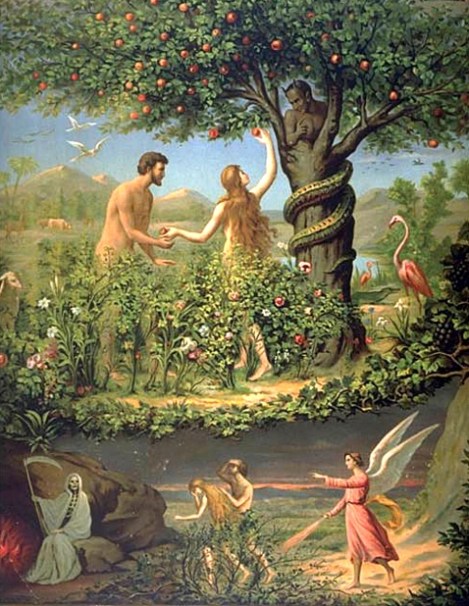
I am struck by the parallel of the story of Adam and Eve, and the story of Jesus.
The very first example of disobedience happened in a garden – the Garden of Eden.

garden-of-eden

Adam and Eve went against the will of God and decided to do things their way.  Because of their choice, they were banished from the place of peace and harmony, where their every need was provided for.  Because of their choice, they were subject to pain and death.

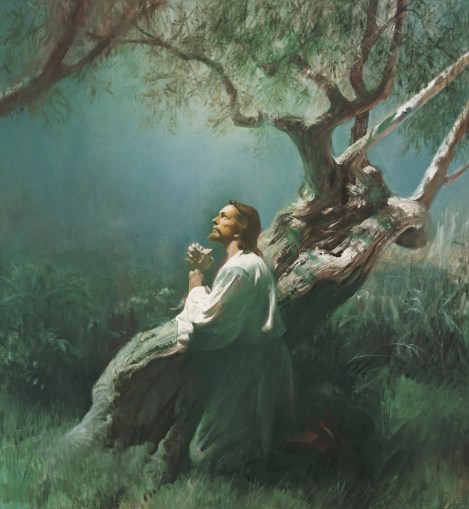
The ultimate expression of obedience to God also took place in a garden – the Garden of Gethsemane.

jesus-praying-in-gethsemane-39591-print

Jesus knew what God wanted him to do.  He’d read the words of the prophets and knew that this is what had to happen.  He didn’t want it.  He said “Father, if you are willing, take this cup from me; yet not my will, but yours be done.” (Luke 22:42, NIV).  He was hoping that there would be a way out, like the ram that appeared when Abraham was about to sacrifice Isaac due to God’s command. He was hoping that there would be another way, that he would not have to suffer and die.

And yet, he accepted what had to happen. Knowing what was going to occur, yet trusting in his Father, he submitted.  He was fully obedient, knowing that it would cost him his life.  Because of God’s love, he gained his life back.

Because of his example of total obedience to God, we now have a pattern for how to live our lives – trusting, without fear, knowing that even death has no hold over us if we are following God’s commands.  The doors to heaven are open to us if we follow his example.


Spring bottles

This is an art-journal page I made recently.  Because of the spiral in the journal, some of the image isn’t flat on the scanner, resulting in a lack of sharpness.

sp1

(detail)

sp2When I transcribed the quote, I wrote it as

“To one who has faith, no explanation is necessary. To one who is without faith, no explanation is possible.” – Thomas Aquinas

but it is really

“To one who has faith, no explanation is necessary. To one without faith, no explanation is possible.” – Thomas Aquinas

Someone on a Facebook page said that it is really from St. Ignatius of Loyola – that there is a bronze bust of St. Ignatius at the Casa Dom Inacio in Brazil with this quote on it. However, all the indications online say it is from Aquinas.


Mixed-media art journal (Strathmore).  Watercolor pencils.  Distress ink pads. English stamps.  Distress ink.  White pen.  Skeleton leaf.

Relatives in sepia

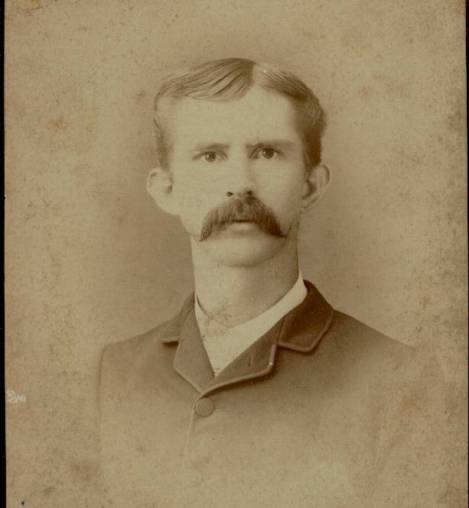
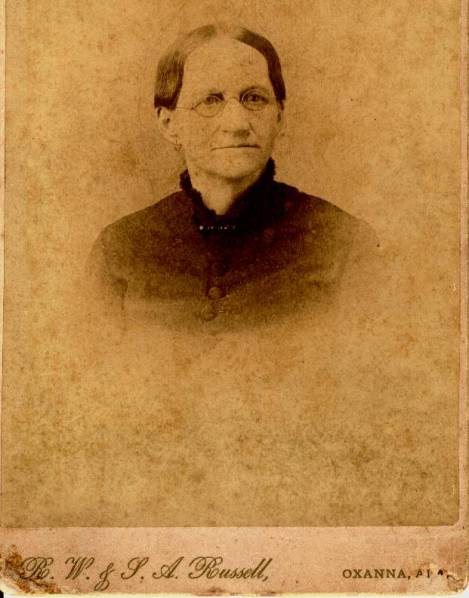
Henry Bascom Rudisill Sr 

HenryBR1

Birth: Sep. 10, 1859  Sandersville  Washington County  Georgia, USA

Death: Jul. 28, 1942  Anniston  Calhoun County  Alabama, USA

He was employed by the Anniston Water Supply Company between 1887 and 1890. He was president of the Anniston Foundry and Machine Company in 1908. Between 1922 and 1929, he was the president of the Rudisill Soil Pipe Company. He married Emory Helen Wilson on 17 October 1899 in Calhoun County, Alabama. He served as Mayor of Anniston, Alabama in 1922 His middle name was also variously spelled Bascom without the “b” on the end.

— His father —

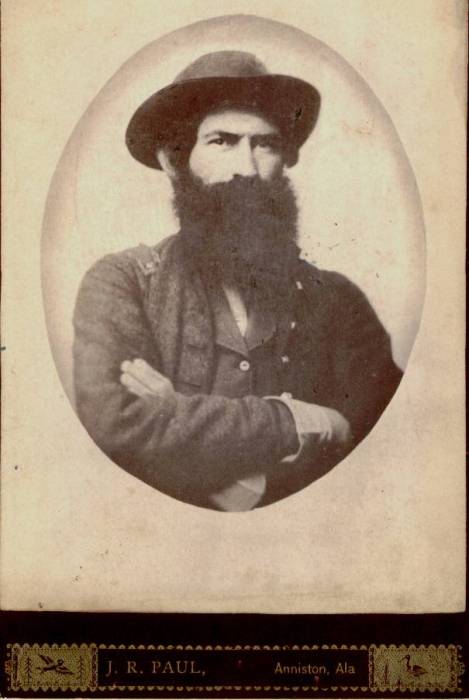
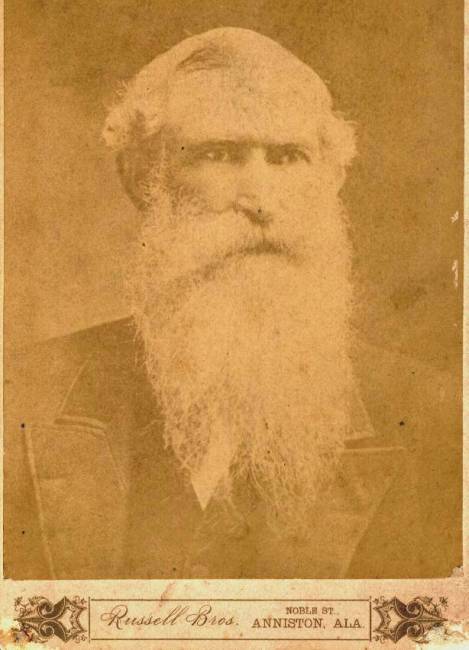
Captain John Weiry Rudisill

JWRJWR2

Birth: May 1, 1823 Powelton Hancock County Georgia, USA

Death: Apr. 24, 1885 Anniston Calhoun County Alabama, USA

He married Martha Ann Rebecca Pournelle on 14 December 1847 in Washington County, Georgia. He served as a Georgia state legislator. He was also an educator, having established the Mount Zion Academy, which may have also been called the Washington County Male Academy, for which he was the superintendent in December 1853. He was listed as the principal of this school in February 1866 as well. He served as a lieutenant with Company E, 1 (Ramsey’s) Georgia infantry during the Civil War, having joined on 18 March 1861 at Sandersville, Georgia. Ramsey’s infantry was disbanded and most soldiers went over to join the 12th Battalion. He was elected Captain of the 3rd Company of the 12th Battalion of the Georgia Light Artillery. He was also a Captain with the 1st Company D, 12th Battalion of the Georgia Light Artillery. In April 1864, he was on special assignment by order of General Anderson, but became ill. He was admitted to the Jackson Hospital in Richmond, Virginia. He later fought and was captured on 22 September 1864 at Fishers Hill, Virginia and was imprisoned first at Harper’s Ferry, West Virginia, but was later sent to Fort Delaware on Peapatch Island, Delaware. He was released by the Union Army on 10 June 1865 after he gave the Oath of Allegiance to the United States. He had little of his land left after the war, as most of it was confiscated by the government for redistribution.

–John’s wife, Henry’s mother —

Martha Ann Rebecca (Pournelle) Rudisill

Martha

Birth: Sep. 30, 1829 SandersvilleWashington County Georgia, USA

Death: Sep. 1, 1911 Forsyth Monroe County Georgia, USA

She was the daughter of William F. Pournelle and Martha Ann Fairchild.

Abstract of her obituary as it appeared in the Monroe [Georgia] Advertiser, issue of September 8, 1911. – Mrs. M. A. Rudisill died at the home of her daughter, Mrs. George R. Banks [Sarah] in Forsyth. She was 82 years of age. She died September 1, 1911. She was the mother of 11 children, 10 of which survive her. They are: John W., H. B., E. J. of Birmingham, Mrs. J. D. Rivers of Griffin, Mrs. T. B. Willis of Forte Meade, Florida, Mrs. George R. Banks of Forsyth, George B. of Fort Worth, Texas, Mrs. William Roberts of Selma, Alabama, Rev. J. F. of Birmingham, Alabama and Mrs. A. S. Coombs of Memphis, Tennessee. Mrs. Rudisill was born in Sandersville on September 30, 1829 as Martha Pournelle. She married in 1847 to Col. John W. Rudisill, one of the best known educators in middle Georgia prior to his death. Mrs. Rudisill’s body was shipped to Anniston, Alabama early Friday morning and interment was in that city on Saturday.


(All text and photos are from Find A Grave)

Blue like sci-fi

From a visual conversation I had online about blue characters in sci-fi. Can you add to this?

From The Fifth Element –

12274263_925893337459079_1452803664720828488_n

From Avatar –

12274732_926124407435972_3993866331698657159_n

From Star Wars –

12311227_10206103722690474_1746238935276500489_n

From X-men –

12313787_985598608173081_3159033521312392259_n

From Farscape –

12316626_10206103616927830_5666509752691879108_n

And then the conversation veered off Sci-Fi to popular culture. I’m not even sure who this guy is.

12301589_925886524126427_3603902793790354270_n

From Charlie and the Chocolate Factory –

12316071_10208345374052998_3668373787163542139_n

From Sesame Street.

CookieMonsterWaving


So is there a comparable selection of monochromatic characters in other colors?  Please share!


The road less traveled

       The road less traveled isn’t about the road.  It is about you.  It is about the fact that you stopped and thought and decided for yourself where and when and how you are going to go to get there. Where is there?  It doesn’t matter.  What matters is how, and that is up to you.   

Your road might be the highway. That is fine. The way doesn’t have to be a back road or a dusty path.  You don’t have to go on foot, carrying everything you think you’ll need in a backpack. You don’t have to suffer.  This isn’t penance. But perhaps it is a pilgrimage.

The famous poem about the two roads is at the end of this post for your convenience. Read it slowly, line by line, as if you are reading it for the first time.  If you are like me, you’ve heard it so often you miss what it is really saying.

But this isn’t about the road – either one.  This is about you.

17522835_10209810296752509_8746089567817351063_n

Where are you going?  Why?  Which way will you get there? Why? Consider it.  Be awake, and mindful.  Choose.  The only wrong choice is to waffle so much that you don’t make a choice at all.  To fail to act for fear of failure is the only true failure.
17554186_10209810296032491_1304691799332560373_n

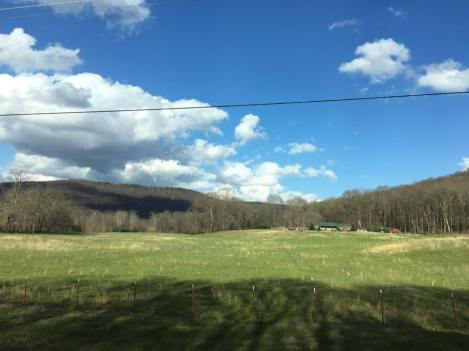
My husband and I have driven together to Chattanooga many times over the years.  Usually we take the interstate.  I-24 East is a pleasant enough drive.  There are nice views and the trip takes about 2 hours.  It is safe, and that is part of the appeal.  There are places we can stop along the way for a snack or a bathroom break or to stretch our legs. However, it is uneventful, and because of the nature of the road, it inspires mindlessness.  You can get from here to there without thinking at all.  That is a concern.

How much of our lives is like that? Too much.

There is a road that runs almost parallel to I-24.  It is the original road that linked the cities before the interstate was built.  It is US-41.  We’ve seen glimpses of it on our right as we are coming home, going over bridge at Nickajack Lake, just West of Chattanooga. One time we got off at the exit just before there and considered taking that way back.  We stopped at a gas station and got some snacks and a map.  We went to the bathroom.  For some reason it felt like we were about to go to the moon and we needed to prepare really hard for this trip. It was going to add at least an hour and a half to our trip – maybe more.  We weren’t sure.  We didn’t know if there were going to be places we could stop along the way to refresh or refuel.
17522860_10209810297232521_6309865160201682721_n

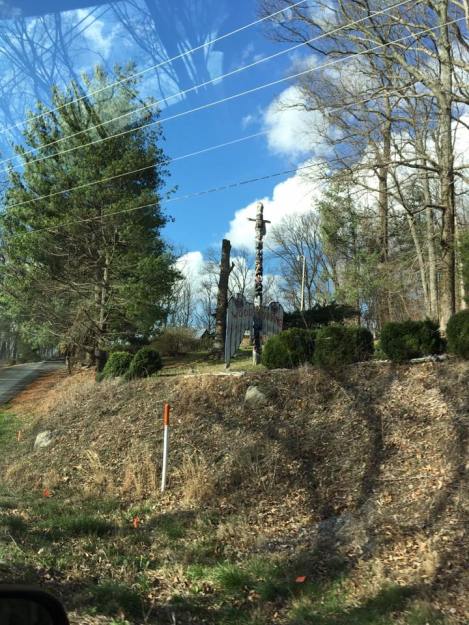
We drove a little way up the road and freaked out a little.  We got back onto the freeway as soon as we could.  Perhaps we were already tired from our trip and just needed to get home.

Just going on a road trip can be the entire purpose of the trip.  Sometimes it isn’t where you go, but how you go.  The journey itself is the destination.

Another time we drove down part of the way on US-41.  It was beautiful.  Lots of hidden scenes and sights that you simply cannot see when going 70 mph.

US-41 is Broad Street in Chattanooga. But then it turns Right and is East Main.

It is how US-11 is also Lee Highway.

You can live in a town and not even notice how the road you’ve lived on all your life is part of something so much bigger – that it stretches all across the country.  It takes a while to find the lines sometimes – they merge with named roads, take detours, appear to drop off and then re-appear.

It is a bit like doing genealogy, now that I think about it.  If you’ve ever tried to uncover your family past, you might understand this.

The writer Charles Kuralt talked about this.  That we gain time when we take the freeway, but we lose something else.  We lose our sense of discovery and wonder.  Perhaps we aren’t meant to go faster, but to go slower.  Perhaps 70mph is too much for humans.  We sacrifice part of who we are, part of our nature, when we go so fast that we can’t see what is going on around us.

Life goes too fast as is. We need to slow down to actually live.  Life isn’t about traveling quickly from birth to death, but noticing all the moments in between.
17499035_10209810297352524_977078950823763385_n

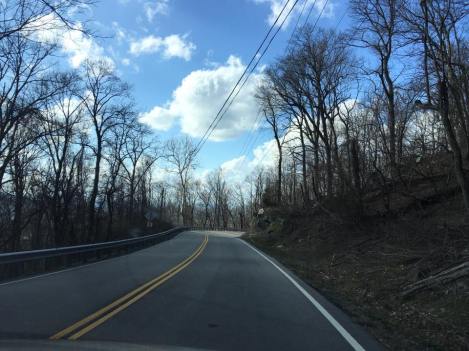
This time, on our way down, I went to find the maps we’d bought, but couldn’t locate them.  Would the GPS signal work?  We’d discovered that problem in the wilds of the North Carolina mountains.  There are areas where you can get pretty lost, still, these days. Technology doesn’t always serve. We asked for directions at a tiny church in a town called Frank.  Something about going up the road for several miles, and turning left at the dentist’s office. All too often, people give directions by what used to be there.  If I was local, I’d know what used to be there – but if I was local, I wouldn’t be asking for directions.   We wore ourselves out looking for that office.  It was mentally exhausting.  I didn’t want a repeat of that experience.

We went anyway, and I’m glad we did.

17457273_10209810296952514_8699597691260757353_n

I’ve learned that the route began around 1926, and runs 2000 miles, North to South, across the US, stretching from Miami, Florida to just before Copper Harbor, Michigan.

Maybe one day we’ll take a road trip and do the whole thing.

17426122_10209810296272497_4252687372558027949_n

The Road Not Taken – by Robert Frost

Two roads diverged in a yellow wood,

And sorry I could not travel both

And be one traveler, long I stood

And looked down one as far as I could

To where it bent in the undergrowth;


Then took the other, as just as fair,

And having perhaps the better claim,

Because it was grassy and wanted wear;

Though as for that the passing there

Had worn them really about the same,


And both that morning equally lay

In leaves no step had trodden black.

Oh, I kept the first for another day!

Yet knowing how way leads on to way,

I doubted if I should ever come back.


I shall be telling this with a sigh

Somewhere ages and ages hence:

Two roads diverged in a wood, and I—

I took the one less traveled by,

And that has made all the difference.