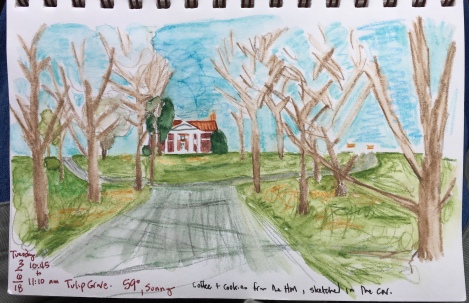
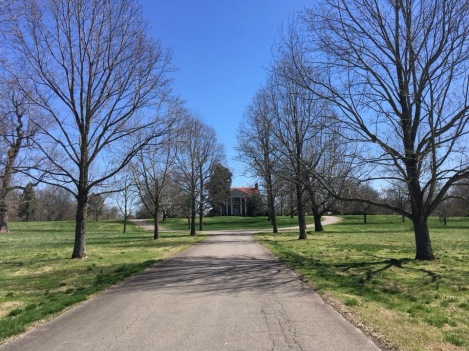
10:45 to 11:10 am, Tuesday morning before work. 59 degrees, sunny. I sat in my car and sketched while drinking coffee and eating cookies bought at the little café at the Hermitage.
Watercolor pencil.

Home » Articles posted by betsybeadhead (Page 22)

10:45 to 11:10 am, Tuesday morning before work. 59 degrees, sunny. I sat in my car and sketched while drinking coffee and eating cookies bought at the little café at the Hermitage.
Watercolor pencil.

Let us look at some words from Paul.
Romans 3:1-21
“Then what is the advantage of being Jewish? Or what is the benefit of circumcision? 2 Much in every way. First of all, they were entrusted with the sayings of God. 3 So what if some did not trust? Will their lack of faith nullify God’s faithfulness? 4 May it never be! Let God be true even if every man is a liar, as it is written,
“that You may be righteous in Your words
and prevail when You are judged.”
5 But if our unrighteousness demonstrates the righteousness of God, what shall we say? God is not unrighteous to inflict wrath, is He? (I am speaking in human terms.) 6 May it never be! For otherwise, how will God judge the world? 7 But if by my lie the truth of God abounds to His glory, why am I still judged as a sinner? 8 And why not say, “Let us do evil, so that good may come”—just as we are being slandered and as some claim that we say. Their condemnation is deserved!
9 What then? Are we better than they? No, not at all.For we have already made the case that all—both Jewish and Greek people—are under sin. 10 As it is written,
“There is no one righteous—no, not one.
11 There is no one who understands,
no one who seeks after God.
12 All have turned aside;
together they have become worthless.
There is no one who does good—no, not even one!
13 Their throat is an open grave;
with their tongues they keep deceiving.
The poison of vipers is under their lips.
14 Their mouth is full of cursing and bitterness.
15 Their feet are swift to shed blood.
16 Ruin and misery are in their paths,
17 and the way of shalom they have not known.
18 There is no fear of God before their eyes.”
19 Now we know that whatever the Torah says, it says to those within the Torah, so that every mouth may be shut and the whole world may become accountable to God. 20 For no human, on the basis of Torah observance, will be set right in His sight—for through the Torah comes awareness of sin.”
Let’s look at 10-18 carefully. This “verse” isn’t written like this in one place. This is a hodge-podge. He says “as it is written” – but he’s assembled these various ideas from all over the Bible, and they aren’t quotations, but summaries. He’s rewriting the Bible to suit his own needs.
I am using the references that the Tree of Life version gives to illustrate this point. I am not coming up with these verses on my own.
Ecclesiastes 7:20
Surely there is not a righteous person on earth
who does what is good and doesn’t sin.
Psalm 13:2-3
2 How long, ADONAI? Will You forget me forever?
How long will You hide Your face from me?
3 How long must I have cares in my soul
and daily sorrow in my heart?
How long will my enemy triumph over me?
Psalm 5:10
10 For nothing upright is in their mouth.
Inside them is a ruin—their throat an open grave.
They flatter with their tongue.
Psalm 139:4
4 Even before a word is on my tongue,
behold, ADONAI, You know all about it.
Isaiah 59:7-8
7 Their feet run after evil.
They rush to shed innocent blood.[a]
Their thoughts are thoughts of iniquity.
Violence and ruin are on their highways.
8 They do not know the path of peace,
and there is no justice in their tracks.
They have made their paths crooked.
Whoever walks in them will not experience shalom.
Psalm 35:2
2 Take hold of shield and buckler,
and rise up to my help.
This “verse” doesn’t exist. Paul strung it together, cutting and pasting what he liked into a whole unit of his choosing. My point – be sure to double check everything you read, even (and sometimes especially) in the Bible. Just because someone says something is true, even if that person is an authority, doesn’t make it true.
(All Bible quotations are the Tree of Life Version (TLV))
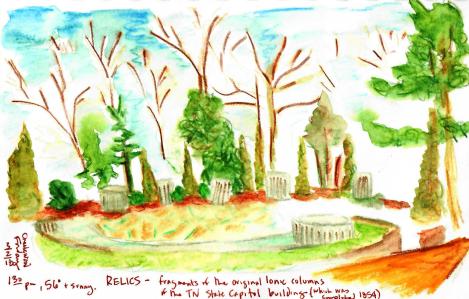
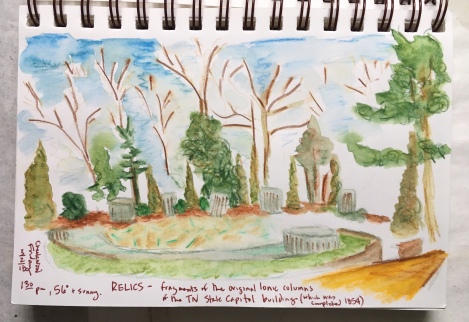
Cheekwood Botanical Garden, Friday 3-2-18, 1-2:30 pm. 56 degrees and sunny.
A brave day, I drove here by myself. I didn’t let the monsters in my head win. This is part of why I bought a membership here – to encourage me to go sketch.
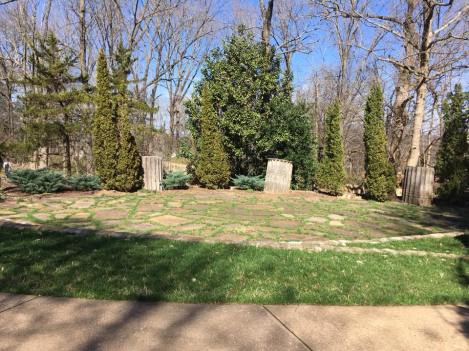
This is the “Ruins” section – there are fragments of the original columns from the Tennessee Capital building, which was finished in 1854. The limestone columns didn’t endure the weather and started to decay. They were salvaged and brought here, to create a sort of small amphitheater.
(My scanner make the colors unusually bright and vivid)
scan 


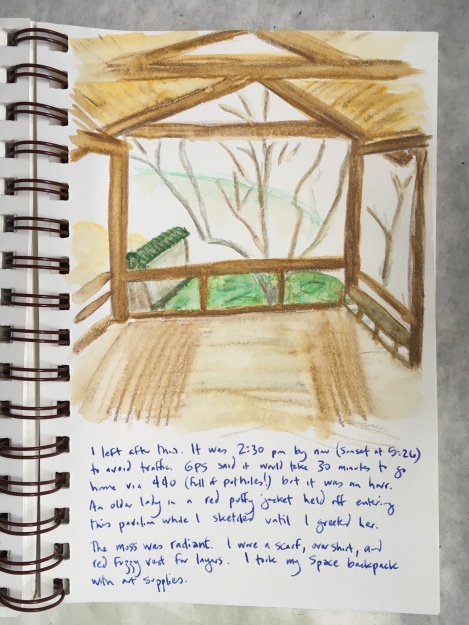
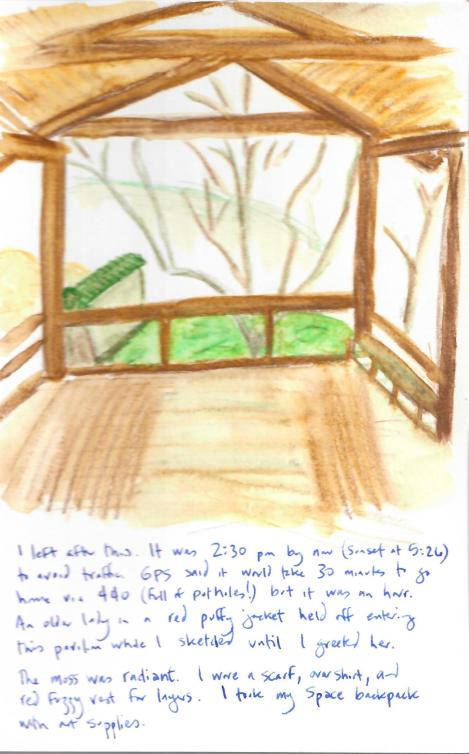
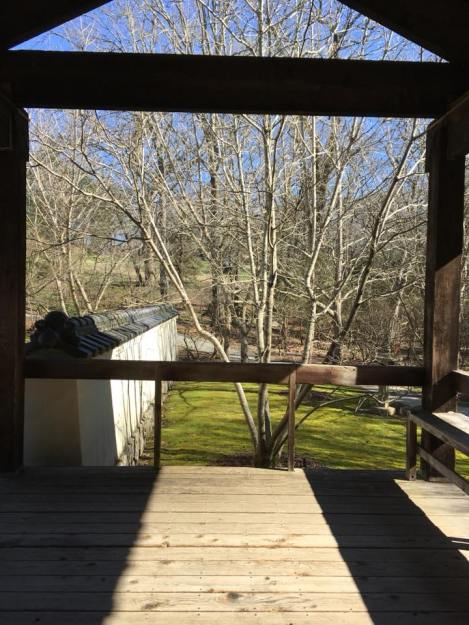
And an unusual view of the Japanese section –
Photo of sketch-
scanned


Make art. Make a life. What you are creating when you make art is yourself. So go on and get your art started. The life you save will be your own. Essays about being a part-time artist with a full-time life.
I have been very anxious about the future – about getting older and needing help. I do not have children or a close family (“distant” isn’t just in miles). There is nobody on the horizon that I can count on to help me when I get older, if my husband dies before me. Or, say we are both old, and both need help. Who will help us?
I have long thought that there should be some sort of community, like a convent or a monastery, where people live and work and die together, as a kind of adopted family. But how to go about making that happen? People value their privacy and independence. People are wary of “religion”, yet it is a good center to a community.
We humans were not made to be alone. We lie to ourselves when we think we can do it all. We are not designed that way.
I have researched “co-housing” and similar communities. But I’m nearly 50. I take care of myself, but how long will it be until I need help? One broken bone, one car accident, and things change quickly. The system needs to be in place before that.
I love how religious people who live in community (monks and nuns) spend their lives together. They don’t go away to a nursing home – that facility is part of the property. It is an expected part of life. They don’t pretend that illness and death isn’t going to happen. I think it makes it easier to know that you won’t be tended by strangers – your own adopted family is taking care of you. Your home is there, with them, not shuffled away into some forgotten facility.
My recent Bible readings speak to the answer –
Psalm 142
I cry aloud to the LORD;
I plead aloud to the LORD for mercy.
I pour out my complaint before Him;
I reveal my trouble to Him.
Although my spirit is weak within me,
You know my way.
Along this path I travel
they have hidden a trap for me.
Look to the right and see:[a]
no one stands up for me;
there is no refuge for me;
no one cares about me.
I cry to You, LORD;
I say, “You are my shelter,
my portion in the land of the living.”
Listen to my cry,
for I am very weak.
Rescue me from those who pursue me,
for they are too strong for me.
Free me from prison
so that I can praise Your name.
The righteous will gather around me
because You deal generously with me.
Isaiah 51:12-14
“I am the One who comforts you.
Who are you that you should fear man who dies,
or a son of man who is given up like grass?
But you have forgotten the LORD, your Maker,
who stretched out the heavens
and laid the foundations of the earth.
You are in constant dread all day long
because of the fury of the oppressor,
who has set himself to destroy.
But where is the fury of the oppressor?
The prisoner is soon to be set free;
he will not die and go to the Pit,
and his food will not be lacking.”
They tell me to wait – that God’s idea of time is not my idea. They remind me that Abraham waited 30 years after he was promised an heir – long after he and his wife were past childbearing years. They remind me that I need to put God first and everything else will fall into place.
(Bible translations are HCSB)
I went on an adventure on my day off to sketch at Tulip Grove. It is an estate attached to the Hermitage, in Tennessee. It was the first time I’d had an opportunity to go back since getting my membership. It has been bitterly cold this winter – not conducive for outside activities.
When I go to a place to sketch, I like to walk around first and see what catches my eye.
Strangely, the most interesting thing about this locale wasn’t the building (which was locked) but the sundial / memorial in the back yard.
Here is my picture of it.

Here is my sketch.

This was sketched around 3:30 pm, Friday January 26th, 2018. It was 56 degrees and sunny. The sun set in about an hour.
It says this on the stone (Marble? Granite?) base –
“The memory of Jane Berry Buntin and her son Horatio live on at Tulip Grove. Their home 1915 – 1964.”
Here is a picture from above –

So who are (were) these people? Why were they living at Tulip Grove- a historical mansion? It had been built for Andrew Jackson Donelson – the heir to Andrew Jackson. He was his wife’s nephew – they never had children.
I did some research.
Jane Elizabeth Berry married Charles Erwin Buntin. They had four children – Charles Erwin (Jr.), Rachael Craighead, Horatio (Ratio) Berry, and William (Billie). They are listed in the book “Notable Southern Families, Volume 2”. Berry is the important line – all the wealth comes from her side. Horatio was a common name in her family.
Jane was born May 29, 1883 in Tennessee. Her parents were also from Tennessee.
Charles Sr. was born April 7, 1880 in Tennessee. His parents were also from Tennessee.
Charles Erwin Jr. was born January 5, 1909 (died May 3, 1985, at 76)
Rachel Craighead was born February 8, 1910 (died January 22, 2001, at 90)
Horatio Berry was born September 15, 1911 (died February 23, 1984, at 72)
William Allison was born January 24, 1914 (died November 2, 1996 at 82)
Jane and Charles bought Tulip Grove in 1914. It is 26.33 acres and has a mansion.
In the 1920 census both parents and all four children are living there.
Charles Sr. died July 3, 1932.
In the 1940 census, Jane is 56 and living with Horatio, who was 28 and William who was 25. They are all listed as employed as farmers, but there is no income listed. All three Buntins are listed as having completed the second year of college.
A white female housekeeper named Francis Hayes (38 years old, completed high school) is also living there.
The home value is listed as $35,000 in 1940.
In 1944 there is a lawsuit against Jane concerning property she owned at 306 and 308 Second Avenue North, which was leased to the Stephens Manufacturing Company, which started 1/1/1942. This means she was involved in real estate at least as early as 1942.
In 1962 she sold 175 to 200 acres in Hendersonville to Maddux Realty and Construction Company. She is listed in the article as “a descendant of the surveyor who gave Tennessee its namesake, Daniel Smith”. The Berry family owned what was Indian Lake (now part of Old Hickory Lake) – it was a land grant from the Revolutionary War that had remained in the family.
She was active in the Ladies’ Hermitage Association (LHA) and signed a warranty deed 3/11/1964 transferring Tulip Grove to the LHA with the agreement that she and her heirs were to be paid one-third of all gate receipts to Tulip Grove for 99 years, in monthly installments. If they didn’t make at least $600 within 6 months (except in the case of renovations or restoration) then the contract is null and void and the property returns to the heirs.
From 1965 to 2001 the family received $300,000. The LHA closed Tulip Grove to the general public in 2001 and paid the minimum amount of $600 every 6 months.
Her heir and granddaughter, Jane Berry Field, sued the LHA around 2011 because they hosted private paid events at Tulip Grove and didn’t give the family any proceeds from those events.
Jane died at age 98, Friday, July 3, 1981, while living at the Imperial House Apartments. She was buried in Mt. Olivet Cemetery, 1101 Lebanon Pike, Nashville TN. All four of her children were buried there as well.
The Imperial House Apartments were located near St. Thomas Hospital, and operated from 1963 to 2017, when they were demolished. They were damaged in the 2010 flood.
I still do not know why only Horatio is mentioned along with Jane on the memorial. Why are the other children not named?
Horatio was married to Willie Davis (Johnson) Buntin. She was born May 24, 1911 and died October 17, 2001. She is listed as “Mrs. Horatio Buntin” in a news article about President Lyndon Johnson (a distant relation of hers), when he visited the Hermitage in 1967. She is listed as a Regent of the Ladies Hermitage Association.
He was seven years old when he learned he was deaf. Born deaf, to Deaf parents, he never knew anything was different about him. His first language was Sign, and it was the only language he needed until it was time to go to school. The only problem was that the school was not within the town. When the town began, there was no need for a school of its own, and the citizens who lived there now all wanted as little taxation as possible. So they sent their children to the nearest town over to go to school.
Haverford was a small town, and a quarter it off it were deaf. Some families were entirely deaf, like how other families all had brown hair or green eyes. It was just the way it was. Some deaf couples had moved here, to join their lives with this unusual community.
You see, everyone here learned Sign from infancy on. It was a way for the babies to talk to their parents before they could use their voices. It was a way for everybody to communicate in crowded bars. It was a way to check if your friend wanted to have a hotdog or a hamburger from 30 yards away in a noisy football arena. It was a good language for everyone to know, whether they could hear or not. More languages meant more brain cells firing, more neurons developing.
It also made the town more welcoming for deaf people, except when it came to schooling. Strangely nobody really thought twice about it, how the school in the next town over separated the hearing kids from the deaf ones. While all classes were taught in English and Sign, the classes with the deaf were different, were lesser than.
It took an outsider to see how. Sometimes an outside perspective can make all the difference. Sometimes “normal” is just what you get used to. Just because you’ve always done it that way, doesn’t mean that is the way it should be.
The deaf children were taught the same subjects, but not in the same way. There wasn’t the depth. The teachers (all hearing) felt they were just biding time, babysitting, not teaching. They had no expectations of their young charges, no hopes for their future. So they didn’t challenge them, didn’t prepare them for life outside of their home town.
In order to graduate every student had to successfully interview for a job, but the advisors did all the work. They would set up the interview, provide an interpreter, and arrange for a taxi. They didn’t show the students how to do any of those things. They might as well have told the students that they were babies and would never grow up. They had never tapped the potential of their students.
It was the outsider who began to question this, to say this was wrong. She had been raised by a deaf mother and hearing father, and knew first-hand how strong the deaf can be if appropriately encouraged. Flowers don’t bloom in gardens that don’t get sun or rain, after all – and people were just the same. She encouraged the town to build its own school, where the students could learn together, regardless of hearing ability. This became what saved the citizens, and knit them into a tighter community, one that was an oasis.
How had this started, this deaf town? The town was founded a century earlier by Benedictine monks, who had all taken a vow of silence. They had all learned Sign to communicate, both with each other and the few lay people they had hired to help them. Everyone had to know the language whether they were there for religious or secular reasons. This ensured the monks didn’t have to break their vow when they had to interact with the workers.
The town had slowly grown up around the monastery. More and more people came – not a lot, mind you, but enough.
But that was before the Soft Revolution, the one that slowly took over the society as a whole, over the course of several decades. It was so subtle, so sly, that people didn’t even realize it was happening.
How did it start? Was it with the “Christians” aligning themselves more with the righteous than with the poor? Was it when they started making church more like a social club than about social justice? Was it when “churches” started protesting at funerals of gay people? Perhaps the push to say “Merry Christmas” instead of the more inclusive and welcoming “happy holidays” was the final blow?
Christians were seen not only as “behind the times” but also as rigid, intolerant, and worst of all, unkind. People left the church, or never joined, because they felt it was irrelevant, or even infantile. “Freethinkers” cried against the pointlessness of the faithful – that they were sheep mindlessly following their master, who sadly was often wanted for tax evasion or sexual immorality.
The church had done it to itself. Nobody had closed the institutions like had occured in the French Revolution. No law had made it happen. But the effect was the same – church was irrelevant, in part because it was irreverent. People hadn’t left church. The church had left the people.
But this little town, this vestige of a silent religious community, remained. Everyone here still used Sign, regardless of whether they could hear or not. It became a tiny oasis in a world of too much noise.
Strangely, surprisingly, it became the center of a new form of faith, one where people listened to God in their hearts instead of from a “leader”. They began to put their faith in an invisible master instead of a visible one. They turned away from following people or institutions or rites or creeds, and started following the One who speaks to us all. This silent community became the new seed of hope in a world all too often distracted and divided.
He heard colors.
He saw voices.
People told him he’d gotten it wrong when he said it like this, but he knew better. It took so much effort to tell anybody the truth of what he experienced that it didn’t matter if he told the whole truth, so help him, God.
God was the only one who could help him now, anyway.
The people recoiled when he told them about the voices. What little they knew about mental health warily shuffled to the fore at the word. Everyone knew that test, said quickly, almost as an aside, an afterthought.
“Do you hear voices”, as if that made sense.
“Of course I hear voices”, he wanted to scream. “How do you think I can hear you now? How does anybody hear voices? Don’t we all?”
But they never said the rest. It was assumed, unspoken, perhaps out of fear of raising the spirits. What they meant was “Do you hear voices of people who aren’t here?”
Ghosts perhaps.
Or demons.
They didn’t care. All they knew was it was bad.
But they conveniently forgot about the prophets, the real ones. They heard voices too. Well, to be precise they heard a Voice, the Voice. The prophets were respected. Sometimes ostracized, but respected.
He didn’t want to admit it wasn’t one, though. There were hundreds. He listened to audiobooks to drown them out. Sometimes the voices joined in. Sometimes he couldn’t tell which characters were real, but he didn’t let on about this. It was best not to alarm people more than they already were.
He was an oddball. Everybody knew. There was no denying he stuck out, and yet he was invisible too. He was so unusual in his manner and looks that everybody walked around him, not engaging him, in case he was wild, or dangerous, or both.
They didn’t know why he felt so odd to them. It was the kind of oddness that you didn’t even notice, like bad feng shui, or the house that is always abandoned, or the business that always fails on that one particular corner.
He was like that, ill-fated, no blame to it, but there you go. It doesn’t matter whether there is blame or not to a car accident, either. The damage is the same.
They didn’t realize that their abandonment only worsened the symptoms, only made him sicker and stranger. It was a snake eating its own tail. It was a feedback loop producing only more and more noise.
Perhaps this was why psychiatrists used to be called “alienists” not very long ago. That sense of otherness, of being alone and lonely, of not fitting in, reinforced over the years by unthinking others, made him feel like he was an alien from another country, or planet. Never welcomed, never included, never brought in from the cold to warm by the fire, he drifted, cold, heartless and loveless.
A short list of fantasy / science fiction / speculative fiction where faith is a major element.
Bowker, Richard – Forbidden Sanctuary
Cogswell, Theodore – Spock, Messiah!
Del Rey, Lester – The Eleventh Commandment
Easton, M. Coleman – Iskiir
Elgin, Suzette Haden – Star Anchored, Star Angered
Farmer, Philip Jose – The Stone God Awakens
Foster, Alan Dean – Cyber Way
Grabien, Deborah – Plainsong
Kemelman, Harry – Friday the Rabbi Slept Late
L’Engle, Madeleine – The Wrinkle in Time series
As far as the East is from the West
Today, January 25th, 2018 is the feast of the conversion of St. Paul the Apostle. What does “conversion” mean? In Christianity, it means “repentance and change to a godly life”. It is very closely related to the Hebrew concept of “teshuvah”, which is often unfortunately translated as “repentance”. A better way of translating it would be “a turning” – to turn away from sin, and to turn towards God.
What are you following? Or better, WHO are you following? Which way are you headed? What direction are you pointed? What is in front of you?
Consider this verse from Psalms –
As far as the east is from the west,
so far has He removed
our transgressions from us.
– Psalm 103:12
And now consider this quote –
“When a person stands facing the east, that person needs but a turning about to face west. Likewise, a sinner needs but a slight mental turning-about to be far removed from one’s transgressions.” – Rabbi Nathan David Sidlovtzer (19th century Hasidic rabbi)
How far apart is the East from the West? A long distance, you’d think. Yet, really, the only difference between East and West is direction. If you turn around, you are facing the other direction.
It isn’t about distance, but direction.
Our sins are removed from us in that turning towards God.
It isn’t about how far away we are from our sinful past, but what direction we are pointed. It doesn’t matter if you have been sober for an hour or a decade – it matters that you are on the right path.
Every time we turn towards God, our slate is wiped clean. We get a second chance.
(Inspired by Hasidic rabbi Nathan David Sidlovtzer’s quote “It is only one step to turn from east to west. Likewise a sinner needs but a slight mental turning-about to be far removed from his transgressions, east to west.”)
You must be logged in to post a comment.