Communion thoughts. How to – part one.

communion

Anybody can celebrate communion. When Jesus celebrated what we now call the Last Supper with his disciples, they were told simply to do this every time they gathered in his name.

He didn’t say they had to be ordained. In fact, Jesus didn’t ordain anybody. He said that to call anybody teacher or Rabbi or Father is to take away from God’s authority.

Jesus came to level the playing field. Jesus makes us all equal.

When I celebrate Communion, I use matzo and kosher grape juice. Both can be purchased at your local grocery store, in the Jewish section.

Communion is a shortened version of the Passover meal, which is a bigger version of the weekly Sabbath meal.

At the Sabbath meal, Jews use challah, a braided egg bread. It is a yeast bread. During the Passover meal, they use matzo, “the bread of affliction”. It is flat and hard. It is a bit like a cracker. It does not have yeast in it, so it doesn’t rise. It is to remind them that their ancestors didn’t have time to let the bread rise when they escaped from Egypt. It is also to remind them of the manna from heaven that God provided for them while they were wandering in the desert for 40 years.

Matzo closely resembles the texture of communion wafers. Or rather, communion wafers are like matzo. It is supposed to be the same thing. Sadly, standard communion wafers don’t look like matzo at all, so Christians don’t see the connection. Nor are we taught it. None of this is a secret, but it isn’t advertised either.

I use kosher grape juice rather than wine because I might have someone there who is in recovery. It is really important for me to include everyone. If I use wine, then those people who cannot have wine are left out. That isn’t right.

I have been to a number of church services that used wine and the priest spelled it out. S/he would say that they used real wine, and that if you couldn’t have wine, to cross your arms over yourself so that the chalice bearer would pass you by. The priest said that you got the full benefit of communion without both elements.

I was a chalice bearer, and that is an awkward moment. Everybody gets wine, except one person. That makes that one person stick out. Their inability to have wine is now essentially public knowledge. It is shameful and embarrassing for them. Something that should be private now isn’t.

There was also a problem at my old church with young children drinking from the chalice. The rule in that denomination was that if you were baptized, you could take communion. They practiced infant baptism. You get the picture. Some children were sucking up the wine like it was Kool-aid.

It all made me think. To use wine is to exclude. To use wine is to cause problems.

I don’t know what makes kosher grape juice kosher, but it sure tastes good, and it comes in a glass bottle. I like that better than plastic. I’m sure I could use standard grape juice but this seems more appropriate.

I put out the matzo, unbroken, on top of a small dish. I pour the grape juice in a cup, half full. I want to make sure everybody has enough, but not make them feel overwhelmed. I pour it at the beginning of the service so that it has a chance to get to room temperature. It is important that people see there is enough for them, but it is also important to finish it off at the end. It can’t be poured back into the container, and it is impolite to pour it down the drain. More on that later.

To Do List

God gives us a to-do list. We are told quite clearly what is expected of us, as servants of God. Those of us who have chosen to follow God don’t have to wonder what our role is. And we most certainly have a role. We are to be a force for good in the world.

Micah 6:8
“Mankind, He has told you what is good and what it is the LORD requires of you: to act justly, to love faithfulness, and to walk humbly with your God.”

Then Jesus gives out very specific instructions to his disciples as they go out into the world. These are the very same instructions he gives to us as well. We are those disciples. There is no difference between them and us.

Matthew 10:7-20
“7 As you go, announce this: ‘The kingdom of heaven has come near.’ 8 Heal the sick, raise the dead, cleanse those with skin diseases, drive out demons. You have received free of charge; give free of charge. 9 Don’t take along gold, silver, or copper for your money-belts. 10 Don’t take a traveling bag for the road, or an extra shirt, sandals, or a walking stick, for the worker is worthy of his food. 11 “When you enter any town or village, find out who is worthy, and stay there until you leave.12 Greet a household when you enter it, 13 and if the household is worthy, let your peace be on it. But if it is unworthy, let your peace return to you. 14 If anyone will not welcome you or listen to your words, shake the dust off your feet when you leave that house or town. 15 I assure you: It will be more tolerable on the day of judgment for the land of Sodom and Gomorrah than for that town. 16 “Look, I’m sending you out like sheep among wolves. Therefore be as shrewd as serpents and as harmless as doves. 17 Because people will hand you over to sanhedrins and flog you in their synagogues, beware of them. 18 You will even be brought before governors and kings because of Me, to bear witness to them and to the nations. 19 But when they hand you over, don’t worry about how or what you should speak. For you will be given what to say at that hour, 20 because you are not speaking, but the Spirit of your Father is speaking through you.”

Matthew 22:34-40
34 When the Pharisees heard that He had silenced the Sadducees, they came together. 35 And one of them, an expert in the law, asked a question to test Him: 36 “Teacher, which command in the law is the greatest?”
37 He said to him, “Love the Lord your God with all your heart, with all your soul, and with all your mind. 38 This is the greatest and most important command. 39 The second is like it: Love your neighbor as yourself. 40 All the Law and the Prophets depend on these two commands.”

When Jesus says this, he is echoing this verse from the Torah-

Deuteronomy 6:4-9
4 “Listen, Israel: The LORD our God, the LORD is One. 5 Love the LORD your God with all your heart, with all your soul, and with all your strength. 6 These words that I am giving you today are to be in your heart. 7 Repeat them to your children. Talk about them when you sit in your house and when you walk along the road, when you lie down and when you get up. 8 Bind them as a sign on your hand and let them be a symbol on your forehead. 9 Write them on the doorposts of your house and on your gates.

Matthew 25:31-40
31 “When the Son of Man comes in His glory, and all the angels with Him, then He will sit on the throne of His glory. 32 All the nations will be gathered before Him, and He will separate them one from another, just as a shepherd separates the sheep from the goats. 33 He will put the sheep on His right and the goats on the left. 34 Then the King will say to those on His right, ‘Come, you who are blessed by My Father, inherit the kingdom prepared for you from the foundation of the world.
35 For I was hungry
and you gave Me something to eat;
I was thirsty
and you gave Me something to drink;
I was a stranger and you took Me in;
36 I was naked and you clothed Me;
I was sick and you took care of Me;
I was in prison and you visited Me.’
37 “Then the righteous will answer Him, ‘Lord, when did we see You hungry and feed You, or thirsty and give You something to drink? 38 When did we see You a stranger and take You in, or without clothes and clothe You? 39 When did we see You sick, or in prison, and visit You?’
40 “And the King will answer them, ‘I assure you: Whatever you did for one of the least of these brothers of Mine, you did for Me.’

Jesus tells us how to recognize someone who believes –

Mark 16:17-18
17 And these signs will accompany those who believe: In My name they will drive out demons; they will speak in new languages; 18 they will pick up snakes; if they should drink anything deadly, it will never harm them; they will lay hands on the sick, and they will get well.”

And what is the last thing that Jesus asks Peter, and thus by extension, the whole church to do?

John 21:15-19
15 When they had eaten breakfast, Jesus asked Simon Peter, “Simon, son of John, do you love Me more than these?”
“Yes, Lord,” he said to Him, “You know that I love You.”
“Feed My lambs,” He told him.
16 A second time He asked him, “Simon, son of John, do you love Me?”
“Yes, Lord,” he said to Him, “You know that I love You.”
“Shepherd My sheep,” He told him.
17 He asked him the third time, “Simon, son of John, do you love Me?”
Peter was grieved that He asked him the third time, “Do you love Me?” He said, “Lord, You know everything! You know that I love You.”
“Feed My sheep,” Jesus said. 18 “I assure you: When you were young, you would tie your belt and walk wherever you wanted. But when you grow old, you will stretch out your hands and someone else will tie you and carry you where you don’t want to go.” 19 He said this to signify by what kind of death he would glorify God.[j] After saying this, He told him, “Follow Me!”

(All translations are from the Holman Christian Standard Bible.)

God is in the darkness

dark1

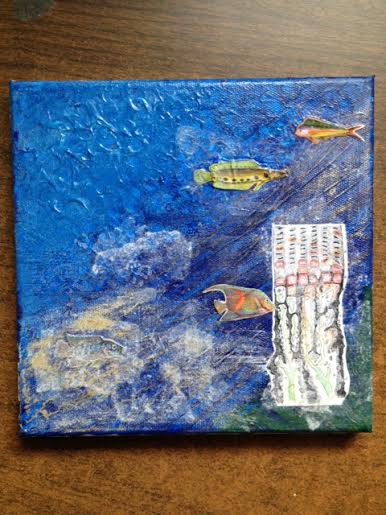
I was painting the background for a space picture. This alone is a new thing for me. I’m trying to learn that it is OK to work on a project over the course of time. I’m trying to learn to do things in stages. I don’t have to do the whole thing at once.

I’m not sure where I got the idea that I had to finish a painting all at once. I have wirework projects that I can’t finish all at once. The work is too hard on my hands and wrists to complete it in one day. There are certainly beading projects that are sitting in plastic bags in bins right now, half finished. I may never finish them.

Perhaps part of it is that acrylic paint can’t be worked with once it is dry, and it dries very fast. Beads don’t care. With beads, I can take the whole thing apart and redo it as many times as I want. Paint isn’t forgiving like that.

But I keep reading about image transfer and collage, and I keep thinking it is cool. I’ve got all the materials I need (I think) and I’ve read quite a number of books about it. I still don’t think I know what I am doing, so I haven’t tried. But I’m trying to convince myself that if I don’t try, it is worse than trying and failing. Not using art supplies for fear that I’ll mess them up is worse than using them and not getting what I was aiming for. At least when I use them, I’m learning how to use them, and I’m learning what works and what doesn’t.

All the image transfer and collage techniques are multi-day projects. You have to paint the background, and let it dry a day. Then you paint a layer of clear glue on it. And let it dry a day. Then put something else on. And let it dry a day. You get the idea. Lots of waiting. Lots of days.

Part of my issue is that I want results now. I’m trying to get over that. I’m trying to use these kinds of projects to get over that. I always have “quick” projects to give me that “I made something” buzz, in the meantime.

So, back to the painting. I needed a black background, but I didn’t want to use black. That is too easy. So I used a really dark grey called Paynes Grey, and a really dark purple called Dioxazine Violet (Hue). I squirted some of each on the canvas and swirled them around and together. I really like the color I got. It isn’t traditionally black, but it is plenty dark. I figure space isn’t black, but more purple/grey, if it had to have a color.

In reality, I figure it is the absence of light, and that doesn’t have a color at all.

But then I didn’t like the lines in it. Because I use my fingers to paint, there were large lines in it. No matter how I swished and flicked my fingers, the lines were still there. I don’t want lines, because they will draw attention to themselves. This is a background. Backgrounds are supposed to stay in the back, right? They are the supporting role, not the main character.

So I started “writing”. I have a friend who does “light language”- which is really the gift of tongues. It can be done with the voice or with writing. Her coming out about it has reminded me of the fact that I’ve done this for years. I stopped doing it because it felt silly. I got really self conscious of it and stopped. I never showed anybody what I was doing. I guess there was some shame in it, because I felt like an oddball.

You aren’t weird if there are other people who do the same thing, though.

So I’ve started doing it again, intentionally. I’m letting the Holy Spirit work through me in this new/old way, and it is really freeing. I’m still really aware how unusual it is so I don’t do it all the time. I’m mindful of my audience.

I don’t think I’ll ever forget that a minister told me to stop talking about how God was talking to me, was waking me up at night to give me messages. A minister, telling me to stop talking about God. In church. To church members. Isn’t that the place where people who have those kinds of experiences go? Isn’t that the place where people seek to have those kinds of experiences? Isn’t that the place where people read about other people in the Bible having those experiences?

I’m glad I chose to leave that church rather than to be silent.

So when I started to write on this painting, I learned something. I didn’t write down or record my experience. I spoke the words out loud and “wrote” them in my light language shorthand. When I write this way, I write left to right, then right to left. I kind of make an S across the page, going back and forth, until I am done.

Here is what I remember of it:

Under the sea, and deep in space, it is very dark. The darkness is vast and silent.

There is potential in darkness.

Babies grow in darkness.

The seed is the same way, swelling, stretching.

And God is there in the darkness.

This reminds me of Jeremiah 1:5 “Before I formed you in the womb I knew you, before you were born I set you apart; I appointed you as a prophet to the nations.”

Which then leads to Psalm 139-12-16
…even the darkness is not dark to You.
The night shines like the day;
darkness and light are alike to You.
13 For it was You who created my inward parts;
You knit me together in my mother’s womb.
14 I will praise You
because I have been remarkably and wonderfully made.
Your works are wonderful,
and I know this very well.
15 My bones were not hidden from You
when I was made in secret,
when I was formed in the depths of the earth.
16 Your eyes saw me when I was formless;
all my days were written in Your book and planned
before a single one of them began.

I was afraid of darkness when I started this project, and now I am at peace. I’ve gotten the message that God is there, at work, even if I can’t see it. I’ve gotten the message that God has a plan for my life.

Then this leads me to Jeremiah 29:11-13
11 For I know the plans I have for you”—this is the LORD’s declaration—“plans for your welfare, not for disaster, to give you a future and a hope. 12 You will call to Me and come and pray to Me, and I will listen to you. 13 You will seek Me and find Me when you search for Me with all your heart.

What an amazing message to come from just painting the background to a piece that I don’t even know what it is going to be.

Thanks be to God.

seed

An apple seed, sprouting.

Once more with feeling…

I’ve finally gotten over the idea that I can’t repeat myself when I write. I found that I was bringing up the same examples, the same stories. I really wrestled with this, feeling that I should go back and rework what I had already written, to update it perhaps.

But sometimes it is good to just write, let it go, and move on. If I go back and rewrite pieces, I feel like I’m not moving forwards. And sometimes what I wrote wasn’t immature, necessarily. It was my viewpoint, from that day, at that time. On another day I’ll want to talk about the same topic, from a different perspective.

Beads have helped me with this. Here are two different necklaces, using the same main beads.

bead combo

themes

In neither was I able to “say” what I wanted to express when I got the beads. I’ve come to realize that is normal. When the beads are jumbled together in the store or in bins, they spark ideas in my head. But when they have to be put together in a line, such as when they are in a necklace, they just don’t come out the same way as they are in my head.

But here’s the thing – what came out looks good, and nobody knows what I had in my head anyway. The only unhappy person is me.

Now – what I do with that feeling is what matters. It could cause me to stop creating. Or, it can cause me to create more, to try to get across what I was trying to “say”. Or, it can cause me to totally reinvent how I use beads. That too might happen.

I’m looking at incorporating beads and paint and collage. Essentially going 3-D with 2-D stuff. While beads are three dimensional, they aren’t in a way. They lay flat on the body, and you only look at them from one side. Going multi-stranded helps – you have colors and textures “rubbing” up against each other from west and east, rather than just north and south. But wrapping around, and under, and through? That is 3-D, and engages the viewer. The viewer can’t see all that is there in one glance, and will never see the entire piece at once. It is constantly presenting new viewpoints and things to discover.

Is that where I am is going? Maybe. I currently don’t have the skills for that. Yet. But that is part of art too. I think part of what makes an artist is a constant low-level feeling of dissatisfaction. If you are happy with things as they are, you don’t need to create.

Necessity is the mother of invention.

But unhappiness is the mother of art.

It doesn’t mean that I’m depressed. How about unhappy, in the sense of dissatisfied? Or feeling like something is missing? That sense is what drives me to create.

It is funny that creating itself, whether music, painting, collage, writing, beading – can lead to unhappiness. I keep feeling like I almost have it, that it is close, but no cigar. But I’m learning how to be OK with that feeling, and use it to create more. I’m learning how to use my tools and get better at what I do. I’m learning to be patient with the process.

When I first started writing, it could take me five hours to get across what I felt I was trying to say. I feel like I’m much more efficient now. And I’ve learned that with anything I do, the “message” may not come across with the medium. No matter how much work I put into it, the audience may not get what I was trying to give them.

That is OK too. I’m learning that just creating is the goal. I’m learning to just let go, and let God work through me, and in me. I learn when I create. The creations aren’t the goal. It is what I learn while I’m making them. If I can sell them to get more materials to create more things, all the better.

What do you say I am?

Recently I have been asked if I was a minister or a teacher. This was in two different settings, but it was close enough together that I decided to start thinking about it.

In both situations I kind of hedged. I didn’t really say no, and I didn’t really say yes. I am both, in a way. I’m both at the same time, but not officially.

But what makes one official? The paperwork? A ceremony? Does training count? What kind? Or is it simply if you do the work, you are the worker?

For three years, I’ve tutored kindergartners who have learning disabilities or have English as a second language. Before that, I did the same in college for years. I’ve taught classes on various subjects in the medieval reenactment group I was in. I’ve taught classes at my old church. In all these situations, what qualifies me is that I do the work. I just know how, and I do it.

I’ve taken classes in Pastoral care, in the Circle process, and been in the discernment process to be a deacon. I’ve read many books on how to be a minister and how to bridge cultures and styles. I’ve gotten certified as a minister online so I can legally perform weddings for people who are not affiliated with a religious community. In this, what qualifies me is the training.

To me, part of being a minister or a teacher is not that I think I’m better than those that I minister to or teach. It is that I feel it is my blessing to help them remember their own power. It isn’t about “lording” over people. It is about leading them back to themselves.

My goal in both being a minister or a teacher is to help build bridges. I’m a facilitator, a translator. I find out what is preventing them from being able to fully be themselves, and I find a workaround. Perhaps there is some prayer form that they don’t know about. Perhaps they would enjoy painting more than beading. I try to find the best fit for the person.

When people ask me if I’m a minister or a teacher, perhaps I should ask them “What do you say I am?” like Jesus did. Jesus didn’t tell anybody what he was. He just did the work – with no training and no certification. He was all about just getting in there and doing it. He wasn’t ordained, and he didn’t ordain anybody. He was actually against the idea of giving over your power to authority figures.

Perhaps if people on their own are asking me if I’m a minister or a teacher, I am. If they see me that way, then I must be that way, right?

But I’m not a minister or a teacher in the way they think I am. I don’t want them to then think that I have some authority or power over them. It is the exact opposite. I’m here to help them find themselves. I’m here to help remove stumbling blocks. I’m more of a facilitator – I make it easier. In a way, I’m more like a cheerleader than a coach.

The value of women – on clothing

Our value as women is based on our relationship with other people and not on our own merits as human beings. We are seen as someone’s daughter, or mother, or wife. We are sold the idea that if we don’t get married and have a family, we are nothing as human beings.

Thus, part of our value as women is based on our ability to attract men. Part of that value is set on how we dress. We are supposed to dress in a way that is seen as attractive to other people, but especially to men.

Now, if we dress in a very modest fashion we are seen as frumpy. We perhaps even seen as being lesbians. There’s very little middle ground in what is allowed for how we dress. It is either too attractive, or not attractive enough.

But the worst part is when we dress “too attractively” and a man attacks.

Part of the mark of a well-trained dog is that you can put a snack or a treat in front of it and it doesn’t lunge for it. Perhaps that is the problem. We have men who are not well-trained. We have men who if they see a woman who is attractively dressed (which she has to be in order to be a woman in our society) they will become like dogs.

They will grope her.
They will catcall her.
They will wolf-whistle to her.
They will attack her.
They will rape her.

The problem is not how women dress. The problem is how men act. The problem is that men are acting like dogs and not like human beings. In this situation, the only thing that makes men and animals different is the training.

Now, not all men act like dogs. But enough do that women have to be mindful of themselves at all times. Enough do that we have to think about what we wear and how we wear it so that we don’t “cause” a man to attack us.

If a man is exercising self-control, a woman can be wearing anything – or nothing – and he won’t attack her.

But – women are told they have to attract a man. We have to dress attractively in order to get a wedding dress. But – if we dress too attractively, it is our fault if we get raped.

All of this is wrong. All of it.

Women are people, first and foremost, and should not be told they have to get married. Women should be supported in becoming a human being first, and a wife second, if at all. Our value as members of society should not hinge on if we can marry or not.

Then, we should be allowed to dress however we want, without fear that we will get unwanted attention because of how we dress.

Let’s look at it this way –

It is not the fault of the homeowner if her house gets robbed. The fact that the door didn’t have fourteen latches on it and a home alarm doesn’t matter. It is the fault of the robber, who went to her home with the intent to break in.

The only problem is that women are encouraged to carefully landscape their yards for “curb appeal” – or “curve appeal” if you will. We are encouraged to make our houses – our bodies – look attractive and appealing. We are taught to be like the bower birds, who build a nest to attract a mate. The one with the most attractive nest gets a mate – and thus gets to pass on his genetics.

But if we are too attractive – we get attacked. So it is our fault. We can’t win.

Time to stop playing the game.

Gender violence and gender harmony

This is about gender violence, specifically it is about violence against women performed by men. Yes I know that there are women who attack men. Yes, there are women who attack women, and men who attack men. This is not about that.

This is about the fact that there are way more women who are being attacked by men just because they are women. Just because they are seen as lesser. I speak about what I know. You always have to write from what you know and what you experience.

Simply being a woman is seen as lesser. We are seen as the weaker sex. We are not encouraged to do anything that is rough-and-tumble. We are not encouraged to do anything outside of our proscribed gender roles. When a woman does anything that is seen as traditionally masculine she is seen as is as butch. When a man does anything that is seen as feminine he is seen as effeminate and is considered to be weaker.

This is a shame. It is not fair for men to not be allowed to be who they are. It is not fair for women to not be allowed to be who they are. There is nothing specific about our genders that make us better able to wash dishes or better able to pay bills. There is nothing specific about our genders that make it logical that one is supposed to be nurturing and caring and the other one is supposed to be hard and aggressive.

Everyone can take care of the house and everyone can take care of the children. It is important that everyone knows everyone’s roles. The role has nothing to do with gender but with ability. And ability comes from education, not gender.

It is important that young boys learn how to cook and darn their own socks. It is important that women know how to balance a checkbook and how to do house and car repairs. It is important that everybody learns how to take care of themselves completely and fully.

If we only know half of our tasks that we are half people.

Perhaps this is why women and men think they have to get married. They think they have to have someone else to take care of them instead of being able to take care of themselves. Imagine how strong marriages would be if both people are independent and strong, so both together make something even stronger.

This is the source of healing. This is the source of peace. We have to stop being women and men. We have to start being people.

Suppressed pain – rethinking domestic assault.

When I slipped a disc in my back, I was in extreme pain for a while. Then I got used to it. When I went to the chiropractor the next day, he tested my blood pressure while I was sitting and when I was standing. It was not different, and it was supposed to be. He told me that was a sign of stress caused by the pain. I wasn’t hurting much, but I did feel a little weird. I now know that feeling was from suppressed pain.

I hear that if you are going to boil a live lobster, it is kindest to do it slowly. Put the lobster in the pot and raise the heat gradually until it just goes to sleep. This is less traumatic than putting it in a boiling pot.

Bad smells become normal after a while. Constant loud sounds do too. After a while you can get used to anything, even if it is dangerous for you.

I’ve been a lobster for a long time. I’ve been in pain for a long time. I’ve been around bad smells and loud noises for longer than is healthy. I’d gotten used to it.

I’m not talking about these things in the literal sense.

I have been the victim of a culture that puts women last. I have been the victim of a culture that tells me and every other woman that our value derives from how we look, how we act, and how we related to men. I have been a victim of abuse from family and boyfriends and strangers. People I thought I could trust have harmed me, with the full approval of a society that says if a woman is harmed, she must have done something to deserve it.

As if men can’t control themselves.
As if men are basically animals.

I didn’t even realize I had been raped by a boyfriend until recently. I thought it was my fault, a misunderstanding. We were dating, but we hadn’t had sex. We’d talked about it, but we hadn’t agreed to it. We were kissing each other and fooling around one minute, and then he had entered me the next.

I thought it was my fault. I shouldn’t have led him on. I shouldn’t have let the situation get that far advanced. Right? That is what I’ve been told by our society.

And now I know. Sex without the consent of both people is rape. Even if both people are dating. Even if both have had sex with each other before.

Every single time it must be clearly mutual, or it is rape.

And it isn’t the woman’s fault. That is the definition of codependency. Nobody is responsible for another person’s feelings or actions. They are. A woman didn’t “make” a man do anything. He chose to. This is true for rape and domestic assault.

If a boundary is violated – whether it is being smacked around or raped – it doesn’t matter who does it. It is still an attack, and it is still the fault of the person who did the attack. The victim is not ever to blame.

We have to change our mindsets. We have to start thinking of violence between people who are supposed to be in a loving relationship as simply the same as violence between strangers.

Approaching a dog – social conventions on physical space.

When you come across a dog, you don’t know whether it is going to bite you or not. So the safest thing to do is to crouch down and appear nonthreatening. You put out your hand, palm down, in the form of a fist. This way your fingers are not exposed. That way the dog can come up to you on its own terms and in its own time and decide if you are safe. It is up to the dog to determine whether you get to touch it or not.

The same is true of people. There are number of people, myself included, who have problems with physical space. I was abused as a child in multiple ways, and I only started learning about boundaries in my 40s.

Because of my past, I have problems with physically being around people. I am very uncomfortable with people coming up and randomly touching me. This is true even if it is someone I know very well, even if it is my husband. If he and I are alone together in the house he can still startle me with touch. If I have my back to him, such as when I’m doing the dishes or I am working at the computer, and he comes up to me to touches me or give me a hug, it frightens me. I have told him repeatedly to give me a warning because it because it makes me scared. He doesn’t quite seem to get it. It is foreign to him.

We have a family friend who has a young son who does not understand boundaries. He is like a bouncy puppy. He is a little overwhelming to me, and it turns out, to many others. As soon as I walk in the door at their house he opens his arms and walks into me for a hug. If we are walking outside, he will come up beside me and throw his arm around me. It is very startling. We haven’t been visiting with this family for very long, so there isn’t a history between him and me. Essentially, I haven’t given him permission to touch me.

He has very few friends his age, and has expressed difficulty making female friends. He is very socially backwards in many ways, and his parents have noticed this but are unaware what to do about it. His mother is very forward and direct like him. She does not seem to understand that not everyone is, so she does not know to teach her son how to “read” whether it is safe to be forward and direct with them.

I’m of course older than the middle-school girls this boy deals with, and even I didn’t know why I feel so uncomfortable around him. If I don’t know, then they certainly don’t know. I can suppress my feelings for the sake of not embarrassing him, but they don’t hold their punches. He’s becoming more and more socially backwards.

It was so uncomfortable that for a while my husband and I considered only visiting with them when he was not there. We have finally realized that God has put this child in our path for a reason, and that we are to be like surrogate parents to him. I still don’t know what to say, or how to say it, but I’m trusting that the Holy Spirit will give me the words, as Jesus promised his disciples.

I really don’t want to embarrass him by telling him how uncomfortable his behavior is to me and many other people. But I do feel that he wants to get along, and wants to know how to “play” the social game. It has rules that sometimes aren’t easy to learn.

One thing I learned when I was working with college students with learning disabilities was that sometimes dyslexia isn’t just about words. Some students with LD have a problem “reading” people and feelings as well. The social rules that we all take for granted are very hard for them as they don’t pick up on nuances at all. They become further and further isolated from the rest of their peers because of this.

I don’t want him to feel isolated, because that is a recipe for another school shooter.

Poem – homeless, helpless?

Is being homeless a bad thing?
Like night, like winter
Perhaps it is a phase
A pause.

And then what if we got homes
For all the homeless,
what then?
Do we tackle
drug abuse,
prostitution,
morbid obesity?

How many different ways
can we harm ourselves?

Jesus says that the poor
will always be with us.
But he also says that
whatever
we do to the least of these
we do to Him.

So what do we do?
Do we help?
And if so, how?

Is helping really helping
or is it weakening?
If you carry someone
then they don’t learn how to walk
On their own.