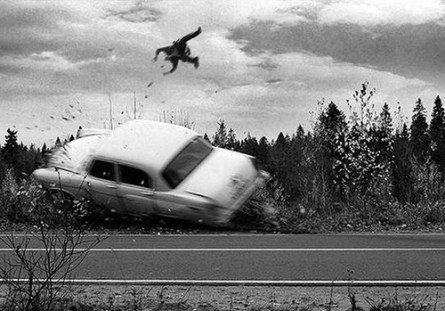
The Camera

This was the first picture she took with her new camera. Well, it was new to her and that was good enough. She found it at a pawnshop over on 9th Street, the street of lost chances and dead ends. Nobody went to live on that street if they could avoid it. But sometimes she went there to browse the pawnshop and see what she could find. There was always something there that she could find room for in her house. But that day she didn’t go to browse. She had decided she needed a camera, and the older the better. She didn’t want anything digital. She didn’t want her tools to be smarter than her. Sure, she had a smart phone that could take pictures, but she wanted something slower. Haste makes waste, after all, and being able to take a thousand pictures a day certainly created some bad shots. No, a roll of 24 shots was right up her alley.

She’d gotten into the mindfulness trend and decided her new hobby was going to be photography. Not that silly point and shoot business, but actually composing photos like you’d compose a sonata or sonnet. She wanted real pictures, with heart and soul.

But she ended up with pictures that were dark. They had soul, but it was of a dangerous bent. The camera never seemed to work when she tried to take a photo of a flower, or a child, or a puppy. Only when something tragic or scary happened would the shutter release, and she had no control over when that would happen.

It wasn’t like she pointed the camera at that car accident. She tried to frame a shot of the roadside flowers. The shutter clicked, or so she thought. She stood up and then the car came around the bend, going 90 to nothing. It hit a pothole in the road and flipped. The passenger flew out, arms flailing and then, the camera, slung on a lanyard around her neck, took the photo.

She didn’t know until she got the film back two weeks later in the mail. She’d spent the whole weekend taking photographs and none of them came out. Or rather – all of them came out perfectly – they just weren’t the photos she’d taken. The camera had taken them all. All weird. All strange. All disturbing. She noticed all the strange things that were happening that weekend she chose to learn how to use her camera. But she’d not focused on them. Who would point their camera at that? A decapitated doll. A strangled snake. And worse.

She was here to share joy with the world, and her camera seemed bent on showing junk.

She took the camera back to the pawn shop. Maybe she could trade it for another? There were no other cameras there that day, and the clerk mutely pointed at the “no refunds” sign written in 48 point font taped to the cash register. But he did offer her the name of the person who had brought it in. This was against policy, of course, but she was a regular and so patient with him so he decided to make an exception as a way to appease her.

Now she had a name. Perhaps this had happened to the last owner. Worse – perhaps the last owner had done something to make this happen. She did a little research. It didn’t take long to make contact. He owned a tea shop just four blocks away, on the other side of the tracks.

She decided to swing by to see what he looked like. Maybe she could get a feel for what kind of person he was. If he looked scary she would just leave. But he didn’t. He looked normal. So she approached him and asked if they could talk. He was used to this. People were forever coming up to him to talk about what was going on in their lives while he was at work – mostly what was going wrong. He often used to say that he should have been a priest or a bartender instead of owning a tea shop. He heard a lot of dark secrets and confessions.

She asked him about the camera. Yes, he recognized it as is. He’d pawned it because he’d gotten a digital camera and didn’t need this one anymore. No, he didn’t recall it taking strange pictures. He said he’d not used it in years, having stored away at his desk. It was the same desk where he made art every day after work. Every day his customers would pour out their problems, like buckets of rocks, into his head. It weighed him down. So he’d pour out all that misery into his artwork. It left him clear to start fresh the next day. It was how he survived. It was how he stayed sane.

They realized that the camera must have picked up some of that strangeness. It had taken up the same skewed perspective of the world as all those people who had unloaded on him. Now the camera, like the people, chose to see only ugliness and deformity.

Soul Cave

A refreshing wave of cool, even sweet air filled her longs. A welcome respite from the oppressive heat outside. And yet, she wasn’t in a cave at all. It was a church, but it wasn’t a building. It was carved out from living rock, a sanctuary in stone.

And yet, it wasn’t. She was at work. From the outside all was the same as it has always been. It was inside that was different. She had done the work, using a spiritual pick-ax to hew out the limestone of her soul, removing the rubble handful by handful. It was the only way. There were no shortcuts with this work. It was slow going, but the other option was not at all. Only by doing this slow private work could anyone attain sanctuary. It couldn’t be found outside, not among the liars and charlatans, the shell games and shysters. Everybody who tried to sell others on their brand of salvation was a false Messiah, no matter how well intentioned.

She was lucky her stone was limestone. Some started with quartz, or marble, or even diamond. Too hard a core was very hard work. Most stopped too soon, barely making an alcove, barely enough to lean in from the rains. Homeless people sleeping in doorways had it better.

Yet others had caves of softer stuff – coal, or even chalk. Softer rock was certainly easier to work, but you ran the risk of the entire structure collapsing in on you. You had to plan ahead, taking out only some, not too much. You had to leave supports, like how stalactites met stalagmites. The best starting material was something strong yet also pliable.

Her soul rock used to be of denser stuff, but living water had softened it.

She thought back to that day when she had finally given up, finally relinquished her vain attempt at controlling her life and the actions of others around her. She gave over control to the still small voice she heard inside her, the voice that was breathed into every person when they were born.

Along with that breath, the first breath, was the quiet voice of the Creator. Outsiders (those who saw only the outside) thought that the child took her first breath, like it was something active, like it was something she did. Insiders knew that God breathed life into everyone, not just Adam. Every single person alive had been jump-started by God. This is why smoking was bad – it polluted that divine gift. This is why carefully regulating your breath was good – you were reconnecting with that gift. In rhythmically breathing in and out, you fell into God’s rhythm, God‘s embrace. You were calm because you had put your trust in the only One who had all the answers – even to questions that hadn’t been asked yet.

She sat inside her cave, just big enough for her, and looked out at the world. From here the light wasn’t so bright, the sounds weren’t so loud. She could experience it all with detachment, not anxiety.

Get with the Program

The asylum was a home to ghosts now. But then again, it always had been. Only back then it was the other kind. Back then the ghosts were bodies without a spirit, instead of the other way around. Or sometimes it was a body with more than one, or the wrong one – one that hadn’t come with the original owner.

People didn’t understand that bodies were a bit like houses. Sometimes they were unoccupied. Sometimes there was a new tenant. And sometimes there were squatters – people who snuck in and never left.

But the asylum’s founders never saw it that way. They saw it as a character flaw that people were less than stable. They were running a warehouse, not a hospital. It was more like a prison than a sanatorium. Nobody got sane there. In many cases they went even further down that rabbit hole. Sometimes so far they never came back.

That all changed when the new Program started. It was small at first – privately funded by a few far-sighted citizens and understanding congregations. It never wanted to take government money. Government money meant government meddling, and that meant nothing ever got done.

The Program’s motto was “Get with the Program” and they didn’t advertise or recruit. People found them through word-of-mouth. People who had gotten their lives back told friends they thought were ready for it. It was private, but not secret. But it was free to the people who needed it. Healing shouldn’t cost money. That cheapens it. But there was a cost. The clients (never patients) had to clean and cook. They were supervised and assisted but they had to do the work. Idle hands meant idle spirits, and the goal of the Program was to re-integrate body and mind. They did this by making the clients participate in their own recovery. They truly healed themselves – and more importantly they were taught how to keep that momentum going once they left.

They weren’t out on their own after the Program. There were weekly meetings to attend as graduates, to remind themselves of how far they had come and the path that led to life. All too often people forgot how they got well and so got sick again, entropy being what it is at all.

The natural way of life leads to decay. The founders of the Program knew that. They taught their clients a series of steps to do daily maintenance on their souls and bodies, just like with a car or house. This was their secret. It wasn’t pills or talk therapy that did the trick, but they were included too. It was more like occupational therapy than psychotherapy, with the occupation being living your life.

For some people, just being alive was work, and hard work at that. The daily tasks of self-care didn’t come easy to them, or they never learned them. So they struggled with tasks that everyone else did unconsciously. Or they did them for a little while – a week, or a month, or even a year – and then forgot, or assumed their stability was normal, forgetting the incredible framework they had to build all the time in order to prop themselves up and avoid collapse.

They were taught that sanity isn’t like taking penicillin. You don’t follow this prescription for eleven days and then stop. It requires daily work to keep away the decay in body and mind, the decay that leads to death. Maybe it isn’t an actual death, but a sort of living death, a half life. Maybe it is a zombie kind of life, one where you go through the motions, never really here.

The goal of the Program was life, full stop. A true integration into reality, an active participation. It included classes in mindfulness, gratitude, and forgiveness. It taught cooking and how to navigate grocery stores. It taught how to budget money, time and energy. It taught how to express feelings verbally and through art. It taught self-sufficiency and interdependence. And it did it all out of love.

Eventually, the building closed, because this new way of living became part of the community’s way of life.  Everyone followed the Program.  It became normal to take care of bodies and souls together, to not see them as separate, or as opposed to each other. It became normal to be healthy in body, mind, and spirit.  They kept the old building as a reminder of how far they had come, and as a warning to not go back.

(Written mid-July 2018, updated February 2, 2019)

Voyage – poem

My ancestors brought me here 
in boats, in planes, in their bodies.
They walked across the land 
that we now know as Spain
that we now know as France
they swam across the channel 
and they landed in Ireland and England. 
I am an immigrant too. 
I came with them,
invisible, hidden
within their bodies.
However they got here I came with them 
as a promise 
as a secret. 
However they came here 
I hitched a ride 
inside them. 

They had no way of knowing 
I was there. 
Or maybe they did. 
Maybe they hoped beyond hope 
that their dreams would
continue and their struggles
would be worth it. 

It is hard living up to the
expectations of people
you’ve never met, 
will only meet 
on the other side of eternity.
But they too had that same difficulty. 
How many people before me look through these 
blue eyes at this blue world
and wonder 
where to go next? 
How many people before me questioned 
should we go on 
or are we finally here?

How will I know 
when I have arrived? 
How will I know when it is time to settle down and
stop traveling? 
How will I know 
when I have reached the end 
of the race and I have
become the fulfillment
of all their dreams?

The fairytale that is called America – poem

They took all the people, 
all the ones who were huddled and tired and yearning, 
and they put them in 
low-income housing. 
They put them in a box
away from services 
away from bus lines 
away from any help 
any chance. 
They said they were doing it to help them 
otherwise 
they’d be on the street.
They put them in a box, smaller than a grave
smaller than their hopes and dreams 
of a second chance 
of a new life 
in the fairytale 
that is called 
America.

Karma was rising

They took it all. The chairs, the tables, the books. They took it all and burned it for their fires to keep warm, the fires to cook their food.

We gave them the abandoned school to use, to live in. We had outgrown it, moved to a modern two-story all the amenities modern construction building five years earlier. We left this one, this building which had served us for decades, left it alone and abandoned. We were moving on and had no time for dealing with the past.

Until they came. The huddled masses yearning to breathe free. They came slowly, quietly, but surely. They came and had no place to stay, so alone and abandoned by other people, their country. They walked here, step by bloody step, first the men alone and then whole families. They left all that they knew for the promised land, a land flowing with food and jobs and peace. None of these were to be had anymore where they came from. Illiterate, impoverished, they came, hoping for a better life for their children.

Little did they know the well of compassion had dried up, and the Christians were the ones who were the most against them. They forgotten the miracle of the loaves and fishes, done twice for emphasis. The Lord showed them in their holy book how to do it. Take what you have, give thanks to God for it, break it, and give it away. There is always not only enough, but more. But the town had succombed to another God, the one of capitalism, the one that looks like greed, with the color of money and the sheen of credit cards.

That god was the god of poverty, but they didn’t know it. That god promised wealth through hoarding, through fear. Their Bible wasn’t the King James but the prosperity gospel. They forgot the stories of 40 years in the desert, trusting in the real God to provide for them day by day. Instead they thought they were to provide for themselves, saving and hoarding and prepping. They no longer trusted in God but in themselves. Their 401Ks – their pensions – their IRAs became their gods, the things that would take care of them. They forgot the story of the rich man who built the new barn to hoard all of his grain only to die in the night.

So they, in their mean charity, gave the visitors the old school, the one with the rusty plumbing, broken toilets, the lead paint. They gave them nothing of value, just their discards, just their trash. They gave them what they thought they deserved, treated them how they saw them – as discards, as trash. They forgot that you should entertain strangers as if they are angels, because you never know. They forgot that their Lord was a refugee once, fleeing from a tyrant who wanted to kill them. They forgot their own country was founded by people fleeing oppression, who sought a better life. Their own country, where they forced their way in by killing those who were already there.

Maybe that was their fear, that the chickens had finally come home to roost, that the check was finally due. After nearly 400 years of segregating and dominating the indigenous population, Karma was rising, demanding balance to be resumed.

(written 6-20-18)

All open

Door after door after door. All open. There were no barriers before her. She couldn’t get lost if she stayed going straight – no turning to the left or right. Have courage! She reminded herself that as long as she trusts in the Lord and asks (and listens) she will know where to go (and when and how).

Maybe the community will happen after she dies. Maybe all her work and writings will be used to build something later. Maybe she doesn’t have to make it happen herself. But maybe – that pause in her momentum was the plan of the Adversary, who wants to keep her from working.

On and on and on with no end. No obstacles. Not even illness or death. The promise of no illness, of not even her shoes wearing out – – – she claims that. 40 years in the desert is nothing, so 27 until retirement? Easy. If we follow God. Who takes care of us? God or our pension /401(k) / savings account?

All will be provided. We can’t see what is in those rooms ahead, but I know it is for our good. Treasures to use when and as they are needed, then walk on, leaving them. Don’t carry anything. With hands full, we cannot receive new blessings. The delight is in the receiving, after all.

(Early June 2018)

I’m not that fish – poem

People keep showing
their ugly side
their needy side
the side that says
they think they are
no good
broken
worthless
hopeless
and it is
exhausting
to swim
against that stream
to be stronger
emotionally spiritually
to say
I know (you think) you are
but what am I
around you?

So much, so often
people are addicted
to feeling bad,
they’ve heard the message
saying
you aren’t enough
unless you
until you
fill in the blank
and they’ve swallowed it
hook line and anchor
and it drags them
along the bottom
in the muck
and the discarded waste
of our throwaway
culture that says
you aren’t enough
even if
you
fill in the blank
because
you are a blank.

They’ve eaten the
bait and are
getting reeled in.

But I’m not that fish
not ready to be caught
filleted open
gutted.

(Early June 2018)

Respect – poem

Aretha taught people how to respect her,
spelled it out so they could understand.
How can someone respect you
if they don’t know what respect is?
Sure, they might know the word,
but they don’t know what it really
looks like, or feels like.

What does respect mean to you?
A letter of thanks, handwritten.
An invitation to a party.
A gift given just because
and not because it is expected.
Respect is a form of love
you can show anyone
and should show everyone.
It isn’t flirting, or dating.
But it is kindness, consideration,
seeing them
as equal as
and as worthy as
you are.

If they don’t give you respect,
perhaps it is because they
have never been given it themselves.
How can they give away
what they don’t have?
Perhaps it is up to you
to teach them respect
by showing it to them
first.

This woman is an island

The room was dark and damp. A faint smell of mildew tickled her nose, caused her to remember that her inhaler was at home. She hadn’t needed it the last several urban adventures and she didn’t want to need it now. She vowed to be careful, to breathe shallowly. It wouldn’t do to have an asthma attack here.

Urban exploring had become her secret passion. Early in the morning, at least an hour before the sun came up, she was out walking across deserted fields to abandoned buildings, her car parked a mile away to avoid attention. She was always back home in time to wash up before going to work. Nobody knew this was how she spent her time. Nobody would have suspected, and this was how she preferred it. Left alone, a silent life, away from the masses who didn’t think, who let their computers think for them.

This was her version of a video game – places to explore, rooms to discover. Who needs virtual reality when actual reality was so much better? Of course, this reality came with real dangers – loose flooring, rusty nails. You could land a trip to the hospital, or the jail, or the morgue.

She wandered alone. Plausible deniability. Nobody could rat her out if they didn’t know. Nobody had to lie for her. She was on her own for everyone’s benefit. She preferred not having to make arrangements to meet or what to bring to the site. If she didn’t have something or was late, it was her fault. She’d rather not have to be mad at anybody for letting her down.

She thought back to her family, her friends. They all had failed her. They all had lied, intentionally or not. She was done with it. Maybe it was true that no man is an island, but this woman was.

To everyone she was a girl, but she knew better. They called her a girl to keep her small, to take away her power. Maybe even to keep her from ever getting power in the first place. What they didn’t know wouldn’t hurt them.

She lived two lives, the public one and the private one. Maybe it was more than that. Her life was divided at home too – the life her husband saw, and the one she lived when he wasn’t around.

When she first got married she would cry when he had to leave – to work for the day, or away for the weekend on a project. But that was when she wasn’t sober. She feared sobriety at the time – that it would mean she’d feel too much, too often. How would she function?

But now she was sober, she’d learned how to feel and move and be alive multi-dimensionally. All those who looked down their noses, those who thought themselves as sober because they didn’t do drugs, they were fooling themselves. It was like people who weighed 200 pounds thinking they weren’t obese because that was normal, even svelte in comparison with others around them. Why change?

Over eating, over drinking – too much TV or social media, whatever. Fill in the blank – the thing they used to avoid life as it is was their drug. Legal or not, it is that which draws away from life, the path that leads to destruction, to being asleep.

Being awake was like riding a wave. So many changes, shifts. So hard, and yet so essential.

This skill was what she honed on her walks into unattended buildings. Fully present was the only option. Anything else meant death.

And death was the last thing she could afford right now.

She had 15 more years of time to do at work, 15 more years of wearing a mask, of faking it. It was still better than what others did. She couldn’t call them friends – more like acquaintances. They weren’t even friends of friends. Just people she knew. Maybe it was time to have better friends. But then again, why?

People thought she needed to read this book, watch this film, listen to that album. She never liked those things. It all felt fake, like they were just talking to themselves. Maybe they were. So maybe “you need to have friends” wasn’t for her, just like all of their other suggestions. Why force herself into their mold? The same people would turn their nose up to taking welfare but were OK with begging from friends to support their habits – namely not working a full-time job. Her take on it was that if you don’t work, you shouldn’t expect those who do to pay your way.

So her way was not their way. Yet she remembered – she used to be like them. It was grace that knocked her out of that groove, that horrible broken record. Perhaps the same grace would come to them. In the meantime, she stayed away from them. She had to. Their ways drew her back into bad habits and new ones. She tried to help them, fix them, and then realized that too was an addiction.

So here she was, alone in an abandoned warehouse. The more she thought about it, it seemed apropos. The building had housed a thriving industry, hundreds of people had worked here, made their lives here. And now it was crumbling away. Now only thrill seekers and transients came here. Perhaps she was a little of both, prowling around these dusty rooms with their peeling paint. Perhaps she too was near the end, but of what? Did the workers here know they’d never get a pension because this “sure thing” wasn’t?

So how had it come to be – for them and for her? How had the tried-and-true, the solid path, become unsure? How had their jobs ended? How had her life moved into one where she felt she had to put on a mask in front of everyone? Perhaps that sort of dishonesty, that lack of being truly present, as is, with no hedging and no apologies, is what finally closed down this business too.

She was going to have to watch her step, in more than one way. Being less than honest is a guaranteed way to get tripped up. And yet, there was this – she’d never lied. She just hadn’t revealed all of her truth. Was that being polite or politically correct? Who was she protecting with her silence? Them, or herself? Did it matter?

Soon it would be time to leave. Soon she would put on her uniform, put on her face for the world. Or maybe she wouldn’t this time. Maybe she’d just simply be herself, unedited. Could they handle it? Could she? The last time she was fully herself they thought she was sick, or crazy. Many’s the time that she did not fully put on her happy mask and the customers or her family accused her of being a bitch, or worse.

But she was tired of shoehorning her extra large personality into an extra small world. They were just going to have to make space for her. Maybe they’d be inspired to follow her example. Or maybe they’d try to commit her again.


(Started early June 2018
Completed late January 2019)