Fat shaming

There’s been a lot recently about how people who are overweight are tired of being picked on. They want to be left alone. I get that. I used to be obese. I wasn’t hot on the fact that I couldn’t easily find clothing that fit me. My first clue that I was larger than the average was when I realized I couldn’t buy underwear at Target. I didn’t think I was that big at a size 22. I thought I was fine.

There is a stigma to being overweight, certainly. There is such a stigma that we use euphemisms. Someone is heavy. Or portly. Or large. They aren’t ever fat or obese or even morbidly obese. We use euphemisms about everything we don’t want to deal with. Someone didn’t die. They passed on. They transitioned. They have left us.

Fat is the new normal. We Americans are so overweight that we don’t even recognize when we are fat. We think obese is 500 pounds. Yet there is still a stigma. There is still social pressure against fat people.

Don’t take it personally. People pick on anyone who is seen as different. Any deviation from the arbitrarily determined norm is seen as weak, and weakness is picked on. If you drink too much or smoke at all you’ll be picked on. If you don’t watch TV you’ll be picked on. If you vote the wrong way, dress the wrong way, talk the wrong way you’ll be picked on.

It isn’t personal. In fact, it is as impersonal as possible.

Society picks on people it deems as different because they see them as weak. It is the same as in the animal world. Baby birds that are seen as less than perfect are kicked out of the nest. Male lions eat their young for the same reason. It is to thin the herd to make it stronger. Weakness isn’t tolerated.

We’d like to think we aren’t animals, but we are. We are animals first and humans second. What makes us human is when we embrace differences and are welcoming to strangers. What makes us human is when we act with kindness and compassion. What makes us human is when we overcome our animal nature and work with each other instead of against each other.

Obesity is attacked because it is seen as a sign of weakness, specifically a lack of self control. It is seen as a sign of gluttony. At its heart it is seen as an addiction, even though few people would be aware enough to name it as such.

While it would be lovely if we could all be what we want to be and nobody got bullied for any reason, there is some good to fat shaming. If it encourages a person to get healthy, then it is great. If their response is to learn healthy coping methods, then it is awesome.

Sadly, this isn’t usually the case. Sadly, most people who use food to deal with their problems don’t suddenly learn new ways to be healthy in mind or spirit. Our society doesn’t teach that. It doesn’t teach self-care.

It teaches blame everybody else and don’t take responsibility for your actions. It teaches people to be a victim. It teaches instant everything. Don’t wait, don’t work for it. It teaches people to get lucky from playing the lottery rather than hard work.

People don’t need to lose weight for losing weight’s sake. They need to get healthy. People need to move more, eat better, and develop healthy ways of dealing with stress and anger. I’ve done it. It can be done. It isn’t easy. Anything worth having isn’t easy. Health is worth having. Learning to deal with problems other than stuffing them down is a valuable thing to know.

I remember where I was in my head four years ago before I started to get well. I remember thinking “how dare they tell me I’m fat” when I’d have to go to the “large” section of the store to buy clothes. I remember. And then I remember I went to the hospital with a racing heart, feeling sick. I remember always feeling out of sorts and out of shape. I remember just not feeling like I liked my body very much because it didn’t fit me very well.

I started moving. I found exercises I liked to do. I started eating better. I started loving myself enough to take care of myself.

I’m glad that society didn’t tell me that everything was fine for being so overweight. I’m glad, because if I’d kept going that way I’d be immobilized. My knees were giving out. My heart was weakening. I didn’t feel comfortable with the idea of even walking up and down my street. Crime wasn’t keeping me from leaving my house; fear of my body giving out was. Being fat was crippling me. Eating instead of facing my problems was crippling me too.

Poem – losing our hearts

Defense of the heart
may be the only way to
be whole.

Remember the time
when you
opened yourself up
so wide
that your heart
fell out?

Even though the
reason you did it
seemed good at the time,
even though the
person you did it for
seemed good at the time
you still got hurt.
You still lost your heart.

Anybody who is anybody knows
that being heartless
is worse than being
gutless.

Maybe
both are bad.
Maybe part of being
human is losing our hearts
and finding them again.

Poem – our tree lives

Life events are like rings
on a tree.
Death of your parents.
Graduation from college.
First house.
First car.

They are how we mark time.
They are how we know
we’ve arrived
or survived
or both.

They are how we define ourselves.

We say that this happened
after our grandmother died,
but before we moved
to our new home.

Each ring, each event
adds to us,
strengthens us,
makes us bigger,
and maybe stronger.

Each ring of a tree
is a year,
is a season.

Each ring of a tree
is enough to make it
thicker
more resistant
to the injustices
of insects
and fires.

Each ring is also that much
more armor
protecting its
tender heart.

Our rings define us
and limit us.
They say who we are
based on what has happened to us
or what we have done.

Passive and active,
we are shaped
and grown.

This soft spot is a place
that hasn’t healed.
Yet.
It may become a hole
a space
a void.

This branch is where we made a choice
to separate
to go our own way.

This burl is where we have grown around
and away from
a wound that never healed.

Burls make beautiful bowls
in the hands
of a woodsmith.

Holes make welcome homes for birds.

Branches are great for climbing
and for tree houses.

Our tree lives are ever growing and changing
And ever reaching upwards
While eternally rooting down
Into the past.

Twenty years gone.

It has been twenty years since my parents have died and I almost forgot. The thing that reminded me was a notice from AAA telling me it is time to renew my membership. I’d gotten it after my parents died because I realized I didn’t have anybody to call if I was stuck somewhere with a broken down car.

They died six weeks apart. Mom died first of lung cancer and then Dad died of a heart attack. Mom’s was an expected death, Dad’s wasn’t. It wasn’t a total surprise – he’d never taken care of himself. But I hadn’t prepared for it like we’d had to do with Mom’s.

I remember the first few years after they had died. Every year when the date for Mom’s death would come up I would dread it. I didn’t have to write it on the calendar to remember it. It would rise up, unwelcome. The memories of my loss would come to visit and stay with me like a crazy relative who overstays her welcome. Then, because my Dad died six weeks later, I’d be in a holding pattern. I’d feel like my life had been put on pause for all that time. Six weeks of feeling my feelings, of holding them and examining them. Six weeks of waiting.

What was I waiting for? It was like I was holding my breath until the day that Dad died would roll around. Somehow that day was the day that the strange double-grieving period was over in my head. It was time to start life again then. I was released.

This pattern went on for years. Sometimes I would meet up with a friend of my Mom’s on her death date. We would console each other over a beer and a burger, or a trip to a craft show. Sometimes I would do something in honor of Mom and Dad. I’d listen to their favorite music, or try a hobby that they liked. They were ways of trying to bring them back to me, if just for a little while. It helped.

But this year I’ve forgotten. This year I’ve found myself in the middle of their death days. This year nearly two weeks have passed since my Mom’s death day and I missed it. I figured that this year would be extra different because it was twenty years.

Every year it has gotten easier. I’ve heard there is a sort of half-life to grief. However long you knew the person, take that time and divide it by two. That length of time is the length of time you will grieve for that person. I’d known them for twenty-five years – so twenty years grieving is way past that time. By that reckoning I should be over it.

You aren’t ever over the death of your parents, or of anyone who meant something to you, who impacted your life. Their loss will always mean something. There is a hole that can’t ever be filled.

The hole does get smaller. It can’t ever completely go away, but it can get less like a gaping wound and more like a scar. It will never be perfect. You’ll always know it is there, but it won’t cripple you like it did.

Maybe this is why I felt the need to make lemon delights this weekend. Maybe in the back of my mind I did remember. This was my favorite dessert that my Mom would make. I’d ask for them for my birthday instead of cake.

A few years ago my mother-in-law tried to make them for me when we were visiting around my birthday. She didn’t have baking powder and used baking soda instead. They weren’t the same, but she got bonus points for trying to console me anyway. Even if she had made them exactly according to the recipe, they wouldn’t have been the same because she isn’t my Mom. Nobody can ever fill that spot. But her trying to soothe me was kind.

But somehow, this week, I got the hankering to make them. I’ve never made them before. I haven’t really cooked before, so I haven’t had flour or eggs or baking powder in the house. I hadn’t thought about buying them because I thought it would be wasteful to have these things here just for this one recipe. But this year I’ve been cooking, and with that, baking.

I talked with my Mom while I made the lemon delights this weekend. People rarely tell you that the relationship continues after the person’s death. They don’t tell you how to do it, how to communicate with them and have a relationship. It turns out that they are still with you, in your heart. You can talk to them, and if you are quiet enough, you can hear them. It is beautiful and sad and special. You can work things out. And that is what we did.

I followed her recipe, that same recipe card that she used, in her funny squiggly handwriting. The card is smeared with stains from dozens of years of use. My husband had gone out on a bike ride so it was just me and the recipe. So I started to talk to my Mom. I told her how sad I was that she had not taught me to cook. I told her how hard it was to be without her, that I wish she could see how well I’m doing now. I wish she could meet Scott. I wish she could read my writing. I wish I wish I wish.

And I heard her. I heard her back, gently, lovingly, sadly. I heard her back in my heart as I mixed and blended and sifted. I heard her tell me that in everything I had ever done I had surprised her. I heard her tell me that she thought that because I was “gifted” that I didn’t need to learn these simple basic things like cooking and housework. I heard her tell me that she was sorry, that she didn’t know. She didn’t know that just because I can grasp things quickly doesn’t mean I don’t need them to be handed to me first. She didn’t know, because she couldn’t know.

And I forgave her. And I move on in my grief. I move on in my loss, the loss of my Mom at a young age. I move on in my loss of all the things I wasn’t taught and didn’t even know I needed to know. I move on, but at the same time I’m moving on I’m moving back, and in, and within. I’m moving around inside this hole that was left when my Mom died.

Maybe she was the one prompted me to make lemon delights this weekend. Maybe she knew that I’d come to in the middle of this time and be sad that I didn’t remember, didn’t memorialize it. Maybe she knew that I would need something to hold on to.

She has given me something in this. This isn’t a blanket or a talisman. This isn’t a token or a fetish. There isn’t something to point to or to work with like worry beads. What she has given me is the knowing, the sure knowing, that she is not gone. She has come back to me in my heart, and in that coming back she has restored a bit of myself to me. She is filling that empty hole that was left when she died. She is filling it with herself.

Irish day

I don’t understand how St. Patrick’s Day has gotten equated with getting drunk. But then again, to be fair, every holiday in America is equated with that.

Cinco de Mayo and St. Patrick ’s Day are both ethnic holidays where people who aren’t even of that ethnicity get roaringly drunk. People who don’t even know anything about the culture before they start to drink get so bombed that they don’t even know anything about their own culture by the time they are done. But it isn’t just these holidays. New Year’s, Fourth of July, Labor Day, Memorial Day – you name it, if there is a holiday, Americans are drinking to it.

Perhaps we collectively have a holiday problem. Perhaps we are just so wound up from our jobs and our families and our lives that we have to escape, at least mentally, every time there is a holiday. Perhaps we need to create lives that don’t need to be escaped from. This doesn’t mean we need to get a better paying job or a bigger house or more friends. This means we need to start appreciating what we have now.

I’m reminded of the story in Exodus, of the Israelites escaping from Egypt. They were slaves in Egypt, but now they are free. They are grumbling to Moses about how they don’t have any food in the desert. They say they were better off in Egypt, that at least they had meat. Right now they have almost nothing, just this crazy manna that shows up every morning. It isn’t what they want. It is filling, and it provides energy, but it is boring. They complain, and Moses complains to God. God thinks they are ungrateful and sends enough quail that they are up to their knees in the birds. They gorge on the quail and get very sick. They never ask for meat again. It doesn’t mean that they don’t ask for anything else – but on that, they’ve learned their lesson.

To me, St. Patrick’s Day is about celebrating the persistence of the heart of Celtic life amidst adversity. The Irish suffered greatly at home and in America a century ago. They were the “immigrant problem” of the time. To be Irish is to endure despite hardship, and to keep your Self intact amidst a culture that wants you to assimilate.

This is something that transcends culture and ethnicity. For all of us who are staying true to your inner Being and not yielding to a culture that tells you to buy more, be mindless, to not care – you are Irish, regardless of your ethnicity.

St. Patrick’s Day isn’t a drinking holiday. It is a holiday about persistence and endurance. It is an Exodus story. It is about finding a safe place to be. Let us remember everything we have gone through to get where we are. Let us not make “here” another “there” that has to be escaped from.

My name is Betsy, and I’m a drummer.

“Hands are not for hitting.” This phrase is used to teach kindergartners that they should not hit people. It is used to teach them that they need to keep their hands to themselves. But then the lesson deepens, whether it is meant to or not. Don’t make noise. Don’t stick out. Don’t take up space, be it physical or audible.

“Hands are not for hitting.” Unless you are a drummer. Somehow I’ve become a drummer. I feel like I’m admitting that I have some sort of communicable disease.

Is it a disease? Is it a sickness? “Disease” is really dis-ease. It is to be ill at ease. To not be comfortable, not well. Invalids have disease. An “invalid” is someone who is in-valid, who is not right, not true. “Invalid” is the same as invalidate. We are used to saying IN-valid with the emphasis on the first syllable when we mean “sick person.” We don’t hear it as the same word when we pronounce it as in-VAL-id, meaning wrong.

There are a lot of jokes about drummers. What do you call a guy who hangs out with four musicians? A drummer. How do you know when your stage is level? Your drummer drools out of both sides of his mouth. It isn’t seen as acceptable to be a drummer. It isn’t seen as civilized.

Mickey Hart, the longtime drummer for the Grateful Dead, wrote a book about his life with drums called “Drumming at the Edge of Magic”. He recounted a story about when his grandmother saw him at a family gathering while music was being played. He was very young, still in diapers, sitting on the floor. He was swaying rhythmically to the music. His grandmother looked at him swaying there and said “Oh no…” while shaking her head. His mother, hearing this, thought that the grandmother recognized some sign of a genetic disease in his movements. She asked, concerned. His grandmother shook her head ruefully and said “Another musician in the family…”

I don’t feel like it is a disease, but a healing. I feel that I’m becoming more myself the more I practice percussion. I’m having to be patient with myself, sure. I want to be perfect. I hate it when I get a good rhythm going and I hit a snag and it sounds like a skip in the record or a bump in the road. I have to remember to slow down. I have to remember to breathe too.

I forget to breathe sometimes when I get into things. I get so involved in getting the rhythm or pattern right that what should be an automatic, unconscious thing just stops being a thing at all. I catch myself holding my breath and sometimes the pattern falls apart. Sometimes not. Sometimes it is like juggling. Sometimes I remember to stop thinking about the rhythm and just let it be what it wants to be.

I like hitting things with my hands. The big wooden book bins at the library all have beautiful sounds that only I know. I’ve found many different notes on them. I’ve not figured out how to make a song yet, and I’m not sure I will. Then it might stop being fun.

Something I like about hand drums is that there are only so many “notes.” It is part of why I played bass guitar for a while. There isn’t a lot to learn. I greatly respect drummers who play on drum kits with sticks, but I feel that is too civilized for me. There is something very primal about hand drums.

I knew where the line was today when I walked into an instrument store that was next to the drum store I go to. It was full of stringed instruments and keyboards. The clerk invited me to try out anything I wanted to. I felt out of my depth. I explained that I had just come from the drum store next door and wanted to know what this store had.

Somehow I felt like I had to identify myself. I told him that I am in the “hitting on things” tribe, and not the “things with strings” tribe. I did ask if they had any wind instruments. I am in the “blowing in things” tribe as well. They just had some slide whistles and pennywhistles. Not quite what I wanted. While there I fooled around with an upright bass but I don’t think I’m ready to make an eight thousand dollar investment in a toy. Bass guitars are a hybrid. They are kind of rhythm, and kind of notes. I could handle a bass, if I felt like learning all those notes. There are a lot of notes.

I have a hankering for a French horn, but then again we are back to the idea of the steep learning curve. I’d have to relearn how to read music, and how to play the thing. There are only three keys to depress but there are different combinations. You can do one at a time or two, or all three. There are also three different breaths you can use. If you combine all of these things you can play any note you want. The problem is knowing what you want and knowing how to make it at the same time.

Sometimes I feel around musical instruments the same way some of my students felt about writing when I tutored in college. They had varying degrees of learning disabilities and writing down their thoughts was often an impossible task. By the time one particular student remembered how to write the letters he would forget what he was trying to say. Since his essay was on his grasp of the subject and not his ability to write, I was employed to help. I would read the question and he would answer and I would type it up. I didn’t change anything he said or do any fact checking. His grade was purely his. Essentially I was the human version of “Dragon Dictation.”

I made it easy for him. I got the words out of his head and onto paper. But there isn’t such a way for me to get the music out of my head and into reality. So right now I’m sticking with things that don’t have a lot going on.

Part of it is just allowing myself to make noise. Playing an instrument takes up space in the world. Making up your own compositions takes up more space. It isn’t physical space, sure, but it is still space. I’m noisy when I bang on things. I have to bang on them a lot to work things out. Children are supposed to be seen and not heard, after all. Making noise is kind of rebellious, and kind of brave.

It is the same kind of bravery that I employ when I write, and especially when I post my writings. To write my thoughts and share them with strangers all over the world is to take up space. It is to say that I think that I have something worth hearing. It is to say that I’m not going to be silent anymore.

In the same way that I’ve had to write a lot to feel like I can easily express myself, I know that I’m going to have to practice a lot to express myself musically. So I’m drumming. Everything needs a beat, a rhythm, after all. It is what our lives start with, that heartbeat, that boom boom boom.

I’m drumming to find myself, to make a space. I’m drumming because it is fun. I’m drumming because it is unexpected. I’m drumming in order to heal.

The smell of compassion.

You see all sorts of things when you work with the public. You smell all sorts too.

I dread warmer days for this reason. Sometimes the counter is just not deep enough to suit. There is always the dilemma – body odor, or perfume? Both are bad for different reasons.

Strong perfume or cologne affects my asthma. I start having a hard time breathing, so I start to breathe very shallowly and sparingly. I’ll make the transaction go as fast as possible just to get them away from me. I think it would be rude for me to just walk away and take a deep breath and come back, but then it is rude to wear so much cologne or perfume that it makes breathing difficult. If you bathe daily and wear deodorant, you don’t need perfume.

But then, sometimes people use artificial scents to cover up the natural ones. That is much harder.

Sometimes the bad odor is a mix of smoking, not bathing, and drinking. If you drink alcohol often enough it comes out in your sweat. Sometimes it is the smell of poverty and desperation. Everything the person puts into their body is cheap. Sometimes the smell is so strong that even if the person isn’t standing there anymore, the smell is. It is like a bad ghost, haunting where they were.

It has to be hard to be in the skin of someone who smells this badly. Some seem to be totally unaware of it. They have gotten used to it. One patron seemed to be aware that he had terrible breath from smoking cheap cigarettes so he’d talk out of the side of his mouth. He’d sort of clench his teeth to talk. He’d then go outside to smoke yet another cigarette. His partner had an entirely different aroma. He smelled of some mixture of cheap cigarettes, gas-station food, and ferret. He seemed totally unaware of the funk that surrounded him. He checks out only DVDs and the smell permeates the plastic on the cases. There is nothing for that aroma except time. I wonder what the next patrons think when they get these titles.

I feel bad for all the people who smell really badly. I want to say something. I want to tell them that they don’t have to poison themselves with cheap food and cheap cigarettes and cheap alcohol. I want to tell them to not treat themselves so cheaply. I want to tell them that everything they are doing to fix their problems is actually causing more problems. I want to save them.

And I can’t. And I shouldn’t.

I’m sure that people wanted to save me when they saw me out doing my errands when I was stoned for ten years. I’m sure that when people saw me glassy eyed and mindlessly smiling they thought that something was wrong but it wasn’t kind to tell me. As long as I wasn’t hurting anybody, let it be. And so they did. I’m sure that I wouldn’t have listened to them anyway. I wasn’t in a place in my head where I could or would listen to anybody.

I am trying to be loving and compassionate, and serve people where they are and as they are, instead of where and as I want them to be. I’m trying to love them on their journey. I’m trying to understand that who they are now is the result of where they have been and I don’t know that story. I’m trying to understand that they are doing the best they can right now, and that even though it isn’t what I think is best, it is what it is.

It is hard. I want them to all slow down and love themselves enough to get off the Ferris wheel, the treadmill, the hamster wheel that our society gives us when it tells us we have to be more than we are. I want to tell them that they don’t have to keep doing it the way they are doing it, because my way is better.

And then I remember that I’m not being loving when I think this. I remember that to not let them make their own choices is to not let them be who they are. Who am I to tell them how to live? Each person has to grow their own way. Each “wrong” choice leads to openings and opportunities. I would not have learned to appreciate working out at the Y if I hadn’t been obese. I would not have learned the secret peace of being sober if I hadn’t been an abuser.

But here’s the trick. Even if they never stop smoking, or drinking, or eating unhealthy food, or doing any number of things I think are “bad”, I have to understand that is OK too. That is the hardest part. I have to know that they may stay just like they are, and that this may not be a stepping stone to health. They may not be a diamond in the rough. They may not ever be a flower in the making.

The ones who smell bad are just the ones whose choices result in that. There are plenty of people who make choices that don’t call attention to themselves, but I might disagree with if I knew.

I remember reading “Zen and the Art of Motorcycle Maintenance” many years ago. Well, I didn’t really read it. I read about a quarter of it. I couldn’t finish it because the narrator kept talking about how sad he was for the people he was with, that they weren’t as enlightened as he was. I knew then that such an attitude was, in itself, not enlightened, and I quit reading.

So now I’m trying to learn this lesson all over again. The minute I try to make someone else into my own image, I’m not respecting them. I can’t fix them. But more importantly, I have to learn that just because they are different from me doesn’t mean that they are broken.

Lemon delight

lemon

Combine together –

1 stick of butter, melted
1 cup of flour
¼ cup xxxx (confectioner’s) sugar

Press into a greased 8 x 8 inch pan, and bake at 350 degrees for 15 minutes.

While that is baking, mix together-

1 cup sugar
2 eggs
2 tablespoons flour
½ teaspoon baking powder
2 tablespoons lemon juice – plus the rind (I used the zest instead)

And pour it over the crust once it is baked. Then bake this all together for 25 more minutes at 350 degrees. Let it cool on a wire rack.

This was from one of my Mom’s friends. She got it from her in 1966. I liked this so much I asked for it often for my birthday instead of cake. I never cooked it with her. She never taught me how to cook. Today was the first time I made this. It was hard. And it was amazing.

On cheap beads and cheap jewelry

There weren’t many bead stores when I first started making jewelry over twenty years ago. I hadn’t even thought about making my own jewelry until I met someone who did. She took me to a bead store in DuPont circle in Washington DC, near where I was living at the time. When I moved back home to Chattanooga there weren’t many options to get supplies for my new hobby.
There was one bead store, way out in the middle of nowhere, thirty minutes away from my house. It was a rarity for that time. That lady was forward thinking. It was called Fat Jane’s beads, and while the owner was named Jane, she wasn’t fat. It was a joke from when she was pregnant. Her store stocked a lot of beads, but they were all in containers and all the containers were in display cabinets. It was a long drive to get there, and a lot of work to find the beads I wanted while there.
I prefer to look for beads unmolested. I like to study each strand for as long as I want to pick out the exact shade and variety I require without having a shopkeeper stare at me. I also don’t want to have to ask for each box to be pulled out of the cabinet. It is as if she didn’t want to sell the beads at all. Beads were the main focus of the store, not a sideline, but it didn’t feel like that at times.
Another place that sold beads was called the New Moon Gallery. They didn’t have many beads, but at least they left me alone to study them. Beads were not their main source of income. They sold books and clothing and music and jewelry to the New Age crowd. I even sold jewelry to them for a while.
The best place to buy beads was Goodwill. I bought necklaces and tore them apart carefully to learn how to make my own. There weren’t books or classes about how to make jewelry then. I figured it out in my own. Goodwill was the best for beads. Not really for selection, but for price. I could buy a necklace for a quarter and redesign it into a triple stranded bracelet and sell it for $15. Cheap price, huge profit. The ladies at the one I frequented knew me and saved off the good stuff just for me so I’d have first dibs.
Too bad people don’t understand how much beads cost these days. They aren’t cheap at all. Goodwill sells all the really good stuff online now. Plastic junk is all you’ll find when you go into the store. Bead stores are more plentiful, but the prices are much higher. At the price per amount of space in the bag, beads cost way more than I remember pot ever costing.
Back when I first started making jewelry, the two went hand in hand. I’d smoke a bit and bead a bit. Creativity flowed. Now I’m sober, I don’t create with beads near as often. I’m just as likely to write or paint or draw now. But I still like creating jewelry and I still like selling it, but the prices have had to go up because the cost of the beads has gone up.
I can certainly make everything cost $20 or less but it will be watered down. There will be lots of cheap glass filler beads. There will be very little design. Boring. Bland. Blah. People have to understand that they get what they pay for.
Who am I kidding? This is a society that eats food with artificial colors and flavors and chock full of preservatives. They don’t like homemade, organic, good for you. They don’t appreciate individual, artisan work. They don’t get one of a kind. It appears I have two choices – I could lower my standards or just expect people to raise theirs.

Goat-cheese and basil scallops

Ingredients

1 pound scallops, washed.
a knob of butter (about half an inch thick)
2 tablespoons dried basil
I heaping tablespoon mild goat cheese.
Half a tablespoon salt

scallops1

Instructions

Put a knob of butter in a large sauté pan over low heat. When the butter is melted, add the scallops.

Cook gently until the scallops have released some of their liquid. Then add the salt, basil, and goat cheese. Stir, distributing the cheese equally. Turn the scallops over to cook the other side once the bottom side has gone from translucent to opaque.

Scallops are done when they turn opaque. Do not overcook – they will be tough.

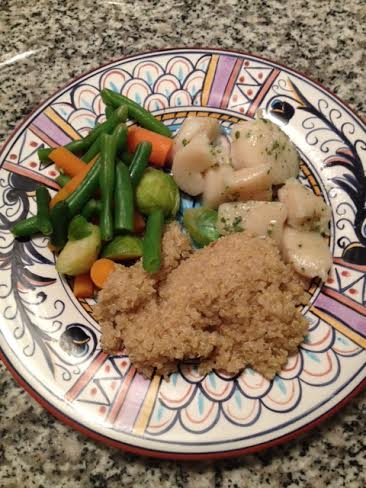
I served this with quinoa and steamed vegetables. I served it the next day as leftovers, mixing it all together with the liquid the scallops cooked in and it was even better.

scallops2

Makes four servings.